
Dynamic risk assessment materially improves capital efficiency, underwriting speed, and regulatory audit readiness for banks and credit unions by replacing overnight batch reporting with continuous, AI-driven monitoring. That shift shows up in the numbers institutions actually care about:
- Time-to-detection drops from days to minutes when a unified, governed real-time data foundation replaces fragmented batch systems.
- Real-time underwriting pipelines built on streaming feature engineering can return credit decisions in under a second while preserving a full audit record.
- Frameworks aligned to BCBS 239 and SOC 2® give risk committees a defensible standard for lineage, snapshotting, and model governance.
Key Takeaways
Automate Regulatory Model Risk Governance
Examine models against 32 qualitative criteria and resolve risk Tiers with pre-deployment checklists per OCC 2011-12 guidelines.
Dynamic risk assessment works because continuous, real-time data replaces batch reporting, cutting time-to-detection and freeing capital that would otherwise sit against undetected risk.
| Point | Details |
|---|---|
| Architecture beats model accuracy | Unified, governed real-time data pipelines matter more than model sophistication for closing visibility gaps. |
| Snapshot every decision | Store full feature vectors and rationale at decision time, or audits can't reconstruct the outcome. |
| Measure one KPI first | Track time-to-detection or capital reallocation on one portfolio slice for 90 days before scaling. |
| Regulatory expectations are rising | BCBS 239 style lineage and intraday reporting are becoming the supervisory baseline, not the exception. |
| Riskinmind maps directly to these needs | Its AI agents deliver sub-second processing, SOC 2® security, and audit-ready reporting for underwriting and compliance. |
Table of Contents
- Why Dynamic Risk Assessment Matters: Five Outcomes That Change the Balance Sheet
- What Makes Risk Assessment Truly Dynamic?
- How Does Dynamic Assessment Unlock Capital Efficiency?
- What Do Regulators Expect From Real-Time Risk Reporting?
- How Do You Roll Out Dynamic Risk Assessment?
- What Happened When KGI Securities Unified Its Risk Systems?
- What Should You Ask Vendors Before You Buy?
- A Strategic Note on Moving First
- See Dynamic Risk Assessment Work on Your Own Portfolio
- Frequently Asked Questions
- Sources
Why Dynamic Risk Assessment Matters: Five Outcomes That Change the Balance Sheet
Continuous risk monitoring isn't a technology upgrade for its own sake. It changes five specific operating metrics that risk and portfolio managers report to their boards every quarter.
- Earlier detection of portfolio deterioration. Instead of discovering a concentration problem at month-end close, streaming data flags sector or borrower stress as it accumulates. Databricks frames this as an architecture problem first: fragmented data estates and overnight batch cycles are what create the visibility gap, not a lack of analytical sophistication in the underlying models.
- Faster, better underwriting decisions. Precomputed, incrementally maintained features let a loan officer see current exposure, not last week's snapshot, which shortens approval cycles without loosening standards.
- Capital reallocation. Surfacing risk earlier gives institutions room to move capital away from deteriorating segments before regulators or examiners force the issue, a benefit EY ties directly to early-warning system adoption at community and regional banks.
- Collateral and liquidity optimization. Real-time visibility into pledged assets means collateral sits idle less often.
- Regulatory responsiveness. When a report can be regenerated on demand instead of rebuilt from scratch, exam prep stops being a fire drill.
Pro Tip: Pick one line of business, one KPI (say, time-to-detection on delinquency signals), and measure it for 90 days before and after your pilot. A single clean before-and-after number carries more weight with your risk committee than a dozen vendor claims.
What Makes Risk Assessment Truly Dynamic?
A dashboard that refreshes every hour is not dynamic risk assessment. It's a faster version of the same batch process, and examiners will notice the difference in your data lineage documentation.
Real dynamic capability requires a specific technical stack:
- Streaming data pipelines that ingest transactional, market, and credit-bureau data continuously, not on a nightly job.
- Materialized, incrementally updated features that underwriting models can query in real time rather than recomputing from scratch.
- Multi-asset exposure aggregation that rolls up credit, market, and liquidity risk into one view instead of three disconnected reports.
- Sub-second what-if simulations that let a portfolio manager stress a scenario during a meeting, not after it.
- Snapshotting of feature vectors and decision outputs at the moment a decision is made, since storing only the final score makes a decision impossible to reproduce during an audit.
- End-to-end data lineage that traces every number back to its source system.
Before you sign anything, run this checklist with a vendor:
- What is the guaranteed data latency, and is it contractual or aspirational?
- Are feature vectors and decision rationale snapshotted at inference time, or only the final output?
- Does the platform generate explainability outputs (SHAP values, reason codes) alongside every underwriting decision?
- Who controls permissions, and how is that governance audited?
Pro Tip: Ask for a sample audit trail during the demo, not just a dashboard tour. If the vendor can't show you a reconstructed decision from three weeks ago in under five minutes, the lineage claims are marketing, not architecture.
Any platform handling this volume of sensitive financial data should carry SOC 2® certification and produce immutable audit trails as a baseline, not a premium feature.
How Does Dynamic Assessment Unlock Capital Efficiency?
Here's a simplified version of how the math works. A community bank monitoring commercial real estate exposure detects early softening in a regional submarket three weeks before it would have surfaced in a quarterly review. That earlier signal lets the bank tighten new originations in that segment and reallocate capital reserved against it, rather than discovering the deterioration after losses have already accrued. EY's research on early-warning systems ties this exact mechanism, earlier signal, faster reallocation, to measurable capital efficiency gains at community and regional institutions.
Track these KPIs to prove the value internally:
- Change in risk-weighted assets (RWA) tied to reallocated exposure.
- Collateral velocity, how quickly pledged assets move to productive use.
- Net interest margin impact from faster capital redeployment.
- Time-to-reallocation, measured from signal detection to committee action.
What Do Regulators Expect From Real-Time Risk Reporting?
Examiners increasingly expect the kind of lineage and traceability that BCBS 239 first codified for global systemically important banks, and that expectation is trickling down to community institutions through exam guidance and model risk frameworks resembling SR 11-7. Continuous processing satisfies several of those expectations directly:
- End-to-end lineage from source transaction to final report line.
- Intraday aggregation capability, especially during stress periods when quarterly cycles are too slow.
- Explainability and documentation attached to every model-driven decision.
- Durable, timestamped snapshots of the inputs behind every decision.
Real-time regulatory reporting shortens calculation cycles from hours or days to minutes and reduces the manual intervention that introduces errors into exam responses.
Supervisors are moving toward live, data-driven oversight. Firms that cannot produce real-time evidence on demand will face escalating supervisory scrutiny as continuous monitoring becomes the expected baseline, not the exception.
How Do You Roll Out Dynamic Risk Assessment?
A phased rollout keeps the project from becoming an open-ended IT initiative:
- Pilot: Connect one data domain and build the first real-time features. Scope it to a single portfolio slice.
- Validation: Establish audit snapshot rules and confirm explainability outputs meet examiner expectations.
- Scale: Extend multi-asset aggregation across the enterprise.
- Governance: Build continuous model validation into the risk committee's standing agenda.
Assign clear ownership from the start:
- A risk owner accountable for outcomes.
- Data engineering for pipeline reliability.
- Model validation for governance sign-off.
- Compliance for regulatory mapping.
- An executive sponsor to keep the pilot funded past quarter one.
The most common failure points are data silos that never get reconciled, features that can't be reproduced identically at audit time, and governance gaps where nobody owns model drift. Address each explicitly in your project charter, not as an afterthought.
What Happened When KGI Securities Unified Its Risk Systems?
KGI Securities moved from two legacy, disconnected systems to a single multi-asset real-time platform, replacing batch-driven calculations with continuous ones across its risk function, an outcome Finextra documents as part of a broader industry shift toward unified risk infrastructure.
- Real-time calculations replaced overnight batch runs entirely.
- Collateral efficiency improved once exposure was visible across asset classes instead of siloed by system.
- What-if analysis that once took analysts hours now runs during a live meeting.
Fragmented risk systems function like unconnected carriages on a train. A unified, real-time platform lets every carriage move in sync, turning risk management from a reactive exercise into a proactive one.
What Should You Ask Vendors Before You Buy?
Bring these questions to every vendor briefing, and insist on specifics, not roadmap promises:
- What is your contractual data latency SLA, and how is it measured?
- How are feature vectors and decision rationale snapshotted for audit reconstruction?
- What does your data lineage documentation look like end to end?
- What explainability outputs accompany each automated decision?
- What does integration cost and timeline look like for a core banking system like ours?
- Sub-second processing SLAs and immutable audit trails should be table stakes, not premium add-ons.
- A platform coordinating specialized AI agents under central oversight, Riskinmind's architecture, for instance, should be able to demonstrate governance across underwriting, compliance, and portfolio monitoring in one briefing, not three separate demos.
Scope a pilot to one portfolio slice, run it for 90 days, and measure time-to-detection and capital reallocation against your current baseline before committing enterprise-wide.
A Strategic Note on Moving First
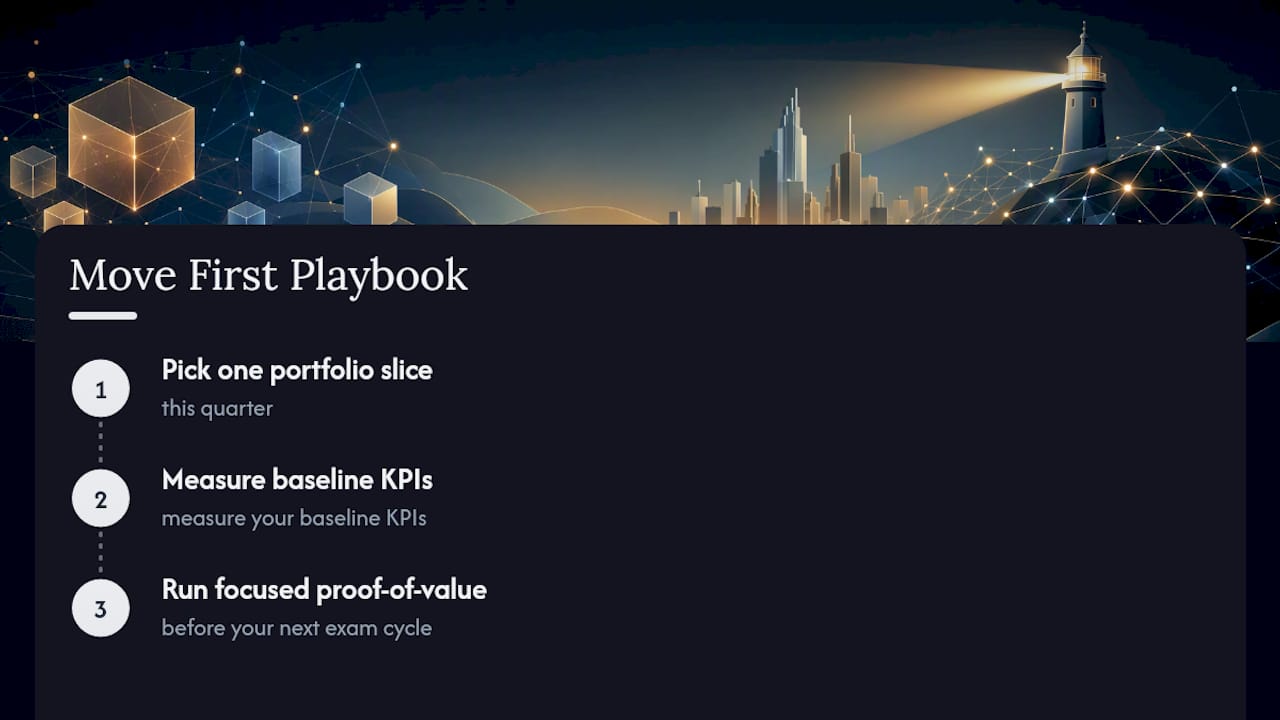
Risk leaders who wait for a regulatory mandate to force this shift are ceding the advantage to competitors already reallocating capital in real time. The institutions gaining ground now treat dynamic risk assessment as capital defense, not compliance overhead. Pick one portfolio slice this quarter, measure your baseline KPIs, and run a focused proof-of-value before your next exam cycle forces the question.
See Dynamic Risk Assessment Work on Your Own Portfolio
Riskinmind replaces the fragmented, batch-driven risk stack most community banks and credit unions still run with one continuously updated platform, so you stop waiting until month-end to find out what already went wrong.
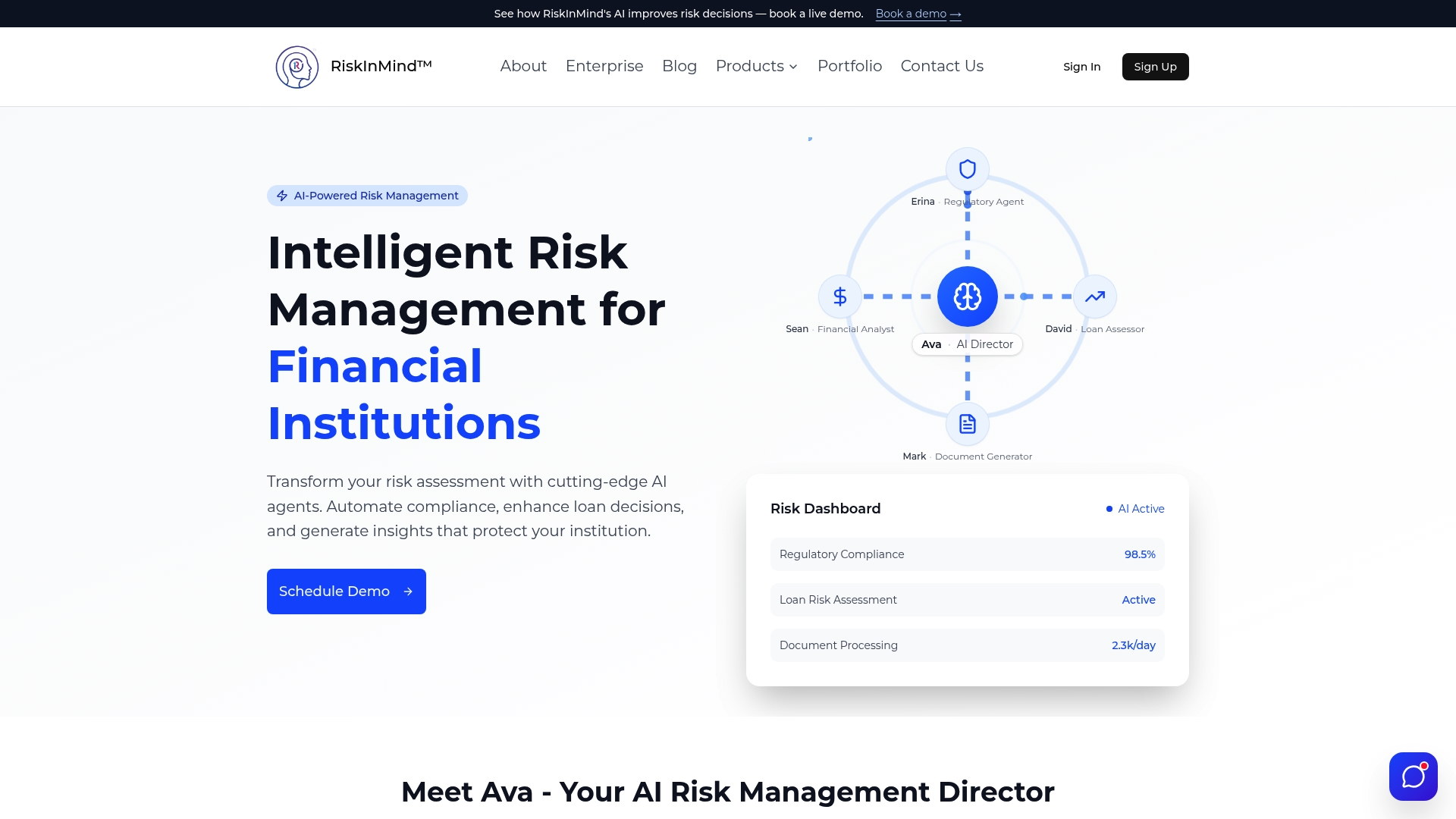
Ava, Riskinmind's central AI director, coordinates specialized agents across credit risk, regulatory compliance, and market analysis, feeding real-time dashboards and audit-ready reports built on SOC 2® certified, bank-grade security with sub-second processing. Underwriting teams get precomputed features and snapshotted decision trails instead of a black box; compliance teams get evidence packages instead of a scramble before the exam. If you want to see this against your own numbers, book a demo and bring one portfolio segment's current KPIs (delinquency trend, time-to-detection, or collateral utilization) so the session shows real output, not a generic tour. For portfolio managers specifically weighing this against a legacy LOS, the underwriting comparison walks through the speed and accuracy gap directly.
Frequently Asked Questions
Why does dynamic risk assessment matter more now than five years ago? Regulatory pressure from frameworks like BCBS 239 and CECL, combined with the availability of streaming data platforms, has made continuous monitoring achievable for community banks, not just global systemic institutions. Waiting now means falling behind peers already reallocating capital in real time.
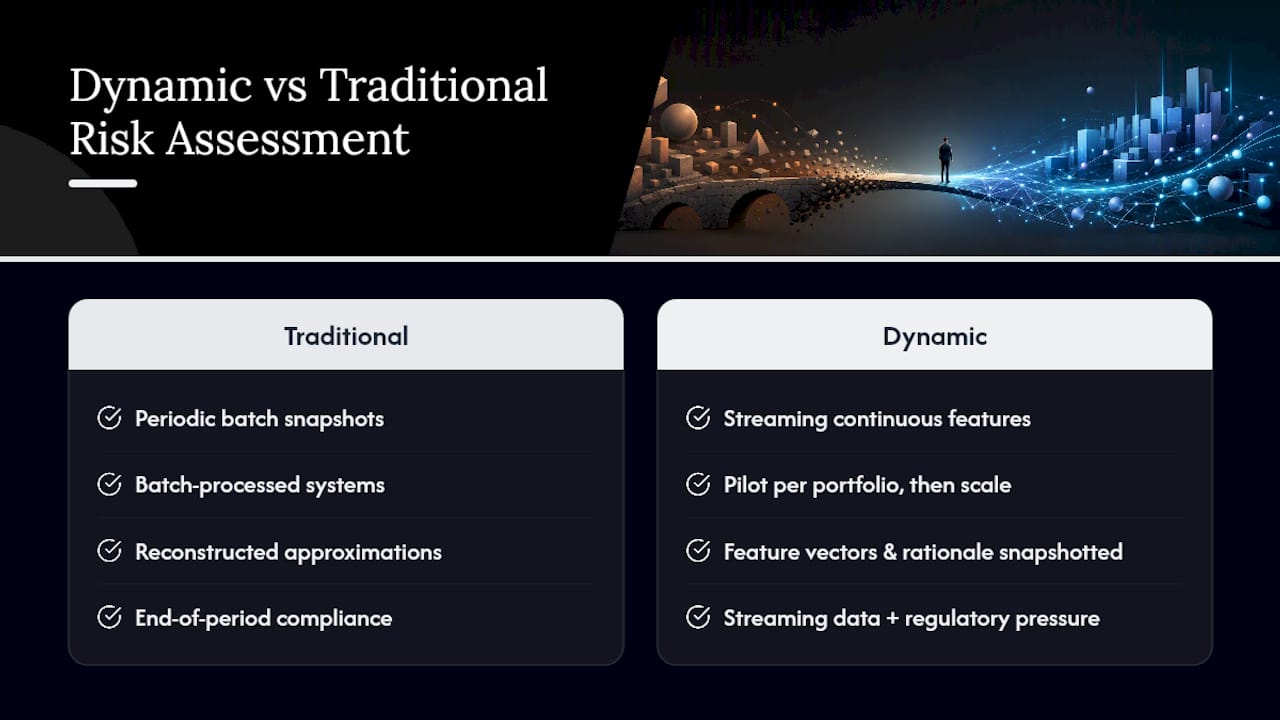
What is the difference between dynamic risk assessment and traditional risk assessment? Traditional risk assessment relies on periodic, often batch-processed snapshots, typically end of day or end of quarter. Dynamic risk assessment uses streaming data and continuously updated features to reflect current exposure at any moment, with decisions and their inputs snapshotted for audit purposes.
Does dynamic risk assessment require replacing our entire core system? No. Most implementations start with a pilot connecting one data domain and one portfolio segment, then scale aggregation across the enterprise once validation rules and audit snapshotting are proven.
How does dynamic risk assessment support audit readiness specifically? It preserves full feature vectors and decision rationale at the moment a decision is made, not just the final score, which lets examiners reconstruct any historical decision on demand instead of relying on reconstructed approximations.
What AI techniques power dynamic risk assessment platforms? Platforms typically combine machine learning models for credit scoring and anomaly detection, large language models for document analysis and reporting automation, and streaming feature engineering pipelines that keep inputs current without manual recalculation.
This article is general information, not a substitute for advice from a qualified financial advisor. Consult a qualified financial professional about your own circumstances before acting on anything here.
Sources
- Modern Risk Demands a Real-Time Foundation: The CRO’s Mandate | Databricks Blog
- The future of early-warning systems in banking | EY
- Underwriting in under a second: Real-Time Feature Engineering for Lending | RisingWave
Recommended
- Finding the Lending Diamonds in the Rough: How RiskinMind.ai Helps Lenders Win in a Down Market | RiskInMind
- Risk assessment in lending: A guide for banks and credit unions | RiskInMind
- Why Loan Mix Diversification Matters for Lenders | RiskInMind
- Why risk management is essential for lenders: AI-driven insights | RiskInMind