
Global corporate default risk has risen 40% over the past decade, and 77% of lenders now expect defaults to climb further in the near term. Yet despite mounting pressure, a surprising number of financial institution executives still operate with an incomplete picture of what rigorous risk management actually requires. The landscape has changed fundamentally: borrower profiles are more complex, regulatory expectations are more demanding, and the margin for error is thinner than it has ever been. AI-driven tools are reshaping what is possible, but only when lenders understand the foundations well enough to implement them with precision and accountability.
Table of Contents
- What is risk management for lenders and why does it matter?
- Key components of effective risk management frameworks
- The case for AI in risk management: Performance data and edge cases
- Best practices for integrating AI risk management in lending
- What most lenders overlook about risk management and AI
- Advance your risk management with purpose-built AI solutions
- Frequently asked questions
Automate Regulatory Model Risk Governance
Examine models against 32 qualitative criteria and resolve risk Tiers with pre-deployment checklists per OCC 2011-12 guidelines.
Key Takeaways
| Point | Details |
|---|---|
| Risk management is fundamental | Lenders rely on robust risk management for regulatory compliance and portfolio stability. |
| AI boosts performance | AI models improve loan approval rates and lower defaults when combined with solid governance. |
| Edge risks require oversight | Unrated assets, model bias, and fast-changing markets make advanced monitoring and stress testing essential. |
| Best practices matter | Integrating AI successfully depends on governance, validation, and expert oversight. |
| Holistic transformation is key | The most resilient lenders balance technology, culture, and ongoing regulatory alignment. |
What is risk management for lenders and why does it matter?
To build on why risk control is so front-of-mind, let's clarify what risk management comprises for today's lenders. At its core, risk management is the structured process of identifying, measuring, monitoring, and controlling exposures that could result in financial loss, regulatory sanction, or reputational harm. For lenders specifically, this spans four interconnected categories: credit risk, market risk, operational risk, and compliance risk. Each requires its own analytical rigor, and weaknesses in any one area can cascade quickly through a portfolio.
Regulatory compliance is a core reason that risk management has become a board-level priority, with frameworks like the Basel principles requiring oversight at both the board and senior management levels. These principles are not optional guidelines. They set minimum standards for how institutions must structure their risk identification, measurement, monitoring, and control functions. Failure to meet these standards exposes lenders not only to financial loss but to supervisory enforcement actions that can reshape entire business strategies.
The consequences of inadequate risk management are well-documented. Institutions that lack robust credit controls tend to accumulate concentrations in sectors or borrower types that appear low-risk during favorable conditions but deteriorate sharply during economic stress. Reputational damage compounds the financial cost when borrowers, investors, or regulators lose confidence in an institution's judgment. These are not theoretical outcomes. They are recurring patterns across credit cycles.
Modern risk assessment methods have evolved considerably, integrating quantitative models, scenario analysis, and increasingly, AI-powered tools. Lenders who still rely primarily on static scorecards or manual review processes are working with instruments calibrated for a slower, less complex environment. The institutions that manage risk most effectively today do so by combining established frameworks with adaptive technologies, governed by clear policies and human expertise.
Key risk categories that every lender must actively manage include:
- Credit risk: The probability that a borrower will default on a loan obligation, calculated through creditworthiness assessments, exposure limits, and ongoing portfolio monitoring.
- Market risk: Exposure to changes in interest rates, exchange rates, or asset valuations that affect the institution's balance sheet.
- Operational risk: Losses arising from failed internal processes, system failures, human error, or external events.
- Compliance risk: Penalties, legal liability, or reputational damage resulting from failure to follow applicable laws, regulations, and supervisory guidance.
"Effective risk management is not an afterthought to lending strategy. It is the foundation on which sustainable credit growth is built."
Pro Tip: Reviewing your institution's risk management best practices against current Basel guidelines at least annually is a straightforward way to identify governance gaps before examiners do.
Key components of effective risk management frameworks
Understanding why risk management is crucial leads naturally into how effective frameworks are constructed and maintained. A well-designed risk framework is not simply a collection of policies. It is an integrated system of governance, measurement methodology, reporting infrastructure, and independent oversight that functions consistently across business cycles.
The foundational components of a sound lending risk framework include:
- Board and executive oversight: Clear articulation of risk appetite, strategy, and accountability structures at the senior leadership level.
- Credit-granting criteria: Documented standards for underwriting decisions, including borrower eligibility, exposure limits, collateral requirements, and pricing parameters.
- Rating and classification systems: Internal or external models that assign risk grades to borrowers and facilities, driving both credit decisions and capital allocation.
- Portfolio monitoring: Ongoing assessment of concentration risk, performance trends, delinquency indicators, and sector-specific exposures.
- Stress testing: Scenario-based analysis that evaluates portfolio resilience under adverse economic conditions, including rising unemployment, interest rate shocks, or sector downturns.
- Independent review and audit: Objective validation of models, processes, and risk assessments by parties not involved in origination decisions.
Sound practices require credit environment oversight, administration and monitoring functions including rating systems, management information systems, and stress testing, and independent controls. This three-pillar structure reflects the Basel Committee's view that no single function can adequately safeguard an institution without checks from the others.
One of the most consequential decisions lenders face within this framework is the choice of credit risk measurement approach. The two primary options under Basel are the Standardized Approach and the Internal Ratings-Based (IRB) approach, each with distinct tradeoffs.

| Feature | Standardized approach | IRB approach |
|---|---|---|
| Risk weights | Fixed, assigned by regulator | Internally derived, model-based |
| Data requirements | Lower | High (requires years of historical loss data) |
| Sensitivity | Lower, less borrower-specific | Higher, more granular |
| Validation burden | Minimal | Significant, ongoing |
| Capital efficiency | Less precise | Potentially more efficient |
| Basel IV output floor | Baseline reference | Subject to 72.5% output floor |
The IRB approach offers greater precision and potential capital efficiency, but it requires validated internal models, extensive data infrastructure, and ongoing supervisory approval. Basel IV's output floor, which caps how much capital reduction an IRB institution can recognize relative to the standardized approach, adds another layer of complexity that lenders must factor into long-term capital planning. The risk mitigation strategies appropriate for each institution depend heavily on which approach governs their capital framework, and selecting the wrong path without proper analysis can create both regulatory and operational problems.
Explore credit risk modeling approaches in depth to understand how modern methodologies are closing the gap between standardized and IRB performance without the validation burden.
"A rating system that no one trusts internally will never survive external scrutiny. Credibility in risk measurement starts with the people closest to the credit."
The case for AI in risk management: Performance data and edge cases
With foundations and frameworks in place, the conversation increasingly focuses on AI's ability to elevate risk management when done right. The performance data is compelling. AI credit scoring improves loan approval rates to 78% and lowers default rates to 6%, compared to significantly higher default rates under traditional scoring models. Refinanced commercial real estate and unrated corporates, however, present elevated risks even within AI-enhanced environments, underscoring that model performance varies materially by asset class and borrower segment.
The practical advantages of AI in lending risk management include:
- Speed: Automated underwriting decisions in under a second, reducing origination costs and improving borrower experience.
- Pattern recognition: Machine learning models detect early delinquency signals and behavioral shifts that static scorecards routinely miss.
- Volume processing: AI can analyze thousands of loan files simultaneously, something no manual team can replicate at scale.
- Dynamic recalibration: Models can update based on new data, adapting to shifting economic conditions faster than annual model reviews allow.
That said, machine learning in credit assessment introduces its own category of risk. Model bias is among the most serious concerns. AI models risk bias and disparate impact, requiring fairness metrics to ensure equitable outcomes. Demographic parity as a fairness constraint reduces disparities by 34% but raises default rates by 2.1%, illustrating that there is no frictionless path to equitable AI in credit decisions. Lenders must actively choose where to set the tradeoff between fairness optimization and credit performance, and document that choice clearly for both regulators and internal governance bodies.
Key governance risks every AI-driven lender must address:
- Black-box model opacity that prevents examiners or internal auditors from explaining credit decisions.
- Training data that reflects historical discrimination, propagating bias into future decisions.
- Model drift, where performance degrades as economic conditions shift away from the training environment.
- Vendor dependency, particularly when AI tools are procured externally without adequate model documentation.
Pro Tip: Before deploying any AI credit model, require the vendor or internal team to produce a full model card detailing training data sources, validation results, fairness metrics, and known limitations. This documentation is not just a regulatory safeguard. It is the foundation of credible governance.
The AI-powered risk management potential is highest when institutions pair strong model performance with equally strong interpretability practices. Institutions using AI for credit union growth have demonstrated that explainability and performance are not mutually exclusive objectives when governance is built in from the start.
Best practices for integrating AI risk management in lending
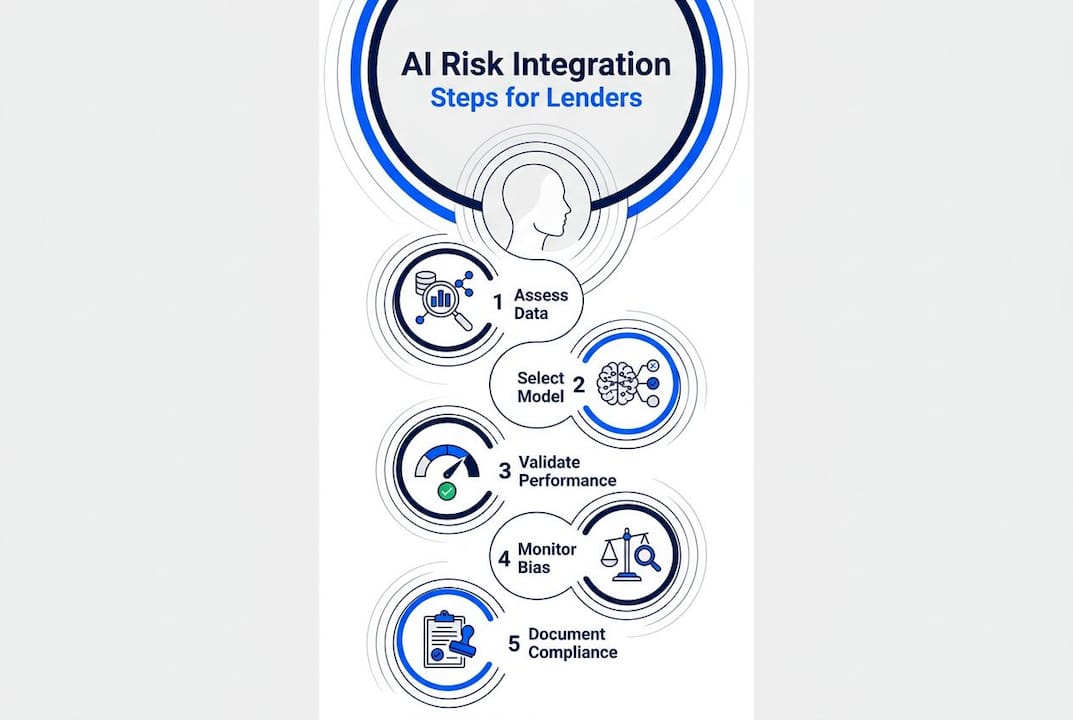
Having seen what AI brings to the table, let's distill concrete steps lenders can take to integrate and optimize these advanced tools in practice.
- Establish a formal AI governance structure before deployment, not after. This includes a model risk management policy, defined roles for model owners and validators, and clear escalation paths for governance exceptions.
- Build bias detection and mitigation into the model development lifecycle. Fairness audits should occur at training, validation, and periodic review intervals, not only in response to complaints.
- Invest in data infrastructure first. AI models are only as reliable as the data feeding them. Incomplete loan histories, inconsistent credit bureau inputs, or poor data lineage will undermine even technically sophisticated models.
- Conduct stress testing at the model level, not just the portfolio level. Stress scenarios should test how the AI model behaves under conditions significantly different from its training data, including rapid interest rate changes or sector-specific downturns.
- Maintain human review thresholds. Define the decision categories that always require human judgment regardless of model confidence levels, particularly for borderline credits, large exposures, or underserved borrower populations.
- Establish model performance monitoring cadences. Quarterly performance reviews with defined tolerance thresholds for accuracy, calibration, and fairness metrics catch drift before it becomes a portfolio or regulatory problem.
AI solutions require governance to effectively mitigate bias and explainability issues, and institutions that embed governance requirements into vendor contracts and internal processes from day one face significantly fewer remediation challenges later. The current risk environment shows rising credit risks across multiple asset classes, making stress testing and early warning systems more critical than ever for maintaining portfolio quality.
Review AI risk management best practices alongside your current framework to identify gaps in governance, documentation, or monitoring. The advanced AI risk management tools now available are designed to address exactly these operational and compliance requirements.
Key structural guardrails for an AI-integrated risk program:
- Model inventory maintained with version control and performance history.
- Independent validation separate from the model development team.
- Regulatory change monitoring mapped to model assumptions and parameters.
- Board-level reporting that translates AI model outputs into business risk language.
What most lenders overlook about risk management and AI
With best practices in mind, consider the realities that only surface through experience with large-scale risk programs. The most persistent misconception we see among lenders adopting AI is that automation and oversight are tradeoffs. They are not. The institutions that have extracted the most value from AI-enhanced risk management are precisely the ones that invested equally in human expertise and model governance. They treated AI as an accelerator, not a replacement.
Regulatory compliance deserves particular emphasis here, because it is still widely treated as a documentation exercise rather than a substantive practice. Contextual model validation matters more than checkbox validation. A model that scores well on accuracy metrics but cannot explain why a specific borrower was declined will not satisfy an examiner who asks for adverse action reasoning. Interpretability is not optional polish. It is core functionality.
AI cannot fully replace judgment or accountability, and explainability is as crucial as performance. This is something that experienced risk professionals have known for years, but it bears repeating because the market pressure to automate quickly creates organizational incentives that run in the opposite direction. Speed of deployment and quality of governance rarely improve together without deliberate institutional commitment.
The institutions that achieve next-level risk management tend to share one characteristic that is harder to quantify than model performance: they have embedded risk awareness throughout their organizational culture, not just in their risk function. Credit officers, relationship managers, and product teams understand the risk implications of their decisions because leadership has made that education a priority. No AI system, regardless of sophistication, can substitute for that institutional fluency. Risk awareness travels through people, not platforms.
Revisiting your risk modeling strategies through this organizational lens, rather than purely a technical one, is often where the most durable improvements begin.
Advance your risk management with purpose-built AI solutions
The gap between traditional risk management and what leading institutions now accomplish with AI is significant, and that gap is widening with each credit cycle. Lenders who understand their risk frameworks deeply and pair that knowledge with the right technology are better positioned to grow their portfolios responsibly, satisfy regulators, and protect their institutions from concentrations that only become visible under stress.
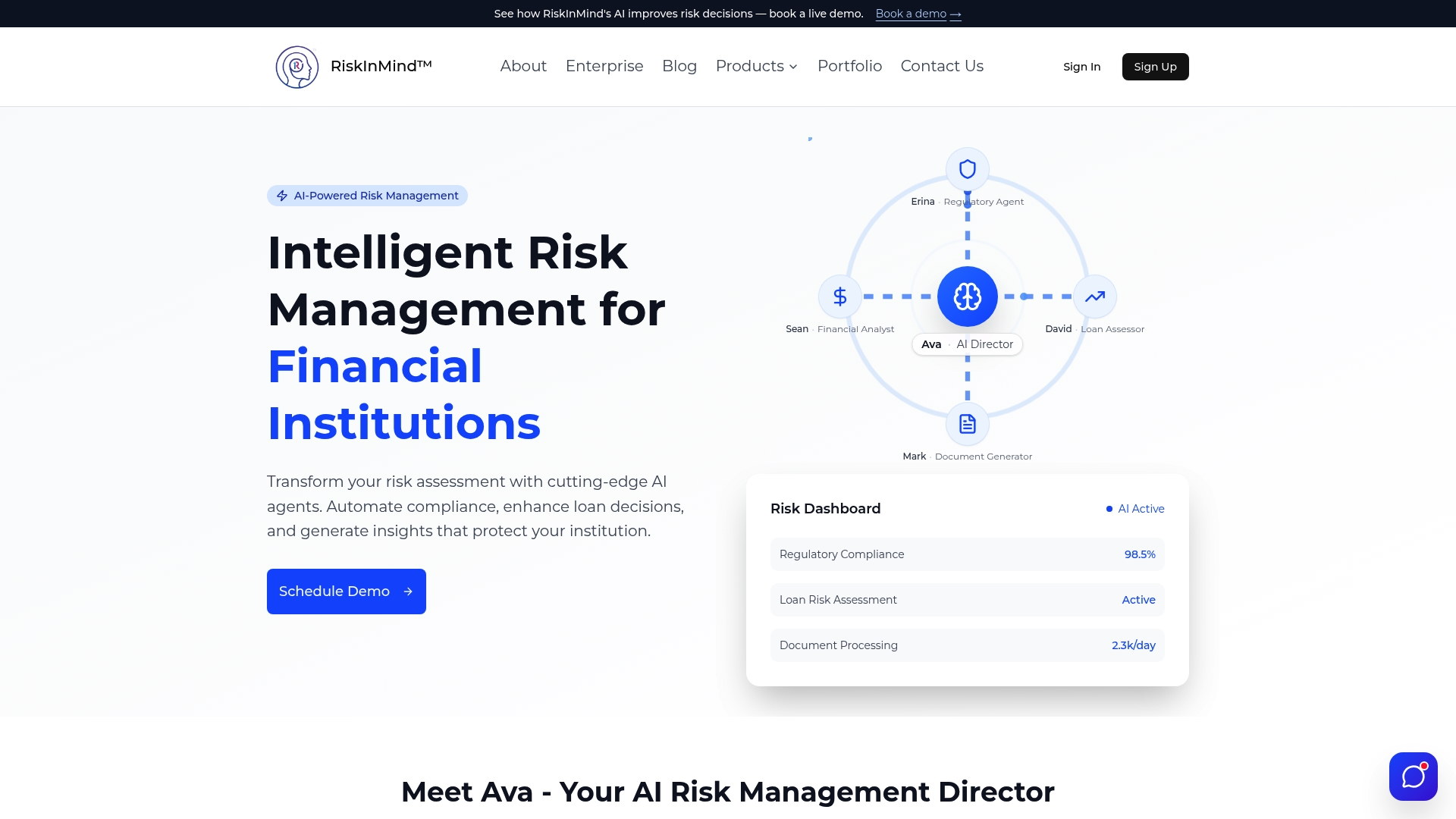
RiskInMind offers an AI-powered risk management platform built specifically for the demands of credit unions, community banks, and lenders. Ava, the platform's central AI director, coordinates a suite of specialized agents covering regulatory compliance, credit risk assessment, portfolio monitoring, and market analysis, all operating with bank-grade security and SOC 2® certification. Responses are processed in under half a second, giving your team real-time insights without sacrificing accuracy or explainability. Explore how RiskInMind's platform can support your institution's risk program with the governance depth and analytical precision your environment demands.
Frequently asked questions
How does Basel IV impact risk management for lenders?
Basel IV raises output floors for certain asset classes and requires stricter validation of internal rating models, making robust risk oversight and capital planning more critical for IRB institutions. Lenders using internal models must ensure their estimates do not produce risk-weighted assets below 72.5% of the standardized approach calculation.
What are common risks if lenders lack proper risk management?
Global corporate default risk has risen 40% over ten years, and institutions without structured risk controls are significantly more exposed to credit losses, regulatory penalties, and capital shortfalls during economic downturns. Portfolio concentrations and early warning failures are the most common precursors to institutional stress.
Can AI alone handle all aspects of credit risk management?
AI solutions require governance to mitigate bias and explainability issues, and expert oversight, model validation, and regular audits remain non-negotiable components of any AI-enhanced credit program. AI accelerates analysis and improves accuracy, but human accountability cannot be delegated to a model.
What is stress testing and why is it important for lenders?
Sound risk practices require stress testing at the portfolio level to assess resilience under adverse scenarios and fulfill regulatory requirements, providing early warning of vulnerabilities before they materialize as losses. Stress testing also informs capital planning and risk appetite decisions at the board level.
How do fairness metrics help reduce bias in AI credit models?
Demographic parity as a fairness constraint reduces disparities across demographic groups by 34% but raises default rates by 2.1%, illustrating that fairness optimization requires an explicit, documented tradeoff decision rather than a purely technical solution. Lenders must calibrate these metrics within their regulatory and credit risk tolerance thresholds.