
Consumer credit AI refers to machine learning and generative AI models that lenders use to score applications, verify income, monitor portfolios, and manage collections. Done well, it speeds up approvals and can extend credit to thin-file borrowers who traditional scores overlook. Done poorly, it can encode bias or produce denials nobody can explain, which is exactly why the Consumer Financial Protection Bureau has drawn a hard line on explainability.
- Most AI credit models combine traditional bureau data with alternative data, but reliance on noisy signals can unintentionally reinforce bias.
- Regulators require clear, specific reasons for credit denials driven by AI, and lenders must maintain detailed audit trails for each decision.
- Bias in AI models often stems from imbalanced training data or proxy features, so ongoing fairness testing and feature audits are essential.
- Explainability tools like SHAP values and natural-language summaries help make AI-driven decisions understandable and defensible.
- Hybrid workflows with human oversight and robust compliance controls are crucial for lawful and fair AI deployment in consumer credit.
Maintain 100% NCUA & OCC Audit Readiness
Monitor regulatory updates 24/7, check internal credit policies, and generate compliance trails with Erina (AI Regulatory Agent).
Table of Contents
- How AI Shows Up Across the Consumer Credit Lifecycle
- What Data Feeds These Models, and Where the Trade-Offs Live
- Regulatory Guidance and Your Rights as a Borrower
- Where Bias Creeps In, and How Institutions Catch It
- Making AI Decisions Explainable and Auditable
- What Consumers, Lenders, and Regulators Should Do Next
- A Compliant Implementation in Practice
- Why Explainability Has to Come Before Automation
- See How RiskInMind Handles Explainability and Audit Readiness
- Where to Read the Primary Research
- Sources
- FAQ
How AI Shows Up Across the Consumer Credit Lifecycle
Lenders now deploy artificial intelligence in credit at nearly every stage of a loan's life, not just at the application gate. The most common consumer credit risk models fall into a handful of buckets, each solving a different operational problem.
- Application scoring: gradient-boosted trees and neural networks weigh dozens of variables to predict default probability faster than manual underwriting ever could.
- Bank-statement analysis: large language models parse deposit histories and cash-flow patterns to catch income and stability signals a static credit file misses.
- Fraud detection: pattern-recognition models flag altered documents, synthetic identities, or inconsistent metadata before funds move.
- Personalization: recommendation engines match credit limits, rates, or product types to a borrower's actual repayment behavior.
- Portfolio monitoring: ongoing models track delinquency drift and concentration risk across the entire loan book, not just at origination.
Most institutions run hybrid systems that combine rule-based guardrails with statistical models, reserving pure large language models for document review and summary tasks rather than the final credit decision. McKinsey's research on generative AI in credit risk finds firms leaning on gen AI heavily for document review, memo drafting, and portfolio monitoring, while treating governance and data quality as the main barriers to letting it touch final decisions directly, per McKinsey's analysis. Humans typically retain sign-off authority on denials, exceptions, and any case that trips a fairness or confidence threshold.
What Data Feeds These Models, and Where the Trade-Offs Live
Traditional bureau data (payment history, utilization, account age, and inquiries) still forms the backbone of most consumer credit analytics. Alternative data extends that picture with bank transactions, utility and rent payments, and in some cases device or behavioral signals.
- Traditional inputs are standardized and well-tested but exclude the roughly one in ten American adults with no credit file at all.
- Alternative data can surface creditworthiness in that thin-file population, but noisy or poorly chosen signals risk acting as proxies for race, gender, or zip code.
- Consumer-side checks matter: review how a lender parsed your bank statements or utility payments, since a misread transaction can quietly tank a score.
The IFC and World Bank's report on alternative data and financial inclusion documents real gains for thin-file borrowers and women, but flags that benefits land unevenly and raise legitimate privacy and governance questions. Survey evidence in that same report shows many lenders believe alternative data helps them approve more applicants, yet adoption stays partial because of cost and compliance concerns, not lack of interest.
Regulatory Guidance and Your Rights as a Borrower
The CFPB's clearest rule for AI credit scoring solutions is simple to state and hard for some lenders to operationalize: a denial has to name the real reasons, not a generic template. Guidance issued in September 2023 prohibits "check-the-box" adverse action notices when a complex model actually drove the decision on different grounds, according to the CFPB's own guidance.
Regulators are watching four things closely: fair lending outcomes, explainability of model outputs, data quality feeding the model, and whether the whole pipeline leaves an audit trail.
- Request specific reasons. If a denial notice reads like boilerplate, ask the lender to name the actual factors the model weighted.
- Check your underlying data. Errors in reported transactions or account status propagate directly into AI-driven scores.
- Document everything as a lender. Institutions must be able to show which factors drove which decision, not just that a model existed.
- Preserve the audit trail. Regulators expect a reconstructable record of model version, inputs, and output for every adverse action.
Where Bias Creeps In, and How Institutions Catch It
Bias in consumer credit AI rarely shows up as an obvious, intentional flaw. It usually comes from imbalanced training data that underrepresents certain borrower segments, from proxy features that correlate with protected characteristics without naming them, or from labeling errors baked in from years of inconsistent underwriting.
The consequences run in two directions: consumers face disparate impact in approval rates or pricing, while institutions face regulatory action and reputational damage once regulators or plaintiffs' attorneys find the pattern.
Mitigation is a checklist, not a one-time fix.
- Train with fairness-aware techniques that explicitly test for disparate impact, not just aggregate accuracy.
- Audit features regularly for hidden correlation with race, gender, or geography.
- Run holdout testing against segments the original training data underrepresented.
- Monitor population and characteristic stability index drift (PSI/CSI) so the model doesn't quietly decay as borrower behavior shifts.
- Keep a human reviewer in the loop for edge cases and any adverse action above a risk threshold.
Pro Tip: Run your disparate-impact tests on a rolling schedule, not just at model launch. A model that passed fair-lending review a year ago can drift into disparate impact as your applicant pool or the broader economy changes.
Making AI Decisions Explainable and Auditable
Explainability separates a defensible credit decision from a lawsuit waiting to happen. Feature-level explanation methods like SHAP values show which inputs pushed a score up or down, confidence scores communicate how certain the model is, and natural-language summaries translate that math into something a consumer can actually read.
- SHAP and similar feature-attribution tools identify the exact variables driving a decision.
- Confidence scores tell reviewers when a model's output deserves extra human scrutiny.
- Plain-language summaries turn technical outputs into denial reasons a consumer can act on.
There's a real trade-off here. Our research on explaining algorithmic credit decisions found that more raw detail doesn't always help consumers spot errors; explanation formats need testing with actual users, not just technical validation. Per CFPB guidance, whatever format a lender chooses, the reasons given must reflect the real factors behind the decision. Strong programs pair that consumer-facing layer with SOC 2 audit trails and human-in-the-loop checkpoints for anything flagged as high risk.
What Consumers, Lenders, and Regulators Should Do Next
Each side of the table has distinct, concrete work to do here, not just general awareness.
- Consumers: request specific denial reasons, pull and review how lenders parsed your bank and utility data, and dispute inaccuracies immediately since they compound in AI-driven scoring.
- Financial professionals: instrument drift monitoring on every live model, document governance decisions as they happen, run disparate-impact tests on a schedule, and design alternative-data features with inclusion in mind from day one.
- Regulators: require explanations that name real factors rather than templates, inspect the training and monitoring metrics behind deployed models, and calibrate oversight to encourage innovation in machine learning in consumer finance without opening fair-lending gaps.
A Compliant Implementation in Practice
Enterprise platforms built specifically for regulated lenders show how the pieces above fit together operationally. SOC 2® aligned controls, granular audit trails, and specialized AI agents dedicated to compliance, credit risk, and fraud detection give risk teams a system where every decision traces back to specific factors.
- Audit trails satisfy the CFPB's documentation expectation by design, not as an afterthought.
- Specialized agents separate credit risk logic from regulatory compliance monitoring, reducing the chance one task's shortcuts contaminate another's outputs.
- Explainable AI approaches turn model outputs into decision summaries a compliance officer can actually defend.
Why Explainability Has to Come Before Automation
The industry's instinct is to chase automation first and bolt on explainability later. That order is backwards. A model nobody can explain is a model you can't defend to a regulator or a denied applicant, no matter how accurate its predictions test out in a lab. The smarter path tests explanation formats directly with consumers, the way FCA research recommends, before scaling any model into production.
Hybrid human-and-AI workflows aren't a compromise; they're the only version of this technology that survives contact with a fair-lending exam. Data quality work is unglamorous and it's also the entire game. Raj covers AI governance and financial risk management topics for Riskinmind, focusing on how regulated institutions adopt automation without losing audit defensibility.
— Raj
See How RiskInMind Handles Explainability and Audit Readiness
RiskInMind gives credit unions and community banks something outsourced or generic AI tools can't: bank-grade automation that never sends your data to a third party, with SOC 2® aligned controls and audit trails built into every decision path. Specialized AI agents handle credit risk, regulatory compliance, and fraud detection separately, each one traceable, so when a regulator or a denied applicant asks "why," you have a specific, documented answer instead of a shrug.
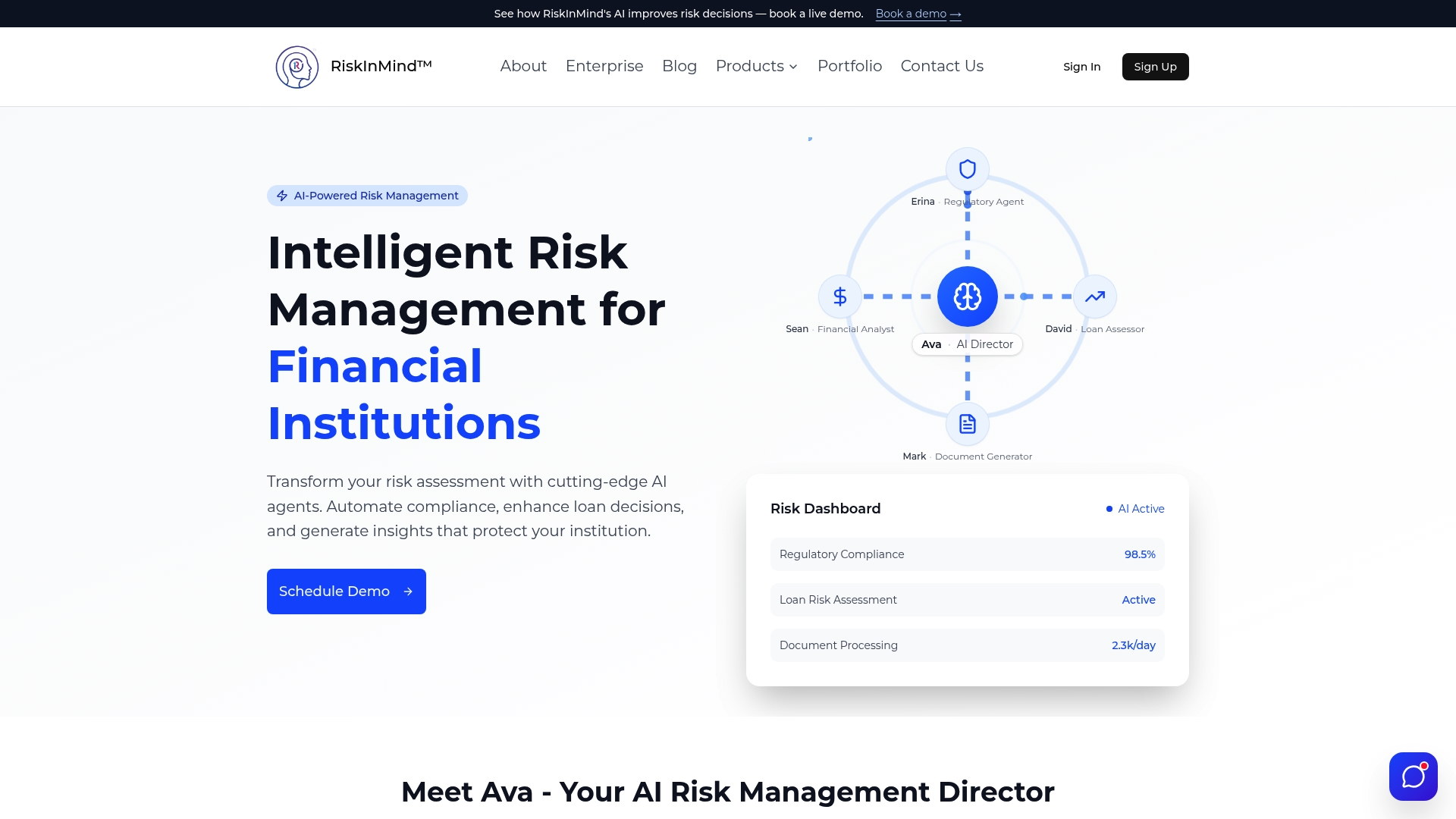
The platform's Fraud Detection and Loan Application tools run on that same governance backbone, with sub-second processing that doesn't sacrifice the paper trail examiners expect. If your institution is weighing how to adopt consumer credit AI without inheriting its compliance risks, start by comparing plans on the RiskInMind pricing page or requesting a walkthrough of the full platform at Riskinmind.
Where to Read the Primary Research
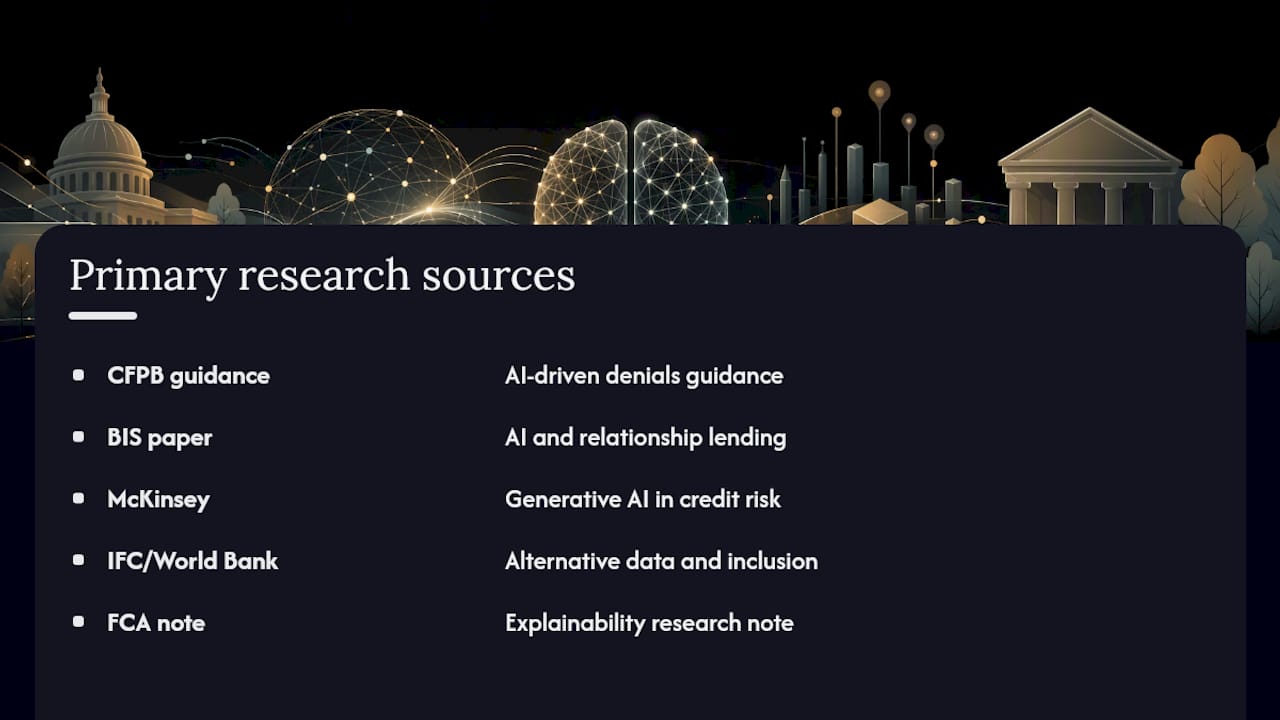
For readers who want the original documents rather than a summary: the CFPB's guidance on AI-driven denials, the BIS working paper on AI and relationship lending, McKinsey's analysis of generative AI in credit risk, the IFC/World Bank report on alternative data and inclusion, and the FCA's research note on explainability.
This article is general information, not a substitute for advice from a qualified financial advisor. Consult a qualified financial professional about your own circumstances before acting on anything here.
Sources
- CFPB Issues Guidance on Credit Denials by Lenders Using Artificial Intelligence
- Artificial intelligence and relationship lending (BIS working paper)
- Embracing generative AI in credit risk | McKinsey
- Cracking the Credit Code: Alternative Data and AI for Financial Inclusion
FAQ
Is AI Used in Consumer Credit Decisions Legitimate?
Yes. Regulated lenders use AI-driven credit models legally as long as they meet fair-lending requirements and can produce specific, accurate denial reasons under CFPB guidance.
What Does Consumer Credit AI Actually Do?
It scores applications, analyzes bank statements and alternative data, flags fraud, and monitors loan portfolios for early signs of delinquency or drift.
Can AI Help Me Get Approved if I Have No Credit History?
Alternative data models can surface creditworthiness for thin-file borrowers by looking at bank transactions or utility payments, though the IFC/World Bank report notes the benefit isn't guaranteed for everyone.
Can I Dispute a Credit Decision Made by AI?
Yes. Under CFPB guidance, you can request the specific factors behind an AI-driven denial and dispute any inaccurate data that fed the model.
Does RiskInMind Offer AI Tools for Credit Risk Assessment?
Yes. RiskInMind provides credit risk assessment, fraud detection, and compliance monitoring tools with SOC 2® aligned audit trails; current pricing for the Starter, Professional, and Enterprise plans is listed on its pricing page.