
Effective fair lending monitoring pairs validated HMDA and application data with targeted comparative file reviews, documented remediation, and consistent board reporting. Compliance teams should anchor the program to the OCC's Comptroller's Handbook and the CFPB's ECOA Baseline Review modules, running baseline assessments supplemented by ongoing, event-driven screens. Tools such as AI-powered risk management platforms can automate much of this cadence, but the governance and judgment behind it stay with your compliance officer.
TL;DR:
- Regular fair lending monitoring should include both baseline assessments and ongoing event-driven screens, with most tasks supported by AI tools but overseen by compliance officers.
- Risk assessment should extend beyond one department, focusing on focal points such as product type, prohibited groups, and geography, with documented self-assessment programs reducing exam scrutiny.
- Combining statistical screening with comparative file review enhances understanding of disparities, but sample sizes must align with regulator guidance to avoid review delays.
- Maintaining data quality with validation, proxy methods, and comprehensive documentation is essential, as poor data can invalidate findings and slow regulatory examinations.
- A modern program integrates automated monitoring tools, continuous risk assessment dashboards, and thorough documentation of models, remediation, and staff training to meet evolving regulatory expectations.
Automate Regulatory Model Risk Governance
Examine models against 32 qualitative criteria and resolve risk Tiers with pre-deployment checklists per OCC 2011-12 guidelines.
Table of Contents
- What Fair Lending Monitoring Covers and Why a Risk-Based Approach Matters
- Risk Assessment Methods: Analytics vs. Comparative File Review
- Data Quality, HMDA/LAR Validation, and Proxy Methods
- Designing the Monitoring Program and Compliance Management System
- Analytics, Models, and Model Risk Management for Fair Lending
- Monitoring Cadence, Metrics, and Board Reporting
- Corrective Action and Documenting Remediation
- Preparing for an Exam: Workpapers and Talking Points
- Operationalizing Monitoring: What an AI-Enabled Platform Can Automate
- Common Regulatory Changes Affecting Fair Lending Monitoring
- Training and Awareness Programs for Staff on Fair Lending Requirements
- Use of Technology and Automation Tools in Fair Lending Monitoring
- A Prioritized 90-Day Checklist for Compliance Teams
- How Riskinmind Supports a Modern Fair Lending Program
- Sources
What Fair Lending Monitoring Covers and Why a Risk-Based Approach Matters
Fair lending risk doesn't sit in one department. It runs through product development, marketing, origination, underwriting, pricing, servicing, loss mitigation, and even real estate owned (OREO) disposition.
The Comptroller's Handbook frames risk through "focal points": a single loan product, a prohibited-basis group, and an outcome, examined together. A focal point might be "mortgage refinance denials for Black applicants" or "auto loan pricing spreads for applicants over 62." For redlining risk, geography replaces outcome as the third variable.
Regulators favor this narrow, layered approach because it concentrates scarce examination resources where the data actually signals risk. A strong self-evaluation program earns real credit here.
- Institutions with documented, recurring self-assessments often see reduced focal-point intensity during exams, as regulators credit strong self-evaluation programs
- Weak or absent monitoring invites broader sampling and longer review periods
- The CFPB's supervision manual expects institutions to describe their monitoring cadence and methodology upfront, not reconstruct it during the exam
Risk Assessment Methods: Analytics vs. Comparative File Review
Statistical screening and comparative file review answer different questions, and knowing which one to reach for saves months of wasted effort. Analytics tell you where disparities exist across a portfolio; file review tells you why a specific decision happened the way it did.
Statistical screening starts with your HMDA/LAR data, run through regression models or score-based comparisons that control for legitimate underwriting factors like debt-to-income ratio or loan-to-value. Because HMDA doesn't capture race or ethnicity for every product, many teams apply demographic proxies such as Bayesian Improved Surname Geocoding (BIFSG) to estimate protected-class status for pricing or servicing analysis.
Comparative file review works differently. Following the Federal Reserve's Interagency Fair Lending Examination Procedures, you select "marginal" applicants: denied prohibited-basis applicants who were close to approval, matched against approved control-group applicants with similar credit profiles. Each file gets logged in an applicant-profile spreadsheet recording underwriting variables and the rationale for the marginal classification.
A practical hybrid workflow looks like this:
- Run the statistical screen across the full portfolio or focal-point product
- Flag files sitting near the decision threshold, where disparities concentrate
- Pull a homogeneous sample by loan type, purpose, amount, and occupancy
- Conduct manual file review against the applicant-profile template
- Triage findings into "explainable," "needs remediation," or "escalate to legal"
Pro Tip: Check regulator sample-size tables before you set your review window. If your sample would exceed the table maximum recommended by regulators, shorten the review period rather than pulling an oversized, unwieldy batch of files.
Data Quality, HMDA/LAR Validation, and Proxy Methods
Analytics built on bad data produce findings that collapse the moment an examiner asks a follow-up question. Before running any screen, validate field completeness, check for logical consistency (a "denied" action taken with an approval date, for instance), and cross-reference LAR entries against loan origination system records.
Demographic proxies like BIFSG and geocoding fill real gaps, particularly for non-mortgage products where HMDA doesn't apply. They estimate race, ethnicity, or geography-based risk when self-reported data is missing or unreliable. But proxies carry margin of error, and your workpapers need to document the methodology, not just the output.
Regulators expect ongoing use of a wide range of data sources beyond your own LAR file, including complaint databases, call reports, and prior exam findings, to build a complete risk profile over time.
Common failure modes that stall an examination include:
- Misreported action-taken codes or missing rate-spread fields in LAR submissions
- Inconsistent property type or lien status coding across origination systems
- Undocumented proxy methodology that examiners can't independently verify
The fix is usually simple: build a pre-analysis validation checklist and run it every cycle, not just before an exam.
Designing the Monitoring Program and Compliance Management System
A fair lending monitoring program lives inside your broader Compliance Management System (CMS), and examiners evaluate the CMS as much as the analytics themselves. Board oversight and a clearly designated compliance officer sit at the top of that structure, with reporting frequency spelled out in policy rather than left informal.
Your policy should define monitoring scope, escalation triggers, remediation service-level agreements, and recordkeeping retention periods. A structured risk assessment framework for identifying higher-risk products and channels gives this policy a defensible foundation rather than a generic template.
Third-party oversight deserves particular attention. If a vendor runs your disparity screens or generates your comparative file samples, your contract needs deliverable validation clauses and model governance language covering the vendor's methodology.
- Written policy naming the compliance officer responsible for fair lending oversight
- Defined escalation path from finding to remediation to board notification
- Vendor contract clauses requiring methodology transparency and deliverable audit rights
- Recordkeeping schedule aligned to examiner document-request timelines
Pro Tip: Ask any analytics vendor for a sample validation report before signing. If they can't produce one, you'll be the one explaining their black box to an examiner.
Analytics, Models, and Model Risk Management for Fair Lending
Machine learning models and alternative data sources introduce fair lending risk that traditional regression models don't carry, mainly because they're harder to explain. If you can't articulate why a model weighted a variable the way it did, you can't defend that outcome to an examiner, and you can't rule out that the model learned a discriminatory proxy on its own.
Model risk management for fair lending analytics should include documented alternative-model searches, sometimes called "less-discriminatory alternative" (LDA) analysis, where you test whether a different model architecture achieves similar predictive power with a smaller disparity. Sensitivity checks, run on train/test splits, show whether your findings hold up under different data slices or time periods.
Documentation to retain includes model code and configuration files, validation reports showing performance across demographic groups, and a plain-language explanation of the decision logic an examiner without a data science background can follow.
- Written justification for model selection, including alternatives considered and rejected
- Reproducible audit logs showing exact inputs, outputs, and model version for every run
- Sensitivity analysis results demonstrating stability across time periods and subpopulations
- Explainability documentation translating model logic into underwriting terms
Pro Tip: Rerun your highest-risk model on last year's data before an exam. If the outputs shift meaningfully, you have a reproducibility problem worth fixing now, not during a document request.
For teams building this out, a dedicated bias testing playbook helps standardize how these checks get documented across products.
Monitoring Cadence, Metrics, and Board Reporting
Periodic deep-dive assessments anchor the program, supplemented by more frequent monitoring checkpoints. Weekly automated data-integrity checks catch bad LAR entries before they corrupt a quarterly screen, monthly disparity screens on key products catch emerging risk early, and event-driven ad-hoc checks respond to new products, pricing changes, or regulatory guidance.
Core metrics worth tracking on a recurring basis include disparity ratios by prohibited-basis group, adjusted denial rates controlling for credit factors, pricing spreads across loan products, and application distribution mapped against geography and demographic proxies.
- A risk-summary dashboard giving the board a one-page view of current disparity trends
- Focal-point drilldowns showing the specific products and groups under active review
- A remediation status table tracking open findings against their resolution deadlines
Board members don't need every regression coefficient. They need to know where risk concentrates and whether remediation is on schedule.
Corrective Action and Documenting Remediation
A finding without a documented fix is just a liability sitting on your books. Every remediation plan needs a stated root cause, specific corrective actions, a named owner, a completion timeline, and a verification step confirming the fix actually worked.
- Document the root cause: was it a policy gap, a model flaw, or individual underwriter judgment?
- Assign a specific owner and a realistic completion date, not an open-ended "in progress"
- Choose between a self-test (protected under some circumstances) and a self-evaluation, depending on legal risk and whether outside counsel needs to be involved
- Independently verify the fix resolved the disparity, using the same methodology that flagged it originally
- Report the closed finding to the board with before-and-after metrics
Proactive remediation, especially when backed by independent verification, tends to shrink exam scope. Examiners give real weight to institutions that find and fix their own problems before a supervisory review does it for them.
Preparing for an Exam: Workpapers and Talking Points
Examiners move faster, and more favorably, when your documentation is already organized before they ask for it. Keep a standing folder of monitoring reports, HMDA validation evidence, applicant-profile spreadsheets, self-test or self-evaluation reports, and vendor deliverable documentation.
Be ready to explain your focal-point selection logic and sampling rationale in plain language. Examiners will ask why you chose a particular product and prohibited-basis group, and "the data pointed there" needs a paper trail behind it.
- Monitoring reports showing methodology, findings, and remediation status by focal point
- Applicant-profile spreadsheets documenting marginal-file selection criteria
- Board minutes demonstrating ongoing oversight, not a single annual mention
- Vendor deliverables with methodology transparency, especially for outsourced analytics
Operationalizing Monitoring: What an AI-Enabled Platform Can Automate
Much of the manual burden in fair lending monitoring, running HMDA validation checks, flagging disparity trends, or pulling candidate files for review, can be automated without removing compliance judgment from the process. Some platforms can run continuous disparity screening rather than a once-a-year snapshot, automatically surface candidate files that meet marginal-applicant criteria, and track remediation status against deadlines.
The controls matter as much as the automation itself: reproducible runs with version-locked model configurations, full audit logs, and role-based access so only authorized staff can modify screening parameters.
- Automated HMDA field validation flagging incomplete or inconsistent entries before submission
- Continuous disparity screening across products rather than periodic manual pulls
- Automated remediation tracking with deadline alerts tied to board reporting cycles
Automating HMDA validation and disparity screening shifts programs from annual snapshots toward near-continuous monitoring, meaningfully shortening the gap between finding and fix.
Common Regulatory Changes Affecting Fair Lending Monitoring
Fair lending regulation doesn't sit still, and the pace of change has picked up as digital lending and alternative underwriting data expand. The CFPB has continued refining what it expects institutions to document in ECOA baseline reviews, including more granular expectations around monitoring cadence and self-test practices, detailed in its updated examination modules.
Redlining enforcement has also expanded beyond traditional branch-network geography to include digital marketing footprints and online lending channels, meaning geographic focal points now need a digital dimension alongside physical branch maps. Institutions that only monitor branch-based lending patterns risk missing where their actual application volume originates.
Alternative credit scoring models, cash-flow underwriting, and third-party fintech partnerships have each drawn increased regulatory attention, since they introduce new variables that can carry disparate impact risk even when no protected-class data enters the model directly. Regulators are asking more specific questions about model governance for these tools than they did even a few years ago.
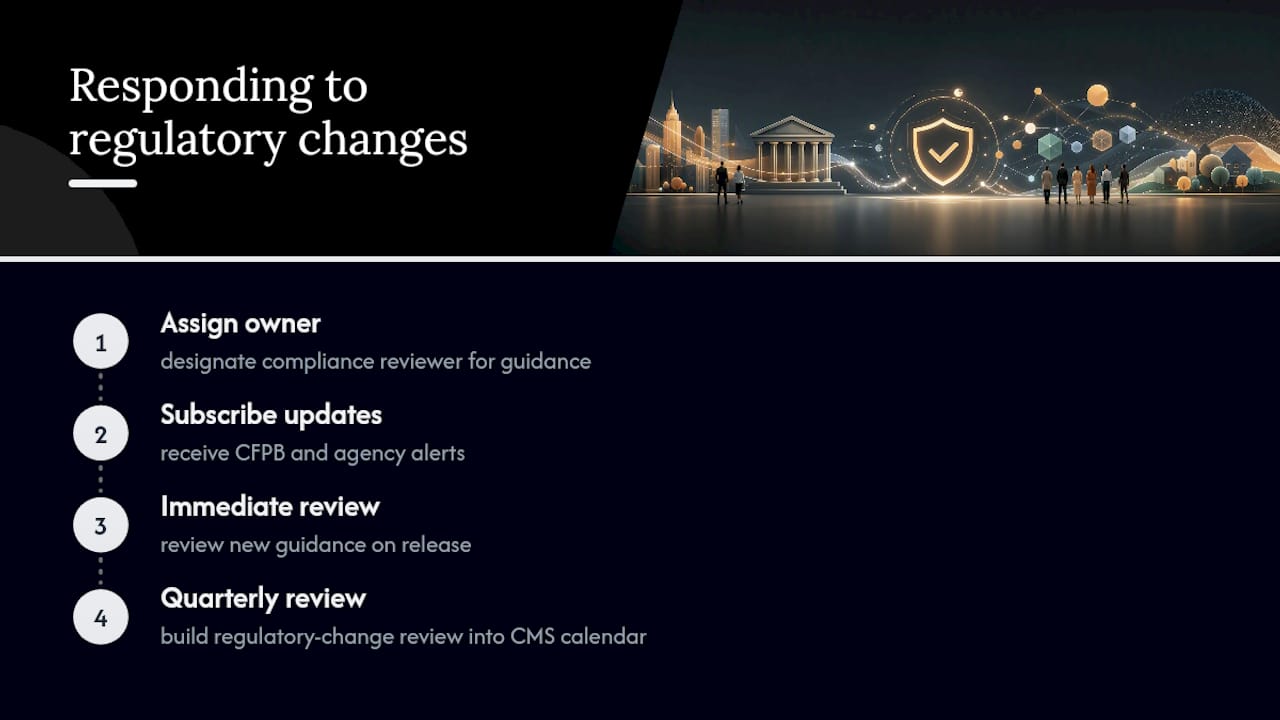
Staying current means someone on your compliance team needs a standing practice of reviewing new guidance the moment it's released, not waiting for the next exam cycle to discover a gap. Subscribing to agency guidance updates and building a quarterly regulatory-change review into your CMS calendar keeps the monitoring program aligned with where enforcement priorities are actually heading, rather than where they were last year.
Training and Awareness Programs for Staff on Fair Lending Requirements
Monitoring catches problems after they happen. Training is what prevents them from happening in the first place, and it needs to reach far beyond the compliance department itself.
Loan originators, underwriters, and servicing staff all need role-specific training, not a generic annual module everyone clicks through. An underwriter needs to understand how overrides get documented and why consistent override rationale matters for accurate disparate impact analysis. A loan originator needs clarity on pricing discretion limits and how discretionary pricing gets monitored. Loan originator compliance failures can contribute significantly to pricing disparity findings, particularly when individual discretion lacks proper constraints or documentation.
Training should be refreshed in response to new products, underwriting models, or regulatory updates rather than strictly on an annual schedule. New hires in customer-facing roles need fair lending fundamentals before they touch a live application, not three months into the job during a scheduled training cycle.
Documentation matters here too. Keep attendance records, quiz or assessment results, and course content versions on file. When an examiner asks how you ensure staff understand fair lending obligations, "we have a training program" isn't sufficient; you need to show completion rates, content currency, and evidence that training connects to actual policy and monitoring findings. A compliance testing program that ties staff training to monitoring outcomes gives you a much stronger story to tell.
Use of Technology and Automation Tools in Fair Lending Monitoring
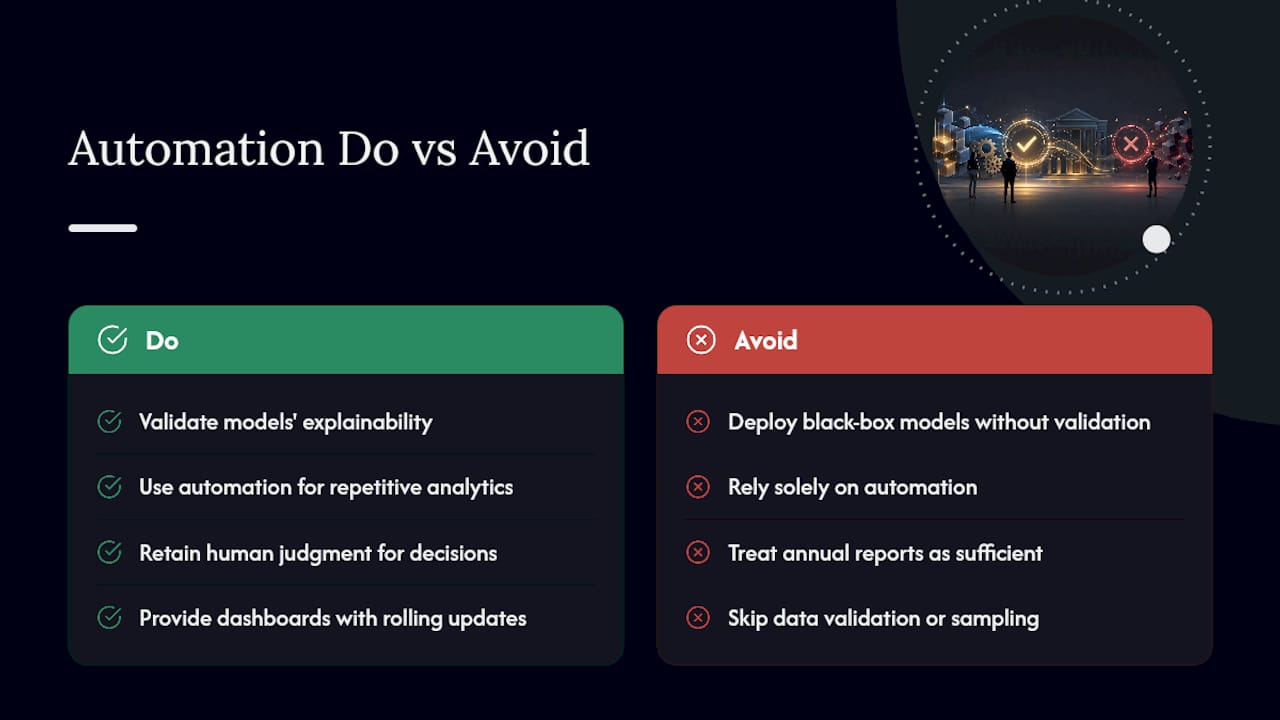
Technology has moved fair lending monitoring from a manual, spreadsheet-driven annual exercise toward something closer to continuous surveillance, and the shift is reshaping what "adequate" monitoring looks like to examiners. Automated statistical screening tools now run disparity calculations across full portfolios in the time it used to take an analyst to prepare a single quarterly report.
Natural language processing and machine learning increasingly support document review, complaint analysis, and even preliminary flagging of files for comparative review, though explainability challenges mean these tools need careful validation before their outputs drive real decisions. A model that flags files efficiently but can't explain why is a liability, not an asset, in an examination context.
Dashboards and visualization tools have also changed how compliance officers communicate findings upward. Instead of a static annual report, boards increasingly expect a living view of disparity trends, remediation status, and emerging risk, updated on a rolling basis rather than reconstructed from scratch each cycle. Dynamic, ongoing risk assessment has become the practical standard many examiners now measure institutions against, even when written guidance still describes an annual baseline.
The tools that work best combine automation for the repetitive analytical work, data validation, screening, sample generation, with human judgment retained for interpretation, remediation decisions, and examiner communication. Automation that removes human oversight entirely tends to create new risk rather than eliminating old risk.
A Prioritized 90-Day Checklist for Compliance Teams
Effective fair lending programs prioritize tasks strategically, beginning with data validation to ensure analytics are reliable and actionable, since analytics built on bad HMDA data waste everyone's time downstream.
From there: run a baseline disparity screen on your highest-risk product, pick one focal point for a comparative file review rather than five, update your CMS policy to reflect what you actually did, and bring the board a concrete update before the quarter closes. A resourced but small team should resist the temptation to monitor every product at once. Start with the product carrying the most volume or the worst prior findings, and prove the workflow before scaling it.
— Raj
How Riskinmind Supports a Modern Fair Lending Program
Some AI-powered risk management platforms support workflows such as continuous disparity screening instead of an annual scramble, automated candidate-file selection for comparative review, and audit-ready reporting that holds up when an examiner asks for the paper trail behind a finding. These platforms often run on secure, certified infrastructure with real-time processing, so screening results and remediation tracking stay current without a manual analyst rebuilding the same report every quarter.
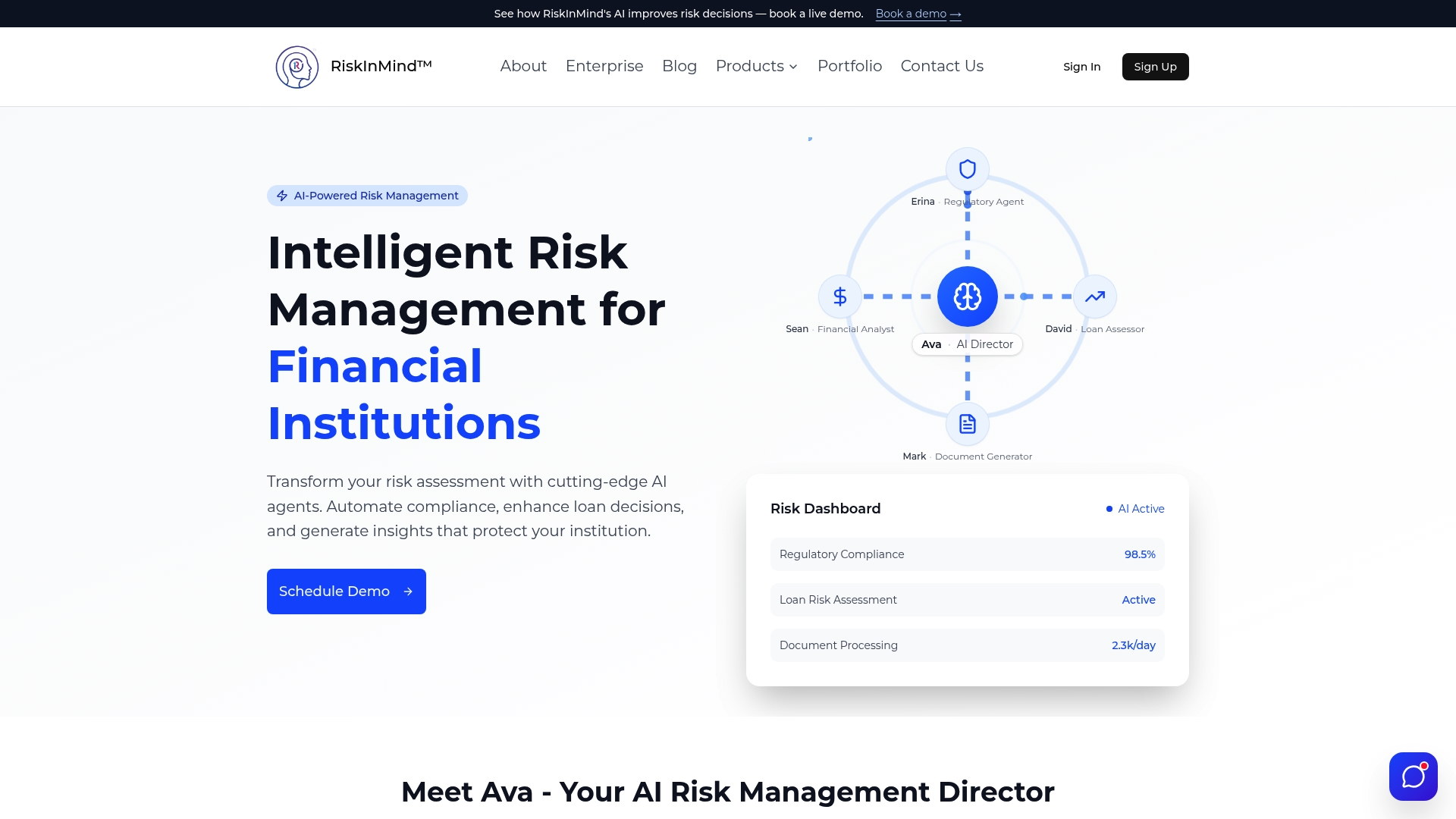
Before requesting a demo, pull together your current HMDA data schema, your existing monitoring cadence, and the focal points you'd prioritize first, whether that's mortgage pricing, auto lending, or a specific geography. That preparation lets a portfolio monitoring walkthrough focus on your actual risk profile instead of generic features. Start by reviewing the loan application and underwriting automation capabilities and scheduling a demo built around your institution's specific focal points.
This article is general information, not a substitute for advice from a qualified financial advisor. Consult a qualified financial professional about your own circumstances before acting on anything here.
Sources
- Comptroller's Handbook: Fair Lending (OCC)
- Interagency Fair Lending Examination Procedures (Federal Reserve)