
Banking professionals are drowning in AI vendor pitches, proof-of-concept reports, and conference keynotes — all promising transformation, few delivering the specific operational evidence you actually need to make a sound investment decision. The examples of AI in banking that matter most in 2026 are not theoretical. They are production deployments with measurable results, real regulatory scrutiny, and clear workflow integration. This article cuts through the noise and focuses on exactly that: what leading banks are doing, what outcomes they are achieving, and how you can evaluate which applications belong in your own institution's roadmap.
Table of Contents
- Key takeaways
- Examples of AI in banking: how to evaluate what actually works
- 1. Agentic AI in mortgage and HELOC adjudication
- 2. AI-accelerated credit decisioning for underserved markets
- 3. Fraud detection powered by large language models
- 4. AI chatbots and personalized financial advice
- 5. Document intelligence and back-office transaction processing
- 6. AI in regulatory compliance and risk reporting
- 7. Comparison of AI use cases for banking prioritization
- My take: AI in banking is an intelligence problem, not an automation problem
- How Riskinmind helps banking teams deploy AI with confidence
- FAQ
Automate Regulatory Model Risk Governance
Examine models against 32 qualitative criteria and resolve risk Tiers with pre-deployment checklists per OCC 2011-12 guidelines.
Key takeaways
| Point | Details |
|---|---|
| Agentic AI is already in production | TD Bank reduced mortgage adjudication time by 99.7%, proving full-scale deployment is viable today. |
| Regulatory evidence is non-negotiable | The FCA now requires proof of governance and human-in-the-loop controls, not just model accuracy metrics. |
| Back-office AI delivers fastest ROI | Document intelligence and transaction automation are generating billions in savings with touchless rates above 90%. |
| Pilot paralysis remains the top threat | Most banks stall between proof-of-concept and production due to unresolved assurance and governance gaps. |
| Evaluation criteria define success | Speed, regulatory readiness, scalability, and ROI measurability must all be assessed before committing to any AI initiative. |
Examples of AI in banking: how to evaluate what actually works
Not every AI deployment deserves your attention. The examples of AI in finance worth studying share four characteristics: they deliver quantifiable operational improvements, they survive regulatory scrutiny, they integrate into existing workflows rather than sitting beside them, and they scale without breaking.
When assessing any AI use case, weigh these criteria before anything else:
- Operational impact: Does the application reduce processing time, improve decision accuracy, or cut labor costs at a measurable rate? Loan processing speed and fraud detection accuracy are the two benchmarks most institutions track first.
- Regulatory readiness: The FCA's AI assurance framework now defines the test perimeter as model performance, deployment context, governance structure, human-in-the-loop controls, and input/output safeguards. Evidence counts, not design intentions.
- Workflow integration: A bolt-on AI tool that requires staff to toggle between systems adds friction. The most effective deployments embed AI directly into origination platforms, core banking systems, and CRM tools.
- Scalability and reliability: Production AI in banking must handle volume spikes, data quality variability, and edge cases without degrading. Pilot performance rarely tells the full story.
- Human-in-the-loop design: AI should augment credit officers, compliance analysts, and relationship managers, not replace the professional judgment that regulators and customers both expect.
Pro Tip: Before signing any AI vendor contract, ask for a documented assurance package that covers governance, model testing logs, and evidence of human oversight integration. Vendors who cannot produce this are not production-ready for a regulated environment.
Despite broad AI adoption, 76% of financial institutions report difficulty measuring AI ROI definitively, which makes rigorous upfront evaluation criteria even more critical.
1. Agentic AI in mortgage and HELOC adjudication
The most striking example in lending right now is TD Bank's deployment of an agentic AI model that reduced adjudication time by 99.7%, cutting average processing from 15 hours to under 3 minutes per case. That is not a pilot metric. That is a full production result on real estate secured lending.

What makes this deployment notable is the architecture behind it. Agentic AI systems operate in continuous sense-reason-act cycles, allowing them to handle autonomous document classification, data extraction, discrepancy flagging, and risk scoring without waiting for human prompts at every step. The human reviewer enters at the exception and decision stage, not the data preparation stage. That shift alone frees underwriters to spend time on judgment rather than administration.
For banking professionals evaluating what is an AI agent in finance, this is the clearest operational answer: an AI agent in finance is an autonomous system that perceives inputs, reasons across data sources, acts on defined objectives, and hands off to human reviewers with a structured output. It does not just automate tasks. It navigates multi-step workflows.
Pro Tip: When piloting agentic AI in lending, map the entire adjudication workflow before deployment. The biggest gains come from re-sequencing steps, not just automating the slowest one.
2. AI-accelerated credit decisioning for underserved markets
A different class of lending AI has proven equally significant in terms of social and operational impact. An AI-powered credit platform cut credit decision turnaround from 10 days to 2 hours, supporting access to credit for over 10,000 farmers who previously faced lengthy manual review cycles.
The role of AI agents in credit analysis here goes beyond speed. These systems synthesize non-traditional data sources, including supply chain records, weather exposure, and market pricing, to build credit profiles where conventional credit bureau data is thin. For community banks and credit unions serving agricultural, rural, or thin-file borrowers, this represents a genuine expansion of creditworthy reach, not just a processing shortcut.
The AI-powered underwriting approaches enabling these decisions rely on machine learning models trained on domain-specific outcome data, which is why generic AI platforms often underperform compared to purpose-built financial intelligence systems.
3. Fraud detection powered by large language models
JPMorgan's use of large language models for fraud detection has become one of the most cited examples of AI in finance for good reason. Generative AI models now identify fraud in both communications and transaction streams, recognizing patterns in text, metadata, and behavioral sequences that rule-based systems consistently miss.
The practical architecture typically includes:
- Continuous monitoring of network traffic and transaction flows for anomaly detection
- Natural language analysis of internal and external communications flagged for social engineering signals
- Real-time scoring of transactions against behavioral baseline models that update dynamically
Beyond the detection accuracy gains, AI-driven fraud defense reduces regulatory exposure. Financial crime losses trigger reporting requirements, enforcement scrutiny, and reputational costs that dwarf the technology investment. For CROs assessing AI risk management best practices, fraud detection is the application where the cost of inaction is easiest to quantify.
4. AI chatbots and personalized financial advice
AI chatbots now handle 24/7 customer service inquiries, resolving routine account questions, payment confirmations, and dispute initiation without human handoff. The operational math here is straightforward: a well-designed AI customer service layer reduces inbound call volume, cuts average handling time, and extends service capacity without proportional headcount growth.
The more sophisticated layer is AI-generated personalized financial advice. Systems built on life-cycle modeling and behavioral data now surface bespoke insights: alerts about spending patterns inconsistent with stated savings goals, early warnings about cash flow gaps, or proactive product recommendations timed to life events. Generative AI introduces anticipatory engagement models that go beyond reactive service.
The regulatory challenge is real. AI-generated financial advice must be consistent with fiduciary standards, suitability requirements, and fair lending obligations. Institutions deploying advice-oriented AI need clear audit trails showing how recommendations were generated and what human oversight applied.
Pro Tip: Position AI advice tools as pre-advisor filtering, not standalone recommendations. When customers arrive at a human advisor with AI-curated context, the conversation is more productive and compliance risk is lower.
5. Document intelligence and back-office transaction processing
Back-office AI is generating some of the most defensible ROI numbers in banking today. AI contract and invoice intelligence has processed $500 billion in transactions, identifying over $1 billion in customer savings across 60 million documents. These are not rounding errors. They represent systematic extraction of value from data that previously required teams of analysts working through static reports.
| Application area | Automation rate | Primary benefit | Maturity level |
|---|---|---|---|
| Cash application and reconciliation | Above 90% touchless | Reduced days sales outstanding | High |
| Invoice processing and validation | 80-95% straight-through | Lower processing cost per invoice | High |
| Contract review and extraction | 70-85% automated | Faster procurement cycles | Medium |
| Regulatory report generation | 60-80% automated | Reduced compliance labor cost | Medium |
The role of automation in portfolio management follows a similar pattern. AI systems that continuously monitor loan portfolios, flag covenant breaches, and generate exception reports free credit analysts to focus on complex restructuring decisions and relationship management rather than data assembly. That shift in cognitive load is where the real productivity gain materializes, as AI adoption transforms finance roles from manual reporting toward validation and judgment.
6. AI in regulatory compliance and risk reporting
Compliance functions inside banks are carrying a growing regulatory burden, and AI is proving effective at absorbing much of the routine workload. Automated compliance monitoring systems now parse regulatory updates, map them against internal policy libraries, and flag gaps without requiring a compliance analyst to read every Federal Register notice.
The FCA's evolving expectations around AI governance make this application particularly time-sensitive. Regulators are no longer satisfied with assurances that a model was validated at deployment. They expect ongoing evidence of governance, drift monitoring, and human review integration. AI compliance systems that generate structured audit trails for every material decision are not optional in this environment. They are the table stakes for operating AI at scale.
For compliance monitoring in financial institutions, the combination of continuous data ingestion and structured output generation means institutions can demonstrate compliance posture in real time rather than assembling evidence after the fact.
7. Comparison of AI use cases for banking prioritization
When comparing these examples side by side, clear patterns emerge that should shape your sequencing decisions.
| AI use case | Speed impact | Regulatory readiness | Cost savings potential | Scalability |
|---|---|---|---|---|
| Agentic lending AI | Very high | Medium (governance required) | High | High |
| Fraud detection AI | High | High (established frameworks) | Very high | Very high |
| Customer service chatbots | Medium | Medium (advice rules apply) | Medium | Very high |
| Back-office document AI | Medium | High (well-scoped) | Very high | High |
| Compliance reporting AI | Low to medium | High (designed for it) | High | Medium |
Several patterns stand out. Fraud detection and back-office document AI have the highest combination of regulatory maturity and cost savings potential, making them the lowest-risk starting points for institutions new to production AI. Agentic lending AI offers transformational speed gains but demands rigorous governance architecture before full deployment. Customer service AI delivers strong scalability but carries nuanced regulatory exposure when it crosses from service into advice.
The most persistent adoption bottleneck is not technology. Organizations that experience pilot paralysis typically stall because they cannot produce the assurance evidence regulators require for full production sign-off. Building the governance layer in parallel with the technology layer, rather than after it, is the single most effective way to move from pilot to production without losing momentum.
My take: AI in banking is an intelligence problem, not an automation problem
I've spent considerable time working with financial institutions at different stages of AI adoption, and the pattern I keep encountering is this: institutions that treat AI as a cost-reduction tool tend to underinvest in governance and end up stuck in pilots. Institutions that treat AI as an intelligence multiplier tend to build the right infrastructure from the start and see compounding returns.
The distinction matters because it changes where you spend your energy. If AI is just automation, you focus on task replacement. If AI is intelligence leverage, you focus on decision quality, which means building systems where AI handles data synthesis and humans handle judgment calls. That model scales. Pure task automation hits a ceiling.
What I've also learned is that the role of AI in financial decision-making is shifting faster than most training programs acknowledge. Credit officers who spend their days reviewing AI-generated risk summaries and challenging model assumptions need different skills than those who built manual underwriting expertise over two decades. The institutions investing in that transition now are the ones that will have functioning human-AI teams when regulatory expectations tighten further.
My honest read on 2026: the banks that will win are not the ones with the most AI tools. They are the ones who have mapped their highest-stakes decisions, embedded AI at exactly those points, and built the governance evidence to prove it works.
— Raj
How Riskinmind helps banking teams deploy AI with confidence
Banking decision-makers who recognize the value in these examples face a practical next challenge: finding an AI platform purpose-built for regulated financial institutions, not a generic enterprise tool retrofitted for lending.
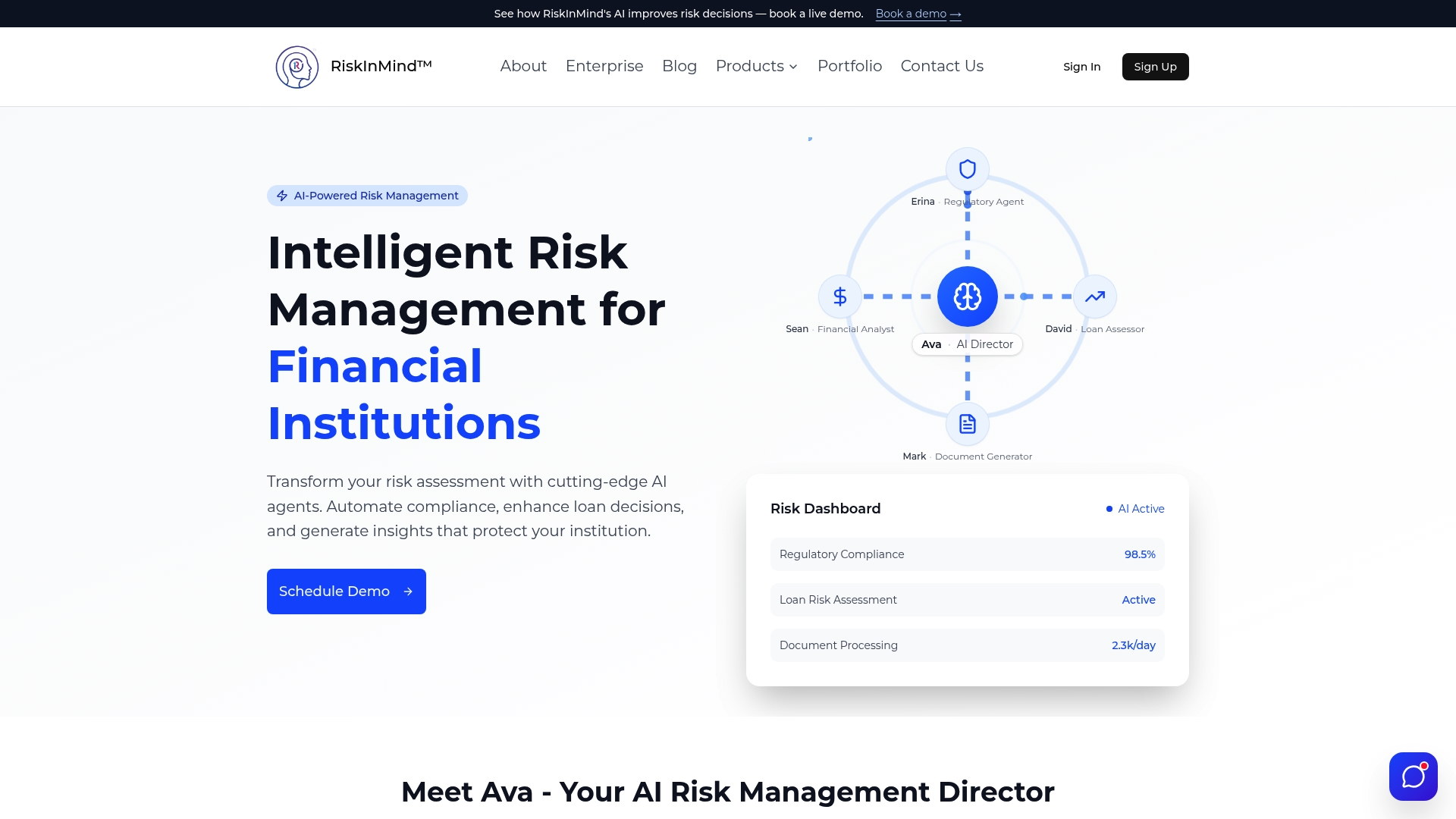
Riskinmind is built specifically for credit unions, community banks, and lenders that need production-grade AI without building the infrastructure from scratch. The platform's AI-driven loan application processing accelerates credit decisions with real-time risk scoring, automated document extraction, and structured human review integration. The CRE Loan Risk Predictor applies AI to commercial real estate portfolios, surfacing risk signals that static models consistently miss. Every component operates under Ava, Riskinmind's central AI director, with SOC 2® certified security and sub-half-second response times. For institutions ready to move from pilot to production, explore the full platform to see where AI can deliver measurable results in your specific risk environment.
FAQ
What are the most proven examples of AI in banking today?
The most production-validated examples include agentic AI for mortgage adjudication, large language models for fraud detection, AI chatbots for customer service, and document intelligence for back-office processing. TD Bank's deployment cut mortgage processing time by 99.7%, representing one of the clearest production benchmarks available.
What is an AI agent in finance?
An AI agent in finance is an autonomous system that perceives data inputs, reasons across multiple sources, executes defined tasks, and hands structured outputs to human reviewers. Unlike basic automation, AI agents handle multi-step workflows with adaptive decision-making rather than fixed rule execution.
How do regulators assess AI systems in banking?
Regulators like the FCA now evaluate AI systems across the full assurance perimeter: model accuracy, deployment context, governance structure, human-in-the-loop controls, and input/output safeguards. Institutions must produce documented evidence of all these elements, not just model validation reports, before receiving production approval.
Why do so many banks stall at the AI pilot stage?
Most institutions stall because they build the technology before building the governance framework regulators require for full deployment. Without documented audit trails, human oversight protocols, and ongoing drift monitoring, moving from pilot to production approval becomes extremely difficult.
How does AI improve portfolio management in banking?
AI improves portfolio management by continuously monitoring loan performance, flagging covenant breaches in real time, and generating exception reports without analyst intervention. This shift lets credit teams focus on complex restructuring and relationship decisions rather than assembling data, which directly improves both portfolio quality and analyst productivity.