
"Bank-grade security" is not a certification you can hand an auditor. It is a risk-based bundle of technical controls, governance discipline, and third-party assurance, anchored to frameworks like NIST CSF 2.0, FFIEC/GLBA guidance, and SOC 2 attestation. What follows unpacks each layer so you know what to demand before you take the phrase at face value.
TL;DR:
- Verification of encryption practices should include documented key management and current standards for data in transit and at rest.
- Vendors claiming bank-grade security must demonstrate continuous monitoring, tested incident response plans, and comprehensive audit logs for all sensitive actions.
- Relying solely on SOC 2 reports is insufficient; review scope, auditor competence, and ongoing monitoring signals like vulnerability scans and control testing.
- "Bank-grade" security is a dynamic standard that adapts to evolving threats and regulations, not a fixed checklist or certificate.
- Outside the banking sector, sectors like healthcare, payments, and government adopt similar security controls, but claims should be substantiated with tangible evidence.
Maintain 100% NCUA & OCC Audit Readiness
Monitor regulatory updates 24/7, check internal credit policies, and generate compliance trails with Erina (AI Regulatory Agent).
Table of Contents
- What Does "Bank-Grade Security" Actually Mean?
- Core Technical Controls That Underpin Bank-Grade Security
- Which Regulatory Frameworks Define Bank-Grade Security?
- How Do You Validate a Vendor's Security Claims?
- What Triggers a Bank Data Breach Notification?
- How Do You Spot Weak "Bank-Grade" Marketing Claims?
- How an Enterprise Risk Platform Implements These Controls
- Where Does Bank-Grade Security Show Up Outside Banking?
- Common Misconceptions About Bank-Grade Security
- How Has Bank-Grade Security Evolved Over Time?
- When "Bank-Grade" Helps and When It Misleads
- How RiskInMind Applies Bank-Grade Security to Risk Management
- Sources
- FAQ
What Does "Bank-Grade Security" Actually Mean?
Vendors use "bank-grade security" as shorthand for a level of protection that is supposed to be non-negotiable in financial services. Once you strip away the marketing gloss, the phrase bundles five properties: confidentiality of customer data, integrity of transaction records, availability of systems during peak load or attack, auditability of every access event, and operational resilience when something breaks.
None of these translate into a single fixed checklist. A $200 million credit union and a super-regional bank both need bank-grade security, but the specific controls scale with size, complexity, and the sensitivity of the data each institution handles. A core processing vendor faces different expectations than a document storage tool.
When someone claims bank-grade security, professionals should validate a handful of outcomes:
- Data is encrypted both in transit and at rest, with documented key management.
- Access requires multifactor authentication and follows least-privilege principles.
- Every sensitive action generates an immutable, searchable audit log.
- The vendor has a tested incident response plan, not just a policy document.
- Monitoring runs continuously rather than through periodic manual review.
Core Technical Controls That Underpin Bank-Grade Security
Encryption is the baseline, but the details matter more than the buzzword. Data should be encrypted in transit using current TLS standards and at rest using strong algorithms with documented key rotation. Key management practices, not just the encryption itself, determine whether a breach even triggers notification obligations. Under the FTC Safeguards Rule, notification duties apply specifically when unencrypted customer information is acquired without authorization, so properly encrypted, properly keyed data can change the calculus entirely.
Identity and access management is the second pillar. That means MFA on every privileged account, identity proofing during onboarding, and access reviews that catch dormant or over-permissioned accounts before an examiner does. NIST's supplementary CSF guidance maps these expectations directly to data-security and platform-security outcomes institutions can test against.
Beyond access, expect:
- A secure software development lifecycle with code signing and vulnerability scanning before release.
- A defined patch cadence, not ad hoc updates.
- Centralized logging feeding a SIEM or equivalent monitoring system.
- Transaction anomaly detection tuned to the institution's actual behavior patterns.
- Documented data retention, secure disposal, and regularly tested backup restoration.
Community banks that skip restore testing often discover backup failures during an actual incident, the worst possible time to learn a backup was corrupted for six months.
Pro Tip: Ask any vendor to show you a restore test log, not just a backup policy. A policy proves intent; a log proves the backup actually works.
Which Regulatory Frameworks Define Bank-Grade Security?
No single regulation defines "bank-grade security," but three sources of authority effectively write the rubric. NIST CSF 2.0 organizes expectations around five functions: Identify, Protect, Detect, Respond, and Recover. Institutions use this taxonomy to map specific controls, like encryption or monitoring, to specific risk outcomes rather than treating security as a single monolithic project.
GLBA and its implementing rules add teeth. The Safeguards Rule requires administrative, technical, and physical safeguards, while updated Regulation S-P requires written incident response programs and customer notification procedures with defined timelines.
Interagency guidance ties it together at the institutional level. The Interagency Guidelines Establishing Information Security Standards require:
- A comprehensive written information security program, not a slide deck for the board.
- Documented board oversight, with regular reporting on program effectiveness.
- Periodic testing of controls, including penetration testing and tabletop exercises.
- Formal oversight of service providers, since a vendor's failure is the bank's failure in the eyes of examiners.
How Do You Validate a Vendor's Security Claims?
SOC 2 attestation is the most commonly cited proof point, and it is also the most commonly misread one. The value of a SOC 2 report depends entirely on its scope, which trust service criteria were tested, which systems were included, and who performed the audit. The FFIEC IT Handbook advises reviewers to check scope and auditor competence rather than accept the certificate as a blanket guarantee.
Procurement and risk teams should build the following into vendor contracts and reviews:
- Require the full SOC 2 report, including the scope section and any exceptions noted by the auditor, not just the summary letter.
- Negotiate audit rights that let your institution or an independent assessor review controls periodically, not only at contract signing.
- Confirm continuous monitoring signals exist, such as live telemetry, recurring vulnerability scans, and a defined penetration testing cadence rather than a one-time engagement.
- Map fourth-party risk by asking the vendor which subcontractors touch your data and what oversight the vendor applies to them.
A vendor unwilling to share scope details or auditor identity is telling you something important before you even read the report.
What Triggers a Bank Data Breach Notification?
The Safeguards Rule and Regulation S-P converge on a similar trigger: unauthorized acquisition of unencrypted customer information generally starts the notification clock. Regulation S-P guidance points to customer notices going out within a defined, reasonably prompt window, unless law enforcement formally requests a delay to protect an active investigation.
A functioning incident response program includes distinct phases institutions should be able to document on demand:
- Detection and initial containment, with a timestamped log of every action taken.
- Impact assessment, scoping exactly which records and systems were affected.
- Notification decisions, coordinated with legal counsel and, where applicable, primary regulators.
- Remediation and post-incident review, feeding lessons back into the security program.
Coordination with regulators and law enforcement matters as much as the technical response. Institutions that run annual tabletop exercises and periodic full-scale simulations tend to notice gaps in their own runbooks long before a real incident exposes them.
How Do You Spot Weak "Bank-Grade" Marketing Claims?
Treat "bank-grade" as an invitation to ask harder questions, not a reason to stop asking them. Request the specific artifacts that back the claim:
- Architecture diagrams showing where customer data is stored, processed, and transmitted.
- Encryption specifics, including algorithm choice and key management ownership.
- The SOC 2 report scope, along with recent penetration test summaries and incident history.
Red flags include vendors who cite "bank-grade" without naming a framework, who cannot produce a SOC 2 report at all, or who describe encryption only in marketing terms like "military-grade" with no algorithm specified. As FFIEC-aligned guidance on third-party management puts it, the real differentiator is documented controls and test results, not the label itself.
Pro Tip: If a vendor's answer to "show me your last penetration test" is a paragraph instead of a report, escalate to legal before signing anything.
How an Enterprise Risk Platform Implements These Controls
RiskInMind's platform illustrates how these standards translate into an actual product rather than a marketing line. The company's SOC 2 report and published security policy give institutions concrete artifacts to review, rather than a bare assurance, and its SOC 2 attestation announcement details the scope covered.
Controls include encryption of data in transit and at rest, granular audit trails for every AI-driven action, and real-time monitoring built into the platform's risk dashboards rather than bolted on afterward.
Institutions evaluating any platform, RiskInMind included, should plan for:
- A due diligence review of the vendor's SOC 2 scope and any subcontractor relationships.
- An integration timeline that accounts for core system connections and staff training.
- A risk technology integration checklist to track each milestone against internal policy requirements.
Where Does Bank-Grade Security Show Up Outside Banking?
Financial institutions did not invent strong data protection, but they set the bar other regulated industries now borrow from. Healthcare systems handling patient records apply nearly identical logic: encryption at rest, MFA for clinical staff, and audit trails for every record access, echoing HIPAA's own risk-based structure. Payment processors outside traditional banking, think large e-commerce platforms or payment app providers, adopt bank-grade encryption and tokenization specifically because card networks require it as a condition of processing transactions.
Government agencies handling benefits payments or tax records increasingly reference NIST CSF language directly in their own security programs, since the framework was built to be sector-agnostic even though banking adoption drove much of its early use. Insurance carriers underwriting cyber policies now ask applicants pointed questions about MFA coverage and incident response testing, essentially importing FFIEC-style expectations into an industry that has no equivalent primary regulator for cybersecurity.
Even software vendors selling into healthcare, legal, or government sectors market "bank-grade security" as a trust signal, borrowing credibility from banking's regulatory rigor even when no banking regulator has any jurisdiction over them. That borrowing is exactly why the vendor-validation habits described earlier matter regardless of industry. A hospital system, a payroll processor, or a legal document platform claiming bank-grade protections should face the same scope and evidence questions a bank's own vendor would face. The label travels well; the substance behind it does not travel automatically with it.

Common Misconceptions About Bank-Grade Security
The biggest misconception is treating "bank-grade" as a fixed technical specification, like a horsepower rating on an engine. It is not. It is a moving target that shifts with threat intelligence, regulatory updates, and the specific risk profile of the institution applying it, which is exactly why two vendors can both claim bank-grade security while offering meaningfully different levels of actual protection.
A second common error is assuming encryption alone satisfies the standard. Encryption without disciplined key management is a locked door with the key taped to the frame. Regulators and auditors care as much about who controls the keys and how access is logged as they do about the algorithm itself.
Institutions also tend to overweight point-in-time certifications. A SOC 2 report reflects controls tested during a specific audit period, not a permanent state of security. A vendor can be compliant in March and materially weaker by October if staff turnover, a missed patch cycle, or a rushed feature launch introduces new gaps nobody re-tested for.
Another pitfall: assuming smaller institutions get a pass on rigor because they lack the budget of a national bank. Interagency guidance does not scale expectations down proportionally with asset size; it scales the specific controls to the institution's actual risk, which for a community bank handling wire transfers can still mean fairly demanding safeguards. Finally, many teams treat vendor security review as a one-time procurement gate rather than an ongoing relationship, missing the fact that fourth-party subcontractors and product updates can quietly change a vendor's risk profile long after the contract is signed.

How Has Bank-Grade Security Evolved Over Time?
Bank security once meant vaults, guards, and dual-control procedures for cash handling, a physical-world model that dominated regulatory thinking well into the era of early electronic banking. The shift toward today's standard began in earnest with GLBA in 1999, which forced financial institutions to formalize information security programs rather than treat data protection as an IT afterthought.
The 2000s and 2010s saw the rise of interagency guidance and FFIEC examination procedures that turned board oversight and documented testing into supervisory expectations rather than best practices. SOC 2 attestation, built on the AICPA's trust services criteria, became the default third-party assurance mechanism as banks increasingly outsourced core processing, document handling, and analytics to specialized vendors.
The most recent shift, and the one reshaping expectations right now, is the move from periodic review toward continuous oversight. FDIC and FFIEC resources increasingly point institutions toward automated, near-real-time monitoring rather than annual questionnaires, and NIST CSF 2.0 itself expanded its scope in its most recent revision to formally include governance as a core function, not just a supporting process.
Regulators are pushing financial institutions toward continuous, automated governance rather than the check-the-box annual reviews that defined the previous decade, a trend that will keep raising the bar for what "bank-grade" is expected to mean going forward.
When "Bank-Grade" Helps and When It Misleads
The phrase earns its keep as shorthand among people who already know what to ask next. It fails badly as a substitute for due diligence, and too many procurement teams still treat it as the finish line rather than the opening question. Prioritize continuous monitoring, verifiable third-party oversight, and auditability over a vendor's own adjectives, and push evidence requests to the board level where they belong, not just to a compliance analyst's inbox.
— Raj
How RiskInMind Applies Bank-Grade Security to Risk Management
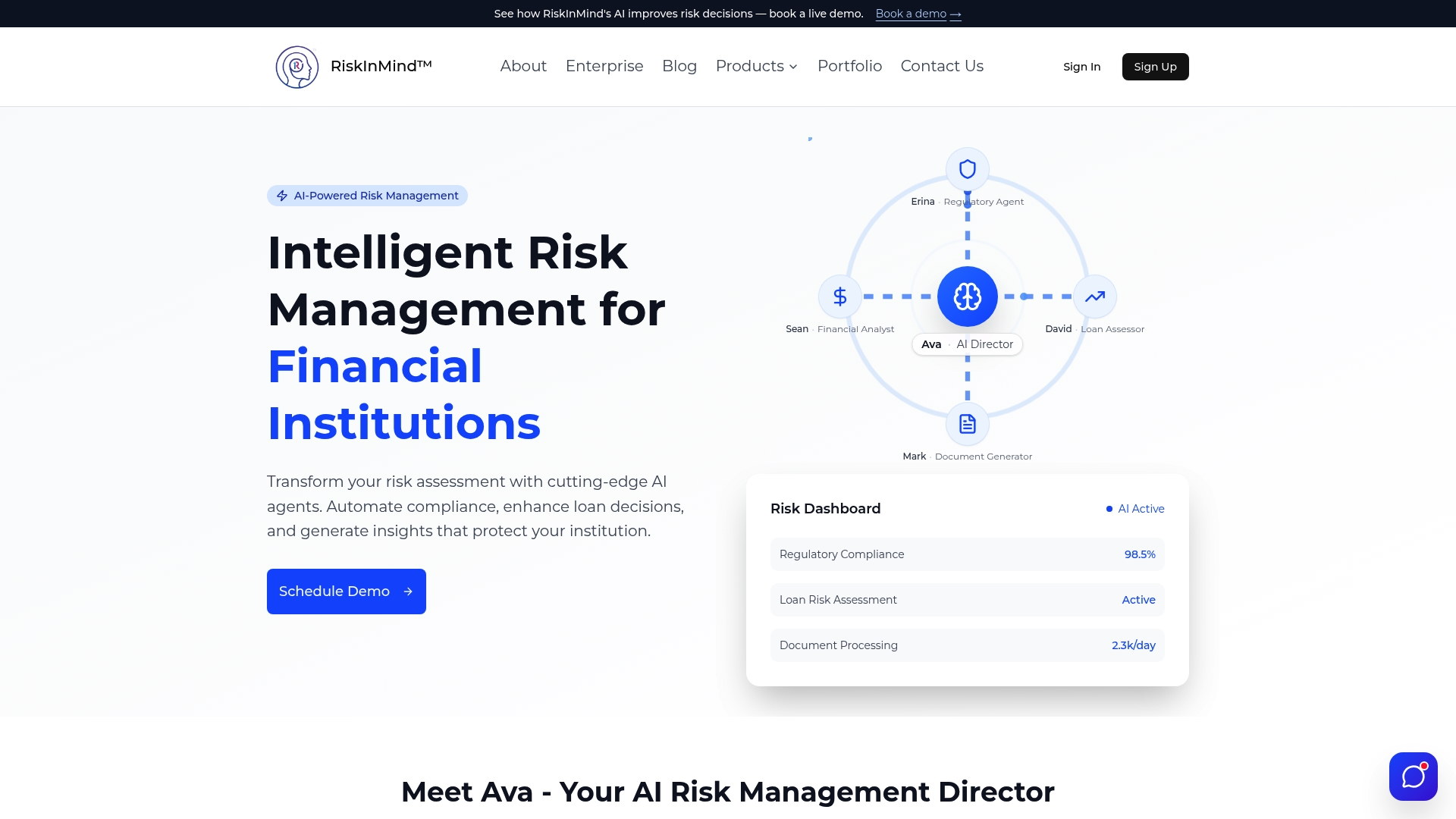
The platform builds around controls examiners expect from any institution's own systems: SOC 2 aligned processes, encryption of data in transit and at rest, and audit trails granular enough to trace every AI-driven action back to a specific decision. Unlike outsourced tools that route sensitive loan or compliance data through third-party models, an in-house AI architecture can help keep that exposure contained, a distinction relevant to vendor-validation questions raised earlier in this article.
For risk, compliance, and portfolio teams comparing this against generic automation tools, the practical next step is to look at the primary sources yourself. Review the SOC 2 security page for scope details, or explore how the Bank OS platform applies these controls across underwriting, compliance monitoring, and portfolio surveillance. Institutions ready to scope a project can check Starter, Professional, and Enterprise plan details directly, since current pricing is published there rather than estimated here.
This article is general information, not a substitute for advice from a qualified financial advisor. Consult a qualified financial professional about your own circumstances before acting on anything here.
Sources
- The NIST Cybersecurity Framework (CSF) 2.0
- Standards for Safeguarding Customer Information (FTC Safeguards Rule)
- Regulation S-P: Privacy of Consumer Financial Information and Safeguarding Customer Information
- Interagency Guidelines Establishing Information Security Standards
FAQ
What Does "Bank-Grade Security" Mean in Practice?
It means a bundle of controls, encryption, MFA, continuous monitoring, and documented governance, mapped to frameworks like NIST CSF 2.0 and interagency guidance rather than a single fixed standard. The strength of the claim depends on scope and evidence, not the phrase itself.
Which Bank Has the Weakest Security?
There is no reliable public ranking of individual banks by security strength, since institutions do not publish comparative vulnerability data and regulators do not release bank-by-bank security scores. Weakness typically shows up institution by institution through breach disclosures or enforcement actions, not through any general reputation.
What Is the $3,000 Rule for Banks?
This commonly searched phrase does not correspond to a documented federal banking regulation; definitions circulating online vary and are not consistently sourced. Readers should consult a bank's own disclosures or the Bank Secrecy Act's actual reporting thresholds for accurate figures.
What Happens if I Have More Than $250,000 in My Bank Account?
FDIC insurance standard coverage applies per depositor, per insured bank, per ownership category, so balances above insured limits in a single account and category are not automatically protected. Account holders can spread funds across ownership categories or institutions to stay within insured limits.
Which Banks Have the Highest Security?
No independent, regularly updated public ranking scores banks against each other on security specifically, since most technical control details are confidential for security reasons. The more useful question for any institution or vendor, banks included, is whether they can produce a scoped SOC 2 report, documented incident response testing, and evidence of continuous monitoring rather than relying on reputation alone.