
A risk platform demo evaluation checklist is a weighted scoring framework that assigns point values to key vendor capabilities, including core functionality, API maturity, and compliance certifications, so risk professionals can compare platforms on objective criteria rather than presentation quality. For credit unions, community banks, and lenders, this structured approach to vendor evaluation separates platforms that perform in controlled demos from those that hold up under real operational conditions. Frameworks like COSO ERM, NIST AI RMF, and certification standards such as SOC 2 Type II and ISO 27001 define the baseline criteria every financial institution should include. Getting the checklist right before the first demo prevents costly replacements and audit exposure down the line.
1. What are the top criteria for your risk platform demo evaluation checklist?
A weighted scoring matrix totaling 100 points, with core functionality weighted at 30%, integration and API maturity at 20–25%, and compliance and security at 15%, produces better long-term platform retention than unweighted checklists. Platforms scoring 75 or above on this scale are considered sustainable long-term investments. The weight distribution reflects where operational failure is most costly for financial institutions.
Maintain 100% NCUA & OCC Audit Readiness
Monitor regulatory updates 24/7, check internal credit policies, and generate compliance trails with Erina (AI Regulatory Agent).
Core functionality (30 points) covers governance workflows, the full risk lifecycle from identification through remediation, and compliance process automation. Ask vendors to demonstrate how their platform handles credit risk assessment, regulatory reporting, and portfolio monitoring in a single workflow. A platform that requires manual handoffs between these functions adds operational risk, not just inconvenience.

Integration and API maturity (20–25 points) is the criterion most often underweighted during demos. RESTful API coverage should reach at least 95% feature availability, with event-driven webhook support for real-time data flows. Your risk technology integration checklist should confirm that the vendor's API documentation is current, versioned, and publicly accessible.
Compliance and security (15 points) requires SOC 2 Type II and ISO 27001 certifications as non-negotiable minimums. Data encryption standards matter here: AES-256 at rest and TLS 1.3 in transit are the current benchmarks. Vendors who cannot produce audit reports on request during the demo phase should be disqualified.
Scalability and performance (15 points) addresses cloud-native architecture, SLA commitments at 99.9% uptime, and documented disaster recovery procedures. Community banks and credit unions often underestimate how quickly portfolio growth stresses a platform not built for elastic scaling.
User experience and administration (10 points) covers dashboard configurability, role-based access controls, and the quality of onboarding and training resources. A platform your loan officers will not use daily is a platform that will be replaced within two years.
AI and innovation features (10 points) include automated risk scoring algorithms, machine learning model transparency, and AI-assisted regulatory reporting. This category carries the lowest weight because AI features without a solid data foundation deliver inconsistent results.
Pro Tip: Build your checklist before the first vendor call. Sharing weighted criteria with vendors upfront filters out those who cannot meet your baseline and signals to serious vendors that you are a prepared buyer.
2. How to structure a weighted checklist for demos and POC phases
The weighted scorecard works only when each evaluator uses the same point scale and records evidence for every score assigned. A 4–6 week proof-of-concept with 2–3 real-world use cases at different lifecycle stages is the standard for validating risk platforms beyond the demo environment. POC phases should test evidence quality, reporting accuracy, and adoption friction, not just feature breadth.
Assign your 100 points across the six criteria above before the POC begins. Then build a scoring table where each evaluator rates each criterion from 1 to 5, multiplied by the criterion weight. This produces a normalized score that removes the influence of a single evaluator's bias toward a polished interface.
Cross-functional evaluation committees produce more accurate results than IT or procurement teams working alone. End-user involvement in scoring prevents committees from overweighting features that look impressive in demos but create friction in daily workflows. Include loan officers, compliance analysts, and your CRO alongside IT and procurement.
Pro Tip: Run at least one POC scenario using your institution's actual data, not the vendor's sample data set. Vendors who resist this request are signaling integration complexity they prefer you discover after signing.
| Evaluation phase | Duration | Key output |
|---|---|---|
| Pre-demo checklist build | 1–2 weeks | Weighted scorecard with defined criteria |
| Vendor demos | 1–2 weeks | Initial scores with evidence notes |
| POC with real use cases | 4–6 weeks | Validated scores and adoption friction report |
| Reference calls | 1 week | Third-party confirmation of vendor claims |
Documenting evidence for each score, including demo observations, API documentation reviews, and reference call notes, is critical for budget justification and audit cycles. A score without a supporting note is a liability when the CFO or board asks why you selected a platform that costs seven figures.
3. Common pitfalls in risk platform demo evaluations
Most risk platform evaluations fail by focusing on demo-ready features rather than operational scalability and the long tail of complex workflows. A vendor's demo environment is optimized for a 60-minute presentation. Your production environment is not.
The most damaging pitfalls in platform evaluation include:
- Overweighting polished demos. A vendor who scores high on presentation quality but low on API documentation is a red flag, not a finalist.
- Testing with vendor sample data. Sample data hides integration complexity, data mapping failures, and performance bottlenecks that only appear with real loan portfolios.
- Skipping API depth testing. Asking for a live API call during the demo, not just a slide about API capabilities, reveals actual integration maturity.
- Ignoring non-standard workflows. Smaller, non-responsive vendors or workflows that fall outside the demo script often expose the platform's real limitations.
- Excluding daily end-users. Compliance analysts and loan officers who use the platform eight hours a day identify friction points that executives and IT staff miss entirely.
- Skipping documentation. Evaluation committees that cannot produce evidence for their scores face challenges during procurement audits and board reviews.
"Evaluations often miss smaller, non-responsive vendors or non-standard workflows that don't fit polished demos. Operational scalability and long-tail workflow coverage are the real differentiators." — Safe Security
The fix for most of these pitfalls is the same: build your risk assessment checklist before vendor contact begins, and commit to scoring only what you can verify with evidence.
4. Industry standards vs. customized checklists: which approach wins?
Generic evaluation checklists, such as those derived from NIST AI RMF or standard GRC buyer guides, provide a useful starting point but miss institution-specific priorities. A community bank evaluating credit risk automation has different weighting needs than a credit union focused on member-facing compliance workflows. Pre-demo maturity self-assessments using COSO ERM or the Three Lines Model help institutions identify real capability gaps before they enter vendor conversations.
| Checklist type | Strengths | Weaknesses |
|---|---|---|
| Generic (NIST AI RMF, COSO ERM) | Covers baseline criteria; widely recognized | Does not reflect institution-specific workflows or risk maturity |
| Weighted, customized | Aligns criteria to business priorities; reduces bias | Requires upfront investment to build; needs committee alignment |
| Vendor-provided | Fast to complete; vendor-friendly | Biased toward vendor strengths; misses operational gaps |
The customized weighted approach consistently outperforms generic checklists for financial institutions because it forces the evaluation committee to define priorities before seeing any vendor presentation. That sequence matters. Institutions that define weights after demos unconsciously adjust criteria to favor the vendor they found most impressive.
Enterprise risk management frameworks like COSO ERM provide the structural vocabulary for your checklist categories. NIST AI RMF adds rigor for evaluating AI-specific features, including model transparency and bias testing. The strongest checklists borrow the category structure from these frameworks and then apply institution-specific weights.
Platforms with high API maturity, customizable export architecture, and strong audit trails achieve longer retention, typically four or more years. Platforms selected primarily on marketing-led feature lists are replaced within 24–36 months. That replacement cycle costs far more than the upfront investment in a rigorous, customized evaluation process.
Key takeaways
A structured, weighted evaluation checklist is the single most reliable predictor of long-term risk platform fit for financial institutions, outperforming demo impressions and vendor-provided scoring tools.
| Point | Details |
|---|---|
| Weight criteria before demos | Assign point values to core functionality, API maturity, and compliance before any vendor contact. |
| Run a 4–6 week POC | Test with real institutional data across 2–3 use cases at different risk lifecycle stages. |
| Include end-users on committees | Loan officers and compliance analysts identify operational friction that executives and IT miss. |
| Document every score | Evidence from demo observations and API reviews is required for budget justification and audits. |
| Customize over generic | Institution-specific weights outperform standard frameworks for long-term platform retention. |
Why I weight API maturity higher than most checklists do
Working with risk and compliance teams at financial institutions, I have seen the same pattern repeat: a platform wins the evaluation on core functionality and user experience, then fails 18 months later because its API cannot support the integrations the institution actually needs. The demo looked clean. The production environment did not.
My view is that API maturity deserves a weight closer to 25% than 20%, particularly for institutions running loan origination, portfolio monitoring, and regulatory reporting on separate systems. The platform that connects those systems cleanly is the platform that gets used. The one that requires manual data exports gets worked around, then replaced.
The other lesson I keep returning to is the value of the pre-demo maturity assessment. Institutions that complete a COSO ERM or Three Lines Model self-assessment before vendor conversations know exactly which capability gaps they are trying to close. That clarity changes the quality of every question asked during a demo and every score assigned during a POC.
Weighted risk scoring frameworks are not just evaluation tools. They are a forcing function that makes evaluation committees articulate what they actually need before a vendor tells them what they want. That sequence is the difference between a platform that lasts four years and one that gets replaced in two.
— Raj
How Riskinmind supports your platform evaluation process
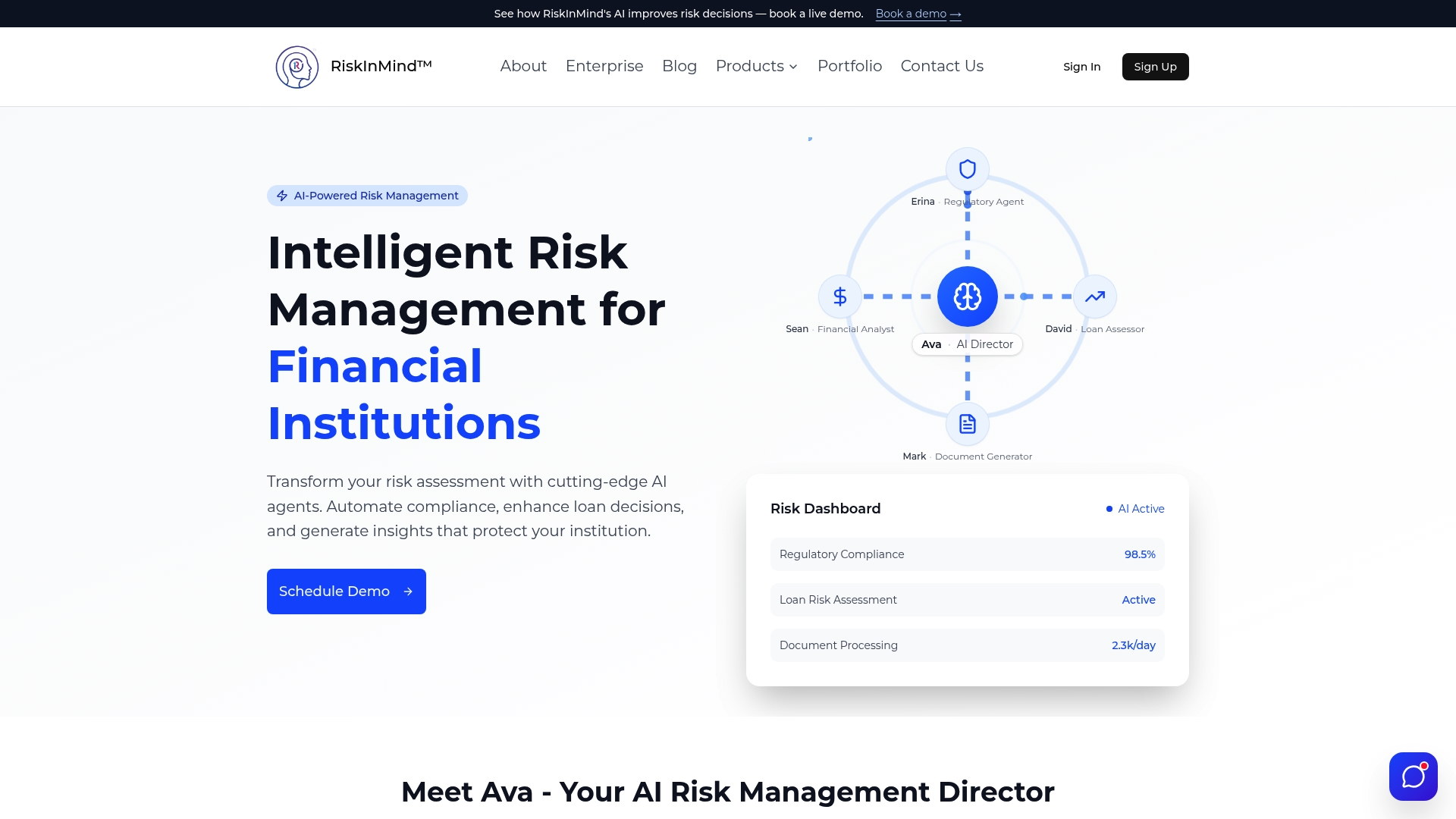
Riskinmind is built specifically for credit unions, community banks, and lenders that need to move beyond manual risk processes. Its loan application risk tools and peer benchmarking analysis give evaluation teams a live reference point for what AI-powered risk automation looks like in production, not in a demo script. Riskinmind holds SOC 2® certification and processes risk data with response times under half a second, meeting the compliance and performance criteria that belong at the top of any vendor evaluation checklist. If your institution is building or refining its evaluation framework, Riskinmind's platform offers a concrete benchmark for what core functionality, API maturity, and AI-driven compliance should deliver at the enterprise level.
FAQ
What is a risk platform demo evaluation checklist?
A risk platform demo evaluation checklist is a weighted scoring framework used by risk and compliance professionals to assess vendor platforms against defined criteria such as core functionality, API maturity, and compliance certifications. It converts subjective demo impressions into objective, comparable scores.
How many criteria should a risk platform evaluation checklist include?
A well-structured checklist includes 10–12 criteria organized into six weighted categories, with core functionality at 30%, integration and API maturity at 20–25%, and compliance and security at 15%. Platforms scoring 75 or above on a 100-point scale indicate a sustainable long-term fit.
How long should a proof-of-concept phase last for risk platform evaluation?
A POC phase should run 4–6 weeks and include 2–3 real-world use cases at different risk lifecycle stages. This timeframe is sufficient to validate evidence quality, reporting accuracy, and adoption friction beyond what a demo environment reveals.
What certifications should a risk platform vendor hold?
Vendors should hold SOC 2 Type II and ISO 27001 certifications as minimum requirements. Data encryption standards of AES-256 at rest and TLS 1.3 in transit are the current technical benchmarks for financial institution environments.
Why do most risk platform evaluations fail?
Most evaluations fail by overweighting demo-ready features instead of testing operational scalability and non-standard workflows. Excluding daily end-users from evaluation committees and skipping evidence documentation are the two most common contributing factors.
Recommended
- Risk Dashboard Features Checklist for Financial Institutions | RiskInMind
- Step by Step Risk Assessment for Financial Institutions | RiskInMind
- Risk Technology Integration Checklist for Financial Institutions | RiskInMind
- Risk Management Documentation Standards for Financial Institutions | RiskInMind