
There is no single federal certificate that grants an AI risk tool regulatory approval. What examiners at the FDIC, OCC, NCUA, and Federal Reserve actually look for is documented internal governance aligned to accepted frameworks — primarily the NIST AI Risk Management Framework and bank model risk guidance under SR 11-7. Before your next examination, three evidence categories will determine whether your AI risk tool passes scrutiny: a complete model inventory with data lineage, independent validation reports that include backtesting and bias/fair-lending test results, and audit-ready change-control logs with human sign-off on residual-risk decisions. Riskinmind's platform with SOC 2® certification is built to produce exactly these artifacts, and the sections below convert examiner expectations into a concrete, assignable action plan.
Table of Contents
- What do US regulators actually expect you to show for AI risk tools?
- Practical compliance checklist: exact controls and evidence examiners will want
- How do you operationalize lifecycle management for examiner confidence?
- What should your vendor due diligence checklist cover for AI platforms?
- What does an examiner-ready package actually look like?
- What is a realistic timeline to move an AI risk tool from pilot to production?
- Key Takeaways
- What practitioners get wrong about AI compliance at community banks
- Riskinmind gives you the examiner-ready evidence trail, built in
- Authoritative references and tools for your compliance program
Automate Regulatory Model Risk Governance
Examine models against 32 qualitative criteria and resolve risk Tiers with pre-deployment checklists per OCC 2011-12 guidelines.
What do US regulators actually expect you to show for AI risk tools?
Regulatory acceptance of an AI-driven risk tool rests on four framework pillars. The NIST AI RMF organizes obligations into four functions — Govern, Map, Measure, and Manage — and examiners increasingly use it as a reference checklist. SR 11-7 (the Federal Reserve's model risk guidance, adopted broadly across federal banking agencies) requires independent validation, ongoing performance monitoring, and documented human oversight for any model that influences credit, capital, or compliance decisions. FFIEC guidance extends those expectations to technology service providers, meaning your vendor's controls are your controls. NCUA supervisory letters apply equivalent standards to federally insured credit unions.
Examiners have shifted their focus toward what practitioners call "governance of governance." Documented human oversight — evidence that a qualified person reviewed, challenged, and approved AI outputs — carries more weight than a polished dashboard with no sign-off trail. Data lineage, bias and fair-lending controls, and demonstrable human-in-the-loop decision authority are the specific areas where community banks and credit unions most often receive findings.
| Examiner Question | Framework Reference | Required Artifact |
|---|---|---|
| Who owns this model and what does it do? | SR 11-7 §3 | Model inventory with use case, owner, data inputs |
| Was the model independently validated? | SR 11-7 §5 | Validation report with backtesting metrics |
| How are fair-lending risks addressed? | FFIEC Fair Lending | Bias test results and documented mitigations |
| What happens when the model drifts? | NIST AI RMF — Manage | KRI thresholds, exception tickets, remediation log |
| Who approved residual risk? | SR 11-7 §4 | Board/committee minutes with human sign-off |
Practical compliance checklist: exact controls and evidence examiners will want
Organize your evidence collection around four control areas. Gaps in any one of them tend to generate examination findings.
Model governance
- Model inventory with unique IDs, business owners, use cases, input data sources, and version history
- Change logs capturing every material update to model parameters, training data, or deployment scope
- Data lineage documentation tracing inputs from origination to model output
Validation and testing
- Independent validation reports (internal or third-party) with backtesting metrics and performance benchmarks
- Bias and fair-lending test results, including the methodology, protected-class analysis, and documented mitigations
- Performance drift logs showing how accuracy, calibration, and KRI thresholds have moved over time
Operational controls and security
- SOC 2® Type II report from your AI platform vendor (or your own, if self-hosted)
- Encryption-at-rest and in-transit documentation, data residency statements, and access-control matrices
- SLA and change-control clauses in vendor contracts obligating notification of material model or data changes
Audit and reporting
- Timestamped audit trails linking every model output to the user, timestamp, and decision context
- Automated KRI dashboards with pre-built KRI libraries that map risk scores directly to compliance categories
- Sample audit-ready reports and meeting minutes showing human review of model performance
Pro Tip: Pull your model inventory first. Examiners reuse it as the anchor document throughout the examination — every validation report, bias test, and change log should reference the same model ID that appears in the inventory.
How do you operationalize lifecycle management for examiner confidence?
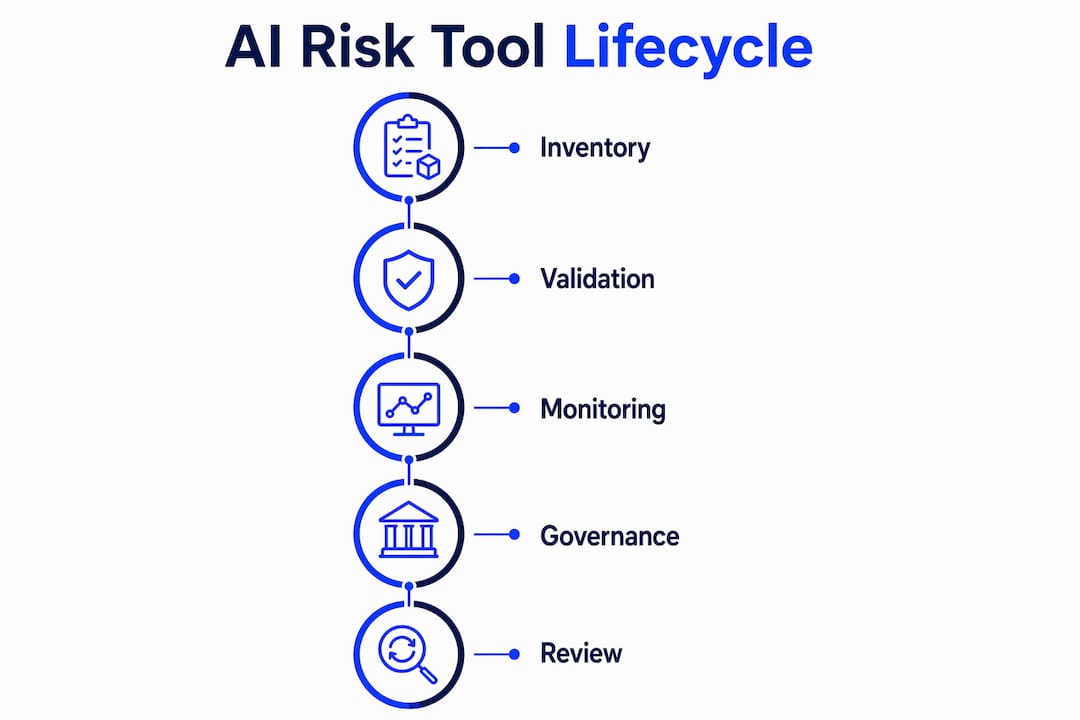
A point-in-time compliance exercise will not satisfy examiners who expect a living program. The lifecycle runs: inventory → validation → deployment → monitoring → revalidation → retirement, and each transition requires documented human authorization.

Continuous monitoring metrics to maintain include model accuracy and calibration scores, KRI threshold breach counts and resolution times, data drift indicators, exception ticket aging, and fair-lending disparity ratios by protected class. When a KRI threshold is breached, automated escalation and tasking converts a dashboard alert into a tracked remediation action with an owner and a due date — preventing dashboards from becoming decorative.
Governance cadence matters as much as the metrics themselves. Model performance should feed a monthly risk committee report, with material findings escalated to the board or audit committee. Human judgment remains central for approving residual-risk tolerances — automation scales the monitoring, but the sign-off authority must stay with a qualified person whose name and title appear in the minutes.
| Lifecycle Phase | Key Artifact | Review Frequency |
|---|---|---|
| Inventory | Model register with lineage fields | Quarterly update |
| Validation | Independent validation report | At deployment; annually thereafter |
| Deployment | Change-control authorization | Per material change |
| Monitoring | KRI dashboard with drift metrics | Monthly |
| Revalidation | Updated validation report | Triggered by drift or material change |
| Retirement | Decommission log with rationale | At retirement |
Pro Tip: Integrate AI-specific KRIs directly into your enterprise risk framework rather than managing them as a separate IT silo. Board-level visibility and consistent risk appetite enforcement depend on it.
What should your vendor due diligence checklist cover for AI platforms?
Third-party AI platforms carry your regulatory exposure. Examiners treat vendor controls as an extension of your own governance program, so due diligence must be thorough and documented.
Security and operational due diligence
- Current SOC 2® Type II report (issued within the past 12 months)
- Penetration test summary and remediation status
- Data encryption standards (AES-256 at rest, TLS 1.2+ in transit) and data residency confirmation
- Incident response plan and business continuity evidence
Model-specific requirements
- Documentation of training data sources, feature engineering, and version history
- Explainability features: can the platform produce a human-readable rationale for each model output?
- Access to validation artifacts: can your team or an independent validator inspect the model's performance data?
Contract language to insist on
- SLA for change control: vendor must notify you at least 30 days before any material model or data change
- Audit log access: your institution retains the right to export complete, timestamped audit logs at any time
- Validation artifact rights: you own or have perpetual access to all validation reports and backtesting outputs
- Incident notification: vendor must notify you within 72 hours of any security incident affecting your data
Contract clauses are your last line of defense when a vendor makes a model change that affects your fair-lending outcomes or capital calculations. An SLA that requires 30-day advance notice of material changes gives your validation team time to re-test before the change goes live — without that clause, you may learn about a model update only when an examiner asks why your disparity ratios shifted.
What does an examiner-ready package actually look like?
An examiner-ready package is a versioned, navigable set of documents that tells a coherent story: here is what the model does, here is how it was validated, here is how we monitor it, and here is the human who approved the residual risk. The longitudinal, versioned narrative — showing how residual risk trended in response to mitigations — is what separates a defensible package from a static compliance snapshot.
Core deliverables:
- Model inventory spreadsheet (CSV/Excel with immutable timestamps and version tabs)
- Validation reports (PDF with appendices for backtesting data and bias test results)
- Change-control log (chronological, with authorizing signatures)
- SOC 2® report and security documentation
- KRI dashboard exports (PDF or Excel, dated)
- Board/committee meeting minutes referencing model performance
- Remediation plans with status and follow-up validation evidence
Format and versioning: use PDF for narrative reports with a cover page that states the model ID, version, and review date. Version every document with a date-stamped filename (e.g., CreditScoreModel_ValidationReport_v3_2026-03.pdf). The executive summary should tie each mitigation action to a measurable change in the residual-risk trendline.
Pro Tip: Include trend charts in the executive summary. An examiner who can see that your disparity ratio dropped after a documented mitigation is far more likely to close a finding than one who receives only a current-period snapshot.
What is a realistic timeline to move an AI risk tool from pilot to production?
- Weeks 1–4 (Discovery and inventory): Assign a model owner and data steward; build the model inventory; pull vendor SOC 2® and security documentation; run baseline performance and bias checks on pilot models.
- Weeks 5–12 (Validation and policy drafting): Commission independent validation; draft model risk policy and governance charter; implement KRI dashboards; finalize vendor contract clauses.
- Weeks 13–24 (Pilot monitoring and remediation): Operate under live monitoring; document exception tickets and remediation actions; conduct first monthly risk committee report; address validation findings.
- Weeks 25+ (Production sign-off and board reporting): Present longitudinal monitoring data to the board or audit committee; obtain formal sign-off on residual risk; assemble the examiner-ready package for internal review.
Key roles: model owner (business line), validation lead (internal statistician or independent third party), data steward (IT/data governance), security lead (IT security), compliance liaison (BSA/AML or enterprise risk), and an executive sponsor with board-reporting authority.
- Hire or contract an ML validation specialist if internal quantitative capacity is limited.
- Schedule an independent validation at deployment and at least annually thereafter.
- Engage your primary regulator or examiner-in-charge early — a pre-examination conversation about your governance program reduces surprises.
Pro Tip: Do not wait for a formal examination request to engage your regulator. A brief, proactive conversation with your examiner-in-charge about your AI governance program signals maturity and often shapes the scope of the examination favorably.
Key Takeaways
Regulatory acceptance of an AI risk tool requires documented governance, continuous monitoring, and human sign-off on residual risk — not a one-time federal certificate.
| Point | Details |
|---|---|
| No single federal approval exists | Demonstrate governance through NIST AI RMF and SR 11-7 alignment, not a certificate. |
| Model inventory is the anchor artifact | Capture lineage, training data, validation dates, and human sign-off as versioned fields. |
| Continuous monitoring is mandatory | Maintain KRI dashboards, drift logs, and monthly risk committee reporting throughout the model's life. |
| Vendor controls are your controls | Require SOC 2® Type II, audit log access rights, and 30-day change-notification SLAs in every AI vendor contract. |
| Riskinmind centralizes the evidence | Riskinmind's platform with SOC 2® certification produces audit-ready reporting, KRI dashboards, and validation artifact exports aligned to examiner expectations. |
What practitioners get wrong about AI compliance at community banks
The most persistent mistake is treating AI compliance as a project with a finish line. Institutions that pass their first examination with a strong AI governance package sometimes let the program drift — validation reports age past 12 months, KRI dashboards go unreviewed, and the model inventory stops reflecting production reality. When the next examination arrives, the gap between the documented program and the live environment is exactly what examiners are trained to find.
A second underappreciated risk is the human oversight gap. Examiners do not just want to see that a human could override an AI output — they want documented evidence that a qualified person did review, challenge, and approve the model's residual-risk assessment on a regular schedule. A governance charter that assigns oversight responsibility without meeting minutes to prove it happened is, in examiner terms, a control that exists on paper only.
The institutions that handle AI examinations most confidently are the ones that integrated their AI-specific KRIs into the enterprise risk framework from day one, rather than managing AI as a technology silo. That integration gives the board visibility, enforces consistent risk appetite, and produces the kind of longitudinal evidence trail that turns an examiner's question into a two-minute document retrieval.
Riskinmind gives you the examiner-ready evidence trail, built in
Credit unions and community banks that deploy AI risk tools face a concrete documentation problem: the controls examiners expect — model inventory, validation artifacts, KRI dashboards, audit logs, bias test results — must be current, versioned, and retrievable on short notice. Riskinmind addresses that directly. The platform centralizes model inventory and data lineage, generates audit-ready reports with timestamped decision logs, and surfaces KRI dashboards that feed directly into your risk committee reporting cycle. SOC 2® certification and bank-grade security satisfy the vendor due-diligence checklist your compliance team needs to complete before deployment.
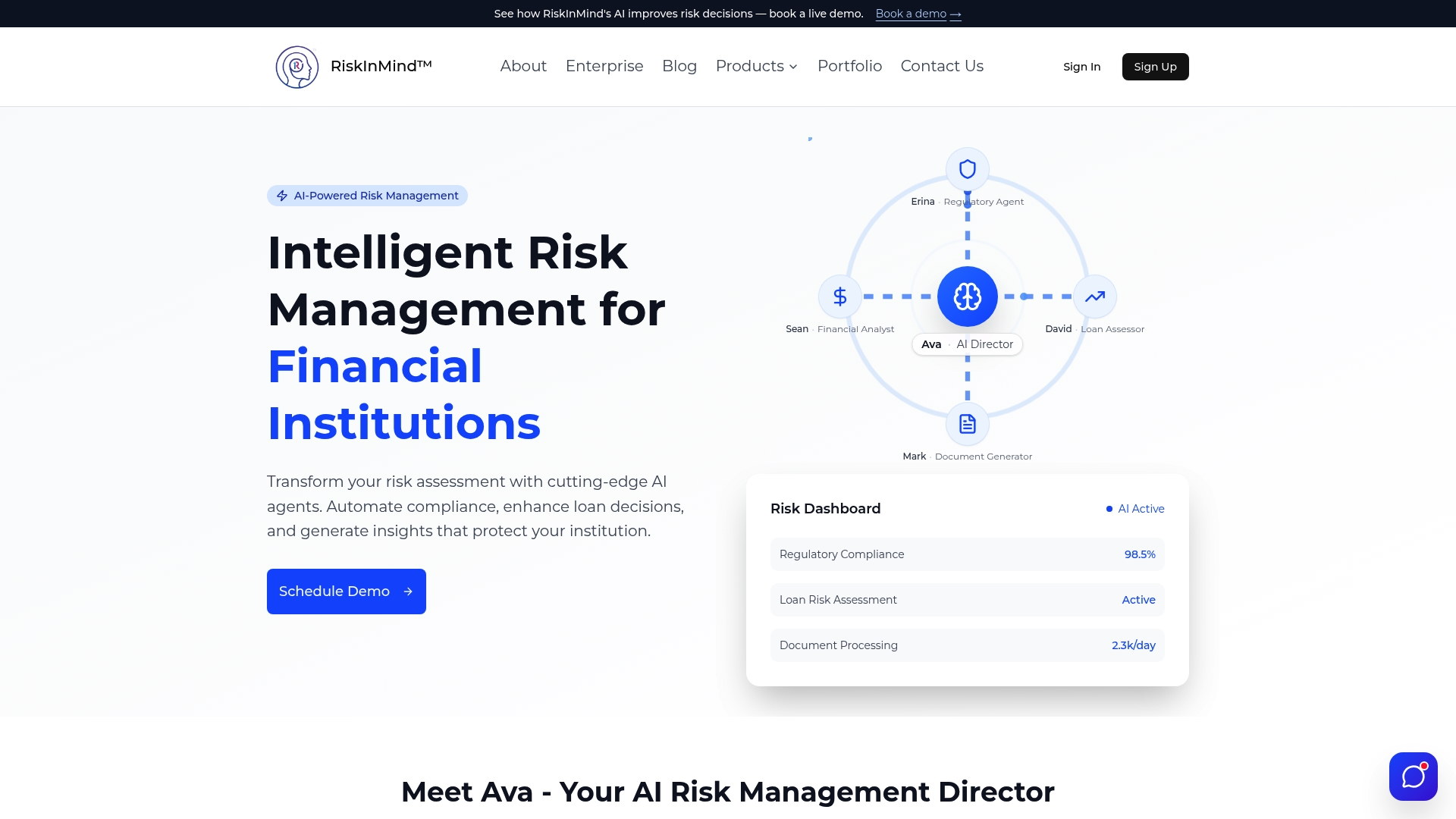
Institutions can explore Riskinmind's loan application module and portfolio risk tools through a live demo, with sample deliverables available to review before any commitment. Request a demo at riskinmind.ai to see the examiner-ready reporting package firsthand.
Authoritative references and tools for your compliance program
The sources below are the primary frameworks and regulator guidance cited throughout this guide. File the framework documents with your examiner-ready package as evidence of alignment; keep gap analyses and internal working artifacts as supporting documentation.
Primary frameworks and regulator guidance
- NIST AI Risk Management Framework (Govern, Map, Measure, Manage functions)
- SR 11-7: Guidance on Model Risk Management (Federal Reserve / OCC, 2011, broadly adopted)
- FFIEC IT Examination Handbook and supervisory letters on model risk
- NCUA supervisory letters on third-party and technology risk
Practical compliance tools
- AI Compliance Gap Analyser — produces per-framework gap tables, action plans, and remediation timelines mapped to NIST AI RMF and other frameworks; useful for pre-examination preparation.
- Riskinmind platform — centralizes model inventory, KRI dashboards, and AI-driven compliance reporting for credit unions and community banks.
Recommended filing guidance
| Document | File with Examiner? | Keep as Internal Artifact? |
|---|---|---|
| Model inventory spreadsheet | Yes | Yes (working version) |
| Validation reports (PDF, versioned) | Yes | Yes |
| SOC 2® Type II report | Yes | Yes |
| KRI dashboard exports | Yes | Yes |
| Gap analysis working files | No | Yes |
| Vendor contract SLA clauses | Yes | Yes |
Recommended
- Regulatory risk assessment: Frameworks, steps, and best practices | RiskInMind
- Risk Assessment Methodology: A 2026 Guide for Financial Leaders | RiskInMind
- Regulatory Technology Explained: A 2026 Guide for Financial Firms | RiskInMind
- Risk analytics step by step: A practical guide for financial institutions | RiskInMind