
Regulatory risk assessment sits at the intersection of strategy, compliance, and competitive positioning, yet most financial institutions still treat it as a periodic box-ticking exercise rather than a living tool for business decisions. That misunderstanding has real costs. When a new rule reshapes capital requirements or a supervisory expectation shifts underwriting standards, institutions without a rigorous, dynamic assessment process are caught reacting instead of preparing. This guide cuts through the confusion between regulatory risk and compliance risk, maps out a clear step-by-step assessment process, and delivers governance best practices that risk officers and CROs can apply immediately.
Table of Contents
- What is regulatory risk and why does it matter?
- Core steps in the regulatory risk assessment process
- Governance, documentation, and avoiding stale assessments
- System-level vs. firm-level assessments: What's the difference?
- A practitioner's perspective: What most guides miss about regulatory risk assessment
- Take the next step: Smarter risk assessment with AI-driven tools
- Frequently asked questions
Automate Regulatory Model Risk Governance
Examine models against 32 qualitative criteria and resolve risk Tiers with pre-deployment checklists per OCC 2011-12 guidelines.
Key Takeaways
| Point | Details |
|---|---|
| Beyond compliance | Regulatory risk assessment is more than a compliance exercise—it shapes strategy and business resilience. |
| Structured process | Effective assessments follow a clear, repeatable sequence to identify, evaluate, and mitigate risks. |
| Keep assessments dynamic | Updating and governing risk assessments regularly prevents reliance on outdated risk profiles. |
| Actionable outputs | Leading practices tie risk assessment findings directly to actions, ownership, and ongoing monitoring. |
| System vs. firm focus | Regulatory risk assessments operate at both the jurisdictional and firm level, informing each other’s priorities. |
What is regulatory risk and why does it matter?
Now that we've set the context, let's define what regulatory risk truly means and the stakes for financial institutions.
[Regulatory risk is the risk] that changes in laws, rules, or supervisory expectations will materially affect an organization's business, costs, or competitiveness. That definition is precise and worth holding onto, because it is frequently conflated with compliance risk, which is distinctly different. Compliance risk is the exposure an institution faces when it fails to follow rules that already exist. Regulatory risk, by contrast, is forward-looking: it concerns how new or amended rules will change the game, not whether today's game is being played correctly.
"Regulatory risk does not require a rule to be broken. It requires only that a rule changes, and that the institution isn't ready."
The business impacts of unmanaged regulatory risk are not theoretical. When the Basel III capital framework was phased in, institutions that had assessed the trajectory of capital rules early were able to realign their lending mix and portfolio composition in advance, maintaining competitiveness while peers scrambled to build buffers. When consumer protection standards tightened around mortgage servicing, lenders without a regulatory risk lens absorbed significant operational and reputational costs that had been entirely foreseeable from the rule proposal stage.
Understanding which areas of your operation are exposed to regulatory change is the starting point. Common domains affected include:
- Profit and loss through increased compliance costs or restrictions on revenue-generating activities
- Capital allocation as new rules can elevate risk weights and reduce available capital for lending
- Risk appetite by narrowing or widening acceptable exposure thresholds
- Operations through new reporting obligations, staffing requirements, and technology mandates
- Competitive positioning when regulatory change favors larger or better-capitalized institutions
For community banks, credit unions, and regional lenders, the stakes are especially high because the margin for absorbing unexpected regulatory costs is thinner than at large banks. Understanding compliance risks in banking in real examples helps ground these abstract exposures in the specific products and workflows your institution actually operates.
Core steps in the regulatory risk assessment process
With a clear understanding of regulatory risk, let's map out the standard steps financial institutions use to assess and manage it.
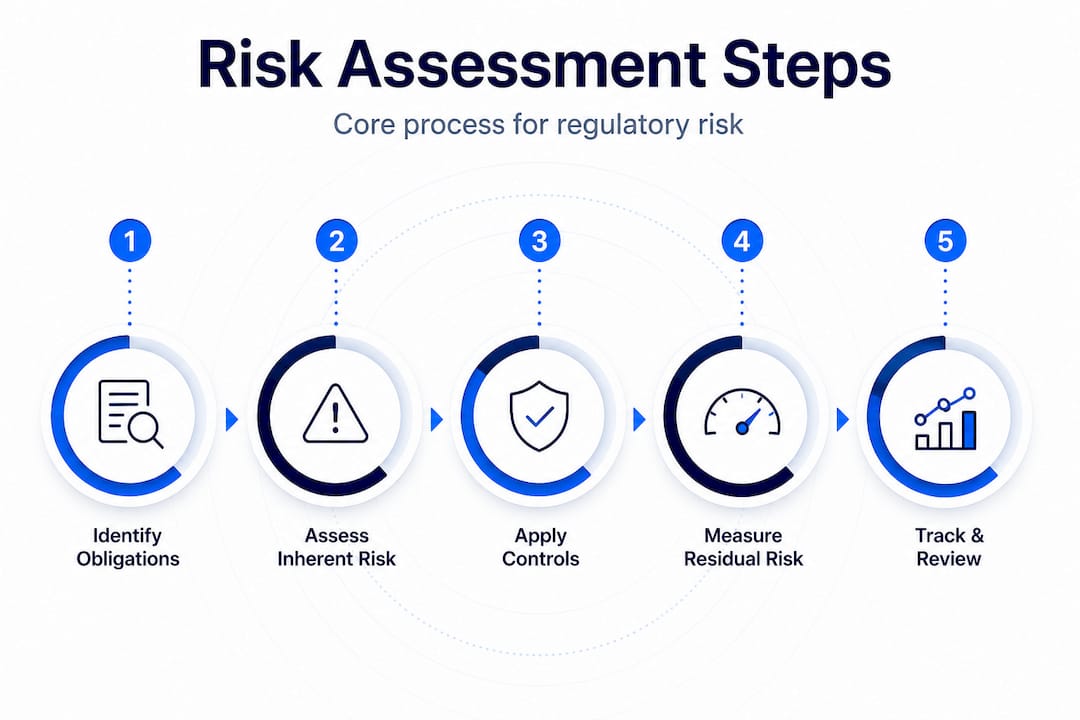
A structured, risk-based process for regulatory risk assessment moves through well-defined phases: identify relevant regulatory obligations, identify inherent risk drivers, evaluate likelihood and impact, assess control effectiveness, and derive residual risk. Each step is sequential but also iterative, meaning that new information gathered at step four often loops back to refine the analysis at step two.
- Identify regulatory obligations. Catalog every applicable rule, guidance note, and supervisory expectation at the federal, state, and relevant international level. For U.S. financial institutions, this typically includes FDIC, OCC, NCUA, CFPB, and FinCEN frameworks, along with state regulators.
- Identify inherent risk drivers. For each obligation, determine what characteristics of your business model, customer base, or product mix create exposure. High transaction volume, complex products, or reliance on third-party vendors are common inherent risk amplifiers.
- Evaluate likelihood and impact. Risk assessment can be divided into phases of hazard identification, exposure assessment, and risk characterization. Translated to the regulatory context, this means estimating how likely a regulatory change is to materialize and how severely it would affect your institution if it did.
- Assess control effectiveness. Evaluate whether existing policies, procedures, monitoring tools, and governance structures are adequate to mitigate identified risks. A control that exists on paper but isn't tested or enforced offers minimal protection.
- Derive residual risk. After accounting for control effectiveness, calculate what exposure remains. Residual risk is the number that should actually drive capital planning, staffing decisions, and strategic priorities.
The distinction between inherent and residual risk is one of the most practically important concepts in this work.

| Dimension | Inherent risk | Residual risk |
|---|---|---|
| Definition | Exposure before any controls are applied | Exposure remaining after controls are in place |
| What drives it | Business model, volume, product complexity | Control quality, testing frequency, governance |
| Management use | Sets the ceiling for worst-case exposure | Informs capital, appetite, and strategy |
| Common mistake | Underestimating due to optimism bias | Overstating control effectiveness |
| Review trigger | New product, regulatory proposal | Control failure, audit finding, organizational change |
Pro Tip: Align your assessment cycle with material business changes, not just annual regulatory checklists. When your institution launches a new product, enters a new market, or acquires a portfolio, that event should trigger a targeted assessment update, not a wait until the next scheduled review.
For institutions looking to modernize this cycle, automating risk assessment for financial institutions offers practical guidance on reducing manual effort while improving accuracy. The risk analytics steps guide provides a complementary framework for integrating quantitative data into the assessment workflow.
Governance, documentation, and avoiding stale assessments
Understanding process is crucial, but the value of regulatory risk assessment is only realized when it's governed, documented, and kept dynamic.
Effectiveness is improved when risk appetite, business-wide risk assessments, customer risk assessments, and risk-based controls are integrated, and when actions from risk assessments are documented and tracked over time. That finding from multi-firm supervisory reviews reflects a consistent pattern: institutions that treat their assessment as a standalone document rather than a living governance input are systematically less effective at managing regulatory exposure.
"A risk assessment that lives only in a binder on a shelf is not a risk management tool. It is a record of what was true on one day."
Regulatory risk assessment is commonly expected to support ongoing oversight and decision-making, with governance over the assessment cycle and outputs integrated into the institution's broader model and risk management infrastructure. That means assigning ownership, setting review frequencies, and building escalation paths for when residual risk breaches appetite thresholds.
The following table outlines the core elements that should be reviewed and managed as part of a dynamic assessment cycle.
| Element | Recommended owner | Review frequency | Update trigger | Tracking metric |
|---|---|---|---|---|
| Regulatory inventory | Compliance officer | Quarterly | Rule finalization, proposal | Number of open obligations |
| Inherent risk ratings | Business line managers | Semi-annual | New product/market | Rating change percentage |
| Control effectiveness | Internal audit | Annual (at minimum) | Audit finding, control failure | Deficiency closure rate |
| Residual risk scores | CRO or risk committee | Quarterly | Threshold breach | Scores vs. appetite limits |
| Action items | Designated risk owners | Ongoing | Assessment review | Percentage completed on time |
Pro Tip: Assign a named owner to every identified risk and every associated action item. Shared ownership is no ownership. When accountability is diffuse, follow-through collapses and assessments become historical records rather than management tools.
Governance also requires that assessment outputs connect visibly to strategic decisions. When the board or ALCO discusses capital allocation, the regulatory risk profile should inform that conversation directly. When a new product is being approved, the regulatory risk assessment for that product should be part of the approval package. This integration is what separates institutions that use assessment data to drive decisions from those that produce assessments to satisfy examiners.
For institutions seeking to modernize this governance function, modern risk management automation can dramatically reduce the manual overhead of tracking action items and maintaining current documentation. Compliance monitoring best practices provide a practical framework for building the ongoing oversight layer that keeps assessments relevant between formal review cycles.
System-level vs. firm-level assessments: What's the difference?
Regulatory risk assessments aren't all the same. Next, let's see how firm-level and system-level assessments compare and why both matter for robust risk practice.
Regulatory consistency assessments such as the Basel Committee's Regulatory Consistency Assessment Programme (RCAP) are designed to check that domestic rules align with international standards. Firm-level assessments, by contrast, focus on how regulatory change and compliance obligations affect a specific institution's exposure, strategy, and operations. These two levels operate on different scales, but they are deeply interconnected.
The RCAP process moves through four phases: scoping (defining which standards and jurisdictions are in scope), assessment (reviewing domestic rule texts against the Basel framework), follow-up (engaging the jurisdiction on identified gaps), and publication (releasing findings for public transparency). The outcomes of RCAP reviews can directly create new firm-level risks, because when a jurisdiction's rules are found to be non-compliant with the international standard, domestic institutions face potential changes to capital requirements, risk weights, or liquidity rules.
| Dimension | System-level assessment (RCAP) | Firm-level assessment |
|---|---|---|
| Primary focus | Consistency of domestic rules with international standards | Effect of regulatory change on institutional exposure |
| Scope | Jurisdictional (entire national framework) | Institution-specific (products, portfolios, business model) |
| Conducted by | Basel Committee peers and technical staff | Internal risk teams, with external validation |
| Key deliverables | Compliance ratings, identified gaps, recommendations | Risk register, control evaluation, residual risk profile |
| Success metric | Full or largely compliant classification | Residual risk within approved appetite |
| Typical frequency | Every few years per jurisdiction | Annual cycle with dynamic updates |
Risk professionals at community banks and credit unions may be tempted to view RCAP as a concern for global systemically important banks only. That instinct is understandable but carries its own risk. When international standards are updated and domestic rules follow, firm-level exposure changes regardless of institution size. Monitoring model risk management impact from major regulatory shifts is one concrete example of how system-level developments cascade into firm-level requirements.
There are several scenarios where understanding both perspectives gives your institution a material advantage:
- When a Basel standard update is finalized and you need to forecast domestic rulemaking timelines
- When your institution operates across state lines and must track inconsistencies between state and federal frameworks
- When stress testing or capital planning requires realistic assumptions about the regulatory environment over a multi-year horizon
- When board members or investors ask about the institution's exposure to pending international or domestic rule changes
A practitioner's perspective: What most guides miss about regulatory risk assessment
The mechanics of regulatory risk assessment are well-documented. Frameworks exist, checklists are available, and most large institutions have formal programs in place. But experience watching these programs operate in real financial environments reveals a gap that no framework fully addresses: most assessments are built to satisfy examiners, not to inform decisions.
The symptoms are recognizable. A risk committee receives a quarterly assessment report that is lengthy, technically thorough, and almost entirely ignored in the actual business discussion that follows. Action items from prior reviews are closed administratively rather than substantively. Risk ratings are updated annually on a fixed schedule regardless of what happened in the market or the regulatory environment in between. Assessments can become stale or non-dynamic, causing outdated risk profiles to inform strategy and control design in ways that expose the institution to risks it believes are managed.
The hard-won lesson from seeing effective programs up close is that the difference isn't methodology. It's ownership. Institutions with truly effective regulatory risk assessment processes have named owners who feel personal accountability for the accuracy and currency of each risk rating. They have feedback loops that surface when a control has degraded or a rating has drifted from reality. They connect assessment outputs directly to budget decisions, staffing plans, and product approvals rather than filing them in a governance repository.
Breaking the cycle requires three specific commitments. First, integrate risk appetite explicitly into assessment ratings so that every residual risk score is evaluated against a threshold rather than reported in isolation. Second, build control testing into the assessment cycle itself rather than treating it as a separate audit function. Third, institute a formal stale-rating review where any risk that hasn't been updated within a defined period is automatically escalated for substantive review.
Building trust through compliance is an outcome that flows from this kind of disciplined practice. Regulatory risk isn't managed by checking boxes. It is managed by building systems that surface real exposure, assign real accountability, and drive real action.
Pro Tip: Build a formal feedback loop into your assessment cycle. After each review period, analyze which identified risks led to actual control changes or strategic adjustments and which ones were simply carried forward. That ratio tells you more about your program's effectiveness than any risk rating.
Take the next step: Smarter risk assessment with AI-driven tools
Translating expertise into action requires the right tools, and managing regulatory risk at the standard described in this guide demands more than spreadsheets and annual review cycles.
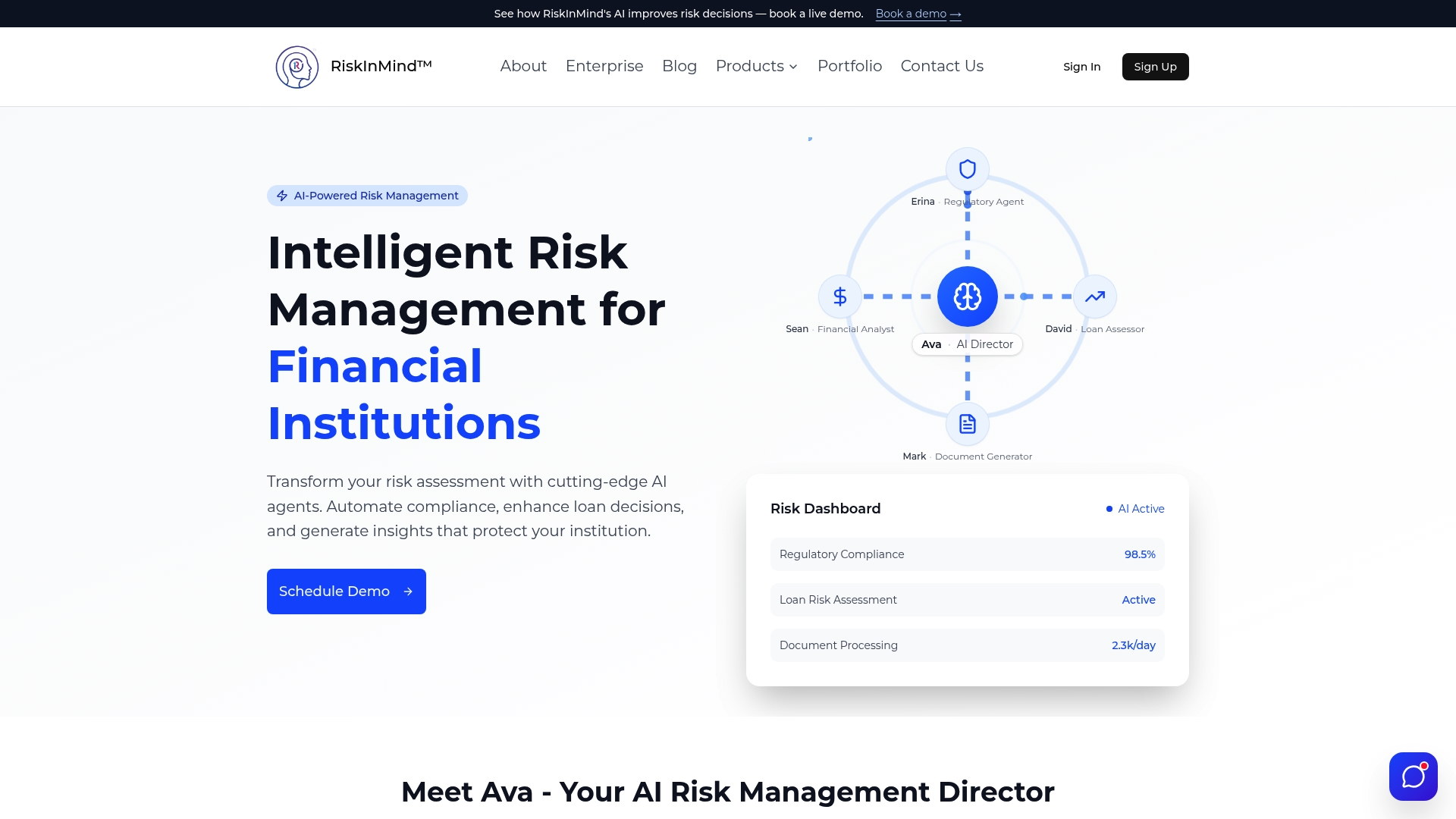
RiskInMind's AI-powered risk management platform is purpose-built for credit unions, community banks, and lenders that need to automate and govern regulatory risk assessment end-to-end. Ava, the platform's central AI director, coordinates specialized agents in regulatory compliance, credit risk, and market analysis to surface real-time risk intelligence, flag emerging regulatory developments, and maintain dynamic risk registers that update as conditions change. With SOC 2® certification, bank-grade security, and response times under half a second, the platform integrates directly with your governance and reporting workflows. Explore compliance automation solutions purpose-built for your regulatory environment, or review available pricing tiers to find the right fit for your institution's scale and complexity.
Frequently asked questions
How does regulatory risk assessment differ from compliance risk assessment?
Regulatory risk assessment looks at exposure to new or changing regulations and their potential impact on business strategy, while compliance risk assessment checks whether current rules are being followed correctly. They are related but address different time horizons and questions.
What are the typical steps in a regulatory risk assessment?
The key steps include identifying regulatory obligations, pinpointing inherent risk drivers, evaluating likelihood and impact, assessing control effectiveness, and determining residual risk. This structured, risk-based process ensures exposures are evaluated systematically rather than anecdotally.
How often should regulatory risk assessments be updated?
Best practice is to update assessments at least quarterly and immediately whenever there are material regulatory proposals, rule finalizations, or significant business changes. Stale, insufficiently dynamic assessments are one of the most commonly cited weaknesses in supervisory reviews.
What are BWRA and CRA in the context of regulatory risk?
BWRA stands for business-wide risk assessment, and CRA is customer risk assessment. Both are structured methods described in FCA supervisory reviews for evaluating regulatory risks at the enterprise and customer-relationship levels respectively.
Why should firm-level risk assessments align with system-level regulatory consistency assessments?
Gaps in domestic rules identified through system-level reviews like the Basel RCAP process often result in future domestic rulemaking that creates new firm-level compliance requirements, so monitoring both levels gives institutions an earlier and more accurate picture of their regulatory horizon.
Recommended
- Streamline your risk analysis process for better compliance | RiskInMind
- Risk analytics step by step: A practical guide for financial institutions | RiskInMind
- How to automate risk assessment for financial institutions | RiskInMind
- Top regulatory compliance risks: Real examples for banks | RiskInMind