
Shared branching creates distributed trust exposure: the moment your member walks into a host credit union, your institution inherits fraud surface you do not directly control. That is the core role of shared branching risk, and it has direct consequences for loss allocation, member trust, and your obligations under NCUA guidance and Regulation CC. Before reading further, three actions belong on your desk in the next 24–72 hours:
- Verify that warning codes are active on all flagged member accounts in the shared-branch switch.
- Review high-value account flags and confirm they restrict guest-branch access where appropriate.
- Confirm incident-response contacts with your network operator so escalation paths are current.
These are not aspirational controls. They are the minimum operational posture for any credit union participating in a shared-branch network.
Maintain 100% NCUA & OCC Audit Readiness
Monitor regulatory updates 24/7, check internal credit policies, and generate compliance trails with Erina (AI Regulatory Agent).
Table of Contents
- How does shared branching actually work?
- What risk categories does shared branching introduce?
- How do shared-branch fraud attacks typically unfold?
- What operational controls reduce fraud at guest branches?
- How do you detect shared-branch fraud with rules, analytics, and AI?
- What should teller training and network coordination look like?
- What are the U.S. regulatory expectations for shared-branch oversight?
- What steps do you take when shared-branch fraud is detected?
- Which KPIs should you track for shared-branch risk?
- Key Takeaways
- Shared branching risk deserves more operational attention than most credit unions give it
- Riskinmind gives your fraud team a faster path from alert to action
- Authoritative sources and where to go next
How does shared branching actually work?
When your member presents at a host credit union, the teller collects a government-issued ID and the member's account number, then routes the transaction through a real-time switch back to your core system. Authorization, balance verification, and posting all happen against your records, not the host's. The host branch never holds your member's funds; it acts as an authenticated access point.
SharedBranching.org serves as the public-facing network locator and the entry point for operating rules, while Velera (formerly CO-OP Financial Services) operates one of the largest shared-branch networks in the country. As of late 2025, more than 5,500 branch locations participate across the U.S., Puerto Rico, and Guam. That scale is exactly why scalable detection matters: a fraud ring can probe dozens of locations across multiple states in a single afternoon.
Operating rules impose specific constraints that directly shape your fraud exposure:
| Transaction Type | Common Network Limit | Regulation CC / Policy Note |
|---|---|---|
| Cash withdrawal | $500 per day (common cap) | Immediate availability; no hold permitted on cash |
| Check-based withdrawal | $500 network cap | Reg CC holds may apply; home CU policy governs |
| Deposit (check) | Accepted per network rules | Reg CC next-day or extended holds apply |
| Restricted account types | Blocked from guest access | Business, fiduciary, and new accounts often excluded |
| Balance inquiry | Permitted; logged | Rapid inquiries are a fraud indicator |
Service consistency across cooperating institutions is a persistent operational challenge. Industry reporting on shared-facility arrangements confirms that member communications and staff training require extra investment to maintain trust when members interact with staff from another institution.
What risk categories does shared branching introduce?
The impact of shared branching on your risk profile spans six distinct categories, each with its own loss mechanism and regulatory implication.
Authentication and identity risk. The host teller cannot access your member's full history in real time. A fraudster with a counterfeit ID and a stolen account number can pass a surface-level verification. Security assessments of shared-branch environments routinely find weak authentication at host institutions, missing multi-factor authentication, privilege escalation paths, and inadequate access logging — all exploitable gaps that your controls cannot patch from the home side.
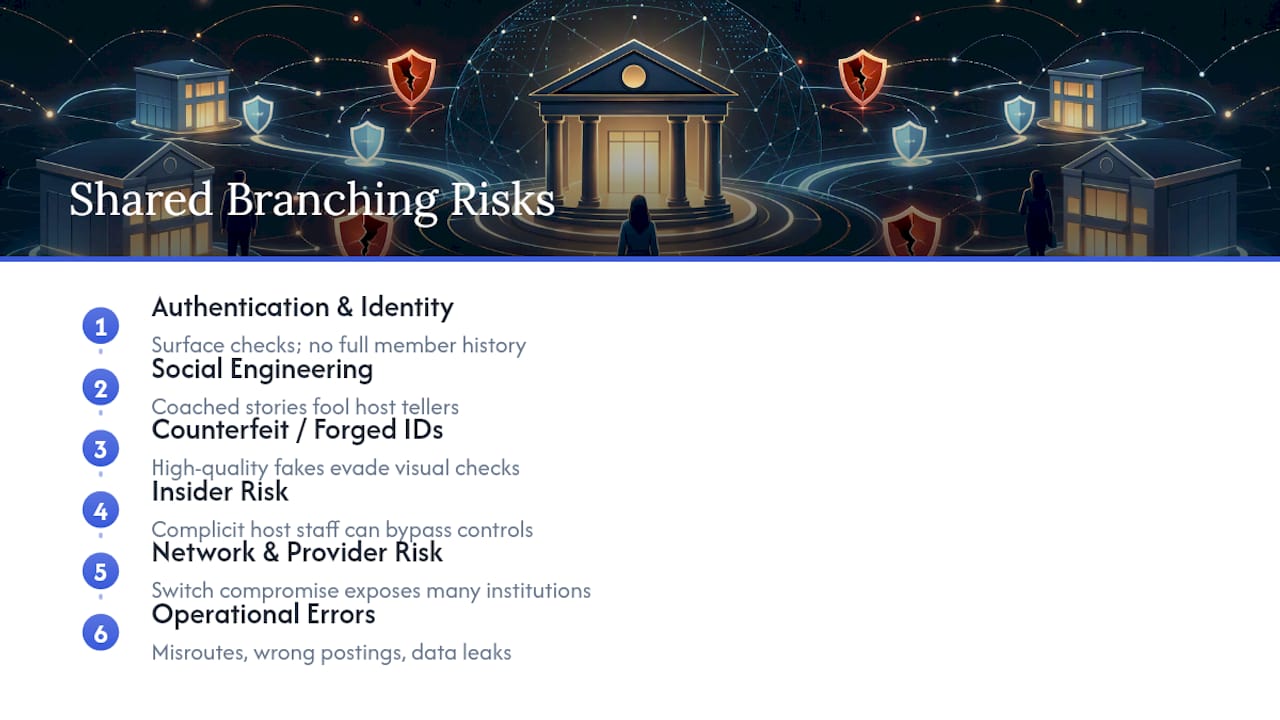
Social engineering. Fraudsters coach accomplices on exactly what to say to a teller: a plausible story about a lost card, an urgent need for cash, a recent move. The host teller has no relationship context to challenge the narrative.
Counterfeit and forged ID risk. High-quality fake IDs are commercially available. Without UV-light verification tools and current ID guides at every host location, visual inspection alone is insufficient.
Insider risk at host locations. A compromised or colluding employee at a host branch can override controls, skip verification steps, or share transaction data. Your indemnification agreement is your primary recourse, but it does not prevent the loss.
Network and provider vulnerabilities. The real-time switch itself is a concentration point. A compromise at the network operator level could expose transaction data across thousands of participating institutions simultaneously.
Operational errors and data leakage. Misrouted transactions, incorrect account postings, and inadvertent disclosure of account details during guest service all create liability. GLBA Safeguards Rule obligations apply to data handled at host branches on your members' behalf, and NCUA examiners expect you to have documented that exposure in your third-party risk program.
How do shared-branch fraud attacks typically unfold?
Understanding the attack flow is what lets you tune detection rules before a loss occurs, not after.
- Counterfeit ID preparation — A fake government-issued ID is produced matching the member's name and approximate physical description. The fraudster selects a host branch geographically distant from the member's home area to reduce the chance of recognition.
Behavioral indicators that should trigger teller escalation include: out-of-state or out-of-area IDs on accounts with a local transaction history, rapid balance inquiries in the 24 hours preceding a withdrawal attempt, a mismatch between the member's stated reason for visiting and the account's usage pattern, and requests to withdraw amounts that land precisely at the network cap. Insider-assisted fraud tends to show up differently: transactions processed without the standard verification steps, supervisor overrides with no documented justification, and a pattern of exceptions concentrated around one teller or shift.
What operational controls reduce fraud at guest branches?
Effective shared branching strategies require layered controls, not a single policy. The following represent the minimum defensible posture for a credit union with active shared-branch participation.
Account-level controls:
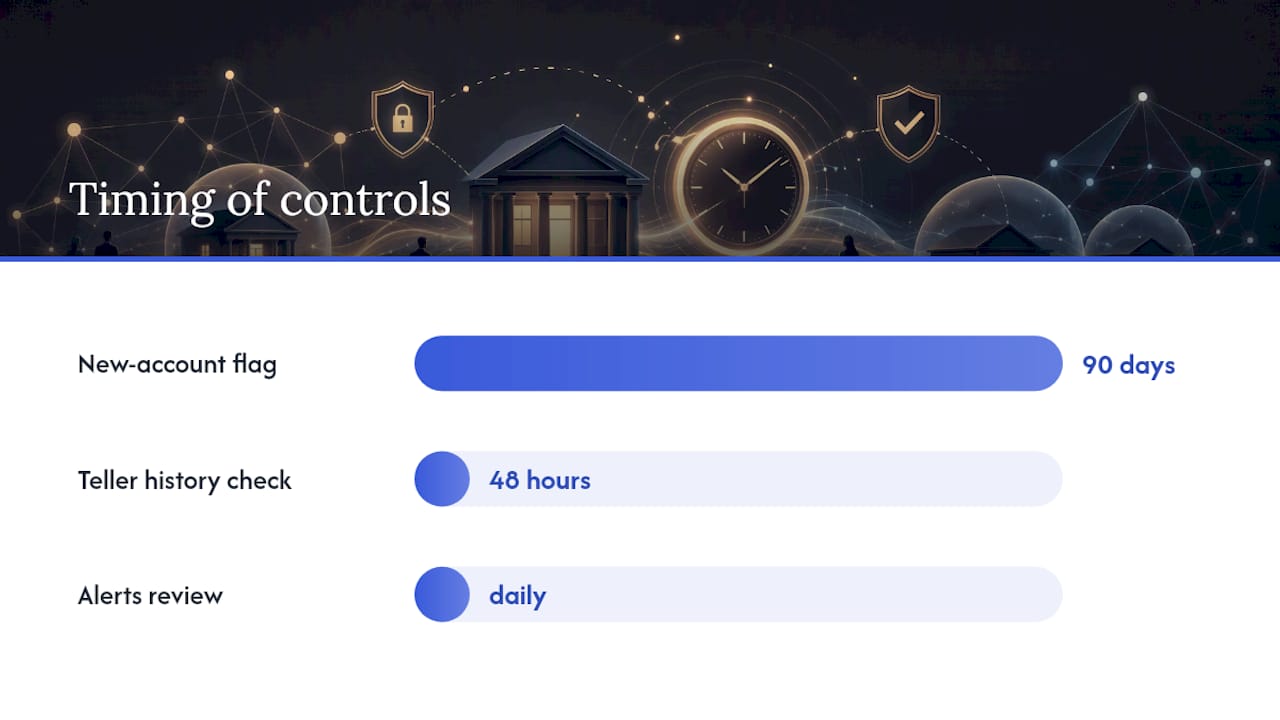
- Activate warning codes on all accounts with active fraud flags, recent disputes, or elevated risk scores; confirm these codes transmit through the switch to host tellers.
- Set or re-verify daily cash withdrawal caps aligned to your risk appetite; the common $500 network cap is a floor, not a ceiling.
- Flag new accounts (opened within 90 days) and high-risk segments for restricted shared-branch access until a transaction history is established.
- Block business, fiduciary, and employee/board accounts from guest-branch access by default.
Teller and procedural controls:
- Require tellers to pull the member's 48-hour transaction history before completing any withdrawal above a defined threshold.
- Mandate UV-light ID verification and cross-reference against a current ID guide for every guest transaction.
- Require supervisor sign-off for any exception to the standard verification process; log the exception with a reason code.
Contractual controls:
- Confirm that your shared-branch agreement includes hold-harmless and indemnification language. NCUA's guidance explicitly advises member credit unions to obtain these provisions and to verify that shared facilities carry sufficient insurance to cover employee misconduct or facility-level losses.
- Negotiate right-to-audit clauses with your network operator and any host branches under a bilateral agreement.
- Define incident notification SLAs in writing: how quickly the host branch or network operator must alert you when a suspicious guest transaction is flagged.
Network-level tools:
- Register for the CO-OP fraud-alert subscription portal and assign a staff member to review alerts daily. Network operators also provide Fraud Analyzer Reports (FARs) that surface cross-institution patterns your local rules will not catch.
- Subscribe to network fraud-alert feeds and act on them the same business day; delayed response is where recoverable losses become permanent ones.
Pro Tip: Flag accounts that have never used shared branching as a distinct risk segment. A first-ever guest-branch transaction on a long-standing account with no travel history is a high-confidence fraud signal. Configuring this flag in your core system costs almost nothing and catches a disproportionate share of account-takeover attempts.
How do you detect shared-branch fraud with rules, analytics, and AI?
An effective detection stack combines real-time rules, cross-member velocity checks, and model-based anomaly detection that ingests network-wide signals. No single layer is sufficient on its own.
| Detection Approach | Strengths | Limitations | False-Positive Risk | Data Requirements |
|---|---|---|---|---|
| Rule-based (static thresholds) | Fast, explainable, low cost | Misses novel patterns; easily gamed | Low to moderate | Transaction logs, warning codes |
| Velocity checks (cross-member) | Catches ring behavior across accounts | Requires cross-account data access | Moderate | Account-level time-series data |
| Anomaly detection (statistical) | Surfaces behavioral outliers | Needs baseline period; less explainable | Moderate to high | Historical transaction data |
| AI/ML model (supervised) | Highest accuracy on known patterns | Requires labeled fraud data; model drift | Low (tuned) | Labeled fraud cases, network signals |
| AI/ML model (unsupervised) | Finds unknown patterns | Harder to explain to examiners | High initially | Raw transaction and behavioral data |
Industry experts, including Velera speakers at CCUA webinars, advocate an omnichannel detection approach that pairs analytics with frontline training and inter-credit-union collaboration. Rules alone cannot keep pace with social-engineering rings that adapt their scripts and timing based on observed teller behavior.
For vendor selection, the inputs you must own before any model goes live include: a clean labeled dataset of confirmed shared-branch fraud cases, integration specs for your shared-branch switch, and a defined explainability standard for examiner presentations. Shadow-mode testing, where a new model runs in parallel with existing rules without triggering actions, is the lowest-risk way to validate performance before cutover.
The network's scale of more than 5,500 locations means that cross-institution velocity signals, a member probing balances at three different host branches in two hours, are only visible if your detection layer can ingest network-level data, not just your own transaction feed.
What should teller training and network coordination look like?
Start with the action: every teller handling guest transactions must verify two independent ID factors and pull the 48–72 hour account history before completing any withdrawal above your defined threshold. That single procedural requirement, consistently enforced, eliminates the majority of opportunistic fraud attempts.
A practical training checklist for host-branch staff includes:
- ID verification walkthrough using current state and federal ID guides, including security feature checks (holograms, microprint, UV-reactive elements).
- Role-play scenarios for common social-engineering scripts: the "lost card" story, the "emergency cash" request, the member who becomes aggressive when asked for a second ID.
- Black-light and ID-check tool usage, with hands-on practice rather than a slide presentation.
- Supervisor escalation triggers: any guest requesting an exception, any ID that does not pass the UV check, any transaction at or near the daily cap from an out-of-area account.
For audit and recertification, schedule mystery-shop programs at least annually, targeting the specific scenarios your fraud data shows as highest-risk. Periodic recertification of teller privileges, confirming that staff who have left or changed roles no longer have shared-branch override access, prevents privilege accumulation. Cross-credit-union drills coordinated with the network operator, where a simulated fraud attempt is run through the switch and response times are measured, are a high-value but underused tool.
What are the U.S. regulatory expectations for shared-branch oversight?
NCUA guidance and Regulation CC are the two primary regulatory anchors for shared-branch risk management. NCUA's legal opinion on shared-branch facilities recommends hold-harmless agreements and insurance verification as baseline protections. Reg CC governs hold timing on deposits made at host branches, and your policies must reflect the correct availability schedules for guest transactions.
Beyond those two anchors, your regulatory obligations include:
- NCUA cyber incident notification: — NCUA's cyber incident notification rule requires federally insured credit unions to report certain incidents within 72 hours. A shared-branch fraud event that involves unauthorized access to member data may trigger this obligation.
For examiner presentations, collect and maintain: vendor SOC 2 reports from your network operator, right-to-audit clause documentation, evidence of periodic testing (mystery shops, teller recertification records), and your incident-response playbook with documented activation history. Examiners increasingly expect to see compliance testing programs that cover third-party and network relationships, not just internal controls.
Pro Tip: Cross-reference your shared-branch incident log against your NCUA cyber notification threshold quarterly. Individually, guest-branch fraud events may fall below the reporting threshold; cumulatively, a pattern of incidents affecting the same member population may require notification.
What steps do you take when shared-branch fraud is detected?
A clear escalation path is what separates a contained loss from a compounding one.
- Assess NCUA reporting obligations — Determine whether the incident meets the threshold for NCUA's cyber incident notification rule. Document your assessment either way.
For law-enforcement coordination, file a Suspicious Activity Report (SAR) with FinCEN when the transaction meets BSA thresholds, and coordinate with local law enforcement when physical evidence (counterfeit IDs, surveillance footage) is available and the loss amount justifies prosecution.
Which KPIs should you track for shared-branch risk?
Monitoring without defined targets produces data, not decisions. The following KPI set gives your risk team a measurable baseline and a defensible reporting framework for the board.
| KPI | Definition | Sample Target |
|---|---|---|
| Guest-branch fraud rate | Fraud losses in guest transactions / total guest transaction volume | — |
| Time-to-detection | Hours from fraud event to warning code activation | Under 4 hours for confirmed cases |
| False-positive rate | Blocked legitimate transactions / total flagged transactions | — |
| Warning code coverage | Accounts with active fraud flags that have warning codes in the switch | — |
| Velocity alert response | Alerts reviewed and dispositioned within one business day | — |
Use these KPIs to set escalation thresholds: a guest-branch fraud rate that exceeds your target for two consecutive months triggers a formal review of teller controls and detection rules. Present the KPI dashboard to your board quarterly, framed against peer benchmarks where available, to justify resource allocation for training, technology, and contract renegotiation. For financial risk mitigation strategies that extend beyond shared branching, the same KPI discipline applies across your broader operational risk program.
Key Takeaways
Shared branching risk is manageable, but only when warning codes, velocity detection, and incident-response coordination operate as a unified system rather than isolated policies.
| Point | Details |
|---|---|
| Warning codes are the first line | Activate and verify warning codes in the switch within 24 hours of any account flag. |
| Withdrawal caps limit exposure | Confirm cash caps align to your risk appetite; the common $500 daily cap is a network floor. |
| Omnichannel detection outperforms rules alone | Pair real-time rules with velocity checks and AI anomaly detection for cross-branch schemes. |
| Regulatory anchors are NCUA and Reg CC | Hold-harmless agreements, insurance verification, and Reg CC hold policies are examiner expectations. |
| Riskinmind supports detection and reporting | Riskinmind's AI platform ingests network signals, automates triage, and produces audit-ready examiner reports. |
Shared branching risk deserves more operational attention than most credit unions give it
The conventional wisdom treats shared branching primarily as a member-convenience feature with manageable fraud exposure. That framing understates the problem. The fraud surface in a shared-branch network is not just your accounts at your branches. It is your accounts at every one of the more than 5,500 participating locations, staffed by people you did not hire, trained to standards you did not set, using ID verification tools you did not procure.
What actually moves the needle operationally is not the sophistication of your detection model. It is the consistency of the basics: warning codes that actually transmit through the switch, teller training that gets refreshed annually rather than at onboarding, and an incident-response contact list that is current when you need it. The credit unions that contain shared-branch fraud losses most effectively are not necessarily the ones with the most advanced analytics. They are the ones where a teller knows to pull the 48-hour transaction history before completing a large guest withdrawal, every time, without exception.
The tradeoff between member convenience and fraud exposure is real, and it should be made explicitly, not by default. Restricting new accounts from shared-branch access for 90 days costs some members a temporary inconvenience. Absorbing a fraud loss on a three-week-old account that was hit at a host branch 800 miles away costs considerably more, in dollars and in the examiner conversation that follows.
Cross-institution coordination is where most programs fall short. The network operator tools, FARs, fraud-alert subscriptions, and warning code infrastructure are only as effective as the credit unions using them consistently. If your fraud team is not reviewing network alerts daily, you are leaving the most cost-effective detection layer on the table.
Riskinmind gives your fraud team a faster path from alert to action
Credit union fraud teams managing shared-branch exposure face a specific operational gap: network signals arrive from multiple sources, triage is manual, and examiner documentation takes hours to assemble after an incident. Riskinmind closes that gap directly.
The platform ingests cross-network transaction signals, applies explainable AI models to surface high-confidence shared-branch fraud alerts, and automates the triage workflow so your team acts on confirmed cases rather than sorting through noise. SOC 2 certification and sub-half-second processing mean the platform meets the security and speed standards your examiners expect. Incident playbooks are built into the workflow, so when a shared-branch event triggers escalation, the documentation your board and NCUA need is generated automatically rather than reconstructed after the fact. Peer benchmarking lets you compare your guest-branch fraud rate and detection KPIs against comparable institutions, giving your board the context to evaluate your program's performance rather than reviewing numbers in isolation.
To see how Riskinmind fits your shared-branch detection program, request a platform demo and bring your current KPI baseline to the conversation.
Authoritative sources and where to go next
The following resources support the controls, regulatory expectations, and detection approaches covered in this article.
- Shared Branching Security — OSec
- Preventing Fraud in the Shared Branch Network
- A new kind of shared branching for trio of Calif. credit unions | Credit Union Journal | American Banker
- Shared Branch Facilities | NCUA
- Do all credit unions work together? Shared branching | LegalClarity
- Webinar Wednesday — Velera (CCUA)
- CO‑OP Shared Branch fraud alerts portal
- RiskInMind
This article provides general informational guidance on shared-branch risk management and does not constitute legal, regulatory, or compliance advice. Confirm current NCUA rules, Regulation CC requirements, and applicable state laws with your legal counsel or a qualified compliance professional.
Recommended
- Stopping the Next 1st Choice: How RiskinMind.ai Helps Credit Unions Catch Trouble Before Failure | RiskInMind
- Credit Union Risk-Based Lending Examples and Policy Template | RiskInMind
- Mobile Banking Risk: What Financial Professionals Must Know | RiskInMind
- Risk management for credit unions: frameworks and AI solutions | RiskInMind