
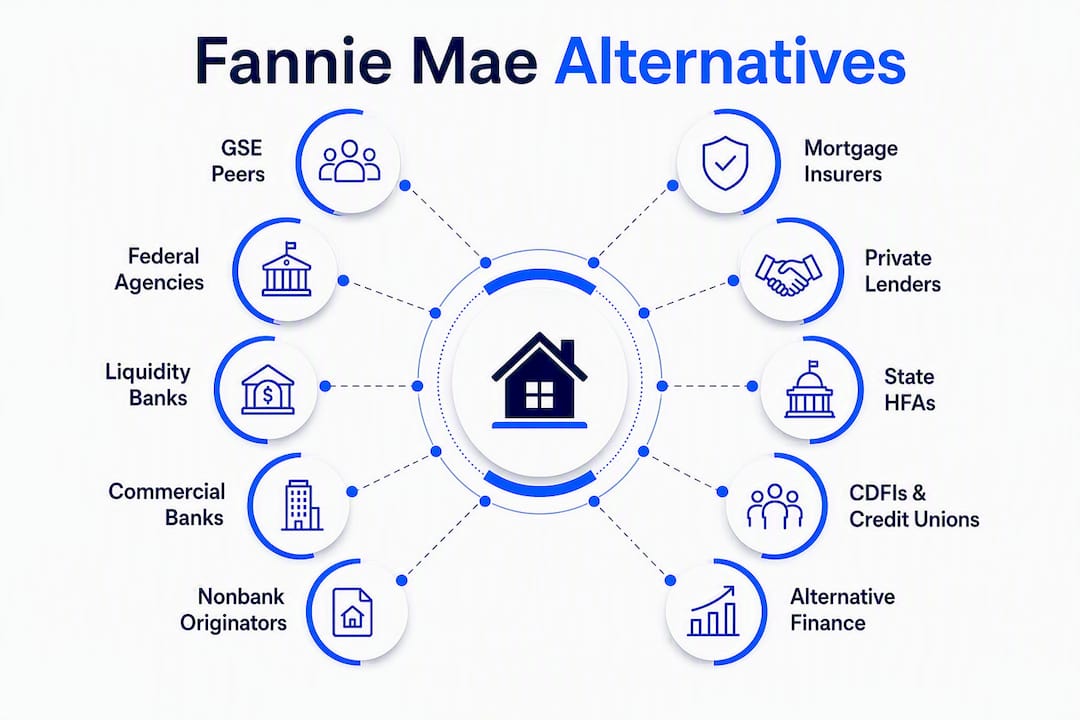
The primary alternatives to Fannie Mae span three structural tiers: GSE peers (Freddie Mac), federal guarantee channels (Ginnie Mae, FHA, VA), and market-structure alternatives including Federal Home Loan Banks, large commercial banks, nonbank originators and servicers, private mortgage insurers, private-label securitizers, state housing finance agencies, CDFIs, and nontraditional financing models such as shared-equity and seller-financed arrangements. Borrower-facing alternatives, including FHA/VA programs, state HFAs, and alternative finance models, differ fundamentally from market-structure alternatives like Freddie Mac, FHLBanks, and private-label MBS, which operate at the institutional level between originators, guarantors, and investors rather than directly with homebuyers. According to CSIMarket's Q1 2026 revenue-based analysis, Fannie Mae holds a majority market share in its segment, with Freddie Mac closely following, together illustrating how concentrated the GSE guarantee function remains and why no single entity provides a clean drop-in replacement.
Table of Contents
Maintain 100% NCUA & OCC Audit Readiness
Monitor regulatory updates 24/7, check internal credit policies, and generate compliance trails with Erina (AI Regulatory Agent).
- How the main Fannie Mae alternatives compare
- A framework for comparing housing finance alternatives
- When does each alternative actually fit your situation?
- Why no single entity replaces Fannie Mae's systemic role
- Key Takeaways
- What risk teams consistently underestimate about non-GSE channels
- Riskinmind gives lenders a clearer view of non-GSE credit risk
- Authoritative sources for further research
How the main Fannie Mae alternatives compare
The following profiles organize every credible alternative by category, covering role, backing, loan products, and counterparty. Each entry carries an entity-type label for quick reference.
GSE Peers
Freddie Mac (GSE) purchases, guarantees, and securitizes conforming residential mortgages under a congressional charter nearly identical to Fannie Mae's. It operates on the same conforming loan limits and credit standards, issues its own mortgage-backed securities (Participation Certificates), and is regulated by the Federal Housing Finance Agency (FHFA). For institutional lenders, Freddie Mac functions as a parallel guarantee channel rather than a true substitute; the two GSEs compete on pricing and seller/servicer terms. Lenders that diversify delivery between both GSEs gain negotiating leverage on guarantee fees.

Federal Guarantee Agencies
Ginnie Mae (federal corporation) guarantees MBS backed exclusively by federally insured loans, primarily FHA, VA, and USDA products. Unlike Fannie Mae, Ginnie Mae carries an explicit full-faith-and-credit guarantee from the U.S. government and does not purchase loans itself. Originators retain the loans and issue the securities; Ginnie Mae wraps the guarantee. This structure means the credit risk sits with the federal insurer (FHA, VA), not with Ginnie Mae or the originator, which produces different capital treatment for investors.
Regional Liquidity Banks
Federal Home Loan Banks (FHLBank system) are 11 regional cooperative banks supervised by the FHFA. Member institutions, including community banks, credit unions, thrifts, and insurance companies, borrow collateralized advances to fund mortgage originations. FHLBanks do not originate or guarantee loans; they provide short- to medium-term liquidity. For a community lender with limited secondary-market access, FHLBank advances can bridge the gap between origination and eventual sale or portfolio retention.

Large Commercial Banks
Wells Fargo, Bank of America, JPMorgan Chase, and U.S. Bank (commercial banks) originate, service, and in many cases retain or privately securitize mortgages at scale. They interact with both GSE and private channels and carry their own balance-sheet capacity to hold portfolio loans. Their integrated origination-to-servicing infrastructure gives them pricing and product flexibility that smaller lenders cannot replicate, though they operate under stricter capital rules (G-SIB surcharges for the largest) that affect portfolio lending economics.
Large Nonbank Originators and Servicers
Rocket Mortgage (Quicken Loans), Mr. Cooper, Freedom Mortgage, PennyMac, Caliber Home Loans, UWM, Better, Flagstar, CrossCountry Mortgage, and Guild Mortgage (nonbank lenders/servicers) collectively hold large servicing portfolios and drive significant secondary-market volume. They access both GSE channels and Ginnie Mae MBS for FHA/VA production. Their digital origination platforms reduce per-loan costs, and their servicing scale affects how loans are priced and delivered to investors. Because they lack deposit funding, they rely on warehouse lines and secondary-market execution, making them sensitive to rate volatility and GSE pricing changes.
Mortgage Insurers and PMI Providers
Republic Mortgage Insurance Company, MGIC, and Radian (mortgage insurers) absorb default risk on higher-LTV loans, enabling lenders to sell those loans into GSE or private channels without retaining the credit exposure. Private mortgage insurance is not a funding source but a credit-risk transfer mechanism. When a borrower puts down less than 20%, PMI effectively substitutes for the additional guarantee coverage that would otherwise require a government-insured product. Lenders moving away from GSE channels for higher-LTV originations must account for PMI cost in their pricing models.
Private-Label Securitizers and Portfolio Lenders
Institutional investors and banks that securitize or retain loans without GSE guarantees (private securitizers/portfolio lenders) represent the non-agency channel. Private-label and portfolio funding shift credit risk to the lender or MBS investors and generally produce higher borrowing costs compared with GSE-guaranteed securities, because investors demand a yield premium for unguaranteed credit exposure. This channel suits jumbo loans, non-QM products, and originators with strong balance sheets or established investor relationships.
State Housing Finance Agencies
State HFAs (state HFA) issue tax-exempt bonds and administer targeted mortgage programs, down-payment assistance, and subsidized rate products for first-time buyers and lower-income borrowers. They typically partner with approved lenders who originate loans under HFA guidelines, then sell them to the HFA or into GSE/Ginnie Mae channels with HFA layered support. Their programs reach borrower segments that fall outside standard conforming criteria.
CDFIs and Credit Unions
CDFIs and credit unions (CDFI/credit union) provide mission-driven mortgage lending with flexible underwriting standards, often serving borrowers in underserved communities or with nontraditional credit profiles. They frequently partner with state HFAs or use FHLBank advances for funding. Their local servicing relationships and community accountability distinguish them from national originators, though their scale limits secondary-market influence.
Alternative Financing Providers
Shared-equity products, lease-purchase agreements, and seller-financed mortgages (alternative finance) operate outside the conventional mortgage framework. Shared equity products pay a lump sum at contract termination in exchange for an investor share of future property value and are primarily used for equity extraction, not purchase financing. Pew research finds that land contracts, lease-purchase arrangements, and seller-financed mortgages often carry higher costs and weaker consumer protections than conventional mortgages, with enforcement and documentation gaps that lenders and regulators should weigh carefully.
A framework for comparing housing finance alternatives
Seven dimensions consistently differentiate these alternatives. Applying them systematically prevents mismatches between a lender's funding strategy and the channel's actual capabilities.
- Government backing: — explicit full-faith-and-credit guarantee (Ginnie Mae, FHA, VA) vs. implied/conservatorship backstop (Fannie Mae, Freddie Mac) vs. none (private-label, portfolio, alternative finance).
| Category | Entity Type | Primary Role | Government Backing | Typical Products | Counterparty |
|---|---|---|---|---|---|
| GSEs (Fannie Mae, Freddie Mac) | GSE | Guarantee, securitization | Implied/conservatorship | Conforming | Originator, investor |
| Federal guarantee agencies (Ginnie Mae) | Federal corporation | Guarantee on MBS | Explicit full-faith-and-credit | FHA/VA/USDA | Originator, investor |
| FHLBanks | Regional liquidity bank | Liquidity/advances | Implicit/member-backed | Conforming, portfolio | Member institution |
| Commercial banks | Commercial bank | Origination, servicing, portfolio | None (deposit-insured) | Conforming, jumbo, portfolio | Borrower, originator |
| Nonbank originators/servicers | Nonbank lender | Origination, servicing | None | Conforming, FHA/VA, non-QM | Borrower, originator |
| Mortgage insurers | Mortgage insurer | Credit-risk transfer | None | Conforming (high-LTV) | Lender, GSE |
| Private-label/portfolio lenders | Private securitizer | Securitization, portfolio retention | None | Jumbo, non-QM, portfolio | Originator, investor |
| State HFAs | State HFA | Subsidy, targeted origination | State-backed | Conforming, FHA/VA | Borrower, originator |
| CDFIs/credit unions | CDFI | Mission-driven origination | Partial (CDFI Fund grants) | Portfolio, FHA/VA | Borrower |
| Alternative finance | Alternative finance | Equity extraction, purchase | None | Non-mortgage | Borrower |
Three scenario mappings illustrate how the dimensions drive decisions. A borrower with a credit score below conforming thresholds and a 3.5% down payment routes through an FHA-approved originator into the Ginnie Mae MBS channel, not through Fannie Mae. A community bank needing short-term liquidity to fund a batch of small-balance mortgages before secondary-market sale draws FHLBank advances against those loans as collateral. An originator with strong investor relationships and a pipeline of non-QM jumbo loans accesses the private-label channel, accepting higher capital requirements and yield concessions in exchange for product flexibility.
When does each alternative actually fit your situation?
Matching the channel to the use case prevents costly repricing or execution failures. The following scenarios cover the most common decision points for lenders, investors, and borrowers.
- Conforming loan, standard borrower profile: Deliver to Freddie Mac or Fannie Mae. Negotiate guarantee fees based on volume and loan-level pricing adjustments. Diversifying between both GSEs gives pricing leverage.
- FHA or VA borrower: Route through a Ginnie Mae-approved issuer. The explicit federal guarantee produces tighter MBS spreads and lower investor yield requirements, which translates to competitive borrower rates despite the FHA mortgage insurance premium.
- Community lender, small-balance originations: Use FHLBank advances for interim funding, then sell conforming loans to a GSE or aggregate into a Ginnie Mae pool. The advance rate and collateral haircut determine the effective cost of carry.
- Jumbo or non-QM origination: Access the private-label channel or retain on balance sheet. Model the capital cost of retention against the execution cost of a private-label deal, factoring in investor demand and the yield premium required for unguaranteed credit exposure.
- High-LTV borrower, conventional loan: Layer private mortgage insurance (MGIC, Radian, or Republic Mortgage Insurance Company) to meet GSE credit-risk requirements. PMI cost must be modeled into the borrower's total payment and the lender's pricing.
- First-time buyer needing down-payment assistance: Direct to a state HFA program or an FHA product with HFA layered support. HFA bond programs often carry below-market rates funded by tax-exempt bond issuance.
- Underserved community or nontraditional credit profile: Engage a CDFI or credit union with flexible underwriting authority. These lenders often use FHLBank advances or CDFI Fund grants to subsidize pricing.
- Equity extraction without a cash-out refinance: Shared-equity products provide lump-sum liquidity in exchange for a future home-value share. They suit homeowners with significant equity but limited income for debt service. Risk teams should note that shared equity products lack standard interest rate, amortization, and loan balance disclosures, requiring redesigned credit-risk models.
- Seller-financed or lease-purchase arrangement: These structures often fall outside federal consumer-protection rules unless the seller finances more than three properties in a 12-month period, per Pew's analysis. Lenders and servicers acquiring these contracts should conduct enhanced due diligence on documentation and enforceability.
Decision checklist for lenders:
- Loan size relative to conforming limits (determines GSE eligibility)
- Borrower credit profile and LTV (determines FHA/VA vs. conventional vs. non-QM routing)
- Need for a government guarantee (Ginnie Mae channel) vs. implied GSE backstop vs. none
- Servicer capacity and investor relationships for private-label execution
- Capital position and warehouse line availability for portfolio retention
- Regulatory classification of the product (QM, non-QM, or non-mortgage alternative finance)
Why no single entity replaces Fannie Mae's systemic role
Replacing Fannie Mae's guarantee and securitization function requires structural choices, each carrying material trade-offs in federal risk exposure, mortgage pricing, and market stability. The Congressional Budget Office describes four illustrative alternative market structures: a fully federal agency model, a hybrid public-private model, a guarantor-of-last-resort model, and a largely private model. Each path changes who absorbs credit losses in a downturn and what borrowers pay in normal conditions.
The fully federal model concentrates risk on the government's balance sheet but preserves the pricing efficiency of an explicit guarantee. The hybrid model attempts to attract private capital while retaining a government backstop, but transitioning to a private-capital-heavy secondary market requires raising guarantee fees and/or lowering mortgage size limits to attract that capital without disproportionately raising borrower costs. The largely private model reduces federal exposure but historically produces higher and more volatile mortgage rates, as private capital demands a yield premium for unguaranteed credit risk.
For risk and strategy teams, three practical implications follow. First, pricing models built on GSE guarantee-fee assumptions will need recalibration under any hybrid or private-label scenario. Second, capital requirements for portfolio retention or private-label participation are materially higher than for GSE-delivered loans, affecting return-on-equity calculations. Third, alternative financing products, particularly shared-equity and seller-financed structures, carry regulatory gaps that create compliance and subprime credit risk exposure that standard mortgage underwriting frameworks do not capture.
Key trade-offs by alternative structure:
- Federal agency model: lowest borrower rates, highest federal balance-sheet exposure.
- Hybrid public-private: moderate pricing, complex risk-sharing arrangements, transition costs.
- Guarantor of last resort: private capital bears routine losses; federal backstop activates only in systemic stress.
- Largely private: maximum federal risk reduction, highest borrower rate volatility, reduced access for lower-credit borrowers.
Key Takeaways
The GSE duopoly (Fannie Mae and Freddie Mac) controls the majority of the conforming secondary market, and no single alternative replicates that combination of scale, pricing efficiency, and implied federal backing.
| Point | Details |
|---|---|
| GSE concentration is high | Fannie Mae and Freddie Mac together account for the dominant share of conforming secondary-market activity, per CSIMarket Q1 2026 data. |
| Ginnie Mae carries the explicit guarantee | Only Ginnie Mae MBS carry a full-faith-and-credit U.S. government guarantee; GSE securities carry an implied, not explicit, backstop. |
| Private-label raises borrower costs | Shifting loans to private-label or portfolio channels generally produces higher rates because investors require a yield premium for unguaranteed credit risk. |
| Alternative finance has regulatory gaps | Seller-financed and lease-purchase arrangements often fall outside federal consumer-protection rules, creating enforcement and documentation risks. |
| Riskinmind supports non-GSE risk modeling | Riskinmind's AI platform helps lenders model credit risk, run portfolio stress tests, and automate underwriting when operating outside GSE guarantee channels. |
What risk teams consistently underestimate about non-GSE channels
The conventional framing treats Fannie Mae alternatives as a menu of funding options, each with a rate and a capital charge. That framing is incomplete. The more consequential variable is regulatory transparency: GSE-backed loans operate within a well-documented, FHFA-supervised framework with standardized representations and warranties, repurchase obligations, and loss-mitigation protocols. When a lender moves volume into private-label, portfolio, or alternative finance channels, those guardrails either disappear or become negotiated contract terms, which means the lender's own risk infrastructure must compensate.
For portfolio managers and CROs, the practical priority is not finding the cheapest non-GSE channel. It is stress-testing pricing assumptions under each structural scenario, mapping the loan book to the channels it actually qualifies for, and conducting rigorous servicer diligence on any third-party arrangement. Shared-equity and seller-financed products deserve particular scrutiny: their lack of standard amortization and disclosure structures means existing credit-risk models will misclassify exposure unless explicitly redesigned. The compliance testing frameworks that work for conventional mortgage portfolios do not transfer cleanly to these products.
The institutions that navigate this well are not the ones with the most channel options. They are the ones with the clearest picture of where credit risk actually sits in each arrangement.
Riskinmind gives lenders a clearer view of non-GSE credit risk
When your loan book extends beyond GSE conforming channels, the risk picture changes fast. Guarantee-fee benchmarks no longer apply, capital requirements shift, and standard underwriting checklists miss the structural differences in non-QM, portfolio, and alternative finance products. Riskinmind's AI platform is built for exactly that gap.
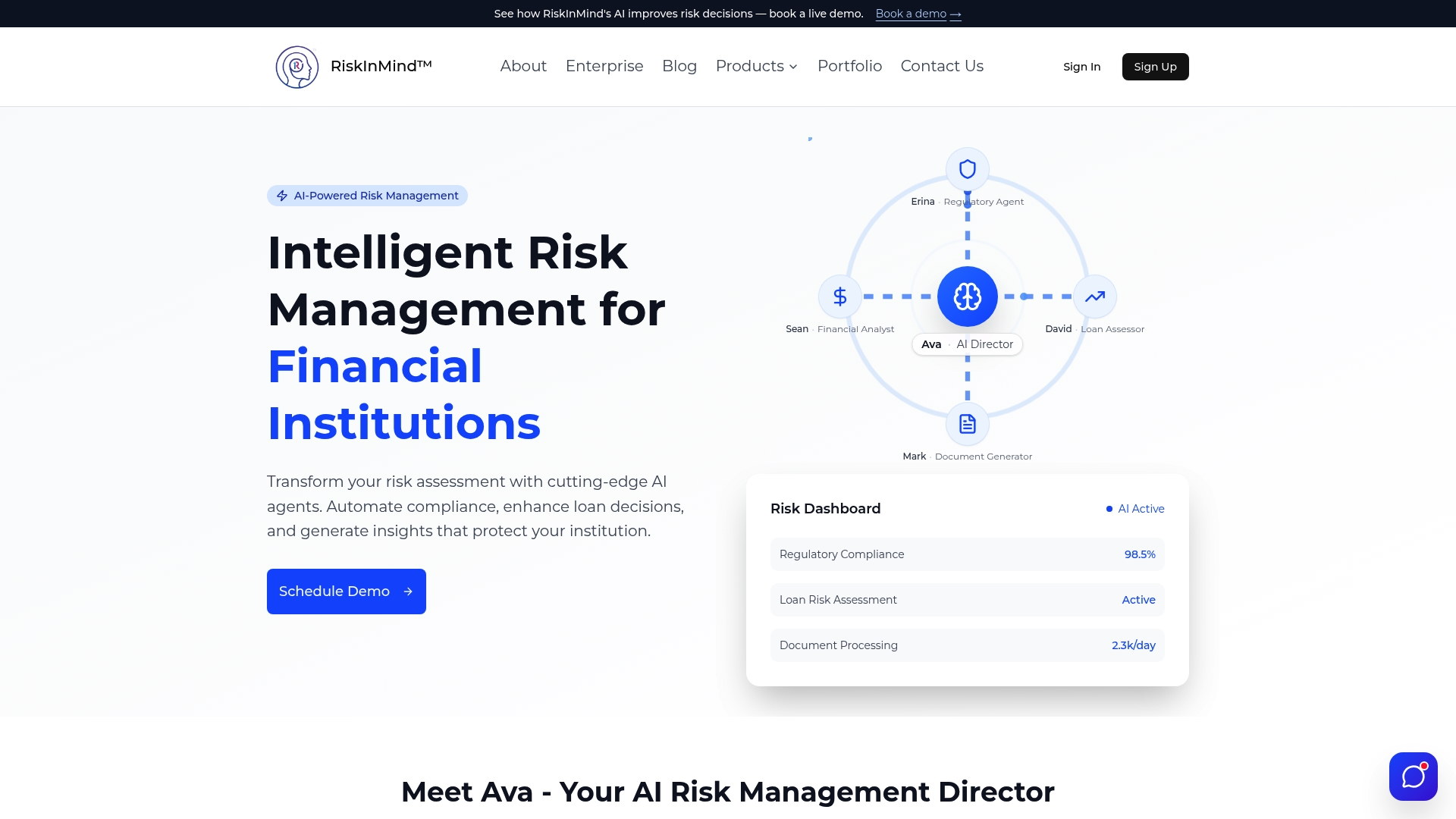
Riskinmind provides peer benchmarking and pricing analytics so lenders can calibrate non-GSE loan pricing against comparable institutions rather than guessing at spreads. Its portfolio stress-testing and CECL reserve modeling tools help risk teams quantify exposure under adverse rate and credit scenarios before they materialize. And its AI-driven underwriting automation, coordinated by Ava, the platform's central AI director, generates credit memos and risk assessments in real time, reducing the manual burden of evaluating loans that fall outside standard GSE guidelines.
Riskinmind is not a mortgage guarantor or a secondary-market channel. It is the analytical layer that helps your institution operate confidently when GSE rails are not available. Explore the CRE Loan Risk Predictor or request a demo to see how Riskinmind maps to your portfolio's specific non-GSE exposure.
This article provides general informational content about U.S. mortgage market structures. It is not legal, regulatory, or financial advice. Confirm current rules and program eligibility with the relevant regulatory authority or a qualified professional.
Authoritative sources for further research
- Congressional Budget Office: Transitioning to Alternative Structures for Housing Finance — Primary source for the four illustrative market structures and federal risk-exposure modeling discussed in the policy section.
- Urban Institute: How Shared Equity Products Work — Detailed analysis of shared-equity product mechanics, disclosure gaps, and regulatory recommendations; supports the alternative finance entries.
- Pew Charitable Trusts: What Has Research Shown About Alternative Home Financing in the U.S.? — Evidence base for cost, consumer-protection, and enforcement gaps in land contracts, lease-purchase, and seller-financed arrangements.
- Ginnie Mae (ginniemae.gov) — Official source for MBS program rules, issuer requirements, and the explicit federal guarantee structure.
- CSIMarket: Fannie Mae Market Share vs. Competitors — Revenue-based market-share data for GSE segment concentration figures cited in the opening.
- Joint Center for Housing Studies, Harvard University — Comparative analysis of government roles in mortgage markets and alternative housing finance models across countries; useful for policy-context research.