
The top AI compliance risks facing organizations today are bias and fairness failures, safety and security gaps, data privacy exposure, poor explainability, and regulatory or legal liability. The single most important immediate action is to inventory every AI system in use and risk-tier each one against the NIST AI RMF characteristics, validity, safety, security, explainability, privacy, and fairness. What follows maps each risk to concrete operational controls and the evidence regulators and auditors expect to see.
TL;DR:
- Inventory every AI system by purpose, data sources, autonomy, and affected users, then score impact and likelihood across NIST AI RMF characteristics.
- Route high impact, high likelihood systems to human review and continuous monitoring; pilot the rubric on two or three such systems first.
- Creditors must give specific, accurate reasons for denials made with AI, regardless of model complexity; generic checklists do not meet that obligation.
- Replace annual only audits with continuous testing, drift detection, safety checks, and timestamped logs; annual reviews cannot keep pace with changing models.
- Require vendors to supply model cards, data lineage, test results, and incident playbooks, with audit rights and advance notice before material model changes.
Automate Regulatory Model Risk Governance
Examine models against 32 qualitative criteria and resolve risk Tiers with pre-deployment checklists per OCC 2011-12 guidelines.
Table of Contents
- Core AI Compliance Risks: Short Definitions and Compliance Consequences
- Regulatory and Standards Landscape: What to Watch and Why It Matters
- How to Assess and Prioritize AI Compliance Risks
- Operational Controls and Vendor Management: TEVV, Monitoring, and Contract Evidence
- A Practical Example: Continuous Monitoring and Audit-Ready Evidence
- Emerging Global AI Regulations Beyond the EU and US
- Case Studies of AI Compliance Failures and Lessons Learned
- Roles and Responsibilities: Compliance Officer, Data Scientist, Legal Team Collaboration
- Implications of AI Compliance on the Model Development Lifecycle
- Methods and Tools for AI Bias Detection and Mitigation
- Training and Awareness Programs for Organizational AI Compliance
- Author Perspective: Three Priorities for Compliance Leaders This Quarter
- How RiskInMind Can Help With Continuous Monitoring and Audit Evidence
- FAQ
- Sources
Core AI Compliance Risks: Short Definitions and Compliance Consequences
Bias and fairness risk arises from systemic sources (historical data that encodes past discrimination), computational sources (proxy variables that correlate with protected classes), and human-cognitive sources (how reviewers interpret model outputs). In credit underwriting and hiring, these risks translate directly into disparate impact exposure and regulatory scrutiny.
Safety risk matters most where AI decisions touch health, physical safety, or material financial exposure, since an erroneous output can cause harm before a human ever reviews it. Data privacy and governance risk centers on training data lineage: where did the data come from, did subject consent to its use, and can the model leak memorized personal information back out. Cybersecurity risk has expanded with generative AI, since large language models introduce attack surfaces that traditional software did not have, including prompt injection, data poisoning, and model extraction attempts.
Explainability and accountability risk is where compliance exposure often crystallizes fastest. The CFPB has made clear that lenders using complex or black-box models for credit decisions must still provide specific, accurate reasons for adverse actions; a generic checklist that does not reflect the model's actual decision logic does not satisfy the obligation.
- Bias and fairness: systemic, computational, and human sources combine to create disparate impact in credit and employment decisions.
- Safety and security: errors in high-stakes deployments can cause harm before review, and generative AI widens the attack surface.
- Privacy and governance: unclear data lineage and consent gaps create both legal and reputational exposure.
- Explainability: regulators require specific reasons for adverse decisions, not generic disclaimers.
Regulatory and Standards Landscape: What to Watch and Why It Matters
Compliance teams are tracking a widening set of binding rules and voluntary standards simultaneously, and the gap between them is where enforcement risk concentrates. The CFPB's guidance on AI-driven credit decisions requires lenders to supply accurate, specific adverse-action reasons under existing consumer protection law, regardless of how the underlying model works. U.S. banking regulators have also moved: an OCC bulletin issued in 2026 reinforces a risk-based approach to model risk management and explicitly flags generative and agentic AI as novel territory that often sits outside earlier guidance, signaling that supervisors expect institutions to extend existing frameworks rather than wait for new rules.
Beyond U.S. borders, the EU AI Act functions as a de facto global baseline for many multinational firms, since legal commentary notes that organizations often design governance to the strictest regime they face rather than maintain separate standards per market.
- CFPB guidance: requires specific adverse-action reasons for AI-driven credit denials, not boilerplate explanations.
- OCC model risk updates: apply existing risk-based oversight to generative and agentic AI as an emerging category.
- EU AI Act: often becomes the strictest-regime benchmark firms design toward, even outside the EU.
- NIST AI RMF and ISO/IEC 42001: voluntary frameworks that convert legal obligations into auditable operational practice.
How to Assess and Prioritize AI Compliance Risks
A repeatable risk-tiering process turns regulatory obligation into something a team can actually execute and defend in an exam. Start with an inventory that records, for every AI system, its purpose, training and input data sources, degree of autonomy, output type, intended users, and downstream impact on consumers or employees. Score each system on impact and likelihood across the NIST AI RMF characteristics, validity, safety, security, explainability, privacy, and fairness, then set thresholds that route high-impact, high-likelihood systems into mandatory human review and continuous monitoring, while lower-tier systems receive lighter periodic checks.
- Build a complete AI inventory covering purpose, data sources, autonomy level, and affected users.
- Score each system against NIST AI RMF characteristics using an impact times likelihood rubric.
- Set tier thresholds, for example a composite score above a fixed cutoff requires continuous monitoring and legal sign-off.
- Select a pilot set of two or three high-impact systems, such as credit decisioning or adverse-action generation, to test the rubric before organization-wide rollout.
- Document the scoring rationale for each system so the rubric itself becomes auditable evidence.
Pro Tip: Give risk-tiering joint ownership between a compliance lead and a data science lead from day one; rubrics designed by only one side tend to miss either the regulatory nuance or the technical reality.
Operational Controls and Vendor Management: TEVV, Monitoring, and Contract Evidence
Testing, evaluation, verification, and validation, known as TEVV, is the operational backbone the NIST AI RMF points to for producing audit-ready evidence. Continuous TEVV in practice means automated data-quality checks running on a schedule, drift detection comparing live inputs against training distributions, runtime safety guards that flag anomalous outputs, and periodic human-in-the-loop validation, with every check logged and timestamped. Industry reporting backs this up directly: static annual audits are no longer considered sufficient, because models and the data feeding them change faster than an annual review cycle can catch.
Vendor relationships need the same evidentiary standard. At minimum, require model cards, data lineage documentation, test results against your risk-tiering criteria, incident response playbooks, and conformity documentation mapped to NIST or ISO/IEC 42001.
- Contract audit rights: the ability to review vendor testing artifacts and incident logs on demand.
- Change-management notice: advance notification before a vendor retrains or materially updates a deployed model.
- Explainability SLA: a committed turnaround for adverse-action explanations the vendor's model must support.
- Breach and indemnity terms: defined notice timelines and liability allocation if the vendor's system causes a compliance failure.
Pro Tip: Negotiate for raw test artifacts, not summary attestations; a vendor's one-paragraph conformity letter rarely survives a regulator's request for underlying evidence.
A Practical Example: Continuous Monitoring and Audit-Ready Evidence
A workable compliance workflow runs in five stages: inventory the system, apply automated continuous monitoring, generate alerts when drift or anomalies appear, capture the resulting evidence automatically, and compile that evidence into an audit report on demand. Platforms built for financial institutions illustrate the mechanics well, since capabilities like real-time risk dashboards, automated document generation, and specialized regulatory agents reduce the manual effort of assembling this evidence by hand.
- Real-time dashboards surface drift or anomaly alerts as they occur rather than at quarterly review.
- Automated document generation produces the underwriting and compliance records examiners request.
- SOC 2 aligned controls provide a baseline for data handling and access governance that auditors recognize.
- Specialized regulatory agents focus on compliance-specific tasks separate from credit or portfolio analysis.
These capabilities reduce manual burden; they are not a substitute for the legal judgment a compliance team applies when interpreting what the evidence means.
Emerging Global AI Regulations Beyond the EU and US
Compliance programs that design only around the EU AI Act and U.S. agency guidance risk missing obligations building elsewhere. China has issued its own AI governance guidelines covering algorithm registration and content controls for generative systems, with requirements that diverge from both the EU's risk-tier model and the U.S. agency-by-agency approach. The United Kingdom has taken a different path still, favoring a principles-based, sector-led governance framework that leans on existing regulators, such as financial and data protection authorities, to apply AI-specific expectations within their own remits rather than adopting a single omnibus law.
The practical result is a patchwork rather than a single global standard. Legal analysis of the 2026 landscape describes global AI regulation as fragmented, with firms commonly choosing to design governance to the strictest applicable regime, often the EU AI Act, and then using NIST and ISO/IEC frameworks as the operational layer that satisfies multiple jurisdictions at once. For a multinational lender or fintech, that means a system deployed in one market may need to meet documentation and explainability standards drawn from a completely different jurisdiction's rulebook, simply because the parent organization chose one global baseline. Tracking these divergent frameworks as they mature, rather than reacting to each one individually, keeps a compliance program from rebuilding its documentation every time a new jurisdiction issues guidance.

Case Studies of AI Compliance Failures and Lessons Learned
Patterns in AI compliance failures tend to repeat across sectors, which is part of why frameworks like the NIST AI RMF and the EU AI Act emphasize documentation and testing so heavily. A multiple-case study of EU AI Act compliance found that practitioners consistently identify the same pain points as hardest to resolve: data quality and governance, accuracy and robustness testing, risk and quality management systems, and transparency documentation. Organizations with lower AI maturity or smaller compliance teams struggled disproportionately with these same four areas, suggesting the failures are less about novel technology and more about under-resourced governance processes.
The common thread across documented failures in credit decisioning, hiring screening, and automated content moderation is a disconnect between the teams building the models and the teams responsible for interpreting regulatory obligations. The same research notes that compliance is hardest precisely where organizational processes and engineering workflows run separately, with data pipelines that were never designed to produce the governance documentation a regulator eventually asks for. The lesson compliance teams keep relearning is that retrofitting documentation after a system is already in production costs far more, in both effort and regulatory risk, than building TEVV and audit logging into the system from its first deployment.
Roles and Responsibilities: Compliance Officer, Data Scientist, Legal Team Collaboration
Clear role separation is what turns a risk-tiering rubric into something that survives an actual examination. The practitioner research on EU AI Act compliance found that successful programs assign distinct ownership: technical teams own model performance metrics and ongoing model health monitoring, legal and compliance teams own regulatory interpretation and the documentation requirements that flow from it, and a governance owner reconciles both functions with procurement when new systems or vendors enter the pipeline.
In practice, a compliance officer translates CFPB or OCC guidance into concrete control requirements the technical team can implement, such as a minimum explainability standard for any model used in credit decisions. A data scientist then builds and monitors the model against those requirements, feeding drift and performance data back into the compliance function rather than treating monitoring as a purely technical exercise. Legal counsel reviews vendor contracts and adverse-action language to confirm it satisfies ECOA and related obligations, and flags cross-border exposure when a system touches multiple regulatory regimes. Without a named governance owner coordinating these three functions, risk-tiering rubrics and TEVV plans tend to exist on paper without ever being consistently applied, which is exactly the gap examiners look for.
Implications of AI Compliance on the Model Development Lifecycle
Treating compliance as a gate at the end of model development, rather than a thread running through it, is the single most common structural mistake compliance teams encounter. Building NIST AI RMF characteristics into the development lifecycle from the start means defining explainability requirements before training begins, not after a model is already deployed and a regulator asks for an adverse-action reason it cannot produce.
In practice, this shifts several decisions earlier: data lineage documentation starts at data collection rather than at audit time, fairness testing runs during model selection rather than as a post-hoc check, and the TEVV plan for continuous monitoring gets built alongside the deployment pipeline rather than bolted on afterward. For generative and agentic AI specifically, the NIST generative AI profile describes risks, like disinformation, expanded attack surface, and model extraction, that are genuinely different from traditional model risks, which means a development lifecycle built around older predictive models often needs real revision, not just an added compliance checklist, before generative AI systems go into production.

Methods and Tools for AI Bias Detection and Mitigation
Bias detection works best as a layered process rather than a single test run before launch. Pre-deployment, teams typically run disparate impact analysis across protected classes, examine training data for historical skew, and test for proxy variables that correlate with protected characteristics even when those characteristics are never directly used. Post-deployment, continuous monitoring compares outcome distributions across demographic groups over time, since a model that passes fairness testing at launch can drift as the population it serves changes.
Mitigation techniques generally fall into three stages: pre-processing adjustments to training data to reduce historical skew, in-processing constraints applied during model training itself, and post-processing adjustments to model outputs or decision thresholds. No single technique eliminates bias risk entirely, which is why the NIST AI RMF frames fairness as one of several trustworthiness characteristics to document and monitor continuously rather than certify once. For credit and employment decisions specifically, pairing bias testing with the explainability documentation the CFPB expects for adverse actions closes the loop between detecting a fairness issue and being able to explain the specific decision logic behind any individual outcome.
Training and Awareness Programs for Organizational AI Compliance
A risk-tiering rubric and a TEVV process only work if the people operating AI systems day to day understand what they are looking at and when to escalate. Effective training programs separate content by role: compliance officers need depth on how regulatory obligations like CFPB adverse-action requirements translate into technical specifications, data scientists need grounding in the legal consequences of model decisions they might otherwise treat as purely technical, and frontline staff using AI outputs need practical guidance on recognizing when a result looks anomalous enough to escalate rather than accept.
Awareness programs work best when they are recurring rather than a one-time onboarding module, since both the regulatory landscape and the organization's own AI inventory change continuously. Tying training refreshes to the same cadence as risk-tier reviews, rather than treating them as a separate annual compliance task, keeps the people closest to the systems aware of which models carry the highest regulatory exposure and why.
Author Perspective: Three Priorities for Compliance Leaders This Quarter
Start with inventory and one high-impact pilot, not a sweeping policy document nobody can execute. Fund continuous monitoring and named cross-functional roles over one-off annual audits. Put vendor evidence requirements into procurement contracts now, before the next model renewal cycle makes them an afterthought.
— Raj
How RiskInMind Can Help With Continuous Monitoring and Audit Evidence
Running the inventory, tiering, and TEVV work described above by hand is possible, but it consumes exactly the compliance staff hours most credit unions and community banks can least afford to lose. Our platform automates core risk processes, including loan underwriting review, regulatory compliance monitoring, and portfolio tracking, through specialized AI agents coordinated by a central AI director, with strong security and SOC 2® aligned controls integrated.
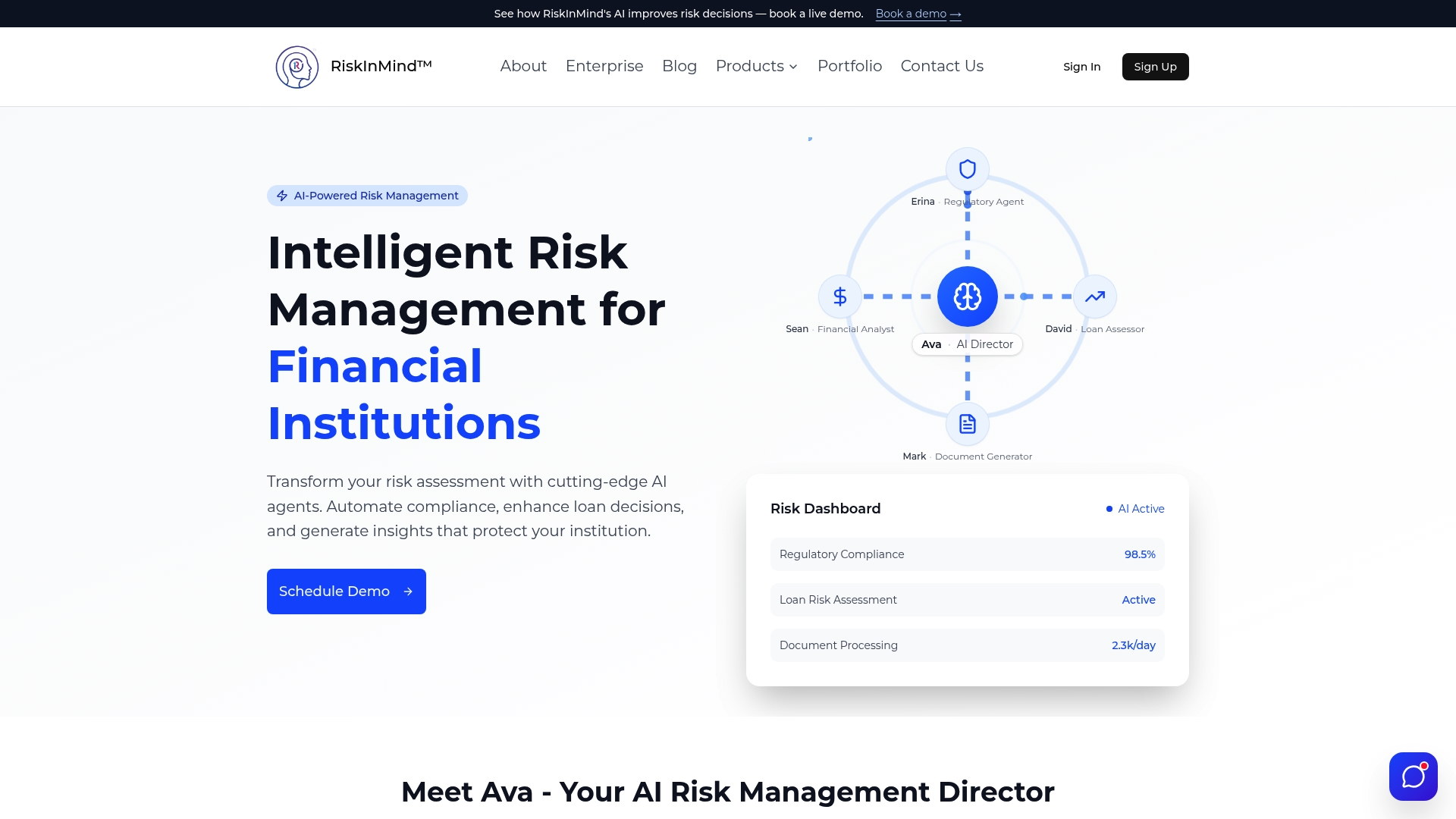
- Real-time dashboards provide risk and compliance teams with continuous visibility instead of quarterly snapshots.
- Automated document generation supports production of records for credit memos and regulatory reporting.
- Specialized regulatory agents focus on compliance monitoring alongside credit risk and market analysis agents.
If your team is ready to see how automated monitoring and evidence capture fit your inventory, you can explore plans on our pricing page or review the full platform at Riskinmind.
FAQ
What are the top AI security risks in compliance contexts?
The risks compliance teams encounter most often are data poisoning and model manipulation, prompt injection and other attack vectors specific to generative AI, and data leakage from training sets that exposes sensitive or personal information. The NIST generative AI profile maps these risks directly to the security and resilience characteristics organizations are expected to monitor continuously.
What is the role of the NIST AI RMF in managing compliance risk?
The NIST AI RMF defines seven trustworthiness characteristics, including validity, safety, security, explainability, privacy, and fairness, and outlines the testing and monitoring measures organizations should document for each. It functions as a voluntary operational standard that many organizations use to demonstrate compliance evidence to regulators and auditors.
Do AI compliance rules apply differently across industries?
Yes. Banking regulators apply model risk guidance such as the 2026 OCC bulletin to lending and credit systems specifically, while the CFPB's adverse-action guidance applies to any creditor using AI in credit decisions regardless of sector. Organizations operating across jurisdictions often design to the strictest regime they face, frequently the EU AI Act, rather than maintaining separate standards per market.
How often should AI systems be reviewed for compliance risk?
Static annual reviews are increasingly considered insufficient because models and the data feeding them change continuously; continuous, evidence-based monitoring with automated drift detection is now the recommended practice. High-tier systems under a NIST-aligned risk rubric typically warrant ongoing monitoring with logged, timestamped evidence rather than periodic manual checks alone.
What should a vendor contract require for AI compliance evidence?
At minimum, a vendor contract should require model cards, data lineage documentation, test results, incident response playbooks, and conformity documentation mapped to a recognized framework like the NIST AI RMF. Audit rights, advance notice of model changes, and a defined explainability service level for adverse-action support help ensure the evidence is actually available when an examiner asks for it.
Sources
- Artificial Intelligence Risk Management Framework (AI RMF 1.0)
- CFPB Issues Guidance on Credit Denials by Lenders Using Artificial Intelligence
- OCC bulletin 2026-13
- Compliance and enforcement in global AI regulation: EU AI Act risks and international regulatory challenges | Foley & Lardner