
If you handle customer financial data or act as a vendor to banks and credit unions, pursue SOC 2 readiness now. The framework's Trust Services Criteria and its Type I versus Type II testing models define what partners and regulators expect, and GLBA and Regulation S-P already require the vendor oversight that a current SOC 2 report satisfies. We built our own platform around that same standard.
TL;DR:
- Security is mandatory, while availability, processing integrity, confidentiality, and privacy should be included only when customer contracts and services require them.
- Type I checks control design at one point; Type II tests whether controls operated throughout a defined period and carries more weight with banks.
- SOC 2 can support GLBA vendor oversight, but it is not a legal mandate and cannot replace PCI DSS when cardholder data is handled.
- Prepare evidence such as access reviews, change tickets, key rotation logs, vulnerability scan results, and tested recovery records; policies alone are insufficient.
- One in five organizations reports material logging or monitoring gaps in first time assessments, and auditors often ask for more evidence in these areas.
Maintain 100% NCUA & OCC Audit Readiness
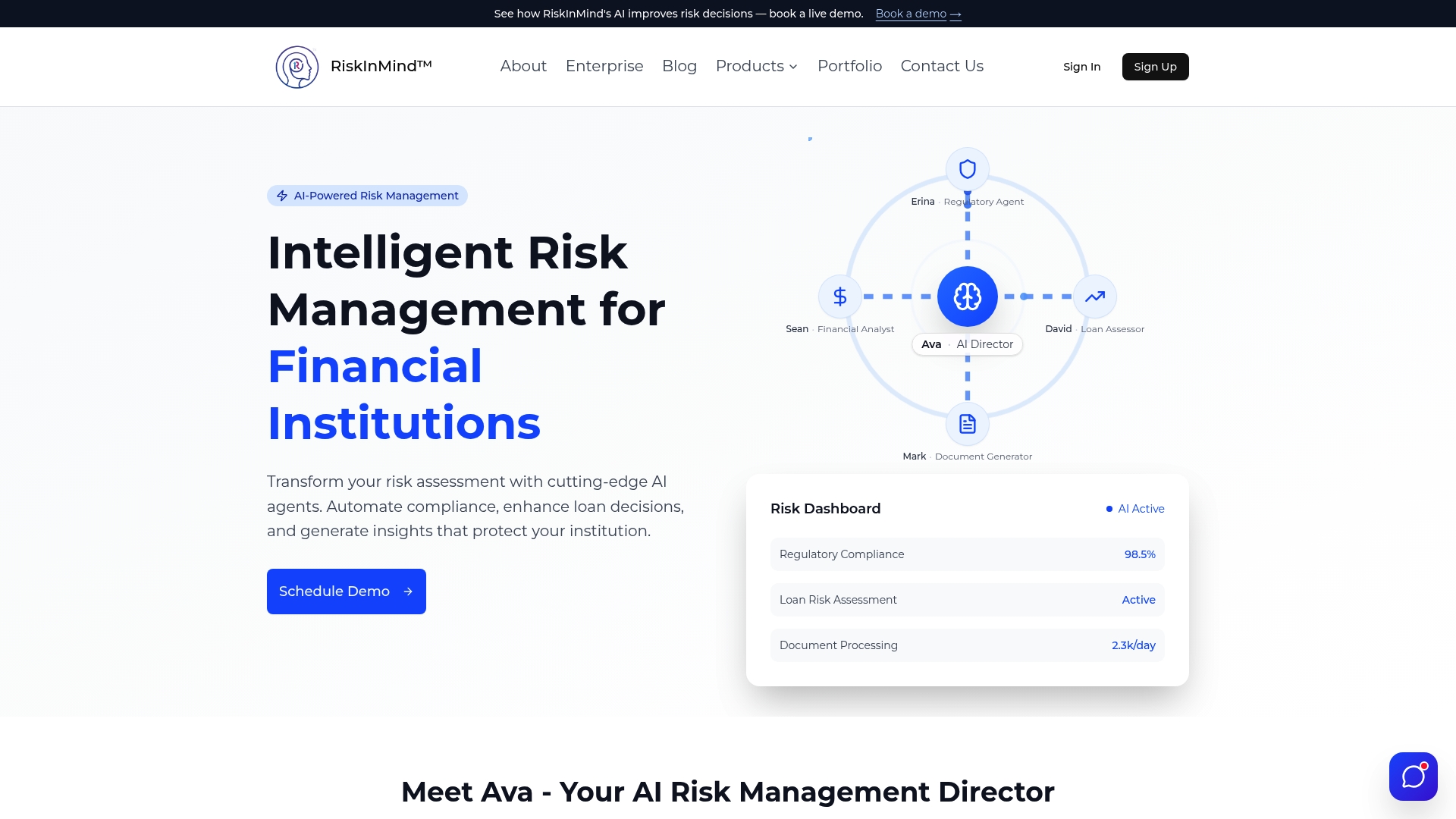
Monitor regulatory updates 24/7, check internal credit policies, and generate compliance trails with Erina (AI Regulatory Agent).
Table of Contents
- What SOC 2 is and why it matters for fintech businesses
- Trust Services Criteria explained with fintech examples for each
- Key controls and the evidence fintech auditors expect
- SOC 2 Type I vs Type II, plus SOC 1 and SOC 3 distinctions
- Audit process, timelines, and what auditors actually test
- How to prepare: a practical SOC 2 readiness checklist
- Regulatory intersections: GLBA, Regulation S-P, and PCI overlap
- What preparing fintechs for SOC 2 has taught us
- How RiskInMind supports SOC 2 readiness and audit-ready reporting
- FAQ
- Sources
What SOC 2 is and why it matters for fintech businesses
SOC 2 is an attestation framework developed by the American Institute of Certified Public Accountants that measures how well a service organization's controls protect the systems and data it manages. Rather than certifying a product, a SOC 2 report documents whether an independent CPA firm found that controls were suitably designed and, in a Type II engagement, operating effectively over a defined period. The report itself is not a pass or fail grade; it is a detailed narrative paired with the auditor's opinion, built to be read by people who need to judge risk rather than market a feature.
That audience is precise. Bank partners request SOC 2 reports before signing vendor agreements, payment networks ask for them during onboarding, enterprise customers' procurement teams review them before renewal, and bank examiners increasingly treat them as baseline evidence of third-party due diligence. Internal risk and audit committees also use SOC 2 findings to track whether control commitments made at contract signing are still being met later.
Fintechs face sharper scrutiny than most software categories for a simple reason: the data in motion is financial, and the consequences of a control failure extend beyond the company itself to depositors, borrowers, and the banks that rely on fintech infrastructure to serve them. A lending platform processing bank statements, a card issuer tokenizing account numbers, or a compliance tool parsing regulatory filings is handling exactly the kind of sensitive information that triggers third-party risk obligations under the Gramm-Leach-Bliley Act's Regulation S-P, which requires financial institutions to adopt safeguards and privacy notices for customer financial information and to extend that oversight to their vendors.
In practice, that regulatory pressure shows up as a short list of recurring expectations:
- Banks and credit unions ask fintech vendors for a current SOC 2 report before onboarding, not after.
- Examiners expect financial institutions to document ongoing vendor oversight, and a SOC 2 report is the artifact most commonly produced to satisfy that documentation.
- Enterprise customers' security teams treat SOC 2 as a minimum bar for data handling, separate from contractual security clauses.
- Internal risk teams use SOC 2 scope and exceptions to calibrate how much additional diligence a given vendor relationship needs.
None of this makes SOC 2 a regulatory mandate in the way PCI DSS is for cardholder data. It functions instead as the common language that lets banks, fintechs, and examiners agree on what "secure enough" means without each party inventing its own audit from scratch.
Trust Services Criteria explained with fintech examples for each
Every SOC 2 report is scoped against one or more Trust Services Criteria, and the choice of which to include shapes both the audit's cost and its usefulness to the people reading it.
Security is the only criterion required in every SOC 2 engagement. It covers protection against unauthorized access, whether that access attempt comes from outside the organization or from an employee overstepping their role. For a lending platform, this shows up as multi-factor authentication on administrative consoles, role-based access to underwriting data, and network segmentation between production and development environments.
Availability addresses whether systems are accessible and performing as committed. Fintechs with uptime obligations to bank partners typically document disaster recovery runbooks, failover testing, and service level agreements that specify acceptable downtime windows.
Processing integrity asks whether a system does what it is supposed to do, completely and accurately. For payment routing or loan decisioning, this means reconciliation checks that confirm transactions post correctly, input validation that catches malformed data before it reaches a decision engine, and audit trails that let an auditor trace a transaction from initiation to settlement.
Confidentiality covers information designated as confidential by agreement, such as proprietary underwriting models or data shared under a non-disclosure agreement. Encryption at rest and in transit, along with strict data retention and destruction schedules, is the typical evidence here.
Privacy governs personal information specifically, and it is where SOC 2 overlaps most directly with GLBA obligations. Clear privacy notices, data minimization practices, and documented consent mechanisms all fall under this criterion.
A practical control inventory for a fintech scoping an audit looks like this:
- Encryption of data at rest and in transit across all systems that touch customer financial information.
- Multi-factor authentication enforced for any account with administrative or production access.
- Transaction integrity checks that reconcile payment or loan data against source records.
- Documented disaster recovery procedures with tested recovery time objectives.
- Privacy notices and data minimization rules that limit collection to what a product actually needs.
Where a fintech also processes cardholder data directly, SOC 2's security and confidentiality criteria overlap with PCI DSS v4.0.1 requirements, but the two attestations are not interchangeable and a SOC 2 report alone will not satisfy a payment network's PCI compliance request.
Pro Tip: Scope only the Trust Services Criteria your customers and contracts actually require; adding criteria you cannot yet operationalize only lengthens remediation before year one.
Key controls and the evidence fintech auditors expect
Auditors do not evaluate intentions. They evaluate artifacts, and the quality of those artifacts determines how smoothly an engagement moves from fieldwork to final report. Several control families recur across fintech SOC 2 engagements:
- Access control and identity management, including provisioning, deprovisioning, and periodic access reviews.
- Change management, covering how code and configuration changes are proposed, reviewed, and deployed.
- Secure development practices, including code review requirements and separation between development and production.
- Encryption key management, covering generation, rotation, and storage of cryptographic keys.
- Logging and monitoring, with centralized collection and alerting on anomalous activity.
- Incident response, including a documented plan, defined escalation paths, and evidence of tabletop exercises.
- Backup and recovery, with tested restoration procedures, not just scheduled backups.
- Vulnerability management, including regular scanning and a remediation timeline tied to severity.
- Third-party risk management, covering how the fintech itself vets its own subprocessors and vendors.
For each family, auditors expect specific documentation rather than policy statements alone. Access control reviews require exported access logs and evidence that periodic recertification actually happened, not just a policy saying it should. Change management needs a sample of tickets showing peer review before deployment. Encryption controls require key rotation logs. Vulnerability management needs scan outputs, including any Approved Scanning Vendor reports where PCI scope applies, along with evidence that findings were closed within the organization's own stated timelines.
The nature of that evidence shifts depending on report type. A Type I engagement is a point-in-time snapshot: the auditor confirms that controls are designed appropriately as of a specific date, and the evidence required is largely documentary, policies, configurations, and architecture diagrams captured at that moment. A Type II engagement tests whether those same controls operated effectively over a defined testing period, which means the auditor samples evidence generated throughout that window rather than at a single point. A Type II auditor might pull access review logs from across the testing period, or request incident tickets from across the entire period, to confirm the control was not just designed well but actually followed.
One in five organizations report material gaps in logging or monitoring controls during a first-time compliance assessment, according to GLBA-driven vendor oversight guidance, which is one reason logging and monitoring evidence tends to draw the most auditor follow-up questions in fintech engagements specifically.
SOC 2 Type I vs Type II, plus SOC 1 and SOC 3 distinctions
Choosing the right report type and framework variant is less about preference and more about matching the attestation to what your customers and contracts actually ask for.
Type I versus Type II is the first fork. Type I confirms that controls are designed appropriately at a single point in time, and it is faster and cheaper to obtain, which makes it a reasonable first step for a fintech under pressure to produce something quickly. Type II confirms that those controls operated effectively over a defined testing period, and it carries far more weight with banks, examiners, and enterprise procurement teams because it demonstrates sustained practice rather than a snapshot.
SOC 1 versus SOC 2 addresses a different question entirely. SOC 1 covers controls relevant to a client's financial reporting, which matters when a fintech's services could affect a customer's own financial statements, such as a platform that processes transactions later reflected in a bank's general ledger. SOC 2 covers the broader operational and security controls described by the Trust Services Criteria, which is what most bank and enterprise vendor reviews actually request.
SOC 3 is a public-facing summary of a SOC 2 report, stripped of the detailed control descriptions that make the full report sensitive. It is useful as a marketing asset or website trust badge, but it will not satisfy a bank's vendor due diligence request, which almost always requires the full SOC 2 report under a non-disclosure agreement.
Selection generally comes down to a short set of questions:
- Has a specific customer or bank partner contractually requested SOC 2, SOC 1, or both.
- Are you being asked for a public attestation (SOC 3) or a detailed report for diligence (SOC 2).
- Is your internal control maturity closer to a documented-but-unproven state (Type I) or a demonstrated operating history (Type II).
- Do you process cardholder data, which may require PCI DSS alongside, not instead of, SOC 2.
Audit process, timelines, and what auditors actually test
A SOC 2 engagement moves through several phases, and understanding each one helps a compliance team staff and budget the project realistically.
- Scoping defines which systems, services, and Trust Services Criteria fall inside the audit boundary, and it is the single decision most likely to cause rework later if done carelessly.
- Readiness assessment identifies gaps between current practices and what the chosen criteria require, typically performed internally or with a readiness consultant ahead of the formal audit.
- Remediation closes the gaps the readiness assessment surfaced, which can range from writing missing policies to deploying new logging infrastructure.
- Engagement and testing is where the independent CPA firm performs the actual audit: walkthroughs of control processes, sampling of evidence across the period, and interviews with control owners.
- Report delivery produces the final SOC 2 report, which the CPA firm signs and which remains confidential to the organization and the parties it chooses to share it with under non-disclosure agreements.
Timelines vary by report type and organizational maturity. A Type I report can often be reached after readiness work, since there is no operating period to observe. A Type II report depends entirely on the length of the testing window, over a defined testing period, plus the weeks needed for the auditor to complete sampling and draft the report afterward. Fintechs new to SOC 2 often pursue a Type I first, then roll directly into a Type II observation period to avoid a gap in coverage.
The auditor's role is independent attestation, not consulting. A licensed CPA firm performs the testing, forms an opinion, and signs the report; it cannot also have designed the controls it is testing without compromising independence. Auditors execute tests through a mix of walkthroughs, where they watch a control being performed, sampling, where they pull a subset of evidence across the period rather than reviewing everything, and direct evidence requests, where they ask for specific logs, tickets, or configurations tied to a control.
Pro Tip: Ask your auditor early which sampling method they plan to use for Type II testing; knowing the expected sample size lets your team prepare evidence in batches instead of scrambling mid-audit.
How to prepare: a practical SOC 2 readiness checklist
Moving from unready to audit-ready follows a sequence that most successful fintech engagements share, even when the specific controls differ by product.
- Scope your systems and data flows. Map every system that stores, processes, or transmits customer financial data, then decide which Trust Services Criteria apply based on customer and contractual requirements.
- Run a gap assessment. Compare current controls against the chosen criteria and document every gap, from missing policies to unconfigured logging.
- Prioritize remediation by risk and effort. Fix high-risk, low-effort gaps first, such as enabling multi-factor authentication, before tackling larger infrastructure changes.
- Assign evidence owners. Every control family needs a named person responsible for producing evidence when the auditor asks, not a committee.
- Instrument automated evidence collection. Centralized logging, defined retention periods, and scheduled vulnerability or Approved Scanning Vendor scans reduce the manual scramble during fieldwork.
- Run internal testing before the real audit. A dry run surfaces evidence gaps while there is still time to fix them.
- Prepare vendor and regulatory documentation in parallel. Since GLBA and Regulation S-P already require documented vendor oversight, align your SOC 2 evidence package with what examiners and bank partners separately request.
Our step-by-step risk assessment guide covers the scoping and data-mapping work in more depth for teams building this process for the first time.
Pro Tip: Build your evidence repository once and tag each artifact to every framework it satisfies; a single access log can answer a SOC 2 auditor, a GLBA examiner, and a PCI assessor without being collected three separate times.
Regulatory intersections: GLBA, Regulation S-P, and PCI overlap
SOC 2 does not exist in a regulatory vacuum for fintechs. The Gramm-Leach-Bliley Act's Regulation S-P requires financial institutions to safeguard customer financial information and to issue privacy notices describing how that information is shared, and it extends oversight responsibility to the vendors those institutions rely on. In practice, GLBA-driven third-party risk requirements are satisfied by exactly the kind of documentation a current SOC 2 report provides, which is why bank partners ask for it by name rather than inventing a bespoke questionnaire for every vendor.
PCI DSS sits alongside SOC 2 rather than beneath it. A SOC 2 report does not substitute for PCI DSS where cardholder data is processed, stored, or transmitted, and fintechs handling card payments need both attestations rather than treating one as a replacement for the other.
The efficient path is to map controls once against all applicable frameworks rather than treating each audit as a separate project. A single access control policy, a single logging standard, and a single incident response plan can generate evidence for SOC 2, GLBA-driven vendor reviews, and PCI DSS simultaneously when the control library is built with all three in mind from the start.

What preparing fintechs for SOC 2 has taught us
The highest-leverage moves are often the least glamorous: extending log retention before an auditor asks, naming a single evidence owner per control instead of a committee, and automating vulnerability scans so nobody scrambles for an ASV report late in the process. The most common pitfall is vague scope, decided late and revisited mid-audit. Continuous monitoring, done well, turns next year's audit into a formality instead of a fire drill.
— Raj
How RiskInMind supports SOC 2 readiness and audit-ready reporting
Our platform supports risk workflows for credit unions and community banks. Our dashboards bring risk information together in one place.
Our SOC 2 page explains our approach, and our announcement on achieving our SOC 2 report walks through our own practice. If you are evaluating vendors for your own risk stack, our pricing page outlines the Starter, Professional, and Enterprise plans, and we welcome a demo request to see the evidence workflows firsthand.
FAQ
What are SOC 2 compliance requirements?
SOC 2 requires an organization to design and, for Type II, operate controls that satisfy the Trust Services Criteria relevant to its services, most commonly security alongside availability, processing integrity, confidentiality, or privacy. An independent CPA firm then tests those controls and issues a signed report rather than a simple certificate.
What is regulatory compliance in fintech?
Regulatory compliance in fintech means meeting obligations like the Gramm-Leach-Bliley Act's Regulation S-P for customer data safeguarding and, where cardholder data is involved, PCI DSS requirements. SOC 2 is not itself a law, but it is the attestation most often used to demonstrate that these underlying obligations are being met.
Are SOC 2 reports confidential?
Yes, full SOC 2 reports are confidential documents shared only with the organization and parties it authorizes, typically under a non-disclosure agreement, because they contain detailed descriptions of security controls. A SOC 3 report is the public-facing summary version meant for general distribution.
What is the difference between SOC 2 Type I and Type II testing?
Type I testing evaluates whether controls are designed appropriately at a single point in time, while Type II testing evaluates whether those same controls operated effectively over a defined testing period. Type II carries more weight with banks and enterprise customers because it demonstrates sustained operation rather than a one-time snapshot.
Sources
- Securityscorecard
- Final Rule: Privacy of Consumer Financial Information (Regulation S-P)
- Just Published: PCI DSS v4.0.1
- Paloaltonetworks