
Credit union leagues are the state-level, dues-supported trade associations that deliver coordinated advocacy, compliance guidance, education, and shared operational resources to member credit unions across the United States. The role of credit union league resources is straightforward: they reduce the time, cost, and regulatory risk that individual credit unions would otherwise absorb alone. For any credit union professional trying to explain league value to a board or justify a membership renewal, the case rests on five core functions:
- Advocacy and public policy at state and federal levels
- Compliance and regulatory support, including connections to NCUA's Office of Credit Union Resources and Expansion (CURE)
- Education, training, and leadership development for staff and volunteer directors
- Shared services and disaster coordination that lower operational costs and speed recovery
- Communications toolkits and research that reduce content-creation burden and inform strategic decisions
America's Credit Unions and the American Association of Credit Union Leagues (AACUL) connect these state-level associations into a national system, amplifying what any single league can accomplish on its own.
Maintain 100% NCUA & OCC Audit Readiness
Monitor regulatory updates 24/7, check internal credit policies, and generate compliance trails with Erina (AI Regulatory Agent).
Key Takeaways
Credit union leagues deliver the most value when their resources are integrated into your credit union's existing compliance, advocacy, and communications workflows rather than treated as standalone services.
| Point | Details |
|---|---|
| Engage advocacy proactively | Respond to policy alerts within 48 hours and participate in advocacy days to amplify your credit union's voice with lawmakers. |
| Use toolkits to cut production time | Request editable design files from your league for recurring campaigns like Youth Month to reduce internal content-creation hours. |
| Rely on leagues for compliance translation | Leagues convert NCUA and CURE program requirements into operational checklists, model policies, and examiner-prep frameworks. |
| Register on SAM.gov now | SAM.gov registration takes two to four weeks and is required for NCUA CDRLF grant applications; do not wait for a grant window to open. |
| Plan disaster coordination before a crisis | Identify your league's disaster coordinator, listserv, and relief grant process before you need them, not during an emergency. |
Table of Contents
- How is the credit union league system organized?
- How do leagues influence law and regulation on your behalf?
- What education and leadership development do leagues offer?
- How leagues reduce your compliance burden and connect you to federal programs
- Shared services, operational support, and disaster coordination
- What communications toolkits and campaign materials can you use?
- How do leagues use research and benchmarking to support your decisions?
- What grants and financial support can leagues help you access?
- Practical examples of how credit unions use league resources
- How to engage your state league effectively
- How leagues support risk and compliance functions in practice
- The operational leverage leagues provide is real, but it requires deliberate use
- Primary sources and further reading
- Sources
How is the credit union league system organized?
State leagues are nonprofit trade associations, typically governed by member-elected boards and funded through dues paid by member credit unions. The Wisconsin Credit Union League, founded in 1934, describes itself precisely this way: a dues-supported trade association that advances credit unions through advocacy, education, and public service. That model is consistent across the country.
Most leagues also operate subsidiary services corporations — separate legal entities that deliver market-tested products like card processing, shared branching, and print services. The dues structure funds the advocacy and education work; the services corporations generate revenue through cooperative purchasing arrangements that pass cost savings back to members.
At the national level, America's Credit Unions (the successor organization to CUNA) coordinates system-wide messaging, maintains a League Resource Center for league professionals, and describes the system's strength as a "powerful layered approach" combining local leadership with reliable national data. AACUL supports the league-to-league layer: peer collaboration calls, downloadable planning calendars, and contract negotiations that benefit all leagues collectively.
How do leagues influence law and regulation on your behalf?
Advocacy is where the coordinated league voice pays its clearest dividend. A single credit union lobbying a state legislature carries limited weight; a league presenting unified, data-backed messaging on behalf of dozens or hundreds of member institutions carries considerably more. Kentucky's Credit Unions lists advocacy as one of its three core service pillars alongside education and compliance, a structure that reflects the national norm.
Typical league advocacy activities include:
- Monitoring state and federal legislation for provisions that affect credit union operations, tax status, or field-of-membership rules
- Coordinating testimony and model bills with legal and policy staff
- Organizing advocacy days that bring member credit union leaders directly to legislators
- Distributing policy alerts and grassroots toolkits so member staff can contact their own representatives with consistent talking points
- Building coalitions with other financial services or consumer advocacy groups when interests align
The data-backed messaging piece matters more than most credit union professionals realize. Leagues compile system-level data on membership growth, loan volumes, and community impact specifically to give lawmakers concrete evidence of credit union value. An op-ed from America's Credit Unions makes the point directly: consistent, unified messaging increases the probability that regulators and lawmakers act in favor of credit-union-friendly policies.
Pro Tip: When your league sends a policy alert, respond within 48 hours. Legislators track constituent contact volume, and a surge of responses from credit union staff and members in the same week carries more weight than a single letter from a league lobbyist.
What education and leadership development do leagues offer?
Leagues package training differently for staff and for volunteer boards, and that distinction matters operationally. Staff-facing programs tend to focus on compliance updates, lending policy, ALM fundamentals, and emerging regulatory requirements. Board-facing programs concentrate on governance, fiduciary duty, strategic planning, and director certification.
Common delivery formats include in-person annual conferences, regional workshops, virtual webinars, on-demand learning modules, and multi-day director schools. Many leagues also run young-professional networks and mentorship programs designed to build the next generation of credit union leadership before succession gaps become critical.
For credit unions with limited training budgets, the league's group-pricing model for events and on-demand modules often represents the most cost-effective path to keeping staff current. If your credit union needs a tailored session — say, an ALM refresher for a newly elected board — most leagues will accommodate a custom request, particularly for larger member institutions or when several credit unions in the same region share the need.
How leagues reduce your compliance burden and connect you to federal programs
Compliance support is one of the highest-value functions leagues provide, and it tends to be underused. Beyond regulatory alerts and model policy templates, many leagues maintain compliance hotlines staffed by subject-matter experts who can answer examiner-prep questions, review draft policies, or walk through a bylaw amendment process in real time. That kind of on-demand consulting would cost a small credit union several thousand dollars per engagement from an outside firm.

The connection to NCUA's CURE office is where leagues add a layer of translation that federal programs alone cannot provide. CURE offers online training, technical assistance, and access to Community Development Revolving Loan Fund (CDRLF) grants and loans for credit unions pursuing chartering, field-of-membership expansion, low-income designation (LID), or bylaw amendments. The eligibility rules and documentation requirements for these programs are detailed and specific. Leagues convert those requirements into operational checklists and organized peer-learning sessions so member credit unions can move from "we qualify" to "we applied" without losing months to administrative confusion.
Key compliance support services leagues typically provide:
- Regulatory change alerts with plain-language summaries and effective dates
- Model policies and template language for common compliance requirements
- Examiner-prep sessions and mock-examination frameworks
- Guidance on SAM.gov registration, a prerequisite for NCUA grant applications
- Direct referrals to CURE technical assistance staff for complex charter or LID questions
Pro Tip: If your credit union has not yet obtained a Low-Income Designation, ask your league's compliance team to run a preliminary eligibility check before you contact NCUA directly. Leagues often know which documentation gaps cause applications to stall and can help you prepare a cleaner submission.
For a broader view of how federal regulatory compliance processes interact with league-delivered guidance, the compliance workflow context is worth reviewing alongside your league's specific program calendar.
Shared services, operational support, and disaster coordination
Leagues reduce per-unit costs for member credit unions through services corporations that aggregate purchasing power across the membership. Card processing, ATM network access, shared-branch participation, and print services are common examples. A credit union that joins a league-affiliated shared-branching network gains transaction capacity it could not replicate independently, and the shared branching risk controls that accompany those arrangements require their own compliance attention.
Disaster preparedness is where the operational value of league membership becomes most visible, and most urgent. Because risk and continuity threats are often regional, leagues frequently shift from programming to operational coordination during crises, matching member needs and distributing aid rapidly, as documented in CreditUnions.com's feature on league disaster response. That coordination includes:
The Carolinas Credit Union League, for example, maintains active disaster coordination resources that member credit unions can access before, during, and after regional emergencies. Relief grants distributed through league foundations provide a second layer of support, often covering employee assistance in the immediate aftermath of a disaster before federal programs activate.
The Ohio Credit Union League publishes annual impact reports that document membership reach and program outcomes, giving member credit unions concrete evidence of the system's collective capacity.
What communications toolkits and campaign materials can you use?
Leagues produce ready-to-use campaign materials that member credit unions can deploy without rebuilding from scratch each year. A typical toolkit includes press release templates, social media copy, flyers, budget worksheets, and editable design files formatted for both print and digital channels. AACUL's elder exploitation prevention toolkit is a concrete example: fully customizable resources and design files that leagues and member credit unions can adapt to local branding, reducing content-creation time for a recurring annual initiative to a fraction of what it would cost to produce independently.
Leagues distribute these materials through member portals, email, and direct requests to communications staff. Editable files are usually available in formats like Adobe InDesign or Canva, though availability varies by league. The most effective uses of these materials tend to be co-branded campaigns where the credit union's logo and contact information are layered onto the league's national theme, giving members a consistent message with local credibility.
Common toolkit applications:
- Youth Month financial literacy campaigns
- Elder financial exploitation awareness programs
- Credit union difference messaging for new-member onboarding
- Legislative advocacy materials for grassroots contact campaigns
Pro Tip: Request editable source files, not just PDFs, when you contact your league's communications team. PDFs are fine for reference, but editable files let your marketing staff localize the content, swap in your brand colors, and resize assets for digital ads without starting over.
How do leagues use research and benchmarking to support your decisions?
Leagues produce several categories of data that credit union professionals use for strategic planning and board reporting. Regional performance benchmarks compare your credit union's loan growth, delinquency rates, capital ratios, and operational efficiency against peers of similar asset size and field of membership. Member surveys capture satisfaction and product-usage data at the system level. Annual impact reports document advocacy outcomes and program results across the membership.
AACUL coordinates research and survey activities across leagues, which means the benchmarks your state league produces are often comparable to data from other states — a meaningful advantage when your board wants to understand how your credit union performs relative to national peers, not just regional ones. America's Credit Unions reinforces this by maintaining a League Resource Center with guides and tools specifically for league professionals, creating a consistent methodological foundation for system-level research.
To participate in peer benchmarking or request custom analysis, contact your league's research or member services team directly. Most leagues run annual surveys with participation windows in the first and third quarters; results are typically delivered as PDF reports or interactive dashboards within 60–90 days of the survey close.
| Data Type | Primary Source | Typical Use |
|---|---|---|
| Regional performance benchmarks | State league research team | Board reporting, strategic planning |
| System-level surveys | AACUL-coordinated, state league distributed | Member satisfaction, product gap analysis |
| Annual impact reports | State league publications | Advocacy outcomes, membership accountability |
| Regulatory trend research | America's Credit Unions / League Resource Center | Compliance planning, examiner preparation |
What grants and financial support can leagues help you access?
Funding pathways for credit unions run through three primary channels: state league foundations, NCUA's CDRLF program, and disaster relief funds administered by league foundations or national bodies. Each channel has distinct eligibility requirements and timelines, and leagues serve as navigators for all three.
NCUA CDRLF grants and technical-assistance grants are available to low-income designated credit unions and credit unions serving underserved areas. Common grant priorities include capacity building, technology and cybersecurity upgrades, staff training, and outreach to underserved populations. Pre-application requirements include SAM.gov registration and, for many grant categories, active LID status. The NCUA CURE office administers these programs directly, but leagues help members prepare documentation, identify the right grant category, and in some cases coordinate consortium applications where multiple credit unions apply together for a shared initiative.
Key funding channels and their requirements:
- State league foundations: typically fund disaster relief, employee assistance, and community development projects; no SAM registration required
- NCUA CDRLF grants: require SAM.gov registration, LID status for most categories, and a detailed project narrative
- NCUA technical-assistance grants: available for specific capacity-building projects; eligibility varies by credit union asset size and designation
- Consortium applications: leagues can help coordinate multi-credit-union applications for shared technology or training projects
| Funding Channel | Eligibility Anchor | League's Role |
|---|---|---|
| State league foundation | League membership | Application guidance, direct distribution |
| NCUA CDRLF grant | LID status + SAM registration | Documentation prep, eligibility check |
| NCUA technical-assistance grant | Asset size and project type | Referral to CURE, narrative review |
| Disaster relief fund | Active membership, documented loss | Rapid distribution, employee assistance |
Pro Tip: Register on SAM.gov before you need a grant. The registration process takes two to four weeks and must be renewed annually. Leagues can walk you through the steps, but waiting until a grant opportunity opens means you will miss the window.
Practical examples of how credit unions use league resources
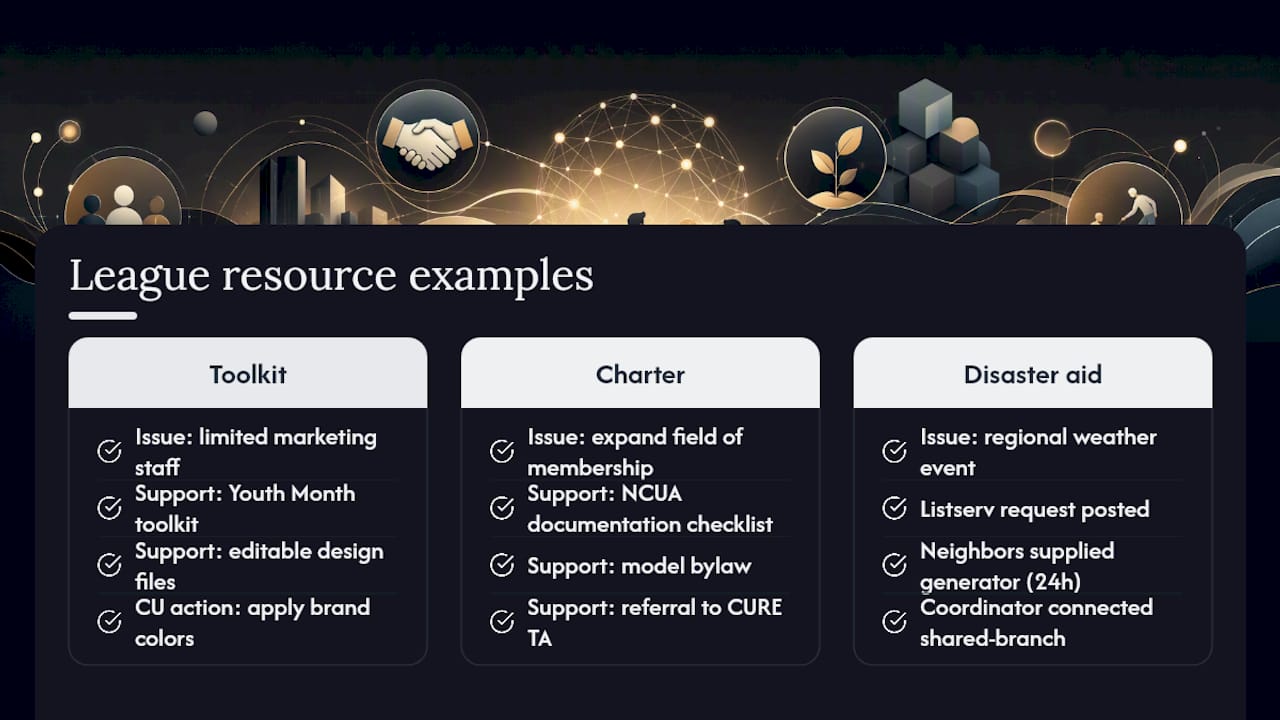
Three scenarios illustrate how the functions described above translate into real operational outcomes.
Toolkit-driven member campaign. A credit union with limited marketing staff uses its league's Youth Month toolkit to run a financial literacy campaign across social media and in-branch. The compliance officer requests editable design files from the league's communications team two weeks before launch, swaps in the credit union's brand colors, and adds a local branch address. Total internal time: under four hours. Without the toolkit, the same campaign would require either a vendor engagement or weeks of internal design work.
Charter conversion and field-of-membership expansion. A mid-size credit union wants to expand its field of membership to include a new employer group. The compliance team contacts the league's regulatory affairs staff, who provide a checklist of NCUA documentation requirements, a model bylaw amendment, and a referral to CURE's technical assistance team. The league's compliance hotline answers two follow-up questions during the application process. The credit union submits a complete application on the first attempt.
Disaster mutual aid coordination. After a regional weather event, a credit union posts a request on its league's listserv for a temporary generator and remote-access IT support. Within 24 hours, two neighboring credit unions respond with available equipment. The league's disaster coordinator connects the affected institution with a shared-branch partner for member transactions and initiates a relief grant application through the league foundation for affected employees. The credit union resumes partial operations within 48 hours.
How to engage your state league effectively
Getting value from league membership requires more than paying dues. The credit unions that extract the most from their league relationships treat the league as an extension of their own staff, not as a vendor they contact only during crises.
Practical steps to engage your league:
- Confirm your membership status and dues tier — some services are tiered by asset size or membership level
- Identify your primary contacts — most leagues have dedicated leads for advocacy, compliance, education, and communications; get all four names and direct contact information
- Request a service inventory — ask your league account manager for a written list of available services, associated costs (if any), and typical turnaround times
- Schedule an annual planning meeting — align your credit union's strategic priorities with the league's program calendar so you can reserve seats at relevant events and request custom sessions early
- Participate in surveys and collaboration calls — your data improves the benchmarks everyone uses, and peer calls surface solutions to problems you may not have encountered yet
Questions worth asking your league at that first planning meeting: What compliance alerts do you send, and how quickly after a regulatory change? Do you offer examiner-prep sessions, and are they included in dues? Can you provide a sample toolkit from a recent campaign? What is the process for a consortium grant application?
How leagues support risk and compliance functions in practice
The most durable value leagues provide to risk and compliance teams is the repeatable playbook: a set of templates, checklists, and model documents that reduce the hours spent rebuilding materials for recurring annual requirements. Campaign templates, policy templates, examiner-prep checklists, and grant application frameworks all fall into this category. A compliance officer who uses a league-provided model policy as a starting point rather than drafting from scratch saves hours of work and reduces the risk of missing a required provision.
Leagues also serve as the connective tissue between state and federal policy work. Lessons learned at the state level — a successful field-of-membership expansion, a model bylaw amendment that passed NCUA review cleanly — feed back into the system through AACUL coordination and America's Credit Unions' League Resource Center, where they become templates other leagues can distribute. That feedback loop is what makes the league system more than the sum of its parts.
Pro Tip: Integrate league compliance alerts directly into your internal compliance calendar. When a regulatory alert arrives, assign it to a staff owner and set a review deadline in the same workflow you use for NCUA examination prep. Treating league materials as inputs to your existing process, rather than as standalone communications, is what separates credit unions that stay current from those that drift.
For credit unions building or refining their internal compliance infrastructure, Riskinmind's compliance process guide and risk management frameworks provide a practical complement to the league-delivered policy templates and regulatory alerts described here.
The operational leverage leagues provide is real, but it requires deliberate use
The credit unions that get the most from their league relationships share one habit: they treat league resources as inputs to internal workflows, not as optional supplements. A compliance alert that sits in an inbox is worth nothing. A toolkit that never gets requested saves no one any time. The operational leverage leagues provide — time savings on recurring campaigns, reduced compliance drift, amplified advocacy, faster disaster recovery — only materializes when credit union leaders actively pull those resources into their own processes.
The practical priority for most credit union professionals is to audit their current use of league services against what their league actually offers. Most credit unions use a fraction of what is available. Schedule a meeting with your league's advocacy and compliance leads before the next examination cycle. Request the toolkit library. Register on SAM.gov if you have not already. The league system exists to reduce the burden on individual credit unions, but it cannot do that work without your engagement.
Primary sources and further reading
The sources below are the authoritative references for the topics covered in this guide.
| Source | What It Provides |
|---|---|
| America's Credit Unions — Leagues | League Resource Center, system-level advocacy data, national coordination tools |
| AACUL League Resources | Peer collaboration calendars, downloadable toolkits, survey coordination |
| The Wisconsin Credit Union League | State league model: dues structure, governance, and service scope |
| Kentucky's Credit Unions — About Us | Three-pillar service framework: advocacy, education, compliance |
| Carolinas Credit Union League | Disaster coordination resources and mutual aid infrastructure |
| Ohio Credit Union League — About Us | Annual impact reports and membership accountability documentation |
| Elder Exploitation Prevention Toolkit — DakCu | Example of a fully customizable league campaign toolkit with editable design files |
Sources
- The League of Credit Unions and Affiliates | Your Local ...
- Leagues | America's Credit Unions
- About Us - Kentucky's Credit Unions
- Elder exploitation prevention toolkit — DakCu/The Memo