
AI-driven market analysis gives risk, compliance, and portfolio teams real-time exposure mapping, scenario-driver summaries, and decision-ready narrative memos, instead of stale, manually assembled reports. Platforms like RiskInMind pair this with governance frameworks aligned to IOSCO guidance and SOC 2® controls, which matters because the value only holds up when the outputs are explainable and auditable, not just fast.
TL;DR:
- Vendors must provide measurable accuracy, latency, and explainability metrics early, especially on data relevant to your specific use case and portfolio.
- Ensuring governance is built into AI deployment, with clear model ownership, version control, and audit trails, is crucial to meet regulator expectations.
- Data readiness, defined latency SLAs, and monitoring processes should be established before implementing market analysis AI to avoid costly delays.
- Common risks include prompt drift, hallucinated outputs, and model homogeneity, which can amplify market volatility and undermine systemic stability.
- Select vendors that disclose real-world performance metrics, SOC 2® certification, and offer raw data access to support robust validation and compliance.
Automate Regulatory Model Risk Governance
Examine models against 32 qualitative criteria and resolve risk Tiers with pre-deployment checklists per OCC 2011-12 guidelines.
Table of Contents
- What Does AI Market Analysis Actually Deliver to Risk Teams?
- What Model Types and Data Feed Market Analysis AI?
- What Governance and Explainability Do Regulators Expect?
- How Should You Integrate Market Analysis AI Into Risk Workflows?
- What Can Go Wrong With Market Analysis AI?
- How Do You Evaluate an AI Market-Analysis Vendor?
- A Practitioner's Take on Adopting Market Analysis AI
- How RiskInMind Supports Market Analysis for Risk Teams
- Sources
What Does AI Market Analysis Actually Deliver to Risk Teams?
Most vendor pitches promise "insights." Risk officers need something narrower: outputs that plug directly into existing controls without requiring a new interpretation layer. AI market analysis, done well, produces four distinct deliverables.
- Short-term alerts that flag spread widening, liquidity stress, or covenant-relevant rate moves before they show up in a monthly report.
- Exposure heat maps that overlay concentration risk against sector, geography, or borrower cohort in something closer to real time.
- Scenario-driver summaries that isolate which macro variables (rates, unemployment, credit spreads) are actually moving a stress-test result, rather than just the result itself.
- Narrative memos that translate model output into the kind of prose a credit committee or examiner expects to see.
These map onto familiar workflows. Underwriting teams use exposure signals as an overlay on debt-to-income and loan-duration scoring. Portfolio managers use scenario-driver output to reset limits before a stress event rather than after. Model validation teams use narrative memos as a starting draft, not a replacement for their own sign-off. The Society of Actuaries has noted that AI's biggest advantage here is not raw speed. It is turning fragmented, unstructured evidence like filings, call transcripts, and covenant text into something a human reviewer can actually use.
What Model Types and Data Feed Market Analysis AI?
The phrase "market analysis AI" covers several distinct model families, and the mix matters more than any single architecture. Transformer-based NLP models read regulatory filings, earnings calls, and news flow at a scale no analyst team can match. Embeddings paired with similarity search pull out signal patterns across thousands of documents by comparing meaning, not just keywords. Hybrid ensembles combining gradient-boosted trees with neural or support-vector components handle structured classification tasks like default probability scoring.
That last category has real evidence behind it. A 2025 study testing a hybrid CatBoost and SVM framework on U.S. financial risk data hit 95.93% accuracy with an F1 score of 0.95, with debt-to-income ratio and interest rate ranking as the strongest predictive features. That is a meaningful benchmark for anyone evaluating a vendor's underwriting model.
Data inputs typically span:
- Live market ticks and order-book snapshots for liquidity signals
- Credit-spread curves and macro time series for rate and cycle risk
- Regulatory filings and alternative text sources (news, transcripts, covenant language)
Multi-modal systems that fuse these feeds have shown sub-50ms latency across 10,000-plus tracked symbols in research testing, which is the kind of throughput real-time risk dashboards depend on. To handle class imbalance (defaults are rare relative to performing loans) and keep results interpretable, practitioners lean on techniques like PCA for dimensionality reduction, SMOTE for rebalancing, and SHAP values for explainability.
What Governance and Explainability Do Regulators Expect?
A model that performs well in testing and fails an audit is a liability, not an asset. IOSCO's guidance on AI in capital markets is explicit that firms need transparency, explainability, and governance built into deployment, not bolted on afterward. Pair that with the NIST AI Risk Management Framework's lifecycle approach and a practical checklist emerges:
- Assign a named model owner accountable for each signal-generating system, not a committee.
- Version every model and dataset change with a timestamp and rationale.
- Generate explainability output (SHAP scores, feature attribution) alongside every material decision.
- Maintain audit trails that reconstruct why a signal fired on a specific date.
Security and procurement diligence run alongside this. SOC 2® certification, vendor attestations, and mandatory notification when a vendor changes model versions should all be contract terms, not assumptions. Ask vendors for validation artifacts directly: backtests against your own portfolio characteristics, scenario stress runs under historical crisis periods, and component-level audits showing how each sub-model contributes to a final score. RiskInMind's guidance on AI risk controls walks through how these controls fit into an existing three-lines-of-defense structure.
Pro Tip: Request a model's false-positive rate on your own historical exception list before a pilot starts. A vendor's aggregate accuracy number tells you little about how the model behaves on your institution's specific borrower mix.
How Should You Integrate Market Analysis AI Into Risk Workflows?
Deployment succeeds or fails on sequencing. Skipping steps to reach production faster almost always costs more time later in remediation.
- Assess data readiness first. Confirm you have sufficient historical volume and label quality to support a meaningful backtest, and set acceptance thresholds before you see results, not after.
- Define latency SLAs and API patterns. Real-time portfolio monitoring needs sub-second response windows; batch stress-testing inputs do not, so match the deployment pattern to the actual use case.
- Build logging and telemetry from day one. Every signal exception needs a runbook that specifies who reviews it and within what window.
- Set a monitoring cadence. Run drift detection continuously and schedule full model revalidation on a fixed calendar, not "when something looks off."
- Define escalation triggers. Name who gets alerted when a signal deviates beyond a set tolerance, and confirm that person has authority to pause the model.
Teams that skip step one tend to discover data gaps mid-pilot, which delays production timelines by months rather than weeks.
What Can Go Wrong With Market Analysis AI?
The failure modes here are structural, not hypothetical. A 2026 review in the Journal of Portfolio Management built a taxonomy of AI-related portfolio risks that every risk committee should read before signing a vendor contract: unstable data, hallucinated outputs, model homogeneity, and feedback loops that amplify rather than dampen volatility.
- Prompt drift: small changes to agent instructions or embedding models can shift downstream signal distributions without warning. CFA Institute analysis recommends joint-distribution drift detectors rather than periodic spot checks.
- Hallucinated narrative output: language models can generate plausible-sounding but unsupported claims in memos. Mitigate with mandatory source citation in every generated narrative.
- Model homogeneity and crowding: when many firms train on similar data and architectures, they tend to reach similar conclusions at the same time, which concentrates rather than diversifies market risk.
That crowding risk is not abstract. Simulation evidence on agentic and continuously retrained systems shows joint drawdown risk can climb sharply once stress conditions push correlated models toward the same trade. The same research found a large share of firms deploying agentic AI still lack the operational governance to catch it. Firm-level controls alone cannot solve a systemic problem. That is why regulators keep pushing for shared monitoring standards, not just individual vendor audits.
How Do You Evaluate an AI Market-Analysis Vendor?
Selection criteria should be measurable from the first conversation, not left until after a contract is signed. Require vendors to disclose:
- Precision and recall on a task resembling your actual use case, not a generic industry benchmark.
- Latency figures under realistic load, including peak market-volatility conditions.
- Uptime history with documented incident response times.
- Explainability indicators, meaning the vendor can show feature attribution per decision, not just an aggregate accuracy score.
On the checklist side, confirm SOC 2® certification status, ask what governance tooling ships with the platform versus what you build yourself, and secure contractual access to raw signal data rather than only summarized dashboards. Insist on advance notification whenever the vendor updates a model version, since a silent update can shift your risk profile without anyone noticing.
For pilots, set a fixed timeline (60 to 90 days is typical), a minimum sample size drawn from your own portfolio, and explicit performance thresholds tied to your existing model risk policy before day one. A pilot with no predefined exit criteria tends to run indefinitely without ever reaching a real decision. RiskInMind's breakdown of AI risk management tools offers a useful comparison point for what a complete feature set looks like.
A Practitioner's Take on Adopting Market Analysis AI
The biggest mistake I see institutions make is buying the model before building the governance. Data readiness, then governance, then pilots. In that order. Skip ahead and you end up retrofitting audit trails onto a system already generating decisions nobody can fully explain to an examiner.
Cross-functional ownership matters more than most teams admit. A model that only the data science team understands will fail its first serious compliance review, regardless of its accuracy score. Risk, compliance, and IT need shared literacy on what the model does and where its blind spots sit.
Start small. One use case, clear KPIs, a fixed pilot window. Firms that treat AI as an embedded operating capability rather than a string of isolated experiments tend to see the larger measurable gains, but that only happens after the first pilot proves the governance holds under pressure.
— Raj
How RiskInMind Supports Market Analysis for Risk Teams
An AI-powered risk management platform can give risk, compliance, and portfolio teams a faster path to governance-first deployment by providing specialized AI agents coordinated by a central director, including market analysis functions alongside credit risk assessment and regulatory compliance monitoring, designed to run with strong security and compliance controls.
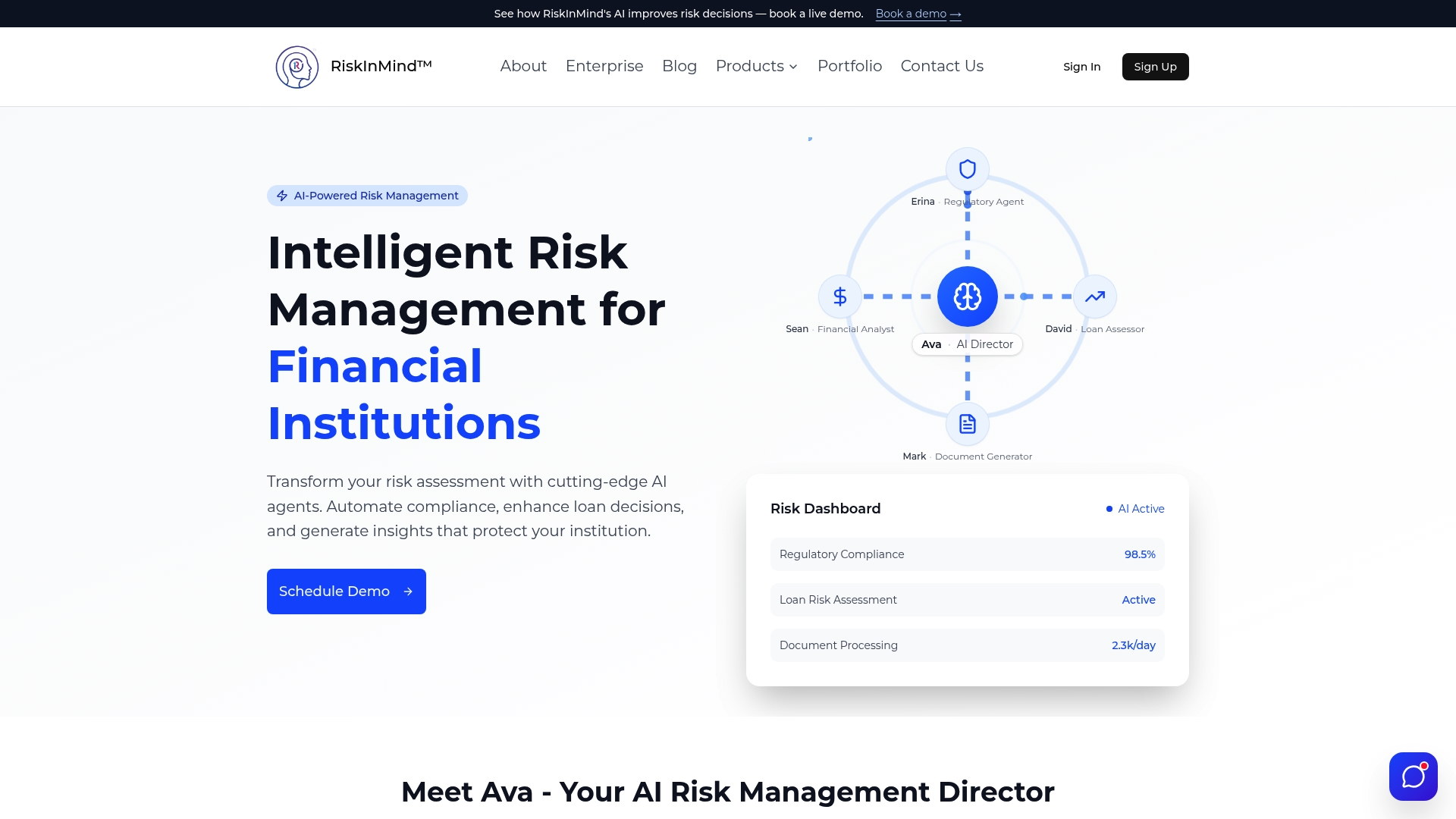
A demo walks through how exposure heat maps, scenario-driver summaries, and narrative memos surface inside a live risk dashboard, and a pilot can be scoped around a single use case, such as underwriting overlays or portfolio surveillance, with outcome metrics defined up front rather than negotiated after the fact. If underwriting automation is the priority, start with the loan application platform to see how market signals feed directly into credit decisioning without a separate manual review layer.
Sources
- AI-Powered Predictive Analytics for Financial Risk Management in U.S. Markets
- IOSCO report on AI in capital markets
- Algorithmic Vulnerability: The Hidden Risks of AI in Asset Management
- Agentic AI governance and systemic risk (arXiv preprint)
- Society of Actuaries report on AI in underwriting and risk