
Fair lending analytics is the discipline of turning your application, underwriting, pricing and exception data into evidence that similarly situated borrowers are treated alike. The strongest programs test the same focal points examiners test, keep exceptions under continuous review, and treat proxy-based race estimates as an approximation with known error. RiskInMind builds its platform for credit unions, community banks and lenders around that kind of continuous, audit-ready monitoring, with granular audit trails behind every analysis.
- Examiners look at product development, marketing, applications, underwriting, pricing and loan officer compensation, so your analytics should cover the same span, not just approval rates.
- High-volume portfolios call for statistical modeling backed by manual file review; low-volume ones call for comparative file review.
- Pricing exceptions and HMDA errors were the two issues most often cited in the CFPB's 2024 supervisory communications.
- BISG proxies carry measurable error, so document their limits and validate them as you would any model.
- Since the CFPB's 2025 shift away from disparate impact, intentional-discrimination evidence and state or prudential-regulator expectations matter more to program design.
Table of Contents
Automate Regulatory Model Risk Governance
Examine models against 32 qualitative criteria and resolve risk Tiers with pre-deployment checklists per OCC 2011-12 guidelines.
- What fair lending analysis actually examines
- Statistical modeling versus file review
- Underwriting performance metrics and how to read benchmarks
- Exceptions: where the findings concentrate
- Proxy methods and their error
- What changed in U.S. oversight
- A worked example: a pricing exception review
- How RiskInMind supports the work
- Our perspective
- FAQ
- Sources
What fair lending analysis actually examines
The OCC's Comptroller's Handbook on fair lending defines the scope broadly: loan product development, marketing, accepting applications (originations, denials and withdrawals), underwriting, pricing, and compensation of loan officers. An analytics program that only reports approval rates by group covers one slice of that.
The same handbook describes redlining as illegal disparate treatment: unequal access to or terms of credit because of the race, color, national origin or other prohibited characteristic of the residents of an area. It can violate both the Equal Credit Opportunity Act (ECOA) and the Fair Housing Act. Redlining is usually shown through comparative evidence of lending in minority and nonminority communities and statistical comparison to lending peers. That makes peer data and geographic coverage maps part of your analytics, not an afterthought.
In practice, a workable analytic inventory has four layers:
- Access: application volumes, denial and withdrawal patterns, and geographic penetration against peers.
- Underwriting: decision outcomes controlling for credit factors.
- Pricing: rate, fees and terms among originated loans.
- Exceptions and overrides: who receives them, who approves them and why.
Statistical modeling versus file review
The OCC handbook says that for high-volume focal points, statistical modeling should be used instead of manual file review. The model controls for legitimate factors and estimates how much each matters to the outcome. A complementary manual comparative file review then checks for data errors, factors the model handled incorrectly, and the robustness of the result.
For lower-volume products, comparative file review is the working method. The handbook's sampling logic is specific:
- Underwriting: at least two samples, denials of the prohibited-basis (PB) group and approvals of the control group.
- Pricing: PB originations compared with control group originations.
- Steering: PB files with less favorable terms compared with control group files with more favorable terms.
The Interagency Fair Lending Examination Procedures add that the primary underwriting technique is a benchmark and overlap comparison: for each underwriting standard, identify the denied minority applicant who was least deficient on it and compare that file against approved control group applicants.
The practical difficulty is assembling clean, consistent data for either approach. Credit policy fields, decision reasons and pricing adjustments often sit in different systems, and a regression is only as reliable as its inputs. Our guide to bias testing in lending walks through how compliance teams structure these tests.
Underwriting performance metrics and how to read benchmarks
Two kinds of metrics matter. Fairness metrics describe outcomes across groups. Accuracy metrics describe how well decisions predict repayment. Fair lending analytics needs both, because a model can be accurate overall and still less accurate for one group.
That second point is the subject of a University of Chicago Booth working paper from August 2025, Differential Validity in Fair Lending. It notes that traditional fair lending has focused narrowly on approval or interest rate disparities, and examines which disparities matter when a model's validity differs across groups.
The monitorship of a lender that used machine learning offers a useful lesson on benchmarks. Its third report describes a primary performance metric that reflects both default and prepayment risk, where a smaller value means a more accurate model. It also cautions that:
- accuracy measured on training data does not guarantee the same accuracy on the deployed population;
- the metric does not capture uncertainty under future drift;
- differences between alternative models inside the uncertainty bounds may not be meaningful.
For your own benchmarks, that means comparing models on out-of-sample data, reporting a range rather than a point estimate, and segmenting accuracy by group before declaring one model better than another.
Exceptions: where the findings concentrate
The CFPB's 2024 Fair Lending Annual Report, published in December 2025, states that the Bureau started 29 fair lending examinations or targeted reviews in 2024. The two issues most often identified in supervisory communications were the granting of pricing exceptions and HMDA violations.
The FDIC's examination manual lists the risk factors examiners look for: vague or unduly subjective underwriting criteria, little guidance on exceptions including credit score overrides, missing documentation of why an exception was made, and high percentages of exceptions or overrides. Examiners may ask for outcomes of exceptions sorted by product and decision center, and include all focal-point exceptions in the initial sample.
A monitoring routine that answers those requests before they arrive tracks:
- exception rate by product, branch or decision center, and by approver;
- documented reason codes for every override;
- pricing deviations from the rate sheet, by group where data permits;
- outcome of exception loans compared with policy-conforming loans.
Our 90-day fair lending monitoring guide lays out how to stand this routine up in a regulator-aligned sequence.
Proxy methods and their error
Most lenders cannot collect race or ethnicity on non-mortgage applications, so analysts estimate it. The standard method is Bayesian Improved Surname Geocoding (BISG), which combines surname and address to produce probabilities by group. The method is useful for screening, but its error is measurable.
An NBER working paper from August 2023 found that in small-business lending, BISG prediction errors among Black Americans bias measured approval disparities downward by 43%. Errors correlate with socioeconomic characteristics, so they are not random noise.
Richard Pace's Modern Fair Lending Analysis (2021) estimates that BISG misclassifies the race of Black sample members 42 to 73% of the time, and finds that all classification approaches under disparate treatment scenarios understate true minority price disparities by 9 to 34%. When pricing differences correlate with income, the continuous approach can overstate disparate impact estimates by 80 to 100% for Hispanic and Black groups.
A separate Pace paper, The Hidden Biases of BISG-Based Disparity Estimates, notes that no model validation results for the regulators' proxy have been publicly released, although such testing is generally mandatory for federally supervised banks under SR 11-7, the Federal Reserve and OCC's model risk guidance.
Three practical controls follow:
- Run results under more than one proxy specification and report the spread.
- Where you hold self-reported data, such as mortgage records, benchmark the proxy against it.
- Treat a proxy-based gap as a trigger for file review, not as a finding on its own.
What changed in U.S. oversight
The CFPB's 2024 annual report states that, under Executive Order 14281, the Bureau will no longer use disparate impact in fair lending supervision or enforcement, has closed exam and investigation elements that relied on it, and is focusing on direct evidence of intentional discrimination and identified victims. Under Executive Order 14173 it no longer consults on special purpose credit programs that rely on race, national origin or sex. The Bureau's semi-annual report adds that it is not pursuing redlining enforcement based solely on statistical correlation or stray remarks.
The same 2024 report still directed institutions to standardize variable testing during credit scoring model development, to apply a standardized approach to less discriminatory alternatives for alternative data, and to assess fair lending risk from data that may proxy for ECOA-prohibited characteristics. It also describes directions on redlining-risk monitoring and fair lending compliance controls.
For your program, this means the statutes themselves have not changed. ECOA and the Fair Housing Act remain law, prudential regulators such as the OCC and FDIC still publish examination procedures built on the comparative analysis described above, and documented testing remains your best evidence of sound controls. Confirm with counsel how your primary regulator and state authorities apply disparate impact to your institution.
On model review, the FinRegLab research report records that CFPB officials in 2023 called rigorous searches for less discriminatory alternatives a critical component of fair lending model review. Our pieces on model explainability in credit and credit model bias controls cover how to document that search.

A worked example: a pricing exception review
Suppose a credit union originates 2,000 auto loans in a year and 300 carry a rate exception below the rate sheet. A sound review would proceed as follows:
- Pull all 300 exceptions with approver, branch, reason code and final rate.
- Model the final rate on credit score, loan-to-value, term and income, then test whether group membership, estimated or observed, adds explanatory power.
- For any flagged segment, pull a comparative sample of exception and non-exception files and look for missing documentation or factors the model omitted.
- Record the finding, the remediation and the retest date.
The output is a dated, repeatable record. That record is what an examiner asks for, and it is far easier to produce when the data is already structured in one place.
How RiskInMind supports the work
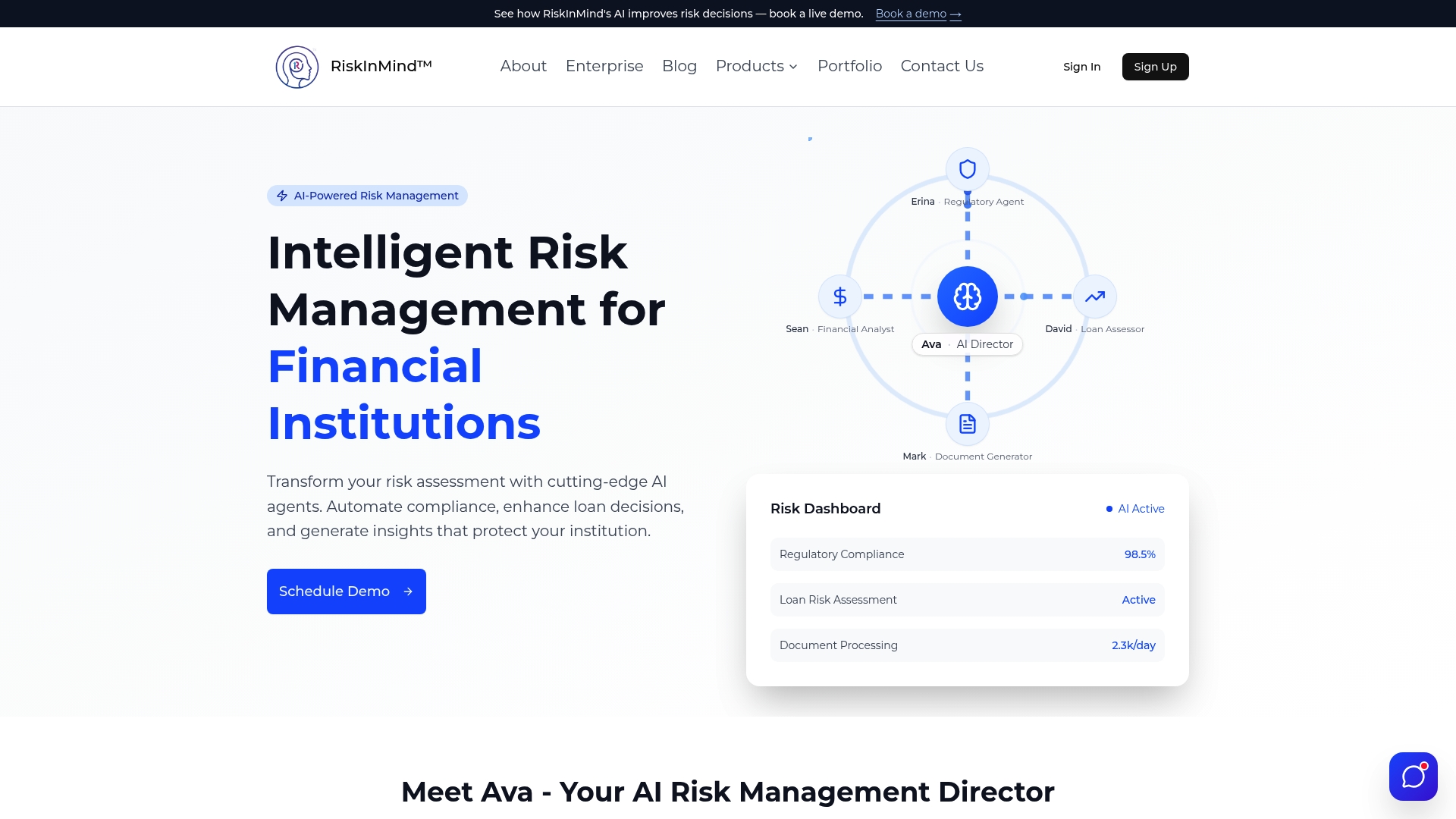
RiskInMind is an AI-powered risk management platform for credit unions, community banks and lenders. It includes a Regulatory Agent, Compliance First, Peer Benchmarking, Bank OS and Portfolio products, risk dashboards and audit-ready reporting. Processing runs in real time, with response times under half a second, and the platform is SOC 2® certified with granular audit trails. Our Loan Application product brings underwriting decisions into a structured workflow, and you can see all product lines and plans on the RiskInMind site or the pricing page.
Our perspective
Fair lending analysis fails most often at the seam between systems: the decision lives in one place, the exception reason in another, the pricing adjustment in a third. We built RiskInMind so that a risk officer sees underwriting, exceptions and portfolio outcomes in one audit trail, with specialized agents handling regulatory monitoring and documentation under a central director, Ava.
Our view is that fair lending is a continuous control, not an annual project. A credit union that reviews exceptions monthly, reports proxy uncertainty openly and keeps every test reproducible walks into an exam with answers instead of a scramble. That is the standard our platform is designed to make routine.
Raj
FAQ
What is the difference between fair lending analysis and fair lending analytics?
Analysis is the individual test, such as a pricing regression or a comparative file review. Analytics is the ongoing system around it: data pipelines, thresholds, exception tracking and reporting. Regulators examine the results of the first, but the second is what keeps results consistent from one exam cycle to the next.
Which underwriting metrics should a small lender track?
Start with approval and denial rates by product and geography, exception and override rates by approver, pricing deviation from the rate sheet, and model accuracy segmented by group. The CFPB's 2024 report named pricing exceptions as one of its two most frequent findings, so that is a sensible first priority.
Can we rely on BISG to measure disparities?
Use it as a screening tool. Published research shows it can understate or overstate disparities depending on the scenario, so pair it with file review and report the uncertainty. Where self-reported demographics exist, compare the proxy against them.
Does the end of CFPB disparate impact enforcement mean we can skip fair lending testing?
No. ECOA and the Fair Housing Act remain in force, and the OCC and FDIC examination procedures still describe comparative statistical and file-based testing. Ask your counsel how your prudential regulator and state authorities treat disparate impact for your institution.
Sources
- OCC Comptroller's Handbook, Fair Lending
- FDIC Consumer Compliance Examination Manual, IV-1 Fair Lending Laws and Regulations
- CFPB Fair Lending Annual Report, 2024
- CFPB Semi-Annual Report, October 2024 to December 2025
- NBER working paper on race proxies in small-business lending
- Modern Fair Lending Analysis, Pace, 2021
- The Hidden Biases of BISG-Based Disparity Estimates, Pace, 2021
- Differential Validity in Fair Lending, Chicago Booth BFI, August 2025
- Fair Lending Monitorship Third Report
- FinRegLab, Explainability and Fairness in Machine Learning for Credit Underwriting, July 2023