
Quantitative risk models fail primarily because their assumptions and historical data cease to hold when markets shift, producing unreliable outputs exactly when decisions matter most. Three mechanisms drive most failures: structural breaks that invalidate calm-period training data, tail-event scarcity that forces models to guess at extremes, and endogenous feedback loops where market participants react in ways the model never anticipated. A Federal Reserve FEDS paper found that model disagreement for VaR and expected shortfall spikes precisely when uncertainty rises, and backtesting alone cannot catch this. Models can also hallucinate extreme scenarios because historical crisis data is thin, leaving statistical structure with nothing real to learn from.
What follows breaks down each failure mode, translates the technical problems into governance and reporting consequences, and lays out a mitigation checklist risk teams can act on this quarter.
Key Takeaways
Automate Regulatory Model Risk Governance
Examine models against 32 qualitative criteria and resolve risk Tiers with pre-deployment checklists per OCC 2011-12 guidelines.
Quantitative risk models fail when structural breaks, tail-event scarcity, and endogenous feedback loops invalidate the calm-period assumptions and data they were trained on.
| Point | Details |
|---|---|
| Regime shifts break models | Structural breaks invalidate calm-period training data exactly when accuracy matters most. |
| Tail data is inherently thin | Models hallucinate extreme scenarios because historical crises rarely provide enough real examples. |
| Model disagreement is a signal | Track divergence between independent models as an early warning that predates backtest breaches. |
| Single-point outputs mislead | Report uncertainty ranges instead of one VaR figure for high-impact capital and reserve decisions. |
| Governance beats model complexity | Tiering, red-team reviews, and escalation owners catch failures that validation alone misses. |
Table of Contents
- Why Quantitative Risk Models Fail: The Seven Root Causes
- What Model Failure Means for Risk Decisions and Reporting
- How to Build Model Governance That Catches Failures Early
- Why Governance Tools Matter as Much as the Model Itself
- What Risk Teams Consistently Get Wrong About Model Failure
- Frequently Asked Questions
- Sources
Why Quantitative Risk Models Fail: The Seven Root Causes
Risk models don't fail randomly. They fail in predictable, recurring patterns that trace back to how they're built, trained, and deployed. Understanding the hierarchy of these failure modes helps you know where to look first when a model's outputs start feeling wrong.
-
Structural breaks and regime shifts. Models estimated on data from stable periods carry statistical properties that simply stop applying once markets turn. The Fed's FEDS research shows that candidate risk models tend to converge during calm stretches and diverge sharply during distress, which is the opposite of when you'd want agreement. Systemic risk research reinforces this: outcomes that looked reliable in backtests become erratic once the underlying regime changes.
-
Tail-event scarcity and hallucination. A model asked to price a one-in-500-year event has almost no real examples to learn from. It fills the gap with distributional assumptions, often a normal or log-normal curve, that understate how fat the tails actually are. CEPR's VoxEU research describes this directly as a hallucination problem: the model isn't lying, it's extrapolating from data that never contained the event it's now being asked to forecast.
-
Endogenous risk and feedback loops. Most models assume the world is exogenous, meaning prices move and the model watches from the sidelines. In practice, when enough participants act on the same signal, whether it's a margin call, a credit downgrade, or a liquidity crunch, their collective response changes the very prices the model is trying to predict. That feedback loop is what turns an isolated shock into a systemic one.
-
Data quality and garbage-in, garbage-out problems. Quantitative risk assessment methods frequently rely on single-point inputs, unrepresentative sampling frames, and independence assumptions that don't survive contact with correlated real-world events. A PSAM/QRA review points out that many QRA exercises lack systematic validation altogether, which means the model's confidence in its own output is often unearned.
-
Overfitting and limits-to-learning in high-dimensional models. Machine learning models with hundreds of features can fit historical noise so well that out-of-sample performance looks strong right up until the sample changes character. Recent econometric research on the limits-to-learning gap shows that finite samples can prevent even well-specified estimators from converging on the true relationship, meaning standard validation metrics can understate real predictive uncertainty rather than reveal it.
-
Interpretability limits and automation bias. Black-box models make it hard for analysts to see why an output changed, which pushes teams toward trusting the number simply because it's there. This is where model risk stops being a math problem and becomes a workflow problem.
-
Organizational misuse and model idolatry. Even a well-built model fails in practice if the organization treats its output as gospel. The Financial Modelers' Manifesto makes the case bluntly: models are simplifications of a complicated world, and treating them as truth rather than tools is itself a failure mode, independent of the model's technical quality.
A useful illustration is the collapse of correlation assumptions in credit portfolios during downturns: defaults that looked statistically independent in calm years suddenly move together, because the same macro shock hits every borrower at once. QRA failures in process industries follow a similar arc, where narrow data and independence assumptions led to real-world catastrophic events occurring far more often than the model implied.
What Model Failure Means for Risk Decisions and Reporting
A single point estimate for VaR feels precise, but precision and accuracy are not the same thing. When a model's confidence interval is wide or its peer models disagree, reporting one number to a credit committee or a board hides exactly the information they need to size a decision correctly. Point estimates work fine for routine monitoring, but they can quietly mislead the exact high-impact decisions, capital allocation, reserve adequacy, concentration limits, where the cost of being wrong is highest.
Backtesting has a related blind spot. It validates a model against the regime it was trained on, which tells you almost nothing about how the model behaves once that regime breaks. The Fed's research on model disagreement suggests a workaround: track how much candidate models diverge from each other, not just how each one performs against history, since divergence tends to widen before a backtest would ever flag trouble.
Two organizational risks compound the technical ones:
- Automation bias sets in when analysts stop questioning outputs simply because a system produced them, especially under deadline pressure.
- Misaligned incentives can reward teams for hitting a model-driven target even when the underlying assumptions have clearly aged out.
- Escalation gaps appear when nobody owns the decision to override a model, so bad numbers flow straight into a report unchallenged.
Regulators increasingly expect institutions to adapt escalation and reporting rules as model uncertainty rises rather than treating every quarter's output with equal confidence.
Pro Tip: Track model disagreement (the spread between two or three independently built models forecasting the same risk) as its own metric. A widening spread is often the earliest warning sign you'll get, well before a backtest breach confirms the problem.
How to Build Model Governance That Catches Failures Early
Reducing model failure risk isn't about building a better model. It's about building a validation and governance process that assumes every model will eventually be wrong and catches that moment quickly.
- Run model risk analysis beyond backtests. Compare outputs across two or three structurally different models and flag when their disagreement widens, since divergence often precedes a visible breach.
- Build targeted stress tests, not generic ones. Simulate specific structural breaks, a liquidity freeze, a correlated default wave, a margin-call spiral, rather than a generic "adverse scenario" that doesn't map to your actual exposures.
- Replace single-point outputs with uncertainty bands. Report a range and a confidence level, not just a number, especially for reserve and capital decisions.
- Triangulate data sources before trusting an input. Cross-check any single-point assumption against at least one independent data source, and document where sampling frames may be unrepresentative.
- Tier your models by consequence, not complexity. A model that drives capital decisions deserves more validation scrutiny than one used for internal monitoring, regardless of how sophisticated either one is.
- Schedule red-team reviews on a fixed calendar. Have a team whose job is to argue against the model's assumptions at least twice a year, not just after something breaks.
Quick 90-day checklist for risk teams:
- Document every model's core assumptions and last validation date
- Set up a model-disagreement dashboard across your top three risk models
- Run one structural-break scenario specific to your portfolio's actual exposures
- Add uncertainty ranges to at least one recurring board report
- Assign explicit escalation owners for model overrides
- Audit your highest-tier model's training data for regime coverage gaps
- Schedule the first red-team review
Pro Tip: Start the disagreement dashboard before you build anything else. It's the cheapest early-warning system available, and it turns "the model says" into "here's where the models don't agree," which is a much more honest conversation with a credit committee.
Why Governance Tools Matter as Much as the Model Itself
Every mitigation above requires infrastructure that most institutions don't build fast enough on their own, real-time drift detection, automated model-tiering, and audit trails that survive examiner scrutiny. That's the operational gap Riskinmind's platform is built to close for credit unions, community banks, and lenders running credit risk, CECL reserve, and underwriting models day to day.
- Model risk tiering that scores exposures by consequence rather than treating every model equally
- Real-time dashboards built to surface drift and model disagreement before a backtest would catch it
- Ava, the platform's AI director, coordinating specialized agents across credit, compliance, and market analysis so no single black box carries the whole decision
- SOC 2 certified infrastructure with audit-ready reporting built for examiner review
Governance without tooling is a policy document. Governance with real-time drift detection is a discipline your examiners can actually verify.
If your institution is evaluating how these mitigations fit into an existing underwriting or portfolio workflow, Riskinmind's loan underwriting platform shows how model tiering and real-time monitoring work together in production, not just in policy.
What Risk Teams Consistently Get Wrong About Model Failure
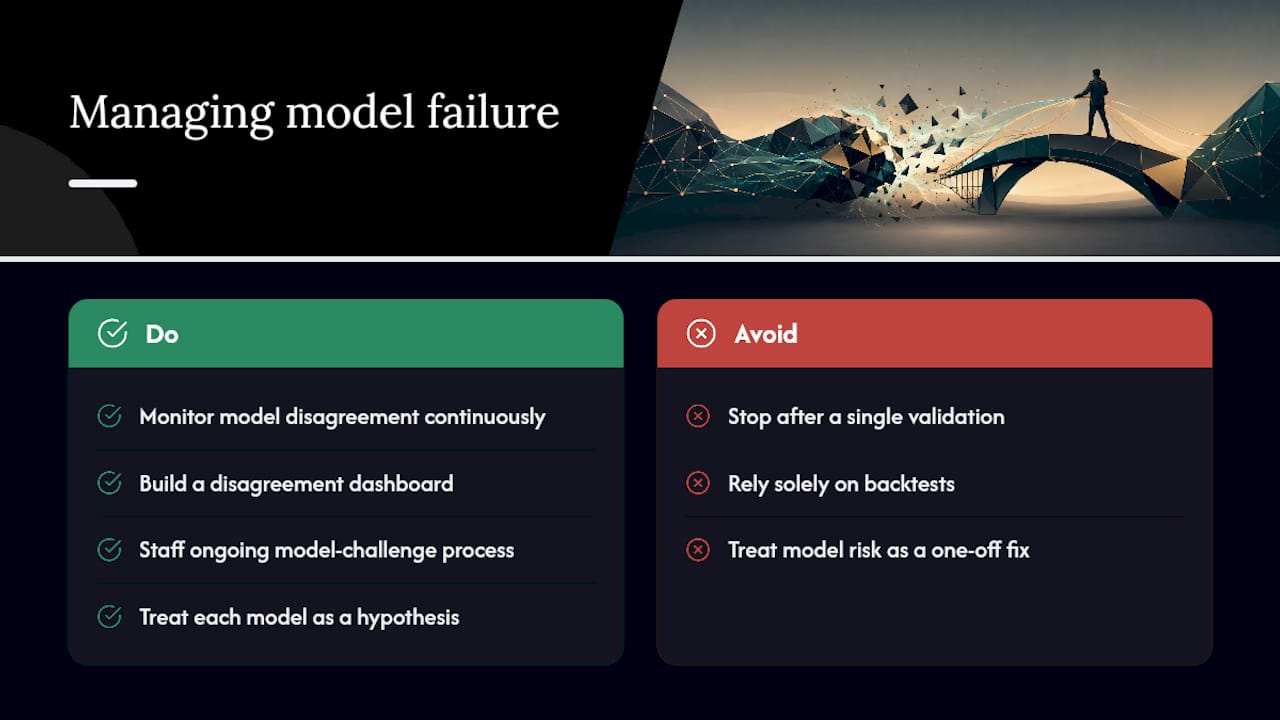
The uncomfortable truth is that most institutions treat model risk as a technical problem to be solved once, rather than an operational condition to be managed continuously. That framing is backwards. The Fed's own research shows model disagreement rising and falling with market uncertainty in a fairly predictable rhythm, which means model risk isn't a mystery, it's a signal you can monitor if you build the dashboard for it.
Conventional advice tells risk teams to "validate the model" and stop there. That's necessary but nowhere near sufficient. A model can pass every backtest in its portfolio and still fail the moment a regime shifts, because backtests grade a model against the past it already knows, not the future it's being asked to predict.
If you take one thing from this diagnostic, prioritize the disagreement dashboard over any single model upgrade. Watching where independently built models diverge tells you more about emerging risk than any one model's internal confidence score ever will. Treat every model as a hypothesis under ongoing challenge, and staff that challenge process like it matters, because during the next regime shift, it will be the only warning you get.
Frequently Asked Questions
Why do quantitative risk models fail during a financial crisis? Models trained on data from calm periods carry statistical relationships that break down once markets shift into distress. The Federal Reserve's FEDS research found that candidate models tend to agree during stable stretches and diverge sharply once uncertainty spikes, which is exactly when accurate output matters most.
What is the biggest limitation of quantitative risk assessment? Data scarcity around tail events is the most persistent limitation. Historical records rarely contain enough extreme scenarios for a model to learn genuine tail behavior, forcing it to rely on distributional assumptions that often understate real risk.
Can backtesting alone validate a risk model? No. Backtesting checks a model against the regime it was trained on, so it tells you little about performance once that regime changes. Model risk analysis that tracks disagreement between multiple candidate models catches emerging problems earlier than backtesting alone.
How does endogenous risk cause model failure? Endogenous risk occurs when market participants' collective reactions, like margin calls or forced asset sales, change the very prices a model assumed were independent of its own existence. Systemic risk research shows this feedback loop is what turns isolated shocks into system-wide events that exogenous-assumption models cannot anticipate.
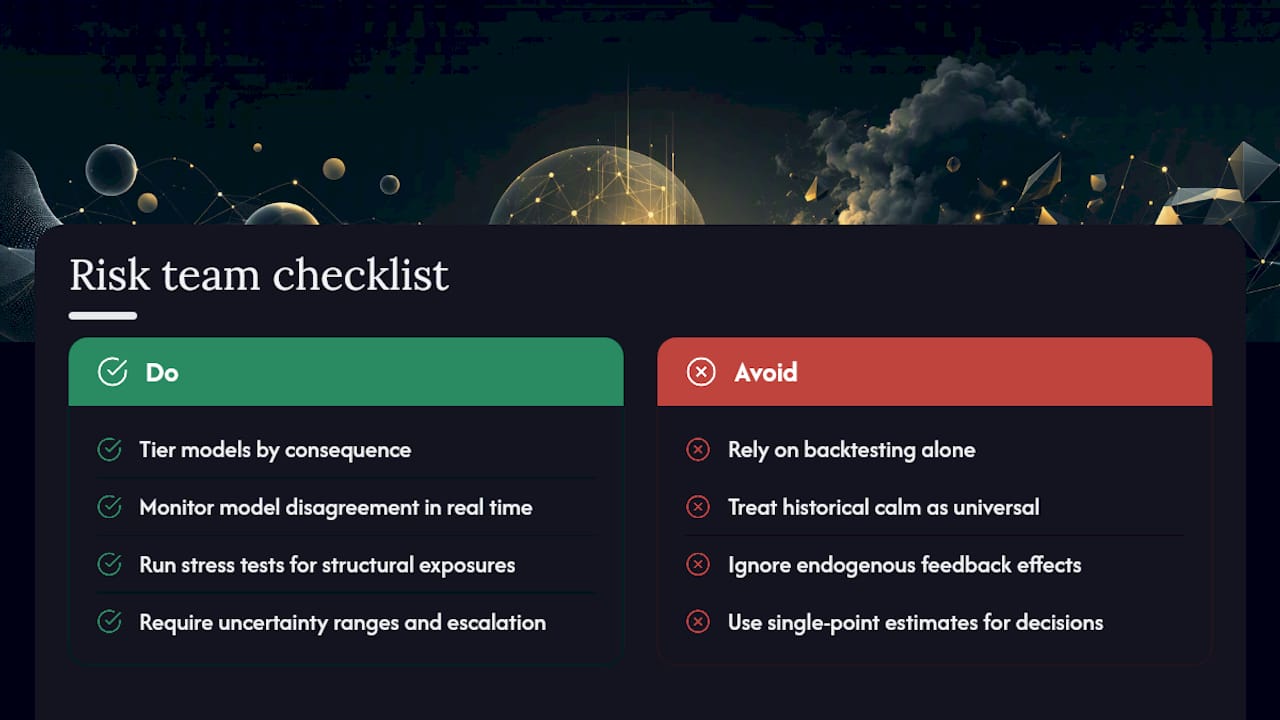
What can risk teams do to reduce reliance on flawed model outputs? Build model tiering by consequence, monitor disagreement between independent models in real time, run stress tests targeted at your specific structural exposures, and require uncertainty ranges rather than single-point estimates for high-impact decisions. Riskinmind's portfolio management solutions support this kind of continuous monitoring alongside human escalation gates.
Sources
- Model risk in forecasting systemic and market risk (Federal Reserve FEDS paper)
- When risk models hallucinate (CEPR / VoxEU column)
- Endogenous risk research
- QRA critique and validation gaps (PSAM/QRA review)
- Limits-to-Learning gap (ML/econometrics research)
Recommended
- SR 26-2: The Biggest Shake-Up to Model Risk Management Since 2011 | RiskInMind
- Predictive Modeling in Finance: A 2026 Guide | RiskInMind
- Model Risk Management: A Practical Guide for Financial Institutions | RiskInMind
- Stop Guessing Which Models Need the Most Attention: Introducing the RiskInMind Model Risk Tiering Calculator | RiskInMind