
Protecting credit union member data is a legal obligation, a fraud-prevention imperative, and the foundation of member trust — governed by the Gramm-Leach-Bliley Act, Regulation P, and NCUA's Guidelines for Safeguarding Member Information under 12 CFR Part 748. Credit unions that get this right maintain examiner confidence, reduce fraud exposure, and retain members who trust them with their most sensitive financial information. Those that fall short face regulatory enforcement, civil liability, and the kind of reputational damage that erodes membership for years.
The three regulatory pillars every credit union professional must know:
- Gramm-Leach-Bliley Act (GLBA) / Regulation P: Requires privacy notices, restricts disclosure of nonpublic personal information (NPI) to nonaffiliated third parties, and mandates opt-out procedures.
- NCUA 12 CFR Part 748 / Guidelines for Safeguarding Member Information: Requires a written information security program with administrative, technical, and physical safeguards, annual board reporting, and vendor oversight.
- Fair Credit Reporting Act (FCRA): Governs how credit unions handle consumer report data, including permissible purposes and accuracy obligations.
Maintain 100% NCUA & OCC Audit Readiness
Monitor regulatory updates 24/7, check internal credit policies, and generate compliance trails with Erina (AI Regulatory Agent).
When these obligations are met, credit unions operate with confidence during exams, members experience fewer fraud incidents, and the institution's digital services rest on a defensible compliance foundation.
Key Takeaways
Credit unions that satisfy both Regulation P's disclosure rules and 12 CFR Part 748's safeguard requirements operate with the strongest legal and operational defense against fraud, enforcement, and member attrition.
| Point | Details |
|---|---|
| Two frameworks, one program | Regulation P governs disclosures; 12 CFR Part 748 governs safeguards — both must be satisfied independently. |
| Essential controls first | MFA, encryption, access controls, written policy, and a tested incident response plan are the non-negotiable starting point for any credit union. |
| Vendor oversight is examined | Contracts alone are insufficient; NCUA expects active monitoring, SOC report review, and documented remediation of vendor findings. |
| Privacy notices must match practice | Examiners compare notice language to actual data-sharing behavior — a mismatch is a finding regardless of member harm. |
| Riskinmind automates the compliance burden | Riskinmind's AI platform provides automated monitoring, vendor risk dashboards, and audit-ready reporting aligned to GLBA and NCUA expectations. |
Table of Contents
- Why does U.S. law require credit unions to protect member data?
- What are the real risks when member data isn't protected?
- Which safeguards do credit unions need to prioritize?
- How should credit unions manage vendor and third-party risk?
- What must credit unions tell members about their privacy practices?
- What steps should credit unions take after a data incident?
- The tension between protection and progress is real — and manageable
- Riskinmind helps credit unions meet these obligations with less manual effort
- Sources
Why does U.S. law require credit unions to protect member data?
Three federal frameworks create the legal baseline, and each one carries distinct compliance triggers.
Gramm-Leach-Bliley Act and Regulation P form the core privacy architecture. Regulation P implements GLBA's privacy requirements: credit unions must provide timely, accurate privacy notices and, except for narrow exceptions, may not disclose NPI to nonaffiliated third parties unless notice and opt-out procedures are satisfied. Examiners under 12 CFR Part 1016 evaluate whether what the credit union states in its notices matches actual data-sharing practices — a gap between policy and practice is a common examination finding.
NCUA's Guidelines for Safeguarding Member Information (12 CFR Part 748, Appendix A) go further than disclosure rules. They require a coordinated information security program scaled to the credit union's size and complexity, covering administrative, technical, and physical safeguards — access controls, encryption, monitoring, incident response, and secure disposal. The board must receive a status report on the program at least annually.
The Fair Credit Reporting Act applies when a credit union furnishes data to consumer reporting agencies or uses consumer reports in lending decisions. Permissible purpose, accuracy obligations, and adverse action notice requirements all fall under FCRA's scope. A credit union that furnishes inaccurate data or uses a report for an impermissible purpose faces both regulatory and private-action exposure.
America's Credit Unions has urged that any national privacy law recognize existing GLBA standards and include preemption from conflicting state rules — a position that reflects the real compliance burden credit unions face when state privacy statutes layer on top of federal requirements. As of 2026, Congressional hearings continue to scrutinize data privacy and cybersecurity obligations for financial institutions, signaling that the regulatory floor may rise.
Key obligation: Regulation P controls who you may share data with; 12 CFR Part 748 controls how you must protect it. Satisfying one does not satisfy the other.
What are the real risks when member data isn't protected?
Weak data controls create cascading consequences that extend well beyond a single exam finding.
- Identity theft and account fraud: Exposed Social Security numbers, account numbers, and payment history give fraudsters everything they need to open accounts, drain balances, or file false tax returns in a member's name. The NCUA's fraud prevention resources document the volume of member-facing fraud incidents tied to data exposure.
- Regulatory enforcement and corrective action: NCUA examiners can issue Matters Requiring Attention, require a corrective action plan, or refer violations to enforcement. Persistent noncompliance with 12 CFR Part 748 or Regulation P can escalate to formal administrative action.
- Civil liability: Members whose NPI is improperly disclosed have standing to pursue claims under GLBA and FCRA. Class-action exposure is particularly acute when a breach affects a large portion of the membership.
- Member attrition: Trust, once broken, rarely returns quickly. Members who experience fraud or learn their data was shared without proper notice tend to close accounts and warn others.
- Operational disruption: A ransomware event or data breach can take core systems offline for days, interrupting lending, payments, and member service at the worst possible time.
Congressional testimony reviewed in 2025 hearings on financial institution cybersecurity confirmed that legislative scrutiny of these risks is intensifying, with lawmakers examining whether existing frameworks adequately address the sophistication of current threats. Credit unions that treat data security as a checkbox exercise rather than an ongoing program are precisely the institutions that draw examiner attention.
The incident response and notification obligations triggered by a breach are covered in detail later in this guide — but the point here is that the cost of response almost always exceeds the cost of prevention.
Which safeguards do credit unions need to prioritize?
The NCUA's Guidelines for Safeguarding Member Information organize required controls into three categories. The table below maps each control to its implementation priority.
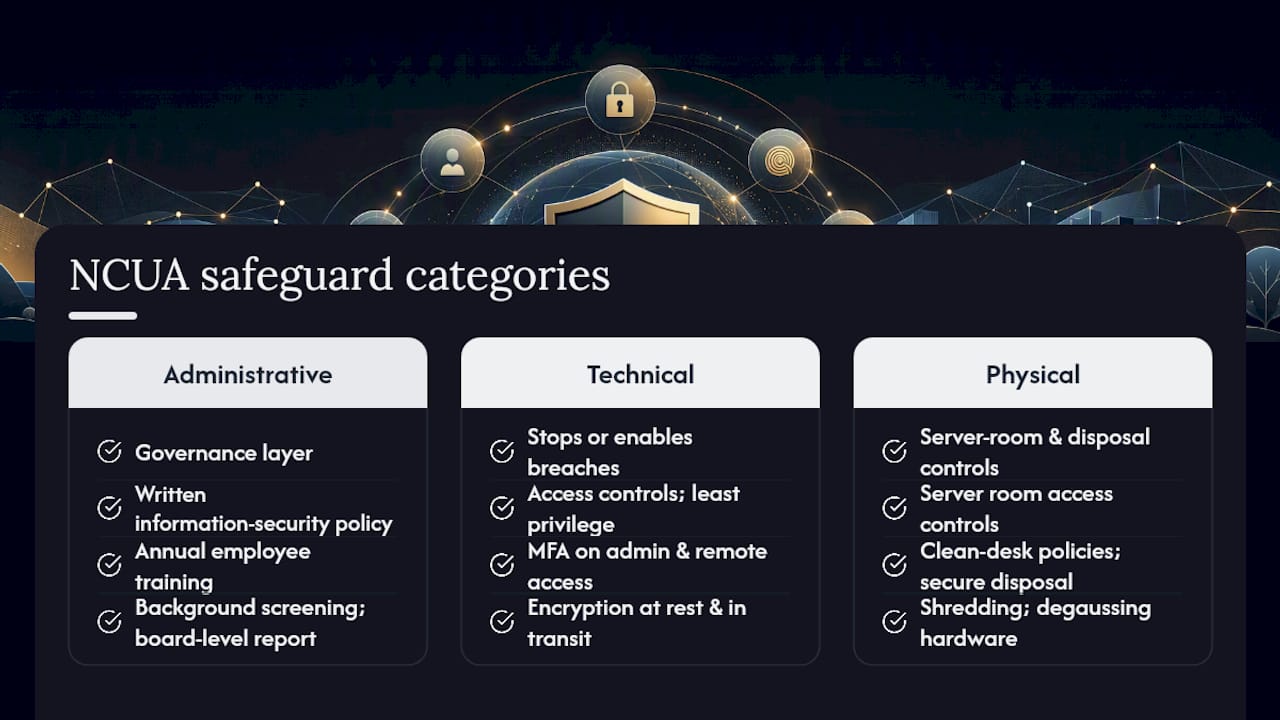
Administrative safeguards are the governance layer. A written information security policy, annual employee training on recognizing phishing and social engineering, background screening for staff with data access, and a board-level security report are the minimum. Small credit unions often underinvest here, treating policy documents as static rather than living controls.
Technical safeguards are where most breaches are either stopped or enabled. Access controls and least privilege mean that a loan officer has no business reading the core system's audit logs, and a teller has no reason to access member records outside their branch. MFA on all administrative and remote access is no longer optional — it is the single most effective control against credential-based attacks. Encryption at rest and in transit protects data even when perimeter defenses fail.
Physical safeguards cover server room access, clean-desk policies, and secure disposal of paper records and decommissioned hardware. Shredding documents and degaussing hard drives before disposal are straightforward controls that examiners still find missing at smaller institutions.
For small credit unions (under $100 million in assets), the practical starting point is: written policy, MFA, encryption, annual training, and a tested incident response plan. Mid-size and larger institutions should layer in continuous monitoring, automated alerting, and a formal vendor risk program.
Pro Tip: Map every control in your information security program to a specific section of 12 CFR Part 748, Appendix A. When examiners ask for evidence, you can produce a one-page crosswalk rather than hunting through policy documents.
How should credit unions manage vendor and third-party risk?
Every vendor with access to member data is an extension of the credit union's risk profile. NCUA examiners expect active vendor oversight — not just written contracts, but evidence of ongoing monitoring, SOC report review, and documented remediation of vendor findings. Contractual language without monitoring is one of the most common examination weaknesses.
A practical vendor risk program follows this sequence:
- Due diligence before contracting: Assess the vendor's security posture, financial stability, and regulatory history. Request SOC 2 Type II reports and review them for exceptions.
- Risk classification: Tier vendors by the sensitivity of data they access and the criticality of the service they provide. A core processor handling all member account data warrants more oversight than a landscaping vendor.
- Contract requirements: Every contract with a vendor that touches member data should include encryption-at-rest and in-transit requirements, a breach notification timeline (typically 72 hours or less), the right to audit or request updated SOC reports, and data return or destruction obligations at contract end.
- Continuous monitoring: Schedule annual SOC report reviews for critical vendors, and review exception items with the vendor in writing. Track contract renewal dates and re-assess risk classification when a vendor's service scope changes.
For a deeper look at structuring vendor due diligence and SOC report review, the third-party risk management guide published by Riskinmind covers the full lifecycle from initial assessment through contract termination.
The practical cadence for most credit unions: critical vendors reviewed annually with SOC report verification, standard vendors reviewed every 18–24 months, and a documented process for reviewing any vendor that experiences a security incident regardless of their tier.
- Identify all vendors with member data access and assign a risk tier.
- Collect and review current SOC 2 Type II reports for critical vendors.
- Confirm contract clauses cover encryption, breach notification, audit rights, and data destruction.
- Document monitoring activities and remediation of any SOC exceptions.
- Report vendor risk status to the board as part of the annual information security report.
What must credit unions tell members about their privacy practices?
Privacy notices are not a formality — they are a compliance trigger with specific content and timing requirements under Regulation P.
MyCreditUnion.gov clarifies that credit unions collect NPI including Social Security numbers, account numbers, balances, payment history, and even cookies from digital interactions. Members have opt-out rights for certain disclosures to nonaffiliated third parties, but those rights are narrower than most members assume. Credit unions may share data for transaction processing and fraud prevention without requiring opt-out consent. Other disclosures — sharing with nonaffiliated marketers, for example — require notice and a meaningful opportunity to opt out.
A compliant privacy notice must include:
- The categories of NPI the credit union collects.
- The categories of NPI the credit union discloses and to whom.
- Whether the credit union shares with affiliates and nonaffiliated third parties, and under what conditions.
- The member's right to opt out of certain disclosures, with a clear mechanism for doing so.
- The credit union's confidentiality and security practices.
- How the notice is delivered (mail, electronic, or in-person at account opening).
Annual notice timing: Under the 2015 amendment to Regulation P, credit unions are not required to deliver an annual privacy notice if they have not changed their disclosure practices and do not share NPI with nonaffiliated third parties in ways that trigger opt-out rights. When those conditions are not met, the annual notice requirement applies.
Pro Tip: Align your privacy notice language precisely to your actual data-sharing practices before each exam cycle. Examiners compare what the notice says to what the credit union actually does — a mismatch is a finding even when no member was harmed.
What steps should credit unions take after a data incident?
Speed and documentation discipline determine whether an incident becomes a manageable event or a regulatory crisis.
- Identify and scope: Determine what systems or data were affected, how many members are potentially impacted, and whether the incident is ongoing.
- Contain: Isolate affected systems, revoke compromised credentials, and block the attack vector. Do not wipe systems before preserving evidence.
- Preserve evidence: Capture logs, system images, and access records before remediation. This documentation supports both the examiner review and any law enforcement referral.
- Notify regulators: NCUA expects prompt notification of significant incidents. Review the NCUA's current guidance on reportable events and timelines, and notify law enforcement when criminal activity is suspected.
- Notify affected members: Provide clear, plain-language notification describing what happened, what data was involved, what the credit union is doing, and what members should do to protect themselves.
- Remediate: Address the root cause, patch vulnerabilities, and update controls to prevent recurrence.
- Post-incident review: Document lessons learned, update the incident response plan, and report findings to the board.
Pro Tip: Maintain a dedicated incident response log from the moment a potential incident is identified. Consistent, timestamped documentation protects the credit union during examinations and, if litigation follows, demonstrates that the institution acted in good faith.
Pro Tip: Test your incident response plan at least annually through a tabletop exercise. Examiners increasingly ask for evidence of testing, not just a written plan.
For context on how modern monitoring tools support early incident detection, the Riskinmind blog on catching trouble before failure outlines detection approaches aligned to NCUA exam expectations.
The tension between protection and progress is real — and manageable
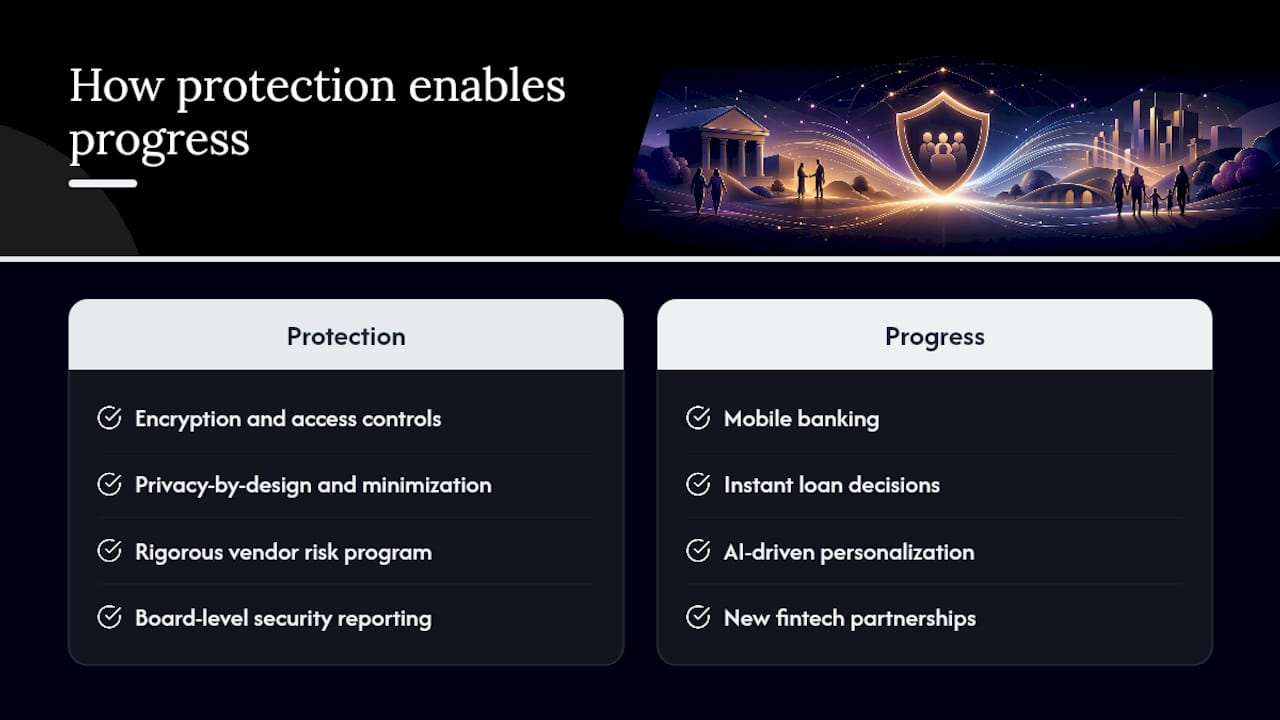
Credit unions face a genuine balancing act. The same digital capabilities that members now expect — mobile banking, instant loan decisions, AI-driven personalization — create new data flows, new vendors, and new attack surfaces. The instinct to slow down innovation in the name of compliance is understandable, but it is the wrong frame.
Strong data protection controls, applied thoughtfully, are what make safe innovation possible. Encryption and access controls do not prevent a credit union from offering a mobile app — they determine whether that app is a liability or an asset. Privacy-by-design, where data minimization and access restrictions are built into new products from the start rather than bolted on afterward, is the approach that lets credit unions move quickly without accumulating compliance debt.
The vendor gating process is another example. A rigorous vendor risk program does not block a credit union from adopting a new fintech partner — it creates the due diligence record that lets the board approve the relationship with confidence. America's Credit Unions has noted that fragmented state privacy requirements risk slowing exactly this kind of innovation by forcing credit unions to navigate conflicting obligations rather than focusing on member service.
Board-level governance is where this balance gets set. When the board receives an annual information security report that covers not just incidents but the state of controls, vendor risk, and emerging threats, it can make informed decisions about which digital initiatives to accelerate and which to approach more carefully. That governance discipline is also what examiners look for when they assess whether a credit union's risk management culture matches its risk appetite.
Data protection is not a constraint on member service. It is the condition under which member service can be trusted.
Riskinmind helps credit unions meet these obligations with less manual effort
Credit unions managing GLBA, Regulation P, and NCUA 12 CFR Part 748 compliance manually carry a significant administrative burden — tracking vendor SOC reports, maintaining audit-ready documentation, and monitoring for anomalies across member data systems. Riskinmind's AI-powered risk platform replaces that manual overhead with automated monitoring, real-time risk dashboards, and audit-ready reporting built specifically for financial institutions.
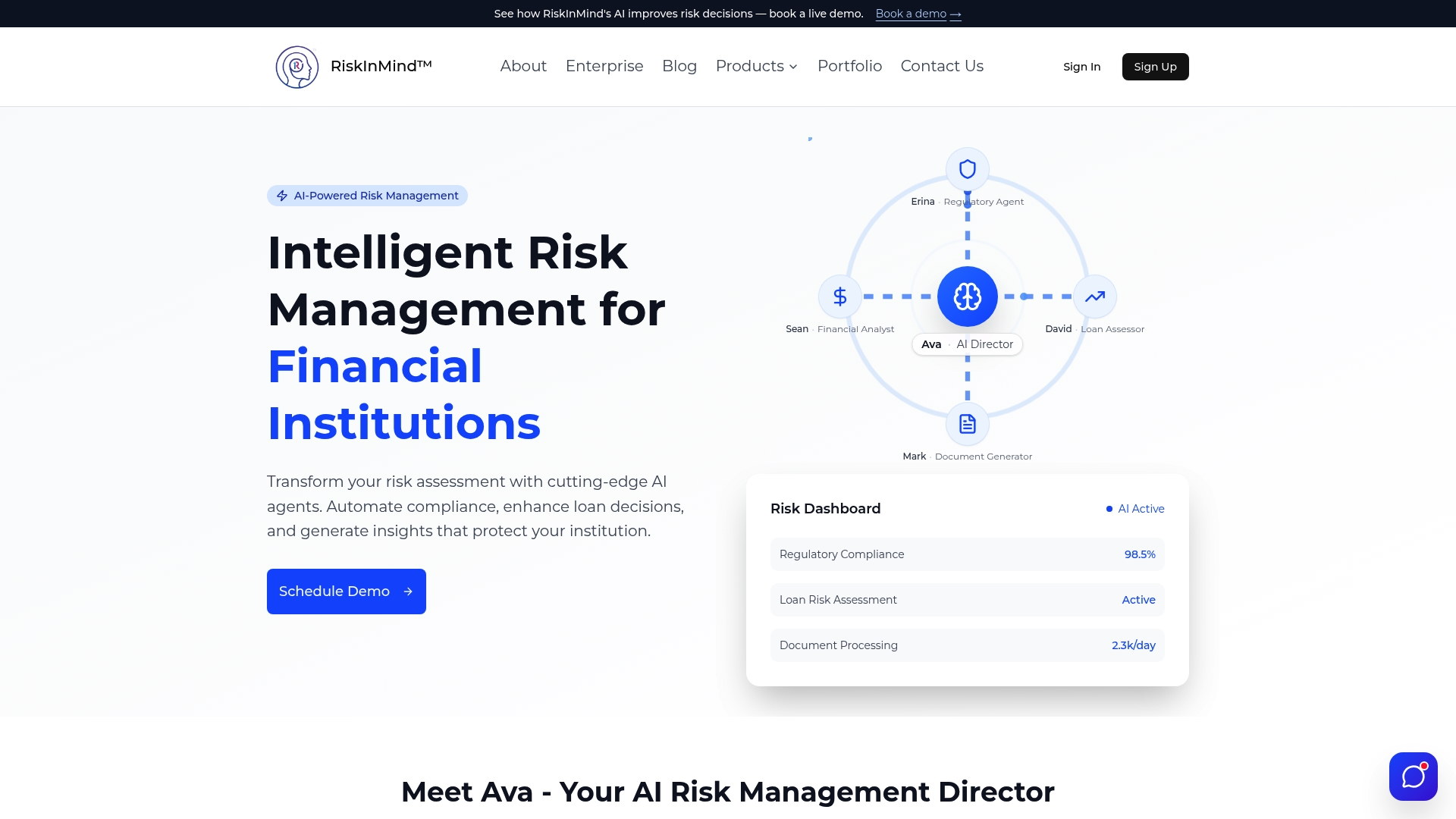
The platform's specialized AI agents handle regulatory compliance monitoring, vendor risk tracking, and portfolio surveillance simultaneously, with response times under half a second. Every output is structured for examiner review, so when NCUA asks for evidence of your information security program's effectiveness, the documentation is already organized. Riskinmind holds SOC 2® certification and operates at bank-grade security standards — the same bar it helps credit unions meet.
For credit unions evaluating whether automated workflows can replace legacy manual processes, the comparison of AI-driven underwriting versus manual systems illustrates the operational difference. Schedule a demo to see how Riskinmind maps directly to your GLBA and NCUA compliance requirements.
Sources
Primary regulator texts and member-facing resources for credit union professionals who need authoritative citations for internal policy work or examiner preparation:
- Privacy of Consumer Financial Information (Regulation P) | NCUA
- eCFR :: Appendix A to Part 748, Title 12 -- Guidelines for Safeguarding Member Information
- Data Privacy and Cybersecurity | America's Credit Unions
This article is general information, not a substitute for advice from a qualified financial advisor. Consult a qualified financial professional about your own circumstances before acting on anything here.
Recommended
- Stopping the Next 1st Choice: How RiskinMind.ai Helps Credit Unions Catch Trouble Before Failure | RiskInMind
- Transforming Credit Union Growth with AI-Powered Risk Intelligence | RiskInMind
- Risk management for credit unions: frameworks and AI solutions | RiskInMind
- Best AI Risk Management Platform for Credit Unions 2026 | RiskInMind.ai vs 19 Competitors