
Effective synthetic identity detection requires a layered, continuous process, not a single checkpoint at account opening. It combines multi-source data verification, link and graph analysis, and machine learning models trained specifically on synthetic patterns, monitored across the full customer lifecycle rather than just at onboarding.
The stakes justify the complexity. Traditional identity verification models, built to catch stolen-identity fraud, miss between 85% and 95% of synthetic applicants because those models look for a real victim who will eventually complain. Synthetic identities have no victim to complain about. Losses tied to synthetic fraud have reached into the billions of dollars for U.S. lenders, and internal industry estimates suggest the true scope stays undercounted because banks routinely classify synthetic charge-offs as ordinary credit losses.
You can start narrowing that gap this week with two moves: instrument device and behavioral telemetry at onboarding so you capture signals beyond the application form, and add Social Security Administration verification through eCBSV to your Customer Identification Program (CIP) workflow.
Automate Regulatory Model Risk Governance
Examine models against 32 qualitative criteria and resolve risk Tiers with pre-deployment checklists per OCC 2011-12 guidelines.
Quick Actions:
- Add device fingerprinting, IP velocity checks, and behavioral biometrics to your onboarding stack
- Enroll in eCBSV to verify SSN, name, and date of birth combinations against SSA records in real time
- Flag thin-file applicants with credit histories inconsistent with their stated age for manual or automated secondary review
Key Takeaways
Synthetic identity detection succeeds when institutions combine multi-source verification, link analysis, and continuously retrained machine learning across the full customer lifecycle rather than relying on a single onboarding check.
| Point | Details |
|---|---|
| Traditional models fail broadly | Legacy identity-theft-focused checks miss 85% to 95% of synthetic applicants, according to Thomson Reuters industry analysis. |
| Losses run into the billions | Auriemma Group estimated several billion dollars in lender losses from synthetic fraud, often miscoded as standard credit loss. |
| Red flags cluster, not stand alone | Watch for SSN-issuance mismatches, multiple identities per SSN, and shared device or IP signals across applications. |
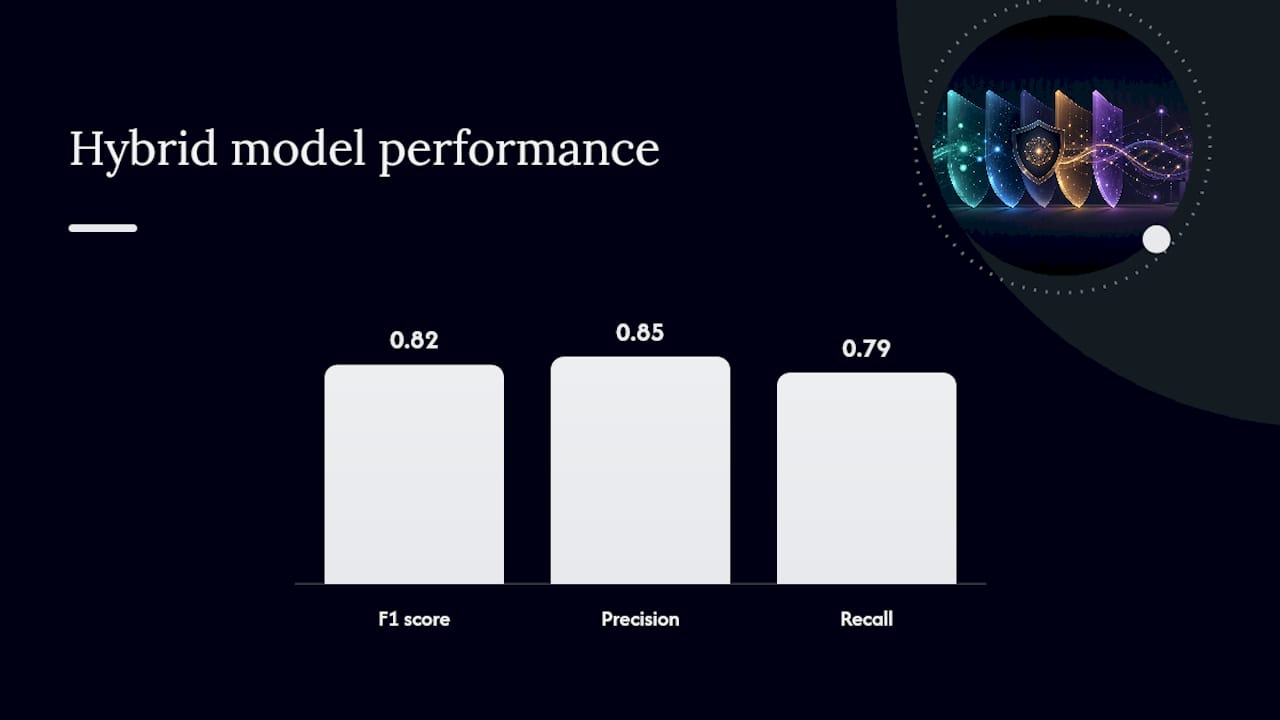
| Layered architecture outperforms single methods | Hybrid graph and machine learning pipelines have reported F1 scores near 0.82 with precision around 0.85. |
| RiskInMind maps detection to real workflows | Riskinmind's loan application and peer benchmarking products apply layered detection logic at onboarding and across portfolios. |
Table of Contents
- What Is Synthetic Identity Fraud and How Does It Differ From Identity Theft?
- Why Do Synthetic Identities Evade Traditional Detection Models?
- What Red Flags Signal a Synthetic Identity at Onboarding?
- How Do You Build a Layered Synthetic Identity Detection System?
- How Do You Roll Out Synthetic Identity Fraud Detection at Scale?
- How Do You Measure Whether Detection Is Actually Working?
- How Does RiskInMind Support Synthetic Identity Detection in Practice?
- What Are the Limits of Current Synthetic Identity Detection Methods?
- What Do Real Synthetic Identity Fraud Cases Look Like?
- How Should You Train and Update Machine Learning Fraud Models?
- Where Is Synthetic Identity Detection Headed?
- How Can RiskInMind Help You Detect Synthetic Identities Faster?
- Frequently Asked Questions
- Sources
What Is Synthetic Identity Fraud and How Does It Differ From Identity Theft?
Synthetic identity fraud is the construction of a new identity from a blend of real and fabricated information, most often a genuine Social Security number paired with a fictitious name, date of birth, or address. Traditional identity theft steals a real person's complete identity and uses it directly; synthetic identity fraud builds a new "person" who does not exist, then nurtures that person's credit profile until it looks creditworthy enough to borrow against.
A typical build follows a pattern. A fraudster obtains a valid but dormant SSN, often belonging to a child or someone who does not actively monitor credit, then applies for a secured card or becomes an authorized user on another account to start a credit file. Over 12 to 24 months, the file matures through consistent, low-risk activity. Only then does the fraudster apply for real credit lines, sometimes at multiple institutions simultaneously, and default without repayment once the credit ceiling is reached.
This is exactly why synthetic fraud evades the reporting systems banks rely on for early warning:
- No real victim exists to notice a stolen identity or file a police report
- Credit bureaus see a legitimately aging file, not a stolen one
- Charge-offs get coded as standard delinquency rather than fraud
- The Federal Reserve's white paper on synthetic identity payments fraud cites Auriemma Group estimates that synthetic fraud may have represented a significant portion of credit losses in a single year, a figure obscured because most institutions never separately tag it
Why Do Synthetic Identities Evade Traditional Detection Models?
Point-in-time identity verification checks a name, address, date of birth, and SSN against static records and calls it done. Synthetic identities are built specifically to pass that exact test, which is the core reason legacy fraud prevention techniques fail against them.
The sleeper-account strategy is the mechanism. A fraudster deliberately keeps a synthetic account dormant or minimally active for months, sometimes years, letting the credit file accumulate a history that looks indistinguishable from a real consumer's slow credit-building journey. Static PII checks pass every time, because the SSN is real, the file is real, and nothing about a single snapshot in time looks wrong.
Randomization made this worse. Before 2011, SSNs followed a predictable geographic and sequential pattern that let institutions flag numbers issued after someone's claimed birth year. The Social Security Administration's randomization scheme eliminated that signal, so a mismatched issuance date no longer jumps out through simple rule checks. Thin-file applicants, meanwhile, get treated as "low risk, new to credit" instead of "possibly fabricated," because most underwriting models were never trained to distinguish the two.
That combination points to one conclusion: detection has to shift from static identity matching toward relationship analysis and behavioral signals that reveal how an identity behaves over time, not just what it claims to be at a single moment.
- Credit-file age and depth get manipulated deliberately, defeating simple recency checks
- SSN randomization removed a once-reliable red flag for issuance-date mismatches
- Thin-file status gets misread as "new consumer" rather than a potential fabrication
- Static, single-source PII checks cannot see relationships across accounts, applications, or devices
Pro Tip: Run a retrospective query against your charge-off portfolio for accounts with a credit history under three years, no delinquency history before default, and an authorized-user relationship established in the first six months. That pattern alone surfaces a disproportionate share of synthetic bust-outs most banks never labeled as fraud.
What Red Flags Signal a Synthetic Identity at Onboarding?
Detecting synthetic identity fraud comes down to watching for combinations of small anomalies, since any single flag alone rarely proves fraud. The Federal Reserve's synthetic identity white paper enumerates several indicator categories your team should instrument directly into onboarding and ongoing monitoring workflows.
- Credit-file anomalies: A file's age doesn't match the applicant's claimed date of birth, or the file shows no activity typical of a genuine credit history (missed payments, credit inquiries from retail purchases, address changes tied to life events).
- SSN-related flags: The SSN was issued after the applicant's stated birth year, or the same SSN appears attached to multiple distinct names and addresses across your systems.
- Identity link anomalies: One SSN links to an unusual number of authorized users, or several applications share a name variant with different SSNs.
- Device, IP, and velocity signals: Multiple applications originate from the same device fingerprint or IP address within a short window, often across different institutions.
- Document and biometric mismatches: Selfie-to-ID liveness checks fail, or submitted documents show inconsistent fonts, metadata, or formatting versus known-good templates.
- Network indicators: Clusters of applicants share addresses, phone numbers, or employer information in patterns consistent with an organized ring rather than coincidence.
Beta tests of machine learning models tuned specifically for these patterns have flagged roughly 85% of synthetic-origin applications in industry trials, a meaningful jump over legacy identity-theft-focused scoring.
How Do You Build a Layered Synthetic Identity Detection System?
No single data source or model catches synthetic identities reliably on its own. The Federal Reserve's mitigation toolkit frames this explicitly: layered, collaborative detection across multiple data types outperforms any single-vendor or single-signal approach, and no institution stops synthetic fraud working in isolation.
Start with the data layer. Prioritize inputs in this order for return on effort:
- Bureau data for credit-file depth, inquiry patterns, and tradeline history
- eCBSV/CBSV verification to confirm SSN, name, and date of birth match SSA records directly
- Device and behavioral telemetry capturing keystroke patterns, session length, and navigation behavior
- Alternative data such as utility payments, rental history, and telecom records for thin-file applicants
Layer analytics on top of that data rather than treating any one method as sufficient. Rules engines catch known patterns fast and cheaply, but fraudsters adapt around static thresholds within months. Graph and link analysis solves that blind spot by mapping relationships across SSNs, addresses, devices, and phone numbers, surfacing the sleeper-account clusters that rules miss entirely because connecting accounts across product lines reveals synthetic identities cultivating creditworthiness long before a bust-out attempt.
Machine learning closes the remaining gap. Unsupervised anomaly detection flags identities that behave statistically differently from genuine consumers without needing pre-labeled fraud examples, useful for catching novel patterns. Supervised classifiers, trained on confirmed synthetic cases, then rank and prioritize alerts for investigator review. A recent hybrid graph-based approach combining these techniques reported an F1 score near 0.82, precision around 0.85, and recall around 0.79 on operational test data, evidence that combined architectures meaningfully outperform any single method.
Ensemble approaches that pair rules, unsupervised anomaly detection, and supervised classifiers balance catching fraud early against keeping false positives low enough that legitimate applicants don't feel the friction.
Explainability matters as much as raw accuracy here. Techniques like SHAP feature-importance scoring let your fraud analysts see why a model flagged an applicant, which keeps analyst trust intact and satisfies model governance requirements during regulatory exams. Pair that transparency with staged step-up verification, where borderline applicants get an extra document or liveness check instead of an outright denial, and you cut friction for genuine thin-file consumers while still isolating the synthetic cases for deeper review.
How Do You Roll Out Synthetic Identity Fraud Detection at Scale?
Deploying detecting synthetic identities across your loan pipeline works best as a phased build rather than a single big-bang launch. Each phase should produce a measurable win before you move to the next.
- Phase 1, quick wins (weeks 1 to 6): Instrument device fingerprinting and IP velocity checks at your existing application flow, integrate eCBSV for real-time SSN verification, and deploy basic rules engines against the red-flag list from the previous section.
- Phase 2, data and modeling (months 2 to 5): Build out graph analytics connecting accounts across your product lines, assemble a labeled dataset of confirmed synthetic bust-outs from historical charge-offs, and backtest supervised models against that dataset before any live deployment.
- Phase 3, operations and governance (ongoing): Establish triage workflows so flagged applications route to trained investigators within a defined service window, schedule quarterly model retraining as fraud patterns shift, and document your privacy and audit controls for regulatory review under BSA and CIP obligations.
Pro Tip: Do not skip the labeled dataset step to save time. A model trained only on rules-based flags will simply learn to replicate your rules engine's blind spots. Pull confirmed bust-out cases from charge-off records specifically coded as fraud, even if that means a manual review of a year of historical files first.
Bring compliance and legal into Phase 1, not Phase 3. eCBSV enrollment, data-sharing agreements, and any behavioral biometric collection all carry disclosure and consent requirements worth confirming before you build dependent workflows around them.
How Do You Measure Whether Detection Is Actually Working?
Precision, recall, and F1 score remain the core trio for evaluating any synthetic identity fraud detection model: precision tells you what share of flagged applications are truly synthetic, recall tells you what share of actual synthetic cases you caught, and F1 balances the two into one comparable number. Track false-positive rate separately, since a model with strong recall but poor precision buries your investigation team in dead-end alerts.
Time-to-detection matters just as much as accuracy. A model that correctly flags a synthetic identity only after $50,000 in credit exposure has accumulated delivers far less value than one that flags it at the thin-file stage.
- Validate models against holdout sets never seen during training, plus backtests on known historical bust-outs
- Run A/B tests on alert thresholds before committing to a production cutoff
- Report precision, recall, false-positive rate, and estimated prevented losses to risk committees on a monthly cadence, with quarterly deep-dives on model drift
A published hybrid detection pipeline reached precision near 0.85 and recall near 0.79 under careful tuning, a useful external benchmark for your own model reviews.
How Does RiskInMind Support Synthetic Identity Detection in Practice?
Riskinmind's platform was built around the same layered logic this article describes: specialized AI agents working under a central AI director, Ava, rather than one generic model trying to catch every fraud pattern at once. That structure matters for synthetic identity fraud specifically, because the credit risk, compliance, and document-fraud problems each need different analytical lenses.
- SOC 2® certified infrastructure with bank-grade security controls appropriate for handling SSN verification and applicant PII
- Sub-half-second real-time processing at the point of loan application, where synthetic identity signals need to surface before underwriting proceeds
- AI agents specialized by function, including credit risk assessment and document fraud detection, coordinated rather than siloed
In practice, the highest-value integration points are the loan application flow itself, where onboarding signals get scored in real time, and ongoing portfolio monitoring, where accounts that passed onboarding checks get re-evaluated as new behavioral data accumulates. Document fraud detection, covered in Riskinmind's analysis of check and document tampering, works as a complementary layer since document manipulation and synthetic identity construction often overlap in organized fraud rings.
The institutions that catch synthetic fraud earliest are the ones that stopped treating identity verification as a one-time gate and started treating it as a continuous signal.
What Are the Limits of Current Synthetic Identity Detection Methods?
No detection method available today closes the synthetic identity problem completely, and risk teams should plan around that reality rather than around a false sense of a solved problem.
Labeled data remains the biggest constraint. Supervised models need confirmed synthetic fraud cases to learn from, but most institutions historically coded synthetic bust-outs as ordinary credit losses rather than fraud, which means training data is often sparse, inconsistent, or several years stale by the time it's cleaned and usable. Graph analytics run into a related limit: they work best when institutions share data across the industry, since a single bank's dataset only sees a fraction of a synthetic ring's activity. Cross-institution data sharing remains limited by competitive concerns, privacy law, and inconsistent data formats, even where the Federal Reserve's toolkit actively encourages it.
Explainability and accuracy also pull against each other. The most powerful graph-based and deep-learning models tend to be the hardest to explain to an examiner or an internal model risk committee, which forces institutions to trade some detection power for auditability. And every method still faces an adversarial opponent: fraudsters actively test which patterns trigger alerts and adjust their build strategy accordingly, so a model tuned against last year's synthetic patterns degrades against this year's variations without regular retraining.
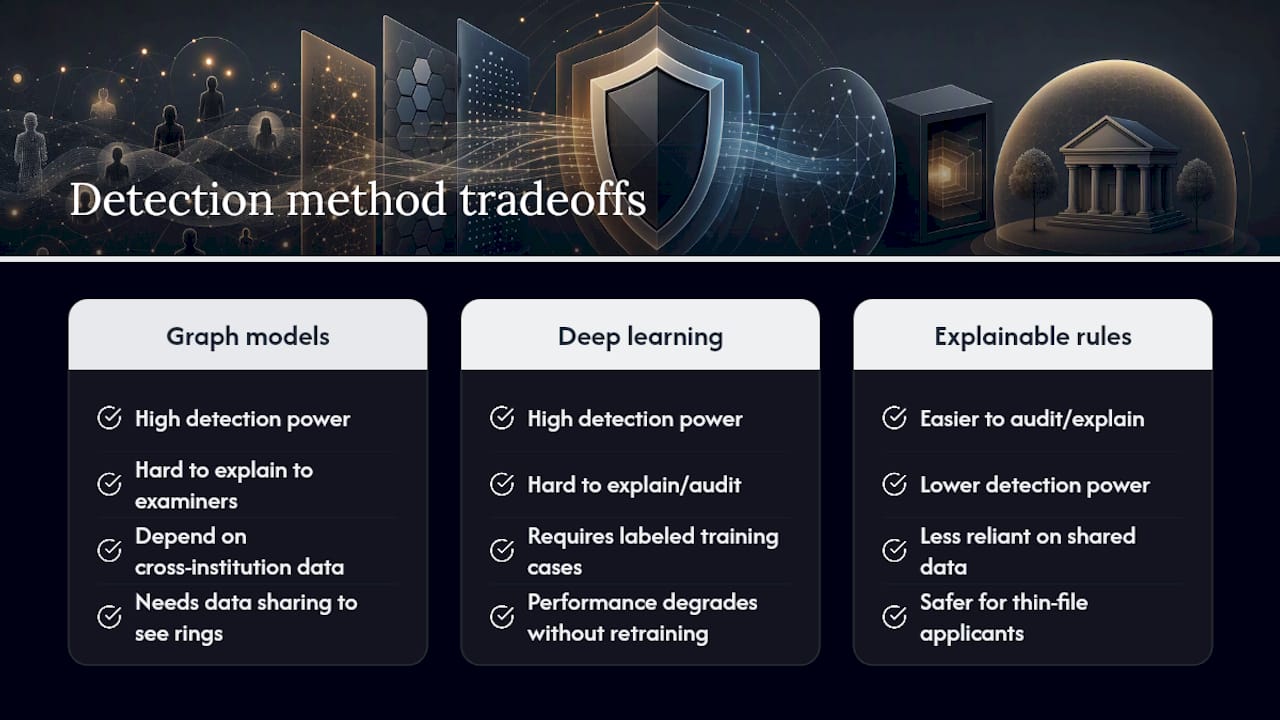
False positives carry a real cost too. Push detection too aggressively and legitimate thin-file consumers, often younger applicants or recent immigrants building credit for the first time, get denied or subjected to excessive friction they didn't earn.
What Do Real Synthetic Identity Fraud Cases Look Like?
The clearest illustration of synthetic fraud's scale sits in the loss estimates themselves rather than any single dramatic case. The Federal Reserve's white paper cites Auriemma Group research estimating several billion dollars in lender losses tied to synthetic identity fraud, with synthetic cases representing a significant portion of credit losses in the year studied, a figure many institutions never separately tagged as fraud at all.
That undercounting is the real story. A synthetic bust-out typically gets booked as a standard charge-off, since the account had a real credit history, real payment activity for months or years, and no victim filing a dispute. Risk teams reviewing historical charge-off portfolios for the specific pattern described earlier in this article, thin credit history paired with no delinquency before a sudden high-balance default, routinely find synthetic cases hiding inside "normal" loss buckets they never flagged as fraud in the first place.
Organized rings amplify the pattern further. Rather than building one synthetic identity, fraud rings construct dozens or hundreds simultaneously, sharing addresses, phone numbers, or employer details across applications in ways that only surface through network-level link analysis rather than single-application review. The Federal Reserve Bank of Boston's interview series on AI and synthetic fraud notes that generative AI tools now let these rings produce more convincing supporting documentation and synthetic profiles at a scale manual review teams cannot match, reinforcing why network-level, automated detection has become the practical necessity rather than a nice-to-have upgrade.
How Should You Train and Update Machine Learning Fraud Models?
Machine learning models built for synthetic identity fraud detection degrade the moment fraudsters adapt around them, which makes retraining discipline as important as initial model accuracy.
Start with data quality over data volume. A smaller dataset of confirmed, well-labeled synthetic bust-outs trains a more useful model than a massive dataset contaminated with mislabeled ordinary delinquencies. Build your labeling process with input from investigators who worked the actual cases, not just automated charge-off codes, since those codes routinely misclassify synthetic fraud as standard credit loss as discussed above.
Backtesting against historical bust-outs before any live deployment catches a model that overfits to your training data's quirks rather than learning generalizable fraud patterns. Run new model versions in shadow mode alongside your production model for a defined evaluation window, comparing flagged cases before cutting traffic over, rather than replacing a working model outright on day one.
Retraining cadence should follow a quarterly rhythm at minimum, with unscheduled retraining triggered whenever your false-positive rate or recall shifts meaningfully outside expected ranges. Practical deployment requires reviewer feedback loops so that investigator decisions on flagged cases, whether confirmed or dismissed, feed directly back into the next training cycle rather than sitting in a case management system unused.
Explainability tooling, such as SHAP-based feature importance, should be part of every retraining cycle review, not a one-time setup step, since a model's feature dependencies shift as fraud patterns evolve and your governance committee needs current visibility into what's actually driving each version's decisions.
Where Is Synthetic Identity Detection Headed?
Generative AI has changed the threat model faster than most institutions' detection roadmaps account for. Fraudsters can now generate synthetic documentation, photo-realistic identity images, and even voice samples that pass basic liveness checks, which means the detection arms race increasingly runs model against model rather than model against static rules. The strongest institutional response isn't a single better algorithm. It's committing to industry data sharing on synthetic indicators, since no single bank's dataset captures enough of a ring's footprint to see the full pattern alone, and treating model retraining as a continuous discipline rather than an annual project.
How Can RiskInMind Help You Detect Synthetic Identities Faster?
Building the layered detection stack this article describes in-house, connectors for bureau data and eCBSV, graph analytics infrastructure, supervised model training, and investigator triage workflows, typically takes risk teams a year or more of engineering time before the first model goes live. Riskinmind compresses that timeline by delivering the layered architecture as a working platform rather than a build project.

The loan application product scores synthetic identity risk in real time at the point of underwriting, combining the device, credit-file, and link-analysis signals covered throughout this article into a single sub-half-second decision, backed by Riskinmind's SOC 2® certified security controls. For institutions further along in their fraud program, peer benchmarking lets your risk committee compare detection metrics like false-positive rate and time-to-detection against comparable lenders, turning the KPIs discussed earlier into a competitive reference point rather than an isolated internal number.
If your current onboarding flow still relies on static PII matching alone, a working demo of Ava and the specialized fraud-detection agents built around her is the fastest way to see the gap between where you are and where a layered system gets you. Request a demo through Riskinmind to walk through your own onboarding data against the platform's detection logic.
Frequently Asked Questions
What is the difference between synthetic identity fraud and traditional identity theft?
Traditional identity theft uses a real person's complete, existing identity without their consent. Synthetic identity fraud constructs a new identity from a mix of real information, often a genuine SSN, and fabricated details like a false name or birth date, so there's no real victim to report the fraud.
Why do credit bureaus struggle to catch synthetic identities?
Bureau files reflect activity, not authenticity. A synthetic identity that pays a secured card on time for a year builds a credit file that looks exactly like a genuine consumer's early credit history, because the underlying behavior really did happen, just not by a real person.
What is eCBSV and why does it matter for synthetic identity fraud detection?
The Social Security Administration's Consent Based SSN Verification (eCBSV) service confirms whether a submitted SSN, name, and date of birth match SSA records, giving lenders a direct data point against fabricated identity combinations that bureau data alone won't reveal.
How long does it typically take fraudsters to build a synthetic identity?
Sleeper accounts often mature for 12 to 24 months before a fraudster attempts a major credit application or bust-out, which is why lifecycle monitoring after onboarding matters as much as the initial identity check.
What metrics should risk teams track to measure detection effectiveness?
Precision, recall, F1 score, false-positive rate, and time-to-detection form the core measurement set, validated through backtests on confirmed historical bust-outs and reported to risk committees on a regular cadence.
Sources
- Trends in synthetic identity fraud
- Detecting Synthetic Identity Fraud in the U.S. Payment System (Federal Reserve Payments Improvement white paper)
- Synthetic Identity Fraud Detection Using Federated Hybrid Graph Autoencoder—An AI-Based Approach