
Champion challenger models pit a production model (the champion) against one or more alternatives (challengers) in a controlled, ongoing test to decide whether to retain, replace, or retire the incumbent. A well-run program ends in one of two defensible outcomes: a validated, production-ready replacement or a governance-backed decision to keep the champion. Supervisory frameworks including SR 11-7 and the OCC's model risk guidance treat this discipline as core to sound model risk management, and platforms like RiskInMind now build it directly into daily workflows.
TL;DR:
- Set eligibility by portfolio size, loss exposure, and regulatory tier; choose statistical challengers for outdated weights, reserving machine learning for structural weaknesses.
- Keep randomized assignments fixed, size samples for the expected effect, and use a holdout that sometimes overrides rejected applications to reveal otherwise hidden outcomes.
- Screen challengers against historical outcomes, but require live results from a separate population before promotion; compare discrimination, calibration, stability, and business impact.
- Independent validators and challenge teams need authority to reject proposals, while audit logs record experiment design, metrics, approvals, rollback decisions, and monitoring alerts.
- Promote winners through shadow mode, a small canary, and phased rollout, retaining a control group and preset drift alerts with a rollback plan.
Automate Regulatory Model Risk Governance
Examine models against 32 qualitative criteria and resolve risk Tiers with pre-deployment checklists per OCC 2011-12 guidelines.
Table of Contents
- What a champion challenger program actually requires
- Designing challengers: techniques, features, and explainability
- Designing experiments that hold up under scrutiny
- Validation metrics and what the results actually mean
- Governance, roles, and supervisory alignment
- Operationalizing challengers and keeping them monitored
- What Raj's work on SR 26-2 brought to program design
- Why most programs overweight the model and underweight the process
- How RiskInMind supports your champion challenger program
- FAQ
- Sources
What a champion challenger program actually requires
Before testing anything, we need to define what belongs in scope. Not every model justifies a formal challenger program: materiality thresholds, typically tied to portfolio size, loss exposure, or regulatory classification, determine which models warrant the investment. A small behavioral scorecard touching a few thousand dollars in exposure rarely needs the same rigor as a credit risk model underwriting a loan portfolio.
Once scope is set, the program needs a living model inventory with clear eligibility rules and change-control triggers, so a model that drifts past a set threshold or a regulatory update automatically queues a challenger review. Challenger types generally fall into three buckets:
- Traditional statistical challengers, such as alternative logistic regressions or scorecards, which carry lower validation burden.
- Machine learning challengers, including gradient-boosted trees or random forests, which often improve classification but raise explainability demands, as the EBA's follow-up report on machine learning for IRB models notes.
- Hybrid approaches, blending a white-box structure with ML-derived features to balance performance and interpretability.
Acceptance into production requires a documentation trail covering model specification, training data lineage, validation results, and sign-off from independent reviewers, the kind of audit trail examiners expect to see without having to ask twice.
Designing challengers: techniques, features, and explainability
Picking a challenger architecture is a cost-benefit exercise, not a race toward complexity. A simple statistical competitor, like a revised scorecard with updated variable weights, can often close most of the performance gap at a fraction of the validation cost of a full machine learning build. Where the champion is underperforming structurally, rather than just out of date, an ML challenger becomes worth the added governance overhead.
Feature space matters as much as algorithm choice. A challenger built on the same variables as the champion will rarely find much new signal; the real test is whether alternative data sources, more granular transaction histories, or updated macro variables surface information the champion cannot see.
Explainability shapes which challengers are realistic to validate on a reasonable timeline:
- SHAP and LIME outputs translate ML variable importance into language validators and examiners can assess.
- White-box models, including regression and decision trees, carry inherently lower governance cost because their logic is transparent by design.
- Hybrid structures can borrow ML-derived features inside a transparent model shell.
Staffing and compute needs scale with challenger complexity: an ML challenger typically demands data science capacity, more validation hours, and ongoing monitoring infrastructure that a simple statistical alternative does not.
Pro Tip: Budget validation hours before model-build hours. An ML challenger that takes a week to train can take a month to validate.
Designing experiments that hold up under scrutiny
A challenger result only matters if the test that produced it was clean. Four design choices separate a defensible program from one that invites regulatory pushback.
- Randomize assignment and keep it persistent. Customers or accounts assigned to the challenger arm should stay there for the test's duration; re-randomizing mid-experiment introduces bias that is nearly impossible to unwind later.
- Size the sample to the effect you expect to detect. A test that is too small produces results indistinguishable from noise; running longer or widening the test cell is often necessary to reach a stable read.
- Use holdouts or test cells to capture outcomes the champion would otherwise hide. When the champion rejects an applicant, that outcome is never observed under the current policy, so a randomized test cell that occasionally overrides the champion's decision is often the only way to generate unbiased challenger evidence.
- Isolate parallel experiments. Running multiple tests on overlapping populations without controls risks contamination, where one experiment's effect bleeds into another's results and neither conclusion can be trusted.
Practitioner guidance from the FICO community's champion/challenger testing resources echoes this: robustness and bias avoidance are design requirements, not afterthoughts.
Validation metrics and what the results actually mean
Choosing a winner starts with the right metrics tracked consistently across both models:
- Discrimination: AUC and rank-ordering to measure how well each model separates good from bad outcomes.
- Calibration: how closely predicted probabilities match observed outcomes.
- Stability: population stability index (PSI) to catch drift in the input population over time.
- Business impact: lift, approval rate changes, and downstream economic effect.
Back-testing against historical data is faster and cheaper, but live outcomes analysis on a held-out population is the only way to confirm a challenger performs as expected under current conditions rather than past ones. Prefer back-testing for early screening and live testing before any promotion decision.
Research shows ML challengers like XGBoost and Random Forest can outperform traditional logistic models in both classification and calibration, with gains that may translate into material capital savings when properly validated, according to EBA research on machine learning performance in credit default prediction. A statistically significant win is not the same as production survivability: a model that performs well in testing but degrades quickly or resists explanation will not hold up under ongoing supervision. Translating a calibration improvement into expected capital relief or loss reduction is what ultimately persuades senior management and the board.
Governance, roles, and supervisory alignment
A challenger result only counts as evidence once it passes through defined governance roles. Model owners propose and maintain models; an independent validation team tests them; an effective challenge function, separate from model development, assesses both; and internal audit confirms the process itself was followed.
SR 11-7 ties these roles directly to supervisory expectations: periodic review, independence of validation staff, and ongoing monitoring are not optional extras but core requirements. The OCC's guidance on sound model risk practices adds that effective challenge depends on the challenger function's independence, competence, and actual authority to influence decisions, not just a sign-off box.
A documentation checklist examiners and internal audit will expect includes:
- Model inventory entries with risk tier and last validation date.
- Experiment design documentation, including randomization method and sample size rationale.
- Validation results with both statistical and business metrics.
- Promotion, rollback, and escalation decision logs with named approvers.
Operationalizing challengers and keeping them monitored
Moving a winning challenger into production works best through staged exposure: shadow mode first, then a small canary population, then a phased rollout with a persistent control group retained for comparison.
- Monitor data drift, feature distributions, and performance decay against preset alert thresholds.
- Define retraining cadence in advance rather than reacting to decay after the fact.
- Keep an incident playbook ready for rollback if monitoring trips an alert.
- Where data is scarce, combined-portfolio evidence and statistical adjustment can substitute for a full test cell, treated as tentative until more data accrues.
What Raj's work on SR 26-2 brought to program design
Years spent on SR 26-2 remediation work taught us that most champion challenger programs fail on documentation discipline, not model quality. Audit trails are built directly into each test rather than relying on separate memos. When evaluating any platform, check for built-in explainers, persistent audit logs, and real-time monitoring dashboards, not just model-building tools.
Pro Tip: Ask any platform vendor to show you a completed audit trail before you see the model dashboard. The trail tells you more about production-readiness than the accuracy score does.
Why most programs overweight the model and underweight the process

The conventional advice on champion challenger testing fixates on model architecture, whether to use XGBoost over logistic regression, when the real failure point is almost always process discipline: inconsistent randomization, undocumented test-cell decisions, or validation teams that lack real authority to say no. A sophisticated challenger built on a contaminated experiment is worse than a simple one built on a clean test, because it produces confident, wrong conclusions.
We would tell any model risk team starting a program to fix the experiment design and governance roles first, before touching model architecture. Persistent randomization, a properly sized holdout, and a validation function with genuine independence will surface more reliable signal than any amount of feature engineering layered onto a biased test. Once that foundation holds, the choice between a white-box challenger and an ML-based one becomes a straightforward cost-benefit question rather than a leap of faith.
— Raj
How RiskInMind supports your champion challenger program
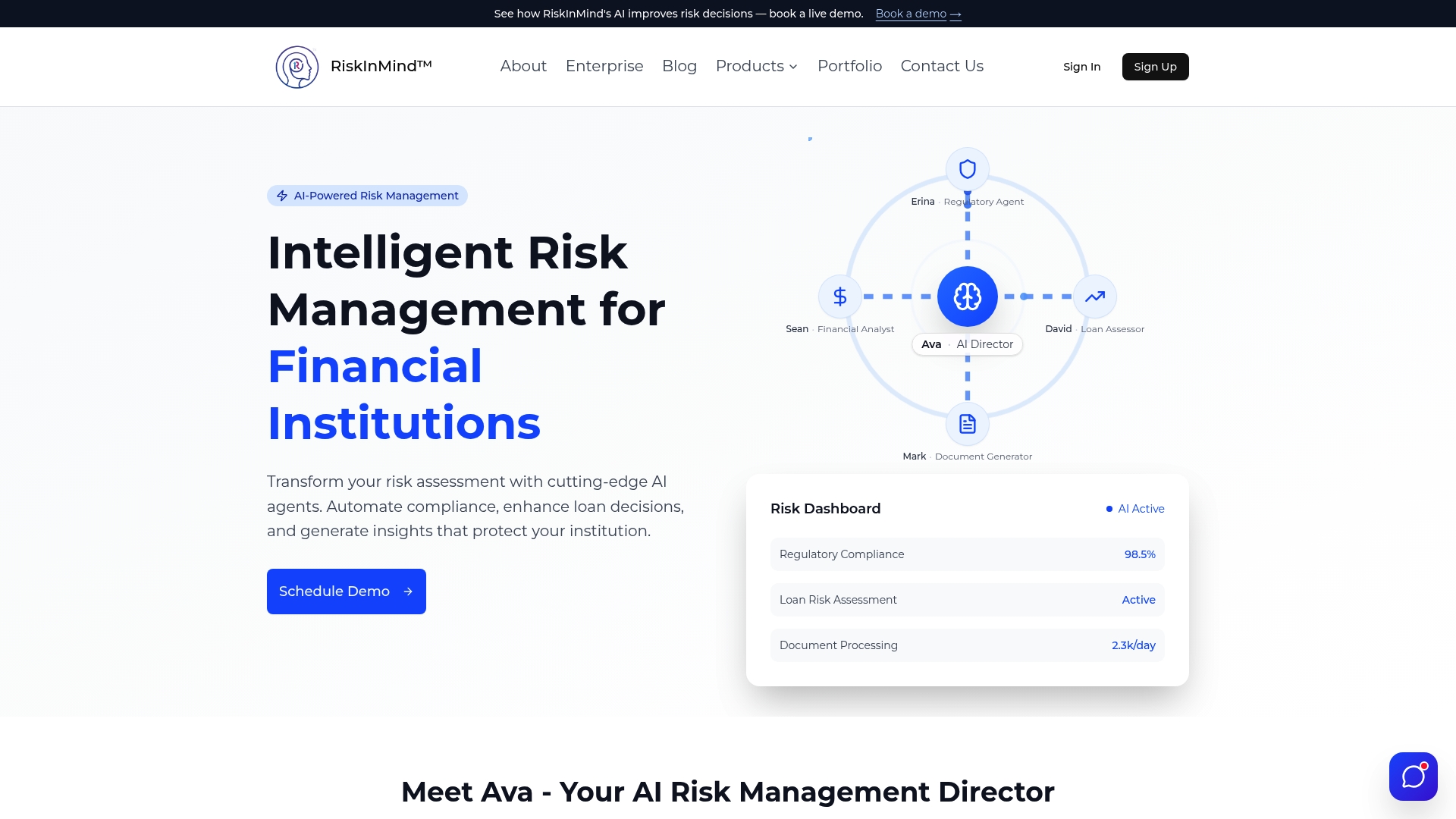
Running a champion challenger program well means coordinating experiment design, audit trails, and monitoring without drowning your team in spreadsheets. AI agents work across credit risk assessment, regulatory compliance, and portfolio monitoring, with security-aligned controls and rapid processing built in.
- Review Starter, Professional, and Enterprise plans to find the right fit for your institution.
- Explore Bank OS and Portfolio capabilities relevant to ongoing model monitoring.
- See the Loan Application product for a concrete credit decisioning example.
Schedule a demo to see how our platform fits into your existing model governance workflow.
This article is general information, not a substitute for advice from a qualified financial advisor. Consult a qualified financial professional about your own circumstances before acting on anything here.
FAQ
What is the difference between a champion and a challenger model?
The champion is the model currently deployed in production, while a challenger is an alternative tested against it under the same conditions. The program decides whether to promote a challenger to champion status based on validated performance and governance sign-off.
How long does a typical champion challenger test run?
Runtime depends on sample size needs and how quickly stable outcomes accumulate, often requiring enough volume to reach statistically reliable results before a decision is made. Teams should size the test before launch rather than stopping early once results look favorable.
How do we avoid selection bias in challenger testing?
Selection bias emerges because outcomes for applicants the champion rejects are never observed under current policy. A persistent, randomized holdout or test cell that occasionally follows the challenger's decision is generally necessary to generate outcome data that is not distorted by the champion's own filtering.
What documentation do regulators expect from a challenger program?
Examiners generally expect a model inventory entry, experiment design rationale, validation results covering both statistical and business metrics, and decision logs showing who approved promotion or rollback. This aligns with SR 11-7 expectations around independent validation and ongoing monitoring.
Does RiskInMind support champion challenger testing?
RiskInMind's platform includes AI agents for credit risk assessment, compliance, and portfolio monitoring with built-in audit trails and real-time processing. Pricing details for the Starter, Professional, and Enterprise plans are available on our pricing page.
Sources
- SR 11-7: Guidance on model risk management (Federal Reserve)
- Sound practices for model risk management (OCC)
- Follow-up report on machine learning for IRB models (EBA)