
CECL requires institutions to estimate lifetime expected credit losses using historical loss experience, current loan-level portfolio data, and reasonable and supportable forward-looking forecasts. There is no single mandated data list. What you collect depends on your chosen estimation methodology, but every approach demands documented sources, retention discipline, and controls examiners can trace from raw data to reported allowance.
TL;DR:
- Smaller institutions can effectively use vintage and loss-rate methods with minimal data while preserving their ability to defend the model during exams.
- Data governance controls such as full time series preservation, documentation of lineage, and role-based access are critical to avoid issues during regulatory reviews.
- When internal loss data is limited, proxy sources like peer loss data, regional unemployment rates, and local house price indices are acceptable if well-documented.
- Institutions must prepare comprehensive model documentation, including data lineage, cohort definitions, methodology rationale, and validation reports, to meet examiner expectations.
Automate Regulatory Model Risk Governance
Examine models against 32 qualitative criteria and resolve risk Tiers with pre-deployment checklists per OCC 2011-12 guidelines.
Table of Contents
- What Are the Core CECL Data Requirements?
- How Do Data Requirements Change by CECL Method?
- What Data Governance Controls Does CECL Require?
- What If Your Institution Is Missing Historical Loss Data?
- What Documentation Do Examiners Expect for CECL?
- Lessons From the Field on CECL Data Pitfalls
- How RiskInMind Supports CECL Data Collection and Reporting
- Where to Verify CECL Policy and Data Guidance
- Sources
- FAQ
What Are the Core CECL Data Requirements?
Meeting CECL data requirements starts with three categories: loan-level attributes, performance history, and forward-looking macro inputs. FASB's ASU 2016-13 requires lifetime loss measurement and consideration of forward-looking information, but it deliberately avoids prescribing one estimation method or one fixed field list. That flexibility is useful, and it's also why so many institutions collect the wrong things first.
Start with loan metadata: origination date, maturity date, original principal balance, current balance, scheduled payment amount, interest rate and rate type (fixed, variable, hybrid), and the full amortization schedule. Without these, you cannot reconstruct expected cash flows or segment loans meaningfully.
Performance history matters just as much as origination data. You need payment dates, delinquency status by reporting period, charge-off dates and amounts, recovery amounts, and modification or troubled debt restructuring flags. Miss the delinquency history and your roll-rate calculations become guesswork.
Cohort identifiers let you segment the portfolio the way your model requires:
- Origination vintage (the year or quarter the loan was booked)
- Product type (auto, commercial real estate, credit card, agricultural, and so on)
- Collateral type and, where relevant, loan-to-value at origination
- Geographic indicators tied to regional economic exposure
- Borrower credit score at origination and, ideally, refreshed periodically
- NAICS code for commercial and industrial loans
Layer in aggregate time series: quarterly gross charge-offs, recoveries, and delinquency rates by segment. Practical CECL data guides recommend preserving history spanning a sufficient period to capture a full business cycle where it exists, since a single benign year of losses understates risk in a downturn.
Finally, capture forward-looking macro series at a granularity that matches your portfolio's concentration: unemployment rates by state or MSA, home price indices by region, and GDP growth, all mapped to the geographies and products where your exposure concentrates.
How Do Data Requirements Change by CECL Method?
The estimation method you pick determines which fields actually matter, and mismatched data and methodology is one of the fastest ways to draw examiner scrutiny.
- Vintage and loss-rate methods need clean historical cohort default and loss data organized by origination period. This is the lightest data lift, and it's why smaller institutions often start here.
- Roll-rate methods require granular delinquency transition histories, meaning you need to know not just that a loan was 60 days past due, but exactly when it moved from current to 30, to 60, to charge-off.
- Discounted cash flow (DCF) models demand collateral values, loss severity assumptions, prepayment speeds, and contractual cash flow terms, on top of everything vintage methods need.
- PD/LGD models add borrower-level attributes (credit score, debt service coverage, loan-to-value) and collateral valuation history, since probability of default and loss-given-default both hinge on borrower and collateral characteristics separately.
Smaller institutions with straightforward portfolios can often adjust an existing allowance methodology rather than build a complex statistical model, according to the Federal Reserve's CECL FAQ, provided they preserve the right historical attributes and document their forecast rationale. Choosing method complexity to match data availability, rather than reaching for the most sophisticated model available, is an approach modelers increasingly recommend precisely because it's easier to defend to an examiner.
When internal history falls short, third-party or proxy data can fill gaps, but document the selection criteria and calibration approach so an examiner can see why that proxy was reasonable for your portfolio.
What Data Governance Controls Does CECL Require?
Operational reliability, not modeling sophistication, is where most CECL implementations actually stumble. Federal Reserve guidance points directly to this: institutions that engage IT and core loan servicing vendors early tend to avoid the data gaps that surface late in an exam cycle.
Build these controls before you need them:
- Preserve full time series in non-destructive storage; never let a core system overwrite prior-period credit characteristics.
- Set retention policies for paid-off and charged-off loans so historical snapshots survive account closure.
- Maintain data lineage documentation tracing every reported number back to its source system.
- Run reconciliation routines tying loan-level detail to general ledger and regulatory report totals.
- Apply role-based access and version control on model inputs and assumption changes.
- Review vendor SOC reports or equivalent assurance documentation for any third-party data or platform feeding the model.
Pro Tip: Before your core system vendor pushes a routine update, confirm it won't purge or overwrite historical loan attributes. A single "cleanup" migration can quietly erase two years of vintage data you'll need at your next exam.
What If Your Institution Is Missing Historical Loss Data?
Regulators will not force you to reconstruct data that isn't reasonably available. SR 19-08 guidance states plainly that institutions aren't expected to rebuild historical periods at undue cost and effort. What examiners do expect is that you start capturing the right data going forward and document why your current approach is reasonable.
Acceptable proxy sources include:
- Call Report aggregate loss data for peer comparison by asset class
- BLS unemployment series matched to your lending footprint
- FHFA house price indices at the state or MSA level for mortgage and home equity portfolios
Match geographic granularity to where your risk actually concentrates. A single-county credit union gains little from national HPI data when a local index exists. On sample size, modeling techniques can often lower the data threshold needed for a statistically workable estimate, which can mean the difference between buying expensive third-party data and using a defensible internal method.
What Documentation Do Examiners Expect for CECL?
Your model file needs to answer one question clearly: can an examiner follow your logic from raw data to reported allowance without asking you to explain a gap? Federal Reserve FAQ guidance frames documentation quality as central to whether an allowance is presented fairly.
Build your support package around these artifacts:
- Dataset descriptions and full data lineage from source system to model input
- Segmentation logic and the rationale behind cohort definitions
- Methodology selection rationale, explaining why the chosen method fits your data and portfolio
- Independent validation reports and reconciliation to regulatory reports
- Written explanations for every qualitative adjustment and the forecast horizon used
Board and management should review these materials on a set cadence, not just before an exam, with internal challenge built into the process and forecast windows re-evaluated as conditions shift.
Lessons From the Field on CECL Data Pitfalls
The recurring failure pattern is dull, not dramatic: spreadsheet sprawl across a dozen disconnected files, vintage definitions that shift between analysts, IT brought in only after the model's already built, and proxy data selections nobody wrote down. None of that is a modeling problem. It's a discipline problem.
The fixes are equally unglamorous. Standardized data templates across business lines, parallel testing run well before go-live, and segmentation rules written down before anyone touches a spreadsheet. Institutions that treat CECL implementation as an operational readiness project first, and a statistics project second, consistently have an easier exam.
— Raj
How RiskInMind Supports CECL Data Collection and Reporting
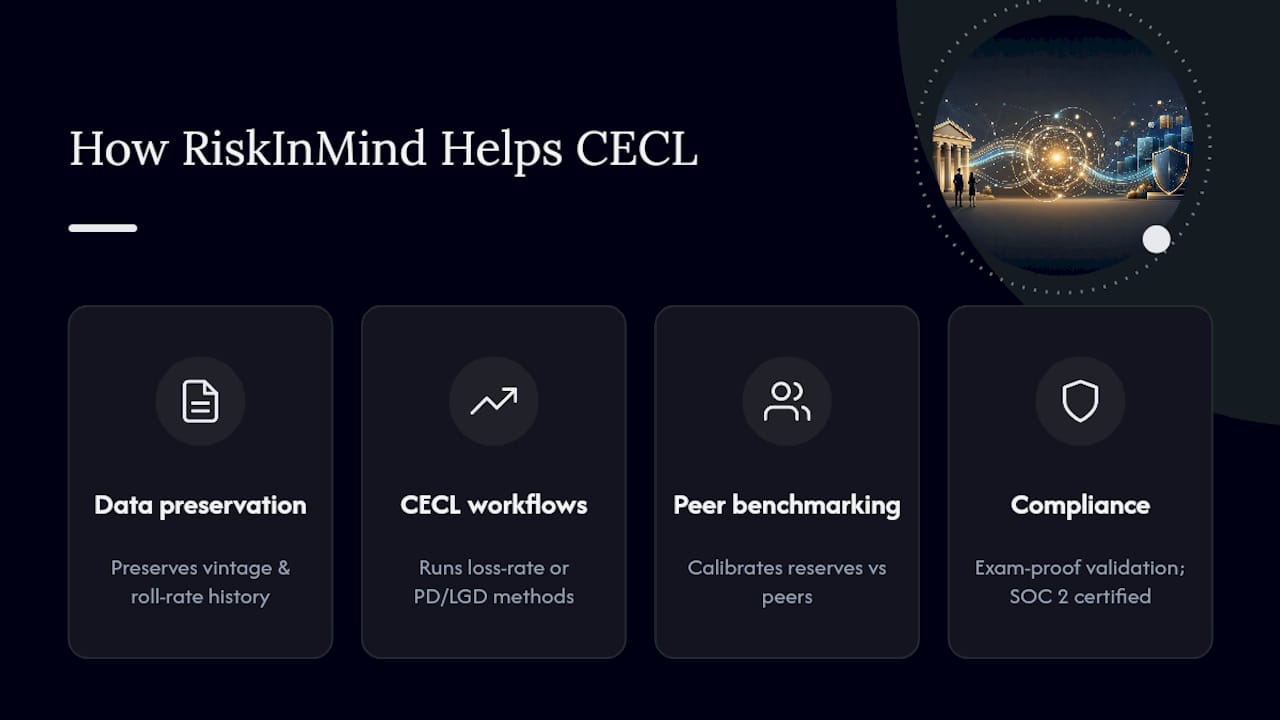
The company offers teams a way to stop reconstructing CECL data manually every quarter and start trusting a system built to preserve it. The platform automates time-series preservation across loan-level attributes, so vintage and roll-rate history stays intact instead of getting overwritten during routine core system updates, and it runs CECL estimation workflows aligned to the method your institution actually uses, whether that's a loss-rate approach or a PD/LGD build.
Riskinmind also layers in peer benchmarking so your reserve estimates can be calibrated against comparable institutions, not just your own history. Its documented exam-proof process walks teams through validation steps that map directly to what examiners request, and the platform carries SOC 2 certification for institutions that need that assurance documented in their own vendor risk files.
If spreadsheet sprawl is already your reality, request a demo to see how automated data capture compares to manual underwriting workflows for your next CECL cycle.
Where to Verify CECL Policy and Data Guidance
For the accounting standard itself, consult FASB ASU 2016-13. For supervisory expectations on data and methodology, review the interagency CECL FAQ and OCC Bulletin 2019-17. Practical field-level templates are available from Wilary Winn's CECL data guide.
Sources
- Frequently Asked Questions on the Current Expected Credit Losses Methodology
- OCC Bulletin 2019-17: Additional interagency FAQs on the new accounting standard on financial instruments - credit losses
- FASB ASU 2016-13 (ASC Topic 326)
FAQ
What Are the CECL Data Requirements?
CECL requires historical loss data, current loan-level portfolio attributes, and reasonable and supportable forward-looking forecasts, with exact fields depending on your chosen estimation methodology.
What Data Is Needed for CECL Calculations?
You need loan metadata (origination terms, balances, rates), performance history (delinquency, charge-offs, recoveries), cohort identifiers (vintage, product, collateral, credit score), and macro forecast inputs like unemployment and home price indices.
What Is the FASB CECL Standard?
The CECL standard is FASB ASU 2016-13, codified as ASC Topic 326, and it requires institutions to estimate lifetime expected credit losses rather than losses already incurred.
What Are the Key Changes Under CECL?
CECL replaced the incurred-loss model with a lifetime expected-loss model, requiring institutions to incorporate forward-looking forecasts and hold reserves against losses expected over the full life of a loan, not just losses already probable.
Do Regulators Require a Specific CECL Data Format?
No single mandated format or field list exists; interagency guidance directs institutions to align data collection with their chosen methodology and document the choice clearly for examiners.