
Regulatory fines surged 417% to $1.23B in the first half of 2025 compared to the same period in 2024, driven primarily by AML/KYC failures and sanctions breaches. For credit union executives, community bank leaders, and CROs, that number is not just a headline. It is a signal that the regulatory environment has fundamentally shifted, and institutions that treat compliance as a checkbox exercise are paying a steep price. This guide breaks down the real foundations of financial compliance, what effective programs look like in practice, the true cost of falling short, and how technology is reshaping what compliance leadership demands in 2026.
Automate Regulatory Model Risk Governance
Examine models against 32 qualitative criteria and resolve risk Tiers with pre-deployment checklists per OCC 2011-12 guidelines.
Table of Contents
- The foundations of compliance in financial institutions
- Key components of an effective compliance program
- The costs of non-compliance: Fines, losses, and reputational damage
- The evolving risk landscape: From over-compliance to RegTech innovation
- A smarter path forward: Rethinking compliance as a strategic enabler
- Enhance compliance and risk management with advanced solutions
- Frequently asked questions
Key Takeaways
| Point | Details |
|---|---|
| Compliance prevents penalties | Strong compliance programs help institutions avoid costly fines and regulatory action. |
| Builds trust and stability | Compliance enhances reputation and strengthens investor and customer confidence. |
| Effective programs require strategy | Governance, regular training, and audits are essential for meaningful compliance results. |
| Balance is key | Avoid over-compliance by focusing on targeted risk management and leveraging technology effectively. |
| Innovation through RegTech | Modern tools like AI enable efficient and proactive compliance management for the future. |
The foundations of compliance in financial institutions
Compliance in financial institutions is not simply about satisfying examiners during annual reviews. It is a structural safeguard that protects institutions from sanctions, preserves market access, and maintains credibility with boards, regulators, and customers alike. The Federal Reserve has been explicit on this point: compliance prevents regulatory sanctions, fines, penalties, and losses that arise from failing to adhere to laws, rules, and supervisory requirements. That framing matters because it positions compliance not as overhead but as a core operational discipline.
Understanding the full scope of compliance requires recognizing the pillars that support it. A well-functioning compliance program addresses four interconnected priorities:
- Consumer and investor protection: Ensuring that products, disclosures, and practices meet fair lending and consumer protection standards.
- Anti-financial crime: Maintaining robust AML, KYC, and sanctions screening to prevent the institution from being used as a conduit for illicit activity.
- Reputational strength: Protecting the institution's standing with customers, counterparties, and the broader community.
- Systemic stability: Contributing to the overall soundness of the financial system by maintaining prudent risk controls.
For institutions seeking an overview of financial compliance and the regulators who shape it, these pillars translate into a complex web of federal and state requirements that evolve continuously. The challenge for executives is not just meeting today's requirements but building programs resilient enough to absorb tomorrow's.
"Compliance risk management programs are essential for large banking organizations to prevent regulatory sanctions, maintain supervisory standing, and protect the institution's long-term viability." — Federal Reserve SR 08-08
This is precisely why raising the bar for risk management has become a strategic imperative rather than a departmental concern. Executives who treat compliance as a finance or legal function alone are misallocating both attention and resources. The most resilient institutions embed compliance thinking into product design, customer onboarding, and technology procurement from the outset. For broader financial compliance insights, the evidence consistently points in the same direction: proactive governance outperforms reactive remediation every time.
Key components of an effective compliance program
Knowing why compliance matters is only half the equation. The harder question is what a genuinely effective program looks like, and how institutions distinguish between programs that satisfy auditors and those that actually reduce risk. Effective compliance programs share a consistent architecture: board-level oversight, written policies and procedures, internal controls, continuous staff training, and independent audit functions that verify whether program objectives are being met.
The sequence in which these components are built matters. A logical approach follows this order:
- Board and senior management engagement: Establish tone at the top, define risk appetite, and assign accountability.
- Written policies and procedures: Document compliance obligations clearly, with version control and regular review cycles.
- Internal controls: Embed automated and manual controls into operational workflows to catch violations before they escalate.
- Continuous training: Ensure staff at every level understand their compliance obligations and the consequences of failure.
- Independent audit and testing: Validate that controls are functioning as designed, with findings reported directly to the board.
The following table summarizes how each component translates into direct institutional benefits:
| Compliance program component | Direct institutional benefit |
|---|---|
| Board oversight | Accountability, strategic alignment, examiner confidence |
| Written policies | Consistency, defensibility, reduced operational ambiguity |
| Internal controls | Early detection, reduced violation frequency |
| Staff training | Lower human error rates, stronger compliance culture |
| Independent audit | Objective validation, faster remediation cycles |
For institutions subject to BSA/AML program requirements, the OCC has reinforced that these structural elements are non-negotiable, not aspirational. The gap between institutions that treat these as living systems versus static documents is where most enforcement actions originate.
Pro Tip: Schedule a formal compliance program review at least annually, but also trigger ad hoc reviews whenever a significant regulatory change, product launch, or acquisition occurs. Programs that are only revisited on fixed cycles tend to drift out of alignment with actual risk exposure.
Building robust compliance programs also means accepting that no framework is permanent. Regulatory priorities shift, threat actors evolve, and customer behavior changes in ways that create new compliance obligations. The institutions that fare best are those that treat their compliance architecture as a dynamic system, not a finished product.
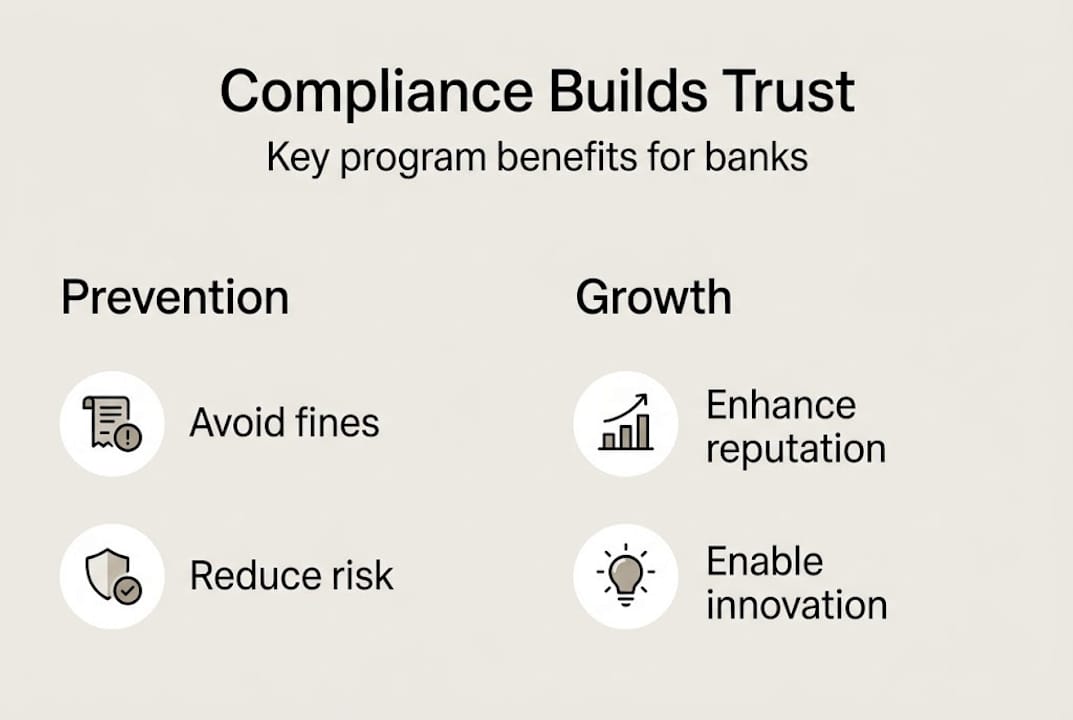
The costs of non-compliance: Fines, losses, and reputational damage
The financial consequences of compliance failures have become impossible to rationalize away. In 2023, 78% of financial institutions faced at least one regulatory fine, with the average penalty reaching $12.5 million. Global AML spending hit $180 billion in 2022, and fines for violations alone totaled $8.9 billion that same year. These are not tail-risk events. They are recurring costs borne by institutions that underinvest in compliance infrastructure.
The 2025 data reinforces the trend. Regulatory fines surged 417% to $1.23 billion in the first half of 2025 versus the same period in 2024, with AML/KYC failures and sanctions breaches as the primary drivers. For context, that is not a gradual increase. It is a step change in enforcement intensity that demands a corresponding step change in institutional response.
The most common triggers for enforcement action include:
- AML program deficiencies: Inadequate transaction monitoring, weak customer due diligence, or failure to file timely suspicious activity reports.
- Privacy and data security breaches: Non-compliance with Gramm-Leach-Bliley Act requirements or state-level data protection laws.
- Sanctions violations: Transactions involving prohibited parties or jurisdictions, often due to outdated screening lists or manual processes.
- Fair lending violations: Disparate treatment or disparate impact findings in underwriting, pricing, or servicing.
Beyond direct fines, the indirect costs are often larger. Preventing legal and financial risks requires accounting for elevated cost of capital, loss of correspondent banking relationships, and the customer attrition that follows a public enforcement action. Institutions that have experienced a major compliance failure consistently report that rebuilding trust with customers and regulators takes years, not quarters.

| Outcome area | Compliant institution | Non-compliant institution |
|---|---|---|
| Regulatory fines | Minimal to none | $12.5M average per incident |
| Customer trust | High, stable | Erosion post-enforcement |
| Cost of capital | Lower, favorable terms | Elevated risk premium |
| Operational disruption | Managed, predictable | Remediation-driven distraction |
For institutions exploring using AI for regulatory compliance, the data makes a compelling case: the cost of advanced compliance technology is a fraction of a single enforcement action, and the operational benefits extend well beyond avoiding penalties.
The evolving risk landscape: From over-compliance to RegTech innovation
The compliance conversation in 2026 is no longer just about doing enough. It is equally about doing too much in the wrong ways. Over-compliance driven by penalty fears leads institutions to de-risk aggressively, closing accounts for low-risk clients based on nationality or geopolitical factors, eroding trust and financial access. Regulators penalize under-compliance, but they rarely penalize over-compliance, which creates a structural incentive for excessive caution that ultimately harms the communities these institutions are meant to serve.
This paradox is one of the most underappreciated challenges in compliance leadership today. The institutions that navigate it best are those that invest in precision rather than volume. Technology plays a central role here:
- AI-powered transaction monitoring: Reduces false positive rates significantly, allowing compliance teams to focus on genuine risk rather than chasing noise.
- RegTech onboarding platforms: Automate KYC and customer due diligence workflows, cutting onboarding time while improving data quality.
- Natural language processing for regulatory change management: Scans regulatory updates in real time and maps changes to existing policies and controls.
- Machine learning for sanctions screening: Improves match accuracy and reduces the manual review burden on compliance staff.
Pro Tip: Avoid applying uniform risk thresholds across your entire customer base. Tiered, risk-based approaches not only satisfy regulatory expectations but also reduce the over-compliance trap by reserving intensive scrutiny for genuinely elevated-risk relationships.
"The future of compliance is not about filing more SARs or running more checks. It is about generating better outcomes, protecting real customers, and demonstrating that compliance programs add measurable value to the institution and the communities it serves."
Exploring over-compliance risks and the rising cost of AML compliance reveals a consistent theme: institutions that treat compliance as a volume exercise are both more exposed and less efficient than those that invest in targeted, technology-enabled approaches. The AI regulatory agents now available to financial institutions represent a meaningful shift in what precision compliance looks like at scale.
A smarter path forward: Rethinking compliance as a strategic enabler
The most persistent misconception we encounter is that compliance spending is purely defensive. It is not. Leading institutions are discovering that a well-designed compliance framework creates competitive advantages that are difficult to replicate: faster onboarding, stronger customer relationships, lower cost of capital, and the organizational confidence to enter new markets or launch new products without regulatory hesitation.
What separates these institutions is not budget. It is mindset. Executives who frame compliance as a strategic compliance mindset unlock innovation pathways that their more defensive peers cannot access. They use compliance data to improve product design. They leverage audit findings to strengthen operational processes. They treat regulatory relationships as partnerships rather than adversarial inspections.
The institutions that will define the next decade of financial services are those that blend technology precision with nuanced human judgment, building compliance programs that are both rigorous and proportionate. That combination is not a luxury. It is the baseline for sustainable growth.
Enhance compliance and risk management with advanced solutions
The evidence is clear: compliance failures are accelerating in frequency and cost, and the institutions that respond with precision and technology will outperform those that rely on manual, volume-based approaches.
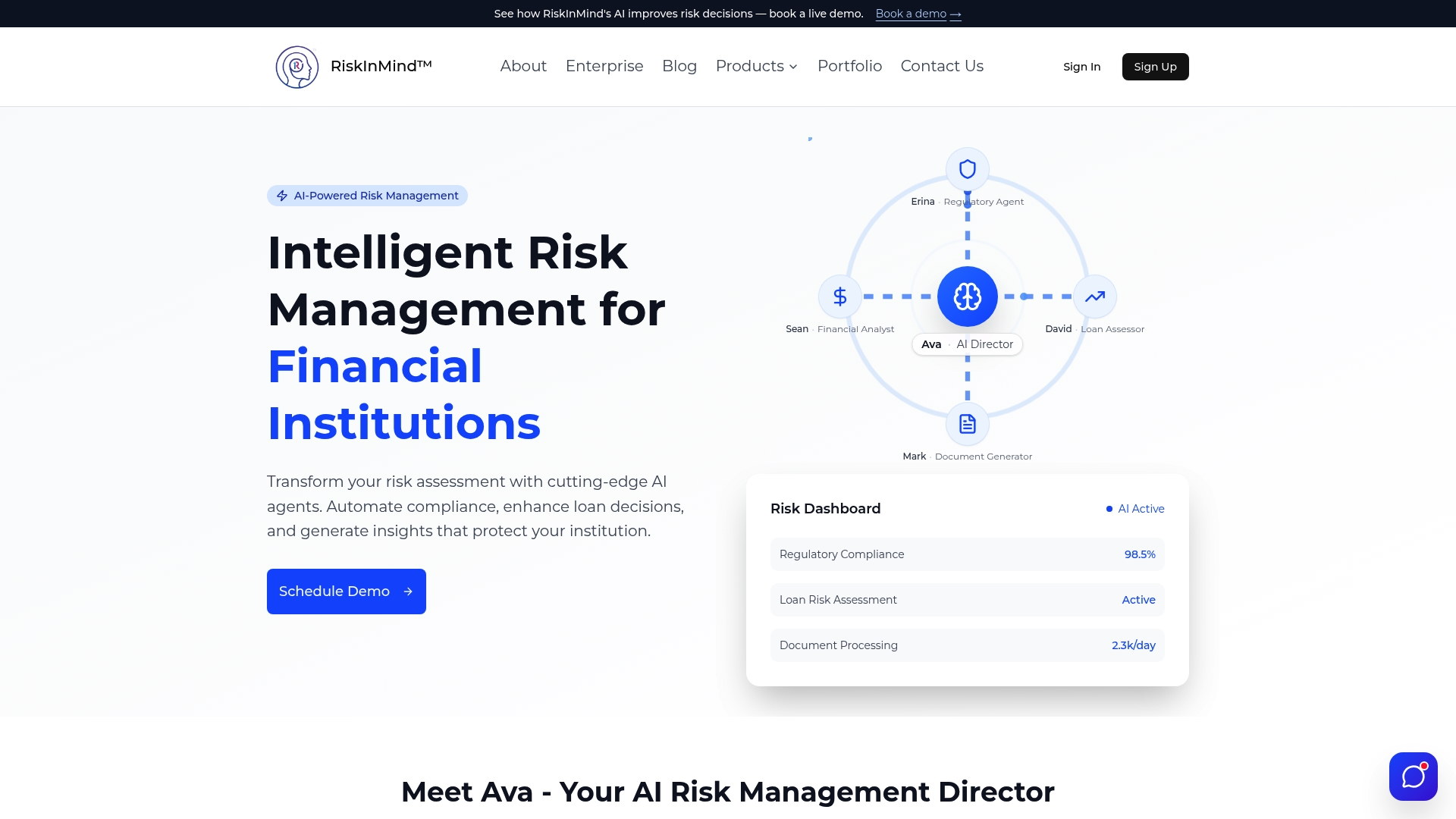
RiskInMind's AI-powered platform gives financial institution leaders the tools to move from reactive compliance to proactive risk intelligence. Ava, our central AI director, coordinates specialized agents focused on automated regulatory compliance, credit risk, and market analysis, all within a SOC 2® certified, bank-grade secure environment. Whether you are managing BSA/AML obligations, fair lending requirements, or real-time portfolio monitoring, our platform delivers sub-half-second response times and the accuracy your institution needs. Explore how AI-powered compliance tools can reduce your compliance burden while sharpening your risk management outcomes.
Frequently asked questions
What are the main reasons compliance is critical for financial institutions?
Compliance prevents regulatory sanctions, fines, and penalties while protecting the institution's reputation and ensuring continued access to financial markets and correspondent banking relationships.
What are the consequences of not complying with financial regulations?
Non-compliance exposes institutions to fines averaging $12.5M per incident, alongside reputational damage, elevated cost of capital, and long-term erosion of customer and regulatory trust.
How does over-compliance affect financial institutions?
Over-compliance driven by penalty fears leads to unnecessary account closures, de-risking of low-risk clients, and damaged community relationships that undermine the institution's core mission.
How can technology improve compliance?
AI and RegTech enable proactive compliance management, reduce false positive rates in transaction monitoring, and improve the precision of risk detection, though effective governance frameworks remain essential to capture their full value.