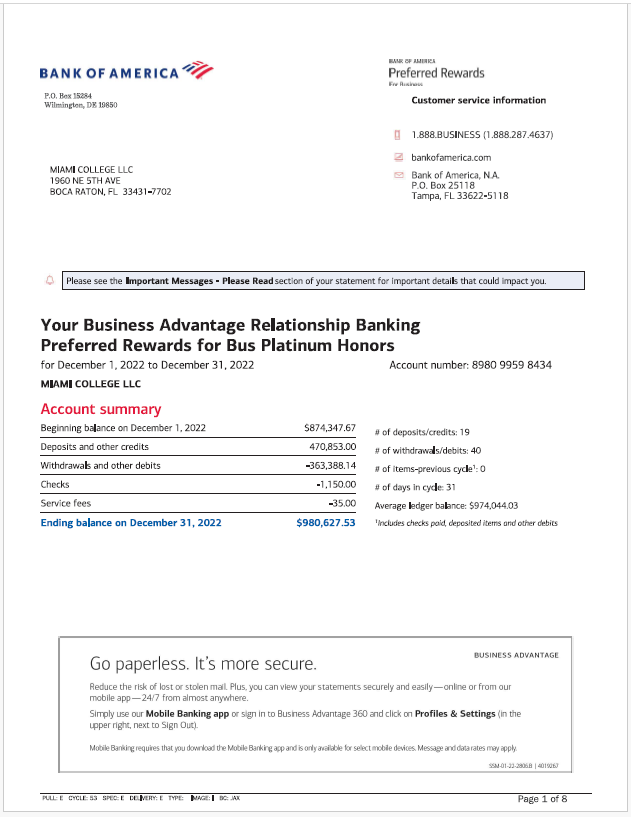
We ran a real Bank of America business statement — Miami College LLC, December 2022, account ending 8434, ending balance $980,627.53 — through RiskMind.ai's Document Fraud Detection product. What came back should be required reading for every CFO, Chief Risk Officer, and lending executive making decisions based on documents like this.
The document looked perfect.
Consistent typography. Perfectly aligned numbers. Standard Bank of America layout. In fact, the AI visual analysis (powered by Gemini) returned a verdict of "No Tampering Evidence" with high confidence. A human reviewer glancing at this statement would likely approve it without a second thought.
Maintain 100% NCUA & OCC Audit Readiness
Monitor regulatory updates 24/7, check internal credit policies, and generate compliance trails with Erina (AI Regulatory Agent).
But forensic analysis told a completely different story.
What was hiding underneath the surface:
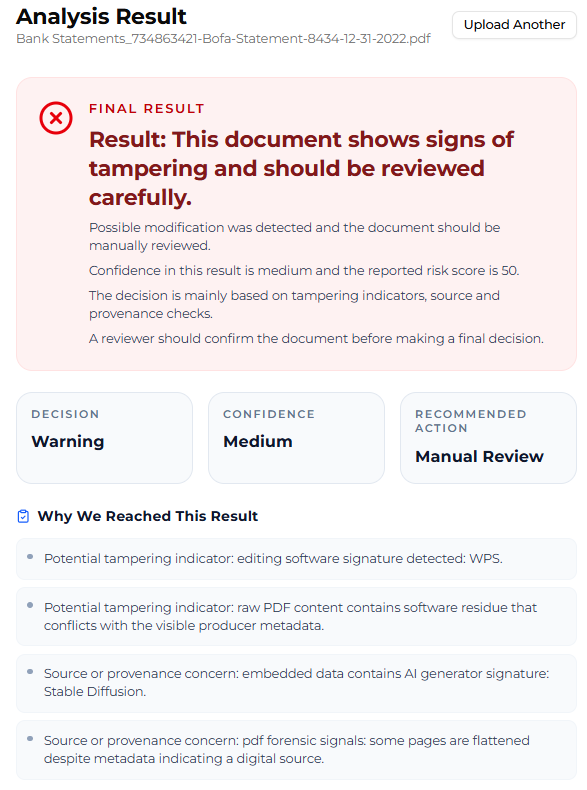
The metadata said this PDF was produced by "Microsoft: Print To PDF." Clean, expected, normal. But deep in the raw binary content of the file, RiskMind found signatures from WPS Office — a completely different editing application. That mismatch is a hard tamper indicator. Someone opened this document in WPS, made edits, and saved it. The metadata was either not updated or was deliberately left pointing to the original producer.
It did not stop there. Embedded inside the PDF was a signature trace from Stable Diffusion, an AI image generator. Five of the document's eight pages were flattened — rendered as images — despite the metadata claiming a fully digital origin. Flattening is a known technique used to obscure edits. You flatten pages to destroy the original text layer and replace it with a pixel image that is much harder to forensically interrogate.
The risk score came in at 50 - a Warning, requiring manual review.
This is the critical nuance executives need to understand when evaluating fraud detection products. The right answer here was not a binary "fraud" or "clean." The right answer was: something is wrong with the provenance of this document, flag it, do not approve it automatically, and put human eyes on it. That is exactly what RiskMind.ai delivered.
Why this matters at the executive level:
Lenders, insurers, and institutions processing hundreds of thousands of documents annually cannot rely on visual inspection — human or AI. Fraudsters are not altering numbers clumsily anymore. They are using professional editing tools and AI to produce documents that are visually indistinguishable from originals. The attack surface has shifted entirely to the forensic layer: metadata, software signatures, page structure, binary content residue.
A product that only asks "does this look right?" will be systematically defeated. You need one that asks "does the provenance of this document hold together end to end?"
The bottom line for buyers:
When evaluating document fraud detection, the questions to ask your vendor are: Can you detect editing software signatures that conflict with declared metadata? Can you identify AI-generated content embedded in financial documents? Can you flag structural anomalies like page flattening that obscure edits? And critically — do you return an auditable evidence trail, not just a pass/fail score?
RiskMind.ai's report on this statement returned exactly that: structured evidence buckets, a risk score, a confidence level, and a recommended action — all traceable and defensible.
The document that looks clean is the one you need to worry about most.
Learn more at riskinmind.ai/products/document-fraud-detection
#DocumentFraud #RiskManagement #FinancialCrime #AI #Fintech #FraudDetection #RiskMind