
Choosing the wrong compliance tool is not just a budget mistake. For risk management professionals at credit unions, community banks, and lenders, a mismatched solution can leave critical regulatory gaps, trigger examination findings, and create audit failures that take years to unwind. The compliance technology market now spans dozens of categories, from broad governance platforms to narrow, AI-powered RegTech agents, and each type serves a distinct purpose. Understanding those distinctions before you commit to a vendor is not optional. This guide walks through the major tool categories, the criteria that should drive your evaluation, and a practical framework for matching the right solution to your institution's regulatory reality.
Maintain 100% NCUA & OCC Audit Readiness
Monitor regulatory updates 24/7, check internal credit policies, and generate compliance trails with Erina (AI Regulatory Agent).
Table of Contents
- Key selection criteria for compliance tools
- GRC platforms: Integrated governance, risk, and compliance
- Point solutions: Targeted compliance automation
- Regulatory intelligence and RegTech tools
- Comparing tool types: Fit for regulatory density and complexity
- Our perspective: The tool is only as good as the process it automates
- See how RiskInMind addresses compliance automation
- Frequently asked questions
Key Takeaways
| Point | Details |
|---|---|
| Tool selection starts with needs | Match scale and complexity with the right tool to avoid costly pitfalls. |
| GRC vs point solutions | Integrated GRC is best for complex, multi-framework needs while point solutions provide fast, targeted fixes. |
| RegTech drives automation | AI-powered compliance tools streamline regulatory change management and reporting. |
| Layered approaches work | Combining tool types is often the most practical strategy for risk management teams. |
Key selection criteria for compliance tools
Before comparing any specific platform or vendor, you need a clear picture of what your institution actually requires. Compliance tools are not interchangeable, and the gap between what a product promises and what it delivers in your specific environment can be significant.
Start with regulatory coverage. Some institutions operate under a single primary framework, while others must satisfy five or more simultaneously, including BSA/AML, CECL, CRA, HMDA, and state-level consumer protection rules. The scope of your regulatory footprint is the single most important filter in your evaluation.
Next, assess automation depth. Tools operate via layered compliance pipelines, moving from regulatory intake through monitoring and alerting, control mapping, automated evidence collection, and finally reporting. A tool that automates only one of those layers may still leave your team doing heavy manual work elsewhere.
Consider these additional criteria before shortlisting vendors:
- Integration compatibility: Can the tool connect to your core banking system, loan origination platform, or existing risk infrastructure without a costly custom build?
- Implementation timeline and cost: Are you looking for a quick deployment in 60 days, or can you absorb an 18-month enterprise rollout?
- Scalability: Will the tool grow with your institution as regulatory requirements expand?
- Reporting capabilities: Can it generate examination-ready reports and board-level dashboards without manual reformatting?
- Data residency: For institutions with GDPR exposure or multi-state operations, where data is stored and processed matters legally.
Pro Tip: Before signing any contract, audit your current data flows end to end. Compliance tools that ingest data from multiple source systems can create unexpected conflicts if data governance policies are not already well-defined. Institutions with integrated governance systems in place typically see faster deployments and fewer post-launch remediation cycles.
GRC platforms: Integrated governance, risk, and compliance
Governance, risk, and compliance platforms represent the most expansive category in the compliance technology market. GRC platforms integrate governance, risk management, and compliance functions into unified systems, typically featuring risk registers, policy management, audit management, regulatory change tracking, and automated evidence collection under a single interface.
The appeal is clear for complex organizations. When your institution manages overlapping frameworks such as SOX, GDPR, NIST, and ISO 27001 simultaneously, siloed point tools create duplicated controls, inconsistent reporting, and audit fatigue. A GRC platform centralizes control mapping so that a single control can satisfy requirements across multiple frameworks at once.
Key capabilities typically include:
- Policy management: Centralized creation, version control, and attestation workflows
- Risk register: Real-time tracking of identified risks, owners, and mitigation status
- Audit management: Scheduling, evidence requests, and finding remediation in one place
- Regulatory change tracking: Automated intake of rule updates mapped to existing controls
"GRC tools excel for organizations managing more than five regulatory frameworks, where the cost of duplicated manual effort quickly outweighs the platform's higher price point."
The trade-offs are real, though. Implementation timelines typically run 6 to 18 months, and annual licensing costs range from $100,000 to over $1 million for enterprise deployments. That is a significant commitment, and the complexity of configuration can slow time-to-value if not managed carefully.
Pro Tip: Rather than deploying institution-wide from day one, pilot your GRC rollout with a single business unit or one regulatory framework first. This approach surfaces integration issues early and builds internal confidence before broader adoption. You can review how a GRC platform overview applies to financial institutions, and explore how organizations approach addressing SOC 2 compliance as an entry point for broader governance programs.
Point solutions: Targeted compliance automation
Not every institution needs the full weight of an enterprise GRC platform. For many community banks and credit unions, the more practical path is a point solution: a tool built specifically for one compliance domain, deployed quickly, and integrated where needed.

Point solutions focus on specific functions such as policy management, audit tracking, AML/KYC, or surveillance monitoring. Rather than trying to cover every framework, they go deep on a single problem, which is precisely their strength.
Common point solution categories include:
- AML/KYC automation: Tools like Fenergo streamline customer due diligence, identity verification, and suspicious activity monitoring
- Audit log management: Automated capture and retention of system activity for examination readiness
- Policy attestation: Workflow tools that route policies to staff for acknowledgment and track completion
- Surveillance monitoring: Solutions built for FINRA Rule 3110 compliance, capturing and reviewing communications
"For institutions with a clear, bounded compliance pain point, a point solution often delivers faster measurable value than a platform that requires months of configuration before producing results."
Deployment timelines for point solutions typically run 1 to 3 months, and annual costs generally fall between $5,000 and $50,000, making them accessible for smaller institutions with limited technology budgets. The downside is fragmentation. When you operate five separate point tools, each with its own data model and reporting format, cross-framework visibility becomes difficult and manual reconciliation creeps back in.
For institutions exploring bank statement analysis automation or other document-level compliance functions, point solutions often serve as an effective first step before broader platform adoption. You can also explore how regulatory technology for financial services is evolving to close those gaps.
Regulatory intelligence and RegTech tools
A newer and rapidly maturing category sits between traditional GRC platforms and point solutions: regulatory intelligence platforms and RegTech tools. These are not simply monitoring dashboards. They represent a fundamentally different approach to compliance automation.
Primary types of regulatory compliance tools now include GRC platforms, point solutions, compliance management platforms, RegTech tools, and regulatory intelligence platforms as distinct categories, each with a specific role in the compliance pipeline.
Regulatory intelligence tools monitor rule changes across agencies such as the CFPB, OCC, FDIC, and Federal Reserve, then curate and distribute those updates to the relevant teams within your institution. RegTech tools go further, using AI to map new regulations directly to existing policies, extract specific obligations, and generate alerts when a control gap is identified.
The table below illustrates how different tool types cover the core compliance pipeline layers:
| Pipeline layer | GRC platform | Point solution | RegTech/Intelligence |
|---|---|---|---|
| Regulatory intake | Partial | Rarely | Strong |
| Monitoring and alerting | Strong | Domain-specific | Strong |
| Control mapping | Strong | Limited | Strong |
| Evidence collection | Strong | Domain-specific | Partial |
| Reporting | Strong | Limited | Partial |
The practical value of AI regulatory agents in this space is significant. Rather than waiting for a quarterly regulatory update from counsel, your compliance team receives real-time alerts when a rule change affects a specific control, with a suggested mapping already drafted. That shift from reactive to proactive compliance is where RegTech delivers its clearest return on investment.
Comparing tool types: Fit for regulatory density and complexity
With the major categories defined, the real question is which combination fits your institution. There is no universal answer, but there are clear patterns based on regulatory density, organizational maturity, and available resources.
| Tool type | Implementation time | Annual cost range | Best fit |
|---|---|---|---|
| GRC platform | 6 to 18 months | $100K to $1M+ | 5+ frameworks, complex orgs |
| Point solution | 1 to 3 months | $5K to $50K | Single domain, fast deployment |
| RegTech/Intelligence | 2 to 6 months | $20K to $200K | Dynamic regulatory environments |
High regulatory density, defined as managing more than five frameworks simultaneously, consistently favors integrated GRC over point solutions because the cost of duplicated controls and manual reconciliation compounds quickly. Point solutions offer fast implementation and lower cost for single domains but create data silos that become liabilities during examinations requiring cross-framework evidence.
Use this decision sequence to match your needs to the right tool type:
- Count your active frameworks. If you manage fewer than three, start with targeted point solutions or a compliance management platform.
- Assess your integration requirements. If compliance data must flow into your core banking system or board reporting tools, prioritize platforms with strong API capabilities.
- Evaluate your regulatory change velocity. If your institution operates in a fast-moving regulatory environment, layer in a RegTech or intelligence tool regardless of your primary platform choice.
- Review your examination history. Recurring findings in specific domains signal a need for deeper point solution coverage in those areas, even within a GRC environment.
- Match to your budget cycle. GRC platforms require multi-year commitment; point solutions can be funded from operational budgets.
Layering tools is not a sign of a fragmented strategy. Many mature institutions operate a GRC backbone for unified reporting while using specialized RegTech agents to handle real-time regulatory intake. Understanding where compliance technology pain points typically surface can help you prioritize which gaps to close first.
Our perspective: The tool is only as good as the process it automates
Here is the uncomfortable truth that most compliance technology vendors will not tell you: buying a GRC platform does not fix a broken compliance program. It accelerates whatever process you already have, which means a poorly designed control framework becomes a faster, more expensive poorly designed control framework.
We have seen institutions spend seven figures on enterprise GRC deployments only to find that their control mapping was inconsistent before implementation, and the platform simply formalized those inconsistencies at scale. The technology did exactly what it was configured to do. The problem was never the tool.
The institutions that extract the most value from compliance technology are the ones that treat the selection process as a forcing function for process clarity. Before you configure a risk register, you need to agree on what a risk is. Before you automate evidence collection, you need to define what constitutes sufficient evidence. These are governance questions, not technology questions.
Our view is that the right sequencing is process first, then automation. A focused point solution deployed against a well-defined process will outperform a GRC platform deployed against an ambiguous one every time. Start narrow, prove value, then expand. The regulatory environment is not getting simpler, but your response to it can be.
See how RiskInMind addresses compliance automation
For financial institutions navigating the complexity of modern regulatory requirements, RiskInMind's AI-powered platform offers a purpose-built alternative to generic GRC deployments. Our AI agents, each specialized in regulatory compliance, credit risk, and portfolio monitoring, work in real time under the coordination of Ava, our central AI director.
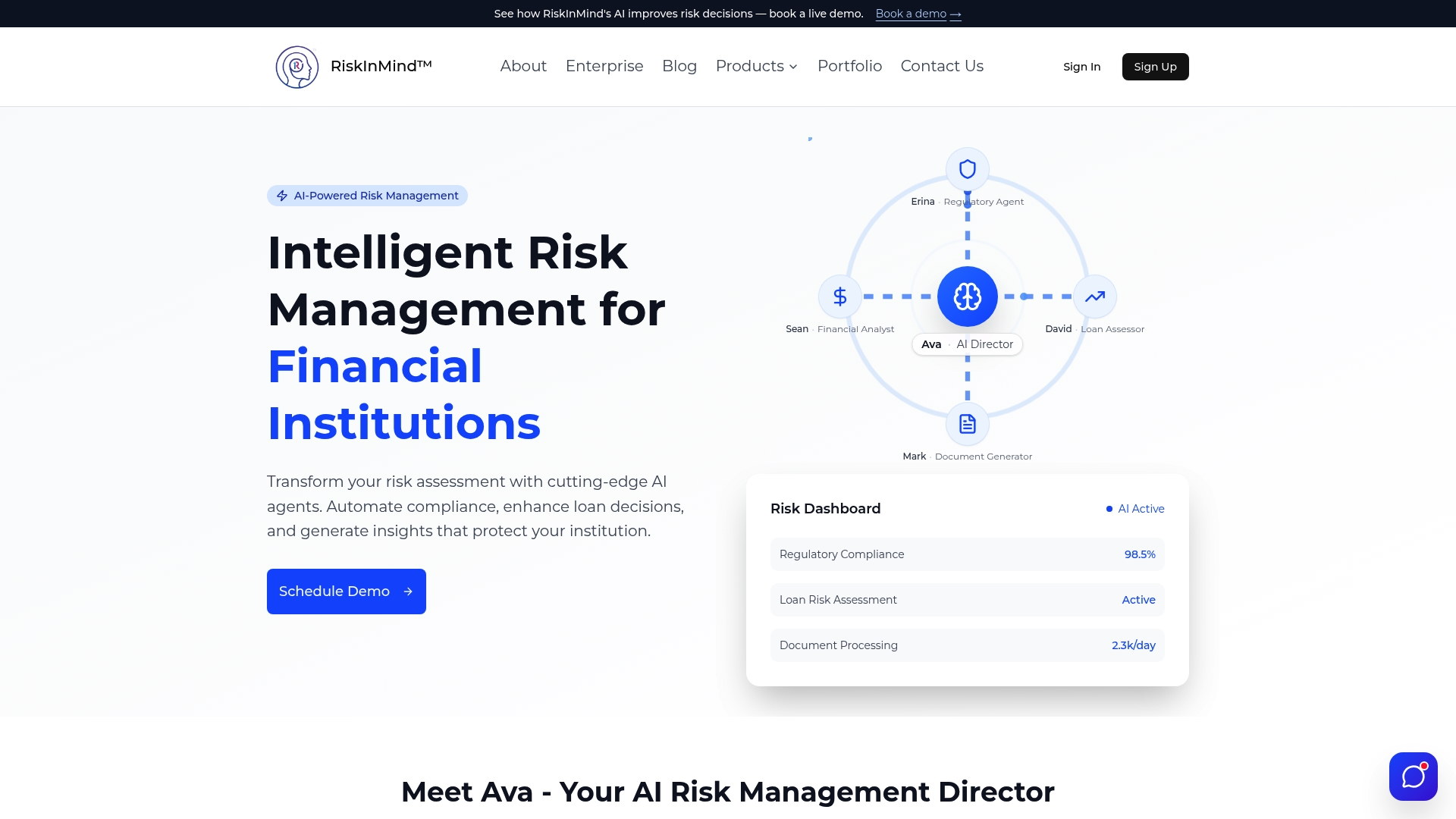
RiskInMind is SOC 2 certified, operates with bank-grade security, and delivers responses in under half a second, giving your compliance team the speed and accuracy that manual processes simply cannot match. Whether you are evaluating your first RegTech deployment or looking to replace a fragmented point solution stack, our platform is designed to integrate with your existing infrastructure and scale with your regulatory obligations. Explore our AI regulatory agents and see how automated compliance monitoring works in practice.
Frequently asked questions
What is the difference between GRC platforms and point solutions?
GRC platforms are integrated systems covering governance, risk, and compliance across multiple frameworks, while point solutions address specific functions like KYC or audit management with faster deployment and lower initial cost.
How do RegTech tools improve compliance automation?
RegTech tools use AI and automation to map incoming regulations to existing policies, generate real-time control gap alerts, and reduce the manual research burden that slows traditional compliance teams.
When should a financial institution choose an integrated GRC platform?
An integrated GRC platform is the right choice when your institution manages more than five frameworks simultaneously or requires unified, examination-ready reporting across global or multi-state regulatory standards.
What is the typical implementation time for compliance point solutions?
Most point solutions deploy within 1 to 3 months, compared to the 6 to 18 months typically required for full enterprise GRC platform implementations.
Can you combine different types of compliance tools?
Yes. Many institutions layer multiple tool types, using a GRC platform as the reporting backbone while deploying point solutions or RegTech agents to cover specific domains or high-velocity regulatory change areas.