
A single gap in your risk analysis process can translate into regulatory sanctions, capital shortfalls, or portfolio losses that take years to recover from. Financial institutions operating in 2026 face a regulatory environment that demands both precision and speed, where examiners expect documented, repeatable workflows and boards demand strategic foresight. The standard risk analysis process consists of identifying risks, analyzing their likelihood and impact, evaluating, treating, and monitoring them continuously. This guide delivers an actionable framework, from foundational steps to advanced methodologies, benchmarks, and the frameworks that top institutions rely on to stay ahead of both regulators and emerging threats.
Table of Contents
Automate Regulatory Model Risk Governance
Examine models against 32 qualitative criteria and resolve risk Tiers with pre-deployment checklists per OCC 2011-12 guidelines.
- Core steps of the risk analysis process
- Choosing and optimizing risk analysis methodologies
- Putting frameworks into practice: ISO 31000 and COSO ERM
- Benchmarks and advanced metrics for risk analysis effectiveness
- A contrarian take: The real value of modern risk analysis isn't just the tools
- Enhance your risk analysis process with tailored AI solutions
- Frequently asked questions
Key Takeaways
| Point | Details |
|---|---|
| Standardized process | A five-step approach—identify, analyze, evaluate, treat, monitor—ensures risk analysis aligns with best practices. |
| Combined methodologies | Blending qualitative, quantitative, and hybrid methods creates more robust risk insights for financial institutions. |
| Framework application | Both ISO 31000 and COSO ERM should be used strategically—one for operational agility, the other for governance alignment. |
| Outcome-driven metrics | Benchmarks like CET1 and RoE, combined with explainable models, enhance regulatory credibility and process effectiveness. |
| AI as an enabler | AI supports risk management but must be integrated with transparent, validated metrics, not as a black box. |
Core steps of the risk analysis process
With the high stakes clear, let's break down the foundational steps that structure every robust risk analysis process. Getting these steps right is not optional; it is the baseline for regulatory credibility and strategic resilience.
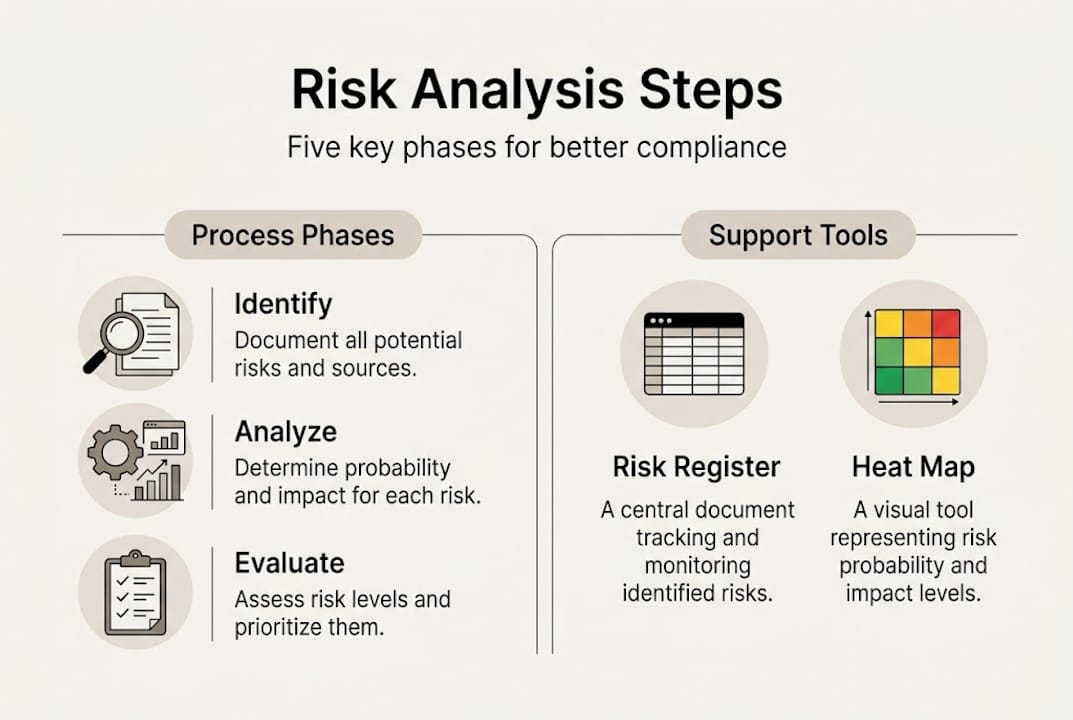
ISO 31000 describes a flexible, iterative process of risk identification, analysis, evaluation, treatment, and review that adapts to institutions of any size or complexity. Each phase builds on the last, and skipping or rushing any one of them creates blind spots that examiners will find before you do.
- Identify: Catalog every material risk across credit, market, operational, and compliance domains using workshops, process maps, and historical loss data.
- Analyze: Assess the likelihood and potential impact of each identified risk using heat maps, risk matrices, and scenario modeling.
- Evaluate: Prioritize risks against your institution's risk appetite and tolerance thresholds, distinguishing acceptable exposures from those requiring immediate action.
- Treat: Select and implement controls, whether risk avoidance, mitigation, transfer, or acceptance, and document the rationale for each decision.
- Monitor: Establish key risk indicators (KRIs) and review cycles to track control effectiveness and flag emerging threats before they escalate.
| Phase | Primary Tool | Output |
|---|---|---|
| Identify | Workshops, loss data | Risk register |
| Analyze | Heat maps, matrices | Likelihood/impact scores |
| Evaluate | Risk appetite statement | Prioritized risk list |
| Treat | Control frameworks | Treatment plans |
| Monitor | KRI dashboards | Ongoing reporting |
These risk analysis process steps align directly with both COSO ERM components and examiner expectations, making documentation at each phase a dual-purpose investment. When your process is structured this way, regulatory inquiries become straightforward rather than disruptive.
Pro Tip: Build continuous review into your monitoring phase rather than treating it as an annual event. Regulatory guidance shifts throughout the year, and institutions that catch changes early spend far less time on remediation. Linking your review cycle to published regulatory calendars is a practical way to stay ahead, and applying ISO 31000 in risk workflows can help you formalize that connection.
Choosing and optimizing risk analysis methodologies
Now that the basic process is mapped, the selection of methodologies will determine your process's rigor and credibility. Not every institution needs the same level of quantitative sophistication, but every institution needs a defensible rationale for the approach it chooses.
Key methodologies include qualitative approaches such as risk matrices and facilitated workshops, quantitative approaches such as statistical models and Monte Carlo simulations, and hybrid methods that combine both. The right choice depends on your data maturity, regulatory expectations, and the explainability requirements of your board and examiners.
| Methodology | Strengths | Limitations | Best Fit |
|---|---|---|---|
| Qualitative | Fast, expert-driven | Subjective, hard to audit | Early-stage or data-sparse risks |
| Quantitative | Precise, auditable | Data-intensive, complex | Credit, market, liquidity risk |
| Hybrid | Balanced, flexible | Requires strong governance | Most financial institutions |
Factors to guide your methodology selection:
- Data maturity: Quantitative models require clean, sufficient historical data; qualitative methods fill gaps where data is thin.
- Regulatory expectations: Examiners increasingly expect model documentation and validation, even for simpler models.
- Resource availability: Sophisticated models demand skilled analysts and ongoing maintenance budgets.
- Explainability needs: Board members and regulators need to understand model outputs, not just trust them.
Model risk management (MRM) is the governance layer that keeps your methodology choices credible. MRM components include policies, model inventory, development and validation procedures, and ongoing monitoring. Each element is non-negotiable for institutions subject to FDIC or Federal Reserve oversight.
"A robust MRM framework is essential for regulatory credibility."
Ongoing model risk monitoring practices and periodic risk model validation are not bureaucratic exercises. They are the mechanisms that catch model drift, data quality issues, and assumption failures before they produce misleading outputs that drive poor decisions.
Putting frameworks into practice: ISO 31000 and COSO ERM
With methodology established, these frameworks offer structured guidance for day-to-day and strategic alignment. The practical challenge is not choosing between them but knowing how to deploy each where it delivers the most value.
ISO 31000 offers a flexible, process-focused framework while COSO ERM integrates risk with strategy and is favored for governance-heavy environments. Central banks globally use both, often in combination, because neither framework alone covers the full spectrum of operational and strategic risk obligations.
Here is how to combine them effectively:
- Map ISO 31000 to operational workflows: Assign each ISO process phase to a specific team, tool, and review cadence within your risk function.
- Anchor COSO ERM to board governance: Use COSO's five components (governance and culture, strategy and objective-setting, performance, review and revision, information and communication) to structure board risk reporting.
- Align both to your risk appetite statement: Ensure that ISO-driven operational findings feed directly into COSO-level strategic decisions, closing the loop between front-line risk teams and executive oversight.
- Document the integration explicitly: Examiners want to see that your frameworks are connected, not siloed. A single integration map showing how ISO outputs inform COSO reporting satisfies this expectation efficiently.
Pro Tip: Use ISO 31000 as the primary framework for operational and IT risk, where process rigor and repeatability matter most, and lean on COSO ERM for board-level oversight and strategic risk alignment. This division of labor keeps both frameworks focused and prevents overlap from creating confusion.
Reviewing COSO principles in compliance alongside your SOC 2 and COSO integration documentation gives your institution a concrete starting point for building that integrated governance structure. The COSO ERM framework itself provides detailed component descriptions that translate directly into board charter language.
Benchmarks and advanced metrics for risk analysis effectiveness
Implementing frameworks is only part of the equation; tracking the right metrics is essential for validation and regulatory dialog. Without measurable benchmarks, your risk analysis process has no feedback loop and no credibility in examiner conversations.

The EBA uses KRIs, DRATs, and financial benchmarks such as CET1 ratios and NPL ratios as core supervisory tools, and these same metrics serve as practical benchmarks for your internal risk analysis effectiveness.
| Metric | Benchmark Value | What It Signals |
|---|---|---|
| CET1 ratio | >12% (strong buffer) | Capital adequacy and loss absorption |
| NPL ratio | <3% (EBA threshold) | Credit quality and underwriting rigor |
| Liquidity coverage ratio | >100% | Short-term liquidity resilience |
| Return on equity (RoE) | 8-12% (peer range) | Efficiency of risk-adjusted returns |
| Cost/income ratio | <60% | Operational efficiency |
Advanced metrics that complement these benchmarks include:
- Key risk indicators (KRIs): Forward-looking signals that flag deteriorating conditions before losses materialize.
- Dynamic risk assessment tools (DRATs): Scenario-based models that stress-test portfolios under multiple macroeconomic assumptions simultaneously.
- Risk-weighted asset (RWA) density: The ratio of RWAs to total assets, which reveals how aggressively or conservatively your institution weights credit and market exposures.
- Cost/income ratios: Operational efficiency measures that regulators use to assess whether risk infrastructure investment is proportionate.
Peer analysis is where these metrics become most actionable. Comparing your institution's ratios against a defined peer group, using regulatory risk benchmarks published by the EBA or FDIC, reveals whether deviations reflect genuine risk management gaps or simply business model differences. Context matters enormously here. A higher NPL ratio at a community development lender serving underserved markets is not the same signal as the same ratio at a conventional mortgage portfolio.
Edge cases deserve explicit attention in your framework. Cyber risk, systemic contagion from non-bank financial intermediary (NBFI) exposures, and concentrated sector risk can each produce tail losses that standard benchmarks do not capture. Incorporating cash flow risk analytics and reviewing the EBA risk dashboard quarterly keeps your institution calibrated to systemic trends that peer benchmarks alone will miss.
A contrarian take: The real value of modern risk analysis isn't just the tools
So what actually moves the needle in risk management, beyond the prescribed frameworks and tools? The honest answer is that most institutions underperform not because they lack sophisticated models but because they lack the organizational culture to act on what those models tell them.
Advanced ML and big data enhance prediction but lack explainability, and institutions that prioritize real-world validation and peer benchmarks over novel models consistently outperform those chasing analytic complexity. No model is better than the assumptions it's built on, and assumptions are a human problem, not a technology problem.
The institutions that get the most value from risk analysis are those where risk findings travel quickly from analysts to decision-makers, where cross-functional teams treat risk data as operational intelligence rather than a compliance artifact. That requires investment in communication, governance, and accountability structures that no software platform can substitute for. Exploring AI's role in risk analysis is worthwhile, but only when the human infrastructure is already in place to interpret and act on AI-generated insights responsibly.
Enhance your risk analysis process with tailored AI solutions
Ready to turn advanced risk insights into measurable results? The frameworks and metrics covered in this guide represent best practice, but executing them at scale requires tools built specifically for financial institutions.
RiskInMind's AI risk management solutions are purpose-built to automate the most demanding steps in your risk analysis workflow, from real-time portfolio monitoring to regulatory reporting, without sacrificing the explainability your board and examiners require. The loan risk predictor delivers credit risk assessments in under half a second, while the regulatory risk agent keeps your compliance posture current as guidance evolves. Request a tailored demo and see how your institution can move from reactive risk management to proactive, data-driven resilience.
Frequently asked questions
What are the main phases of the risk analysis process?
The main phases are identifying, analyzing, evaluating, treating, and monitoring risks, as defined by standards like ISO 31000. Each phase produces documented outputs that support both internal governance and regulatory review.
Which frameworks are most recommended for financial institutions?
Most central banks use ISO 31000 and COSO ERM in combination, with ISO 31000 covering 85.7% and COSO ERM covering 64.3% of surveyed institutions, providing both operational and governance coverage.
What metrics should be tracked to measure risk analysis effectiveness?
Key metrics include CET1 ratios, NPL ratios, RoE, and liquidity coverage ratios, with benchmarks published regularly by the EBA and FDIC to support peer comparison.
How does AI impact risk analysis processes in finance?
AI improves risk prediction but must be validated and explained; real-world testing and stakeholder buy-in are crucial to ensure model outputs drive sound decisions rather than false confidence.
How can risk analysis handle emerging threats like cyber risk?
By incorporating operational risk assessment and continuous review cycles, processes can adapt to new threats; cyber attacks remain elevated in 2025 and 2026, making dynamic reassessment a non-negotiable element of any modern risk framework.