
Risk governance frameworks give organizations a formalized, transparent system for identifying, monitoring, and managing risk in alignment with strategic objectives and regulatory standards. They are not simply policy documents. They are the structural backbone that connects board oversight, executive accountability, and operational risk controls into a coherent, functioning whole. Three frameworks define best practice in the United States and globally: the COSO ERM Framework, built on five components and 20 principles; the NIST Risk Management Framework, a structured cyclical process comprising seven steps; and the IRGC Risk Governance Framework, which extends governance into societal and stakeholder dimensions.
At their core, risk governance frameworks accomplish four things:
- Establish board-level oversight and clear accountability for risk decisions
- Define the policies, risk appetite, and communication channels that guide risk-taking
- Integrate risk identification, assessment, and monitoring into organizational processes
- Create the documentation and reporting structures that satisfy regulatory expectations
Maintain 100% NCUA & OCC Audit Readiness
Monitor regulatory updates 24/7, check internal credit policies, and generate compliance trails with Erina (AI Regulatory Agent).
How risk governance differs from risk management
Risk management and risk governance are not interchangeable, though they are frequently treated as if they were. Risk management is the operational activity: identifying specific risks, assessing their likelihood and impact, selecting responses, and monitoring outcomes. Risk governance is the overarching system that authorizes, directs, and evaluates all of that activity.
Think of it this way. Risk management answers the question "What risks do we face, and how do we respond?" Risk governance answers "Who decides, who is accountable, and how do we know the system is working?" Governance sets the policy environment, defines risk appetite, and provides the oversight structure within which management operates.
The Three Lines of Defense model makes this distinction concrete:
- First line: Business units own and manage risk day to day
- Second line: Risk management and compliance functions provide oversight, policy, and challenge
- Third line: Internal audit provides independent assurance to the board
Governance lives primarily in the second and third lines, and in the board itself. Without that structure, risk management activities lack the authority and accountability to function consistently across the organization.
Who owns what in a risk governance framework
Role clarity is where many governance frameworks succeed or fail. The Financial Stability Board's peer review found that during the global financial crisis, boards often lacked directors with sufficient financial industry experience, and risk committees were sometimes staffed by individuals with limited expertise and independence from management. The consequences were severe: excessive risk-taking went unchallenged, and governance frameworks that looked adequate on paper produced no meaningful check on behavior.
Effective governance assigns clear, non-overlapping responsibilities across three tiers:
- Board of Directors: Ultimate accountability for the risk management framework, approval of the risk appetite statement, and oversight of the CRO and risk committee outputs
- Chief Risk Officer (CRO): Firm-wide responsibility for maintaining the risk profile within board-approved appetite, reporting risk exposures on an aggregated basis, and recommending mitigation strategies
- Risk Committee: Dedicated board-level structure providing focused analysis of risk exposures and constructive challenge to management proposals
- Internal Audit: Independent assessment of whether the governance framework, internal controls, and oversight processes are operating as intended
Boards with strong risk oversight capabilities provide critical challenge to management, elevating governance quality and reducing risk-taking excesses. That challenge function only works when directors have the experience and independence to exercise it.
Pro Tip: Build explicit escalation protocols into your governance charter. Define which risk categories require board notification, which require committee review, and which the CRO can resolve independently. Ambiguity in escalation paths is one of the most common causes of governance breakdowns under stress.

How risk appetite, policies, and charters anchor the framework
A risk governance framework without formal documentation is an informal understanding, and informal understandings do not survive leadership transitions or regulatory examinations. Three documents form the foundation:
- Risk Appetite Statement (RAS): Defines the types and levels of risk the organization is willing to accept in pursuit of its objectives. The CRO and risk management function are responsible for ensuring the firm's risk profile remains within the RAS as approved by the board.
- Risk Management Strategy: Provides an overview of how the framework addresses each material risk, with reference to relevant policies, standards, and procedures
- Risk Charter: Documents the mandate, authority, composition, and reporting lines of the risk committee and risk function
These documents do more than satisfy regulators. They create the decision boundaries that allow executives and business units to act quickly without seeking board approval for every risk decision. When the RAS is well-constructed, it communicates risk tolerance in terms that operational teams can actually apply, whether in credit underwriting, vendor selection, or capital allocation. The COSO ERM framework explicitly links risk appetite to strategy and objective-setting, treating alignment between the two as a prerequisite for effective performance management.
How to select and implement a risk governance framework
No single framework fits every organization. Selection depends on sector, regulatory environment, organizational size, and the nature of the risks being governed. The three dominant frameworks each serve a distinct primary purpose:

| Framework | Primary focus | Steps / components | Best suited for |
|---|---|---|---|
| COSO ERM | Enterprise-wide strategy and performance | 20 principles | Organizations integrating risk with strategic planning |
| NIST RMF | Information security and privacy risk | 7 steps | Federal agencies and organizations with significant IT risk exposure |
| IRGC | Complex, multi-stakeholder, societal risk | Pre-assessment, appraisal, evaluation, management, communication | Organizations navigating regulatory, environmental, or public-interest risk |
Implementation follows a consistent sequence regardless of which framework you adopt:
- Assessment: Inventory existing governance structures, identify gaps against the chosen framework, and document the current risk profile
- Design: Develop or revise the RAS, risk policies, committee charters, and reporting templates
- Adoption: Train the board, executive team, and first-line business units on their roles and the new documentation
- Communication: Establish reporting cadences and escalation channels across all three lines
- Monitoring: Build review cycles into the governance calendar, including the annual compliance review and a comprehensive framework review at least every three years
For financial institutions, a risk technology roadmap that maps governance requirements to system capabilities is a practical starting point. Integration with existing compliance structures, capital adequacy processes, and audit programs reduces duplication and strengthens the overall framework.
Core risk management processes that governance frameworks must cover
A governance framework defines the rules; these processes are where the rules get applied. Each one feeds data back into the governance structure, informing board reporting and risk appetite calibration.
- Risk register: The central inventory of identified risks, their owners, assessed severity, and current mitigation status. A well-maintained register is the primary input to board and committee reporting.
- Risk assessment methodology: The structured approach for evaluating likelihood and impact, whether quantitative, qualitative, or scenario-based. A consistent risk assessment methodology prevents different business units from applying incompatible severity scales.
- Vendor and third-party risk management: Governance frameworks must extend to material third parties. The NIST CSF explicitly addresses supply chain risk management as a component of the GOVERN function, requiring standardized methods for categorizing and prioritizing third-party exposures.
- Disaster recovery and business continuity: These plans sit within the governance framework as documented risk responses for operational disruption scenarios. They require board approval, regular testing, and integration with the risk appetite statement.
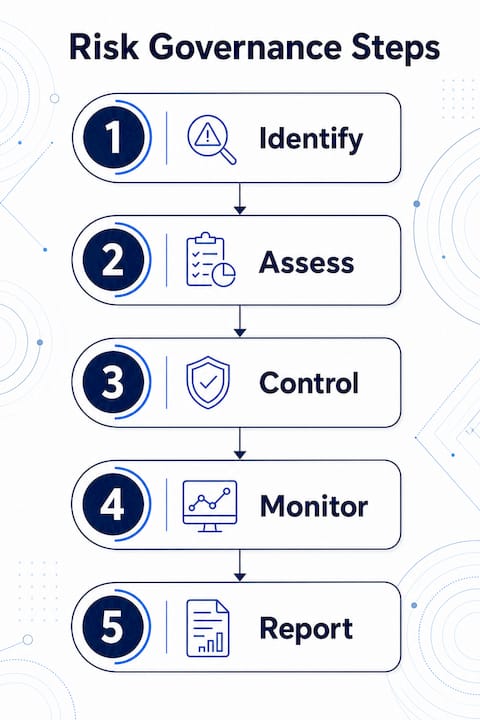
A practical step-by-step risk assessment process ties these components together, ensuring that outputs from each feed the governance reporting cycle rather than sitting in operational silos.
Advanced perspectives on effective risk governance and reporting
Risk reporting is undergoing a structural shift. The traditional model produced compliance-oriented reports: voluminous, backward-looking, and formatted for auditors rather than decision-makers. The emerging standard requires something different. Effective risk reports must include explicit decision asks, structured escalation protocols, and content tailored to the governance tier receiving them. A board report and a business unit dashboard serve different purposes and should look nothing alike.
The COSO ERM framework's fifth component, Information, Communication and Reporting, captures this directly. Its three principles require organizations to leverage information systems, communicate risk information across governance levels, and report on risk, culture, and performance together. Separating risk reporting from performance reporting produces an incomplete picture; integrating them allows the board to assess whether risk-taking is generating commensurate returns.
The IRGC framework adds a dimension that purely financial governance models often miss. Risk governance must navigate not only quantifiable exposures but also societal ambiguities and controversies, requiring transparent communication and genuine stakeholder engagement. For financial institutions operating under public scrutiny, that dimension shapes how governance decisions are communicated externally, not just internally.
Governance insight: Organizations with mature data architectures that integrate risk and performance metrics achieve faster decisions and stronger regulatory relationships than those maintaining separate reporting streams. The shift from static risk registers to dynamic, AI-powered risk reporting is where governance frameworks gain real operational leverage.
The FSB peer review finding remains instructive: the information provided to boards during the financial crisis was voluminous and not easily understood, which directly hampered directors' ability to fulfill their responsibilities. Governance quality is not measured by the volume of risk data produced. It is measured by whether the right people receive the right information in time to act on it.
Key Takeaways
Effective risk governance frameworks connect board oversight, documented risk appetite, and structured reporting into a system that keeps risk-taking aligned with organizational strategy.
| Point | Details |
|---|---|
| Governance vs. management | Risk governance sets policy and accountability; risk management executes the operational response within those boundaries. |
| Three Lines of Defense | Business units own risk, the risk function provides oversight, and internal audit delivers independent assurance to the board. |
| COSO ERM structure | The COSO ERM framework is built on five components and twenty principles, linking governance, culture, strategy, performance, and reporting. |
| NIST RMF process | The NIST RMF follows a seven-step cycle: Prepare, Categorize, Select, Implement, Assess, Authorize, and Monitor. |
| Reporting evolution | Risk reports must include explicit decision asks and escalation protocols, moving beyond compliance outputs to strategic decision support. |
How Riskinmind supports your governance framework
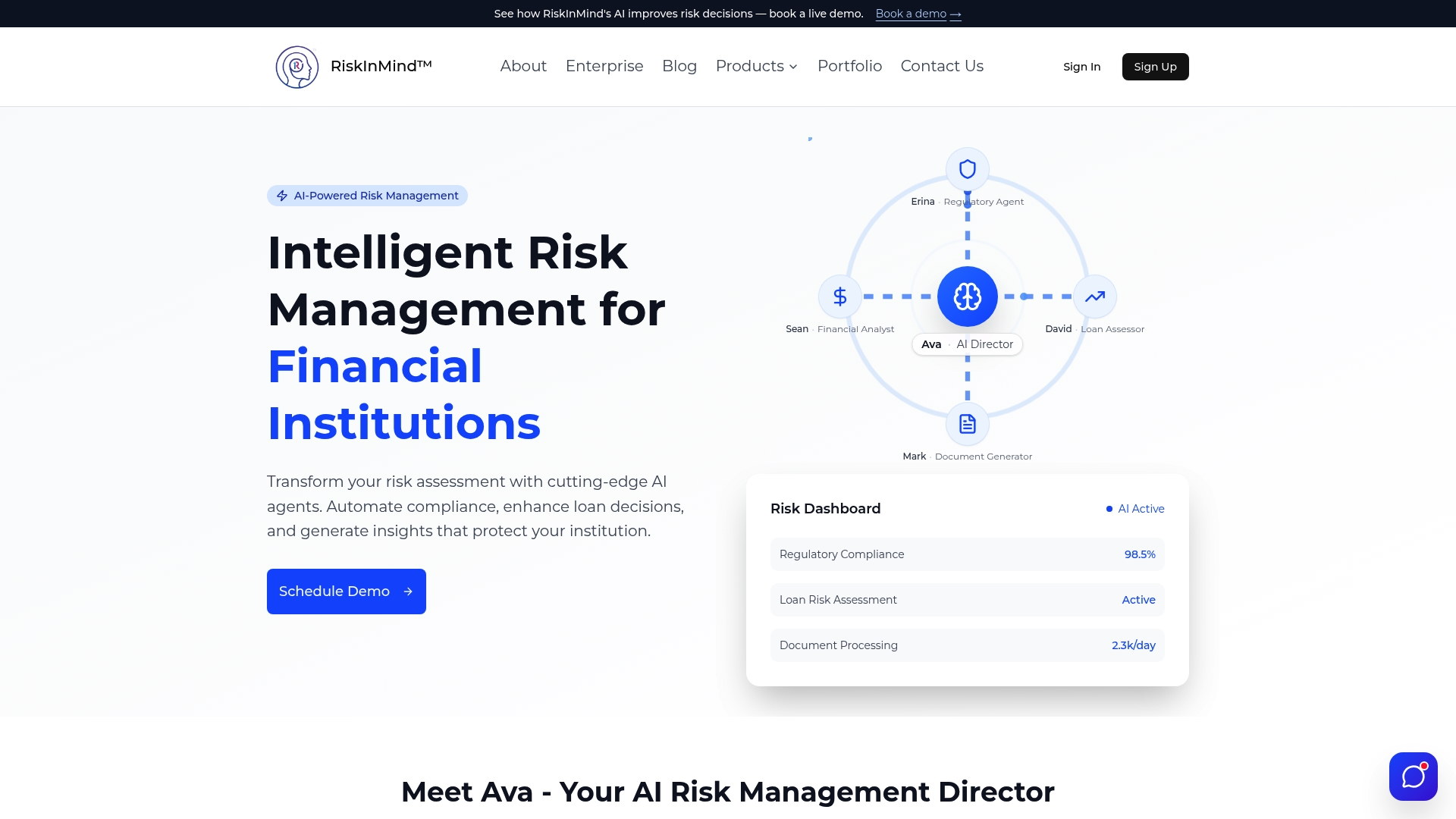
Riskinmind is built for the governance demands that credit unions, community banks, and lenders face every day. Its AI-powered platform automates risk identification, assessment, and reporting across the full governance cycle, giving CROs and risk committees the real-time visibility they need to fulfill their oversight responsibilities. From loan application risk analysis to portfolio-level monitoring, Riskinmind translates governance framework requirements into operational tools that actually get used. If your institution is working to close the gap between governance documentation and governance practice, Riskinmind is where that work starts.