
A risk technology roadmap is a strategic planning document that aligns business goals with technology risk management priorities, giving financial institutions a structured path through cybersecurity, compliance, and operational challenges. The industry term for this practice is technology risk management planning, and the roadmap is its primary output. The best risk technology roadmap examples share three traits: a defined 12–24 month horizon, integration with frameworks like ISO 31000 or NIST RMF, and measurable outcomes that executives can act on. For credit union leaders, community bank CROs, and technology decision-makers, a well-built roadmap is not a compliance checkbox. It is the document that decides where risk capital goes.
1. Risk technology roadmap examples that work in practice
Financial institutions build roadmaps in several distinct formats. Each example below reflects a real use case, a defined success metric, and a format choice that matches the institution's size and risk maturity.
Automate Regulatory Model Risk Governance
Examine models against 32 qualitative criteria and resolve risk Tiers with pre-deployment checklists per OCC 2011-12 guidelines.
Board-ready IT roadmap with integrated risk oversight
The most cited format in financial services is the board-ready IT roadmap, which covers a 12–24 month horizon and integrates operational risk, cybersecurity posture, and legacy technology lifespans. This format works because it speaks two languages at once: technical detail for the IT team and financial impact language for the board. A community bank using this format would map each technology initiative to a risk category, assign a dollar exposure estimate, and show the board exactly which systems are approaching end-of-life. The result is executive budget confidence, not just a project list.

Scalable IT roadmap for multi-site expansion
A professional services firm or regional bank opening new branches needs a roadmap built around operational speed. One proven approach sets a success metric of achieving full operating standards within 30 days of lease signing for each new office. That single metric forces the roadmap to prioritize standardized network builds, shadow IT reduction, and pre-approved vendor lists. For financial institutions expanding into new markets, this format translates directly into reduced operational risk at each new location.
Post-acquisition technology consolidation roadmap
After a merger or acquisition, financial institutions face a specific and urgent risk: two incompatible technology environments running simultaneously. A post-acquisition roadmap focuses on environment discovery first, then tool consolidation, then cost reduction. The sequence matters. Skipping discovery and jumping to consolidation is the most common mistake in this scenario. A credit union that acquired a smaller lender, for example, would use this roadmap to identify duplicate systems, map data flows, and set a 90-day deadline for decommissioning redundant platforms.
Cybersecurity-first risk roadmap
Some institutions build their technology risk roadmap entirely around cybersecurity priorities. Financial organizations commonly use swimlane views and table-based formats for this type, prioritizing high-impact items like security patching for immediate execution. A cybersecurity-first roadmap assigns each initiative a priority tier: immediate, high, medium, or low. Security patching sits in the immediate tier. Legacy firewall replacement sits in the high tier. This format gives the security team a defensible execution order and gives the board a clear view of residual risk at each stage.
Regulatory compliance roadmap aligned to DORA or EU AI Act
For institutions operating under the Digital Operational Resilience Act (DORA) or preparing for EU AI Act obligations, a compliance-driven roadmap is the right starting point. This format maps each regulatory requirement to a technology control, assigns an owner, and tracks completion status quarterly. The roadmap becomes the primary evidence document during regulatory examination. Institutions that build this format early avoid the reactive scramble that follows a regulatory finding.
Risk register-integrated roadmap
A risk register-integrated roadmap treats the risk register as a living input, not a static attachment. A risk register must be updated at least quarterly to remain relevant, and ignoring positive risks or opportunities is a common mistake. This format pulls active risks directly into the roadmap timeline, so every technology initiative is traceable to a specific risk item. When a new risk emerges, the roadmap updates automatically rather than waiting for the next annual review cycle.
GRC platform migration roadmap
Many financial institutions still manage risk programs in spreadsheets. Spreadsheets work for small teams but fail at scale. Transitioning to integrated GRC platforms is recommended when managing over 50–100 active risks for better version control and traceability. A GRC migration roadmap covers data migration, user training, integration with existing core banking systems, and a parallel-run period before full cutover. This is one of the highest-return technology investments a mid-size credit union can make.
2. Key components and frameworks in effective risk technology roadmaps
Every defensible roadmap shares four structural components: a risk register integration layer, a governance and escalation path, documented decision authority, and a compliance tracking mechanism. Missing any one of these reduces the roadmap from a management tool to a project list.
Framework selection: ISO 31000, NIST RMF, and FAIR
Framework choice drives roadmap credibility. ISO 31000 provides a general risk management process applicable across all institution types. NIST RMF is preferred for government-aligned organizations requiring detailed control libraries, whereas FAIR translates technical risk into financial terms, making it the preferred choice for board decision-making. Financial institutions benefit most from frameworks that link technical risk directly to financial impact. A CRO presenting to the board needs numbers, not heat map colors.
| Framework | Best use case | Output type |
|---|---|---|
| ISO 31000 | General risk management across all institution types | Process and principles |
| NIST RMF | Government-aligned or heavily regulated institutions | Control library and documentation |
| FAIR | Board-level financial risk quantification | Dollar-denominated risk estimates |
Moving beyond heat maps
Qualitative heat maps must be complemented or replaced by traceable, semi-quantitative, or quantitative estimates once risk materiality exceeds certain thresholds. Heat maps communicate direction, not magnitude. A board cannot approve a $2 million technology investment based on a red square on a grid. Pairing heat maps with quantitative estimates from FAIR or scenario-based models gives the roadmap the defensibility regulators and boards expect. For a deeper look at assessment methods beyond heat maps, the risk assessment methodology guide from Riskinmind covers traceable approaches built for financial leaders.
Governance and escalation paths
Defining risk thresholds without documented escalation paths, decision authority, and communication responsibilities reduces roadmap effectiveness. This is one of the most common governance failures in financial institution roadmaps. Every roadmap item above a defined risk threshold needs a named decision owner, a documented escalation path, and a communication timeline. Without these, the roadmap stalls when a risk event occurs because no one knows who decides.
Pro Tip: Add a one-page governance summary to the front of every roadmap. List the decision owner, escalation contact, and review frequency for each risk tier. Boards and examiners will reference it first.
3. How to choose and tailor a risk technology roadmap for your institution
Roadmap selection depends on three variables: organizational size, risk program maturity, and regulatory environment. A $500 million community bank and a $10 billion regional bank face different complexity levels, even if they share the same risk categories.
Start by auditing your current risk program against these four categories:
- Cybersecurity risk: Are you tracking vulnerabilities, patch status, and incident response readiness in a single system?
- Data privacy risk: Do you have a current data map showing where customer data lives and who accesses it?
- Legacy system risk: Have you documented the end-of-life dates for every core system and the cost of extending support?
- Operational resilience: Does your institution have a tested recovery time objective for each critical system?
Each category becomes a workstream in your roadmap. Assign a risk owner, a target state, and a timeline to each workstream before selecting a format.
For institutions operating under FINMA, EU regulations, or DORA, the compliance workstream must appear in the roadmap as a first-tier priority, not an afterthought. Outcome-driven risk policies empower defensible, measured risk-taking, enabling initiatives like AI adoption or cloud migration with proper governance. This means your roadmap can include innovation initiatives, provided each one has a corresponding risk control documented alongside it. For institutions building AI governance into their roadmaps, the AI risk management best practices guide from Riskinmind provides a proven five-strategy framework.
Pro Tip: Build your roadmap in 90-day sprints with a formal review at each interval. Quarterly reviews catch emerging risks before they become incidents and keep the register current.
Pitfalls to avoid:
- Updating the risk register less than quarterly
- Building escalation thresholds without naming a decision owner
- Treating positive risks (opportunities) as outside the roadmap scope
- Selecting a framework without mapping it to your specific regulatory obligations
4. Comparison of common risk technology roadmap formats
Format choice affects how stakeholders read, update, and act on the roadmap. The right format for a 10-person risk team differs from the right format for a 200-person enterprise.
| Format | Best for | Key advantage | Update frequency |
|---|---|---|---|
| Swimlane view | Cross-department workstream alignment | Shows parallel workstreams and dependencies clearly | Monthly |
| Table-based | Initiative tracking by priority, owner, and schedule | Easy to filter, sort, and share with non-technical stakeholders | Weekly or bi-weekly |
| Hybrid | Mid-size institutions with mixed audiences | Combines visual clarity with detailed tracking | Quarterly with monthly patches |
| Simplified one-page | Small teams or early-stage risk programs | Fast to produce and easy to present to boards | Monthly |
Swimlane formats work best when multiple departments own separate workstreams that must coordinate. A cybersecurity workstream, a compliance workstream, and a legacy modernization workstream running in parallel are easier to manage in a swimlane than in a flat table. Table-based formats work best when the primary audience is a project management office or a risk committee that needs to filter by owner, status, or priority. The technology integration checklist from Riskinmind provides a practical starting point for institutions building their first structured roadmap.
Key takeaways
A risk technology roadmap is only as effective as the governance structure, update cadence, and framework alignment behind it.
| Point | Details |
|---|---|
| Use a 12–24 month horizon | Board-ready roadmaps covering this window gain executive budget confidence and support resilience planning. |
| Match framework to output need | Use FAIR for board-level financial quantification; use NIST RMF when detailed control documentation is required. |
| Update the risk register quarterly | Registers updated less than quarterly lose relevance and fail to capture emerging risks or opportunities. |
| Document escalation paths | Every risk threshold needs a named decision owner and a documented escalation path to remain actionable. |
| Transition to GRC platforms at scale | Spreadsheets fail when managing more than 50–100 active risks; integrated GRC platforms maintain traceability and audit readiness. |
My take on where risk technology roadmaps are heading
I have reviewed risk programs at financial institutions ranging from small credit unions to mid-size regional banks, and the pattern is consistent: the roadmap is the first document that reveals whether a risk program is real or performative. A program with a well-maintained roadmap, quarterly reviews, and documented escalation paths almost always has stronger controls underneath it. A program with a static annual document almost always has gaps.
The shift I find most significant right now is the integration of AI governance into technology risk roadmaps. Institutions are deploying AI tools for underwriting, fraud detection, and customer service, but most roadmaps treat AI as a technology project rather than a risk category. That is a governance gap. AI systems carry model risk, data bias risk, and regulatory risk under frameworks like the EU AI Act. Each of those belongs in the roadmap as a named workstream with a control owner.
The other shift worth watching is the move from qualitative to quantitative risk assessment. Boards are asking harder questions. "How much does this risk cost us?" is replacing "How red is this box?" Institutions that build FAIR-based quantification into their roadmaps now will be ahead of the regulatory curve when examiners start expecting dollar-denominated risk estimates as standard practice.
The institutions that treat their roadmap as a living document, updated quarterly and presented to the board in business impact language, are the ones that get budget approved, pass examinations cleanly, and move faster on innovation. The roadmap is not overhead. It is the instrument that lets you take calculated risks instead of accidental ones.
— Raj
How Riskinmind supports your risk technology roadmap
Building a defensible risk technology roadmap requires more than a template. It requires real-time data, peer context, and AI-powered analysis that keeps pace with your institution's risk environment.
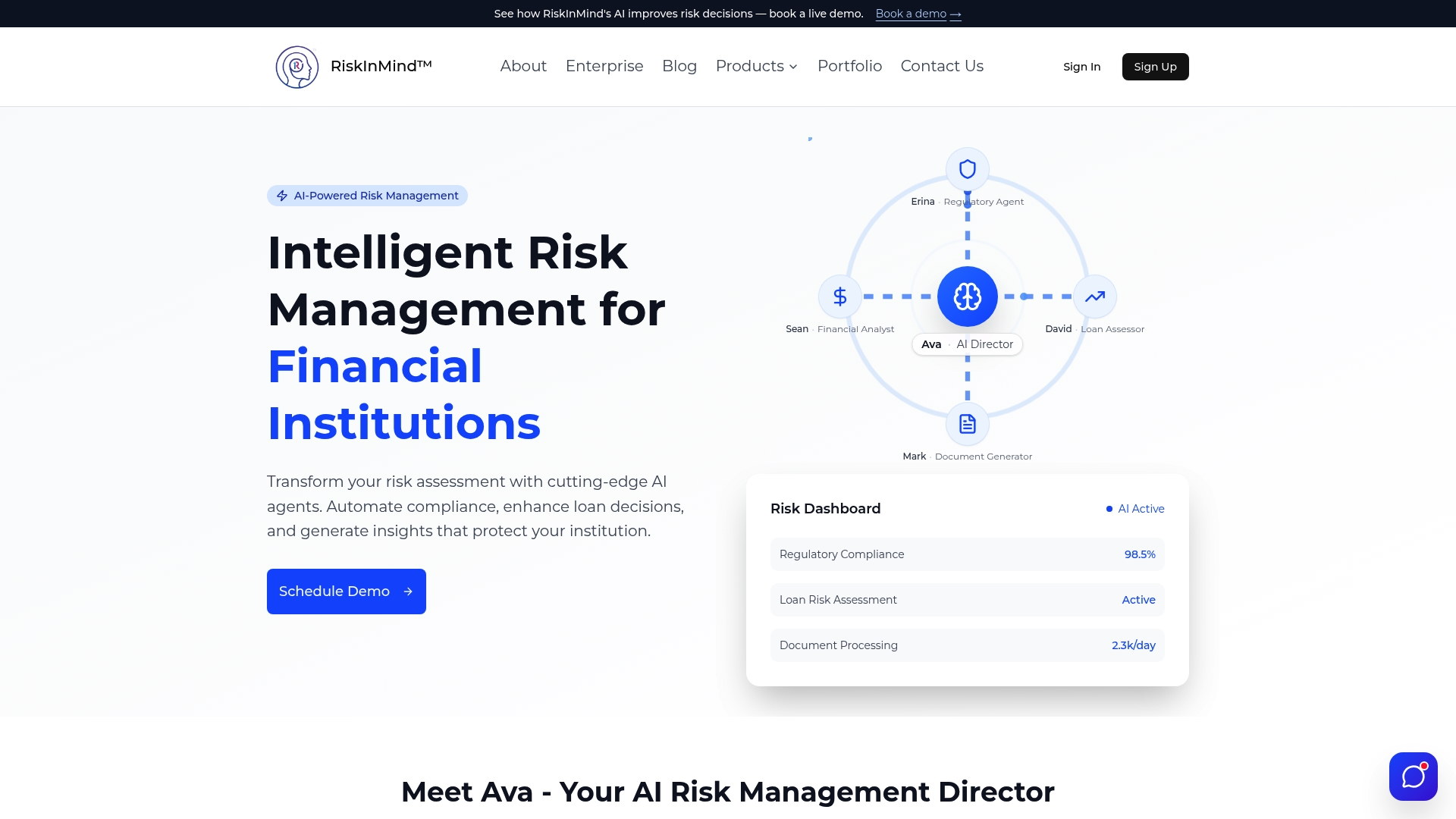
Riskinmind is built specifically for credit unions, community banks, and lenders. The platform's AI agents cover credit risk assessment, regulatory compliance, and portfolio monitoring, giving your team the data layer that makes roadmap decisions defensible. The loan application risk tool integrates directly into underwriting workflows, while peer benchmarking gives your institution a calibrated view of where your risk profile stands relative to comparable institutions. Both tools support the measurable outcomes that strong roadmaps require.
FAQ
What is a risk technology roadmap?
A risk technology roadmap is a strategic planning document that aligns technology initiatives with an institution's risk management priorities, typically covering a 12–24 month horizon and integrating cybersecurity, compliance, and operational risk categories.
What frameworks work best for financial institution roadmaps?
ISO 31000 suits general risk management, NIST RMF fits government-aligned or heavily regulated institutions, and FAIR is preferred when the board requires dollar-denominated risk estimates for decision-making.
How often should a risk technology roadmap be updated?
A risk register feeding the roadmap must be updated at least quarterly to remain relevant. Institutions with active risk programs review the full roadmap monthly and conduct formal updates every quarter.
What is the biggest mistake in building a risk technology roadmap?
Defining risk thresholds without documented escalation paths and named decision owners is the most common failure. Without clear governance, the roadmap stalls when a risk event requires a fast decision.
When should a financial institution move from spreadsheets to a GRC platform?
Institutions managing more than 50–100 active risks should transition to an integrated GRC platform. Spreadsheets cannot maintain the version control, multi-user access, and audit traceability that regulators expect at that scale.
Recommended
- Risk Technology Integration Checklist for Financial Institutions | RiskInMind
- Mobile Risk Management for Financial Institutions: 2026 Guide | RiskInMind
- Risk Platform Demo Evaluation Checklist for Financial Institutions | RiskInMind
- Risk Dashboard Features Checklist for Financial Institutions | RiskInMind