
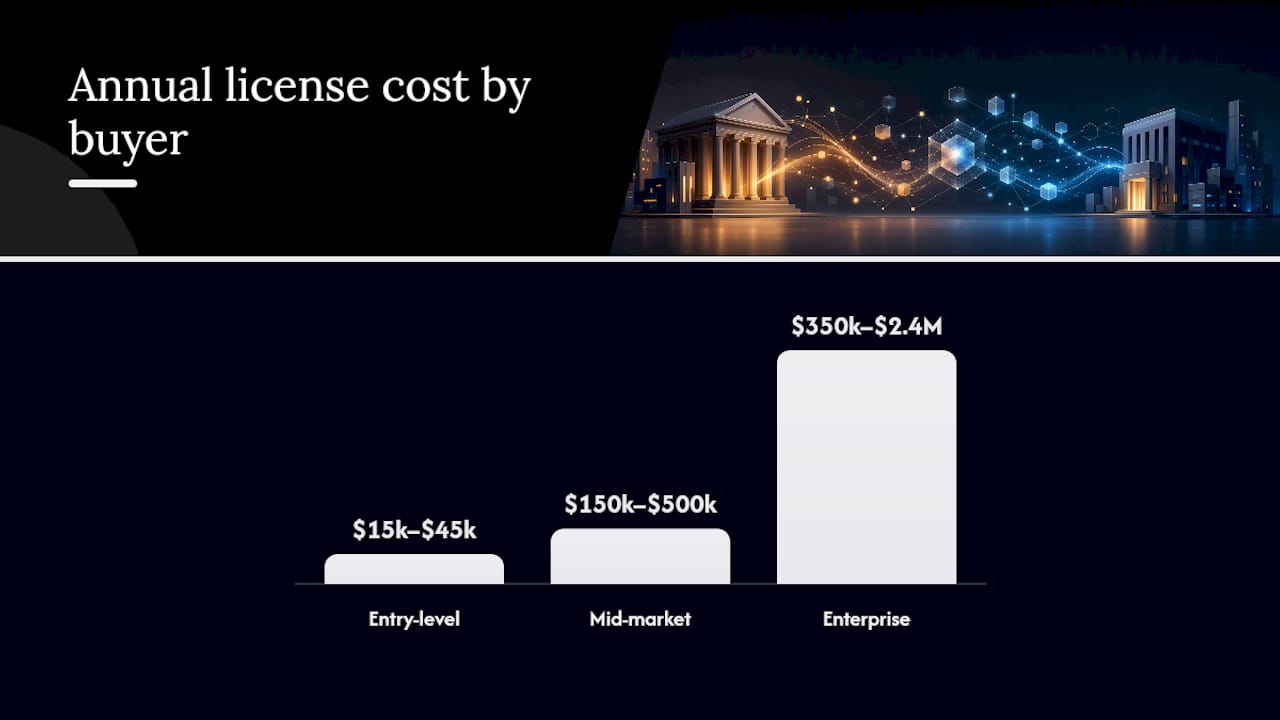
Entry-level risk software runs $15,000 to $45,000 a year, mid-market deployments land between $150,000 and $500,000, and enterprise multi-module contracts often reach $350,000 to $2.4 million annually. The single rule that saves buyers the most money: negotiate the license and the implementation services as two separate deals, because vendors price them differently and bundling them together hides where the real discount room sits.
- Negotiating license and implementation services separately can lead to significant savings, especially since vendors price them differently.
- Enterprise risk platforms typically cost $350,000 to $2.4 million annually, with implementation adding up to 1.4 times the first-year license fee.
- Cost-effective risk software depends heavily on choosing between named and concurrent user licenses, with the latter often saving organizations 20% to 30%.
- Total ownership costs include professional services, internal labor, data feeds, testing, support, and potential renewal escalations, which can double the initial license price.
- AI-driven platforms may increase upfront costs but can reduce ongoing manual labor costs substantially over three years, improving return on investment.
Automate Regulatory Model Risk Governance
Examine models against 32 qualitative criteria and resolve risk Tiers with pre-deployment checklists per OCC 2011-12 guidelines.
Table of Contents
- How much does risk management software cost by pricing model?
- What do risk software costs actually look like at each company size?
- What should you include in a total cost of ownership calculation?
- How do you negotiate risk software pricing effectively?
- How long does risk software implementation take, and what internal resources does it need?
- How does AI change the cost and ROI of risk software?
- What are the financial risks of vendor lock-in in risk software contracts?
- What should you budget for software updates and upgrades?
- What does data security and compliance cost in risk software?
- What should you demand from every risk software vendor's quote?
- How RiskInMind Helps You Budget for AI-Driven Risk Management
- Sources
How much does risk management software cost by pricing model?
Every risk software quote is really three or four line items dressed up as one number. Understanding how each layer works is what lets you compare a $180,000 quote from one vendor against a $240,000 quote from another and know which one is actually cheaper.
Named versus concurrent user licensing is the first fork in the road. A named license ties a seat to one specific employee, and you pay for that seat whether they log in once a day or once a quarter. A concurrent license charges based on how many people are using the platform at the same moment, which favors organizations with shift-based analysts, seasonal underwriting spikes, or large teams that rarely log in all at once. Credit unions with a lean risk team but heavy quarter-end reporting cycles often save 20% to 30% by negotiating concurrent seats instead of named ones, though vendors will resist this because it caps their per-user revenue ceiling.
Module-based pricing is the second layer, and it's where vendors make their real margin. Core risk platforms typically sell credit risk assessment, compliance monitoring, portfolio analytics, and reporting as separate modules, each with its own license fee. Buy three or more modules together and most vendors will discount the bundle, but the caveat matters: bundle discounts often apply only to the license fee, not to the implementation or connector costs tied to each module. A five-module bundle that looks like a 25% savings on paper can still cost more in year one than buying two modules cleanly, because each module you add drags its own integration and data-mapping work behind it.
Fixed enterprise license agreements (ELAs) cap your cost regardless of user growth within a defined band, which appeals to institutions expecting rapid headcount growth in risk or compliance. Usage-based and volume pricing, by contrast, charges per assessment, per loan file, or per report generated. This model fits assessment-driven tools well, since a small community bank running 200 loan reviews a month shouldn't pay enterprise-scale license fees built for 10,000.
Then there are the costs vendors rarely lead with:
- Platform or OEM fees charged when the risk software runs on top of a third-party data or infrastructure layer
- Connector fees for linking the platform to your core banking system, loan origination system, or data warehouse
- Sandbox environments for testing configurations before go-live, frequently billed as a separate line item
- Data feed subscriptions for market data, credit bureau pulls, or regulatory update feeds
Ask for every one of these as its own line in the quote. A vendor who folds platform fees into a single "license" number is making it harder for you to compare their offer against a competitor's itemized one.
What do risk software costs actually look like at each company size?
Numbers help more than percentages here, so consider three buyer profiles that map to how most financial institutions actually shop for risk software.
Entry-level profile: a single-branch credit union or small community lender. Annual license costs for compliance monitoring plus basic credit risk tools typically fall in the $15,000 to $45,000 range for licensing alone.
Mid-market profile: a regional bank or multi-branch credit union with $500 million to $5 billion in assets. These buyers typically need three to five modules covering underwriting automation, portfolio monitoring, and regulatory reporting. License-only costs commonly sit in the $150,000 to $500,000 annual range, with first-year all-in spend frequently landing 30% to 50% higher once implementation and connector work are included.
Enterprise profile: a large regional or national lender with multiple business lines. License-only annual costs for a full multi-module deployment often range from $350,000 to $2.4 million, depending on module count and user volume. At this scale, per-user pricing behaves differently than smaller buyers expect.
Statistic Callout: Implementation services for enterprise risk platforms commonly add 0.8x to 1.4x of the first-year license cost to the total year-one budget. On a $400,000 license, that means implementation alone can run $320,000 to $560,000, before a single recurring add-on is counted.
Per-user pricing tends to drop meaningfully once you cross large user-count thresholds, which is why two enterprise buyers with similar headcounts can end up with very different per-seat economics depending on where they land relative to a vendor's volume breakpoints. If your institution is hovering just below a pricing band, ask the vendor directly what happens to per-user cost if you cross it, because that threshold is a real negotiation lever, not a fixed wall.
A second pattern worth flagging: the ratio between license cost and true all-in cost widens as deployment complexity grows. A small credit union might see license and all-in costs sit close together, maybe a 1.3x ratio. An enterprise lender running multiple integrations, custom workflows, and several data feeds can see that ratio climb past 2x once every recurring add-on is counted. Treat the headline license number as the floor of your budget conversation, never the ceiling.
What should you include in a total cost of ownership calculation?
License fees are the visible part of the iceberg. The costs that sink budgets are the ones nobody puts a number on until the invoice arrives.
A complete total cost of ownership calculation needs to account for:
- Professional services fees for initial configuration, data migration, and workflow setup, billed either as a fixed project fee or hourly.
- Internal labor from your own risk, IT, and compliance staff, which frequently gets left out of vendor comparisons entirely despite being one of the largest true costs of implementation.
- Integration and connector work tying the platform to your loan origination system, core banking platform, or data warehouse.
- Data feed subscriptions for credit bureau access, market data, or regulatory updates that renew annually and often escalate.
- Sandbox and testing environments, commonly priced between $35,000 and $75,000 each when not bundled into the base license.
- Premium support tiers, which can range from $40,000 to $180,000 annually depending on response-time guarantees and dedicated staffing.
- Training costs for onboarding staff, especially for institutions with high analyst turnover or multiple branches needing repeated sessions.
- Renewal escalation clauses, which quietly raise your license cost year over year, sometimes tied to inflation indices, sometimes to a flat contractual percentage.
The 0.8x to 1.4x implementation multiplier is the single most useful shortcut for sanity-checking a quote. It usually means scope is being underestimated and you'll see a change order mid-project. Complex environments with heavier data acquisition and continuous monitoring needs tend to push toward the higher end of that multiplier, according to TechTarget's breakdown of risk assessment cost drivers.
Pro Tip: Build your three-year TCO by taking year-one all-in cost, adding two years of license renewal at the contract's stated escalation rate, then adding recurring add-ons (support, sandboxes, data feeds) at their current pricing without assuming any discount. Vendors rarely volunteer a worst-case number, so calculate it yourself before you sign.
Internal labor deserves its own line, not a footnote. Buyers routinely underbudget the hours their own risk and IT staff spend on data mapping, testing, and change management, and that internal time can exceed the vendor's own professional services cost when totaled across a project. A risk technology integration checklist helps map out where that internal effort concentrates before you commit to a go-live date.
How do you negotiate risk software pricing effectively?
Discount ranges depend almost entirely on which procurement path you choose, and the gap between paths is bigger than most buyers expect.
Running a competitive RFP with two or more vendors bidding against each other typically yields discounts in the 20% to 32% range off list price. Negotiating with a single vendor without competitive pressure tends to land at the lower end of the broader 12% to 40% discount spectrum reported across GRC and risk software deals. Multi-year commitments and larger user-volume scale push discounts higher still, since vendors value locked-in revenue and reduced renewal-cycle sales cost.
A few tactical moves consistently pay off at the negotiating table:
- Insist on an itemized statement of work (SOW) that separates license fees, implementation labor, and each add-on into its own line, not a single bundled number.
- Push for a fixed-fee migration and configuration cost rather than a time-and-materials estimate, which shifts scope-creep risk onto the vendor.
- Negotiate a cap on true-up costs, meaning the price you'll pay if your user count or transaction volume grows mid-contract, before you sign, not after.
- Ask for a defined seat-band growth clause so you know exactly what triggers a price increase and by how much.
Pro Tip: Send this exact question to every vendor during evaluation: "Please itemize sandbox pricing, connector fees, platform fees, and your true-up definition as separate line items in your proposal." Vendors who answer quickly and specifically are typically the easier ones to work with post-contract. Vendors who hedge or fold everything into one number are telling you something about how the relationship will go after signing.
Watch for contract red flags: renewal clauses with escalation percentages left vague ("market rate adjustment"), true-up definitions that reference undefined "peak usage," and professional services estimates with no cap on total hours. Competitive bidding and multi-year terms remain the two most reliable discount levers available to a buyer, and neither requires giving up anything on the services side of the negotiation. Keep licensing and services as separate conversations with separate signatures if the vendor allows it. Procurement teams that unbundle these two negotiations consistently report more leverage on both.
How long does risk software implementation take, and what internal resources does it need?
Large-scale, multi-module deployments commonly average around ten months from contract signature to full go-live. Smaller pilots and single-module rollouts typically move faster, often completing within a few months, though they still require significant internal attention along with vendor effort.
Budget internal time across four roles: a project sponsor from risk or compliance leadership, a technical lead from IT to manage integrations, a data owner who understands your loan and portfolio data structures, and end-user representatives from underwriting or portfolio management who test workflows before rollout. For a mid-market implementation, a realistic range is 400 to 900 internal FTE-hours spread across these roles over the project timeline. Enterprise multi-module projects can push well past 1,500 hours once you count testing cycles, training sessions, and change management.
- Start with a single-module pilot on your highest-volume workflow to prove value before expanding scope.
- Phase larger rollouts by business line rather than attempting a simultaneous cutover across underwriting, compliance, and portfolio monitoring at once.
- Build a testing and validation window into the timeline, not as a buffer if things run late, but as a planned phase with its own budget.
A risk technology roadmap that sequences modules by expected ROI, rather than by vendor convenience, tends to compress both cost and internal disruption. Phasing also caps early spend, which matters if your board wants proof of value before approving the next module's budget.
How does AI change the cost and ROI of risk software?
AI-driven platforms shift where your money goes rather than simply lowering the total. Moving to continuous, AI-enabled risk assessment typically raises upfront tooling and integration costs, but it can meaningfully reduce indirect costs like manual review hours and processing delays over the life of the contract. The trade-off is real: you're paying more at signing to pay less every month after.
An AI-powered risk management platform illustrates the shape of that trade-off. It can run a suite of specialized AI agents, each focused on areas like regulatory compliance, credit risk assessment, or market analysis, coordinated by a central AI director. Real-time processing with response times under half a second changes what "turnaround" means for underwriting and portfolio monitoring, and some platforms carry SOC 2® certification along with bank-grade security controls, which matters directly when you're modeling the risk mitigation costs discussed below.
When you model ROI for an AI-driven risk platform, don't just compare license cost against your current spend. Model these instead:
- Reduced internal FTE hours spent on manual credit memo drafting and document review
- Fewer compliance incidents or late filings caught earlier by automated monitoring
- Faster underwriting turnaround time, which affects loan volume capacity without adding headcount
- Lower error-correction cost from catching data and documentation issues before they reach a human reviewer
Case examples of risk platform ROI show how these savings accumulate over 18 to 36 months rather than in the first quarter, which is exactly why a three-year TCO view matters more than a year-one sticker price when AI automation is part of the pitch. Buyers who only compare year-one cost against a legacy manual process will systematically undervalue what an AI-driven platform saves later.
What are the financial risks of vendor lock-in in risk software contracts?
Vendor lock-in shows up in three financial forms, and each one costs you leverage at renewal time. The first is data portability: if your risk data, model configurations, and historical assessments live entirely inside a proprietary format, switching vendors later means rebuilding that history, which can cost more than the original implementation. The second is integration depth: the more connectors and custom workflows you've built against one vendor's API, the more expensive an exit becomes, since every integration has to be rebuilt against a new platform.

The third, and most financially painful, is renewal leverage. Once your team is trained, your data is migrated, and your workflows are built around one platform, the vendor knows switching costs are high, and renewal pricing often reflects that. This is precisely why locking down true-up definitions and seat-band clauses at signing matters so much: those contractual growth definitions are your best defense against a vendor using lock-in leverage against you two or three years in.
Before signing, ask specifically about data export formats, API access for building your own integrations, and whether the contract includes any exit-assistance clause covering data migration support if you leave. A vendor confident in their value proposition should have no problem committing to these in writing.
What should you budget for software updates and upgrades?
Most risk software contracts bundle minor updates and patches into the base license fee, but major version upgrades, new module releases, or significant AI model updates sometimes carry separate costs, particularly for platforms with older, non-cloud architectures. Cloud-hosted risk software generally handles updates with less disruption and less direct cost to the buyer, since the vendor pushes updates centrally rather than requiring an on-premises reinstallation project.
Ask vendors directly whether major version upgrades are included in your annual license fee or billed separately, and get that answer in writing rather than relying on a sales conversation. Some contracts define "included updates" narrowly enough that a genuinely useful new feature gets classified as a paid add-on rather than a covered upgrade.
Budget for the indirect cost too: even a "free" update can require internal testing time to confirm existing workflows and integrations still function correctly afterward. For platforms handling regulatory compliance or credit decisioning, skipping that testing step to save time is not a place to cut corners.
What does data security and compliance cost in risk software?
Security and compliance aren't a line item you can skip, and treating them as an afterthought in your budget is how institutions end up with expensive remediation costs later. Risk assessment costs, as TechTarget notes, include personnel time, external consulting, tooling, and continuous monitoring, and the compliance layer of a risk platform touches all four categories directly.
Factor in the cost of your own internal security review before signing any contract: legal and IT security teams need time to evaluate a vendor's certifications, data handling practices, and breach notification terms. For institutions handling sensitive credit and financial data, that internal vetting process alone can run several weeks of staff time, and skipping it to save time is the kind of shortcut regulators notice.
Recurring compliance costs include audit support fees if the vendor charges for generating audit-ready documentation, any premium tier required for real-time monitoring alerts tied to regulatory thresholds, and the internal cost of periodic access reviews to confirm only the right staff can view sensitive risk data. A platform carrying independent certifications like SOC 2® reduces some of this internal vetting burden by giving your compliance team a recognized standard to point to, but it doesn't eliminate the need for your own periodic review of how the vendor actually handles your institution's data day to day.
What should you demand from every risk software vendor's quote?
Before you sign anything, put these exact requests in writing to the vendor. Ask for an itemized SOW that separates license, implementation, and every add-on into its own row, no exceptions. Get sandbox pricing and connector fees quoted individually rather than folded into a single number, and get the platform's true-up definition spelled out with hard caps, not vague language about "peak usage."
Fight hardest on two things: the true-up cap and the fixed-fee migration cost. Everything else is negotiable at the margins, but those two clauses determine whether year three of your contract looks anything like year one's budget.
Your go/no-go sign-off criterion should be simple: if a vendor won't itemize their quote or won't commit to a written true-up definition before you sign, that's a answer about how the relationship will run after the ink dries.
— Raj
How RiskInMind Helps You Budget for AI-Driven Risk Management
RiskInMind gives portfolio managers, lenders, and credit unions a way to see the automation trade-off in action before committing budget, through a demo built around your actual underwriting and compliance workload rather than a generic sales walkthrough.
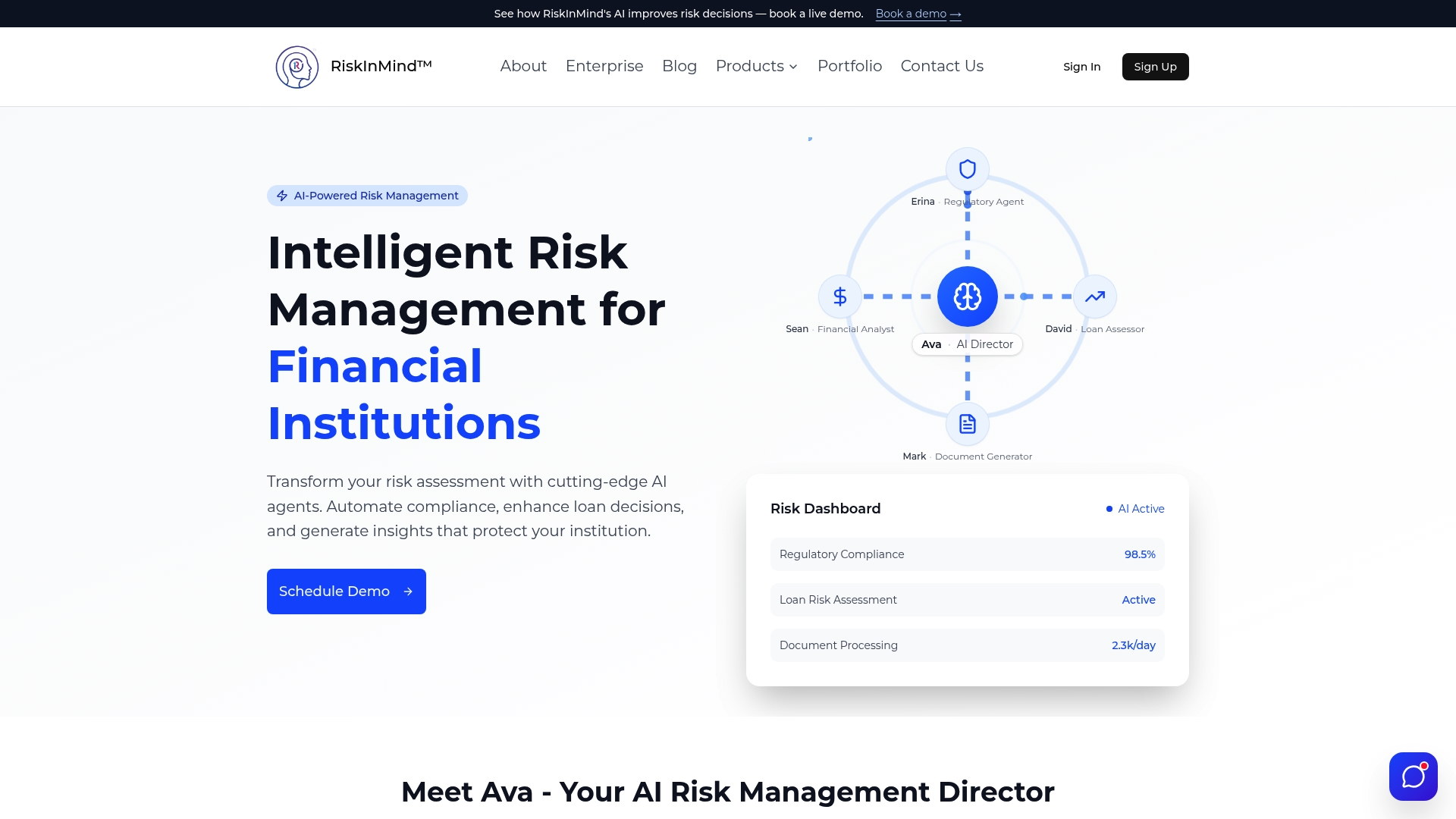
The platform's AI agents, coordinated by Ava, are built to reduce the manual hours that typically inflate ongoing risk software costs: automated credit memo generation, real-time portfolio monitoring, and audit-ready reporting all shift work away from analyst hours and toward sub-half-second automated processing backed by SOC 2® certification and bank-grade security. If your institution is comparing AI-driven underwriting against a legacy loan origination system, that comparison page walks through exactly where the cost composition shifts. Portfolio managers and lending directors evaluating peer-level benchmarking as part of their cost case can also review the peer benchmarking product page for how portfolio-level analytics factor into the ROI math. Request a demo to see how your specific loan volume and staffing model translate into a realistic first-year budget.
Sources
- Riskonnect Pricing 2026: What Enterprises Actually Pay
- GRC Software Pricing Guide 2026: What Companies Pay
- How do risk assessment costs vary and why? | TechTarget
- Riskonnect Pricing: Is It Worth It In 2026?