
Coordinating risk, compliance, and credit oversight across disconnected systems leaves risk managers buried in manual work and exposed to audit gaps. Many risk management platforms either hide pricing details until late in the process or require technical onboarding that smaller teams cannot absorb. This comparison covers automation features, domain coverage, and pricing transparency so you can select a risk management software vendor that fits your institution’s capacity and compliance needs.
Table of Contents
Maintain 100% NCUA & OCC Audit Readiness
Monitor regulatory updates 24/7, check internal credit policies, and generate compliance trails with Erina (AI Regulatory Agent).
RiskInMind
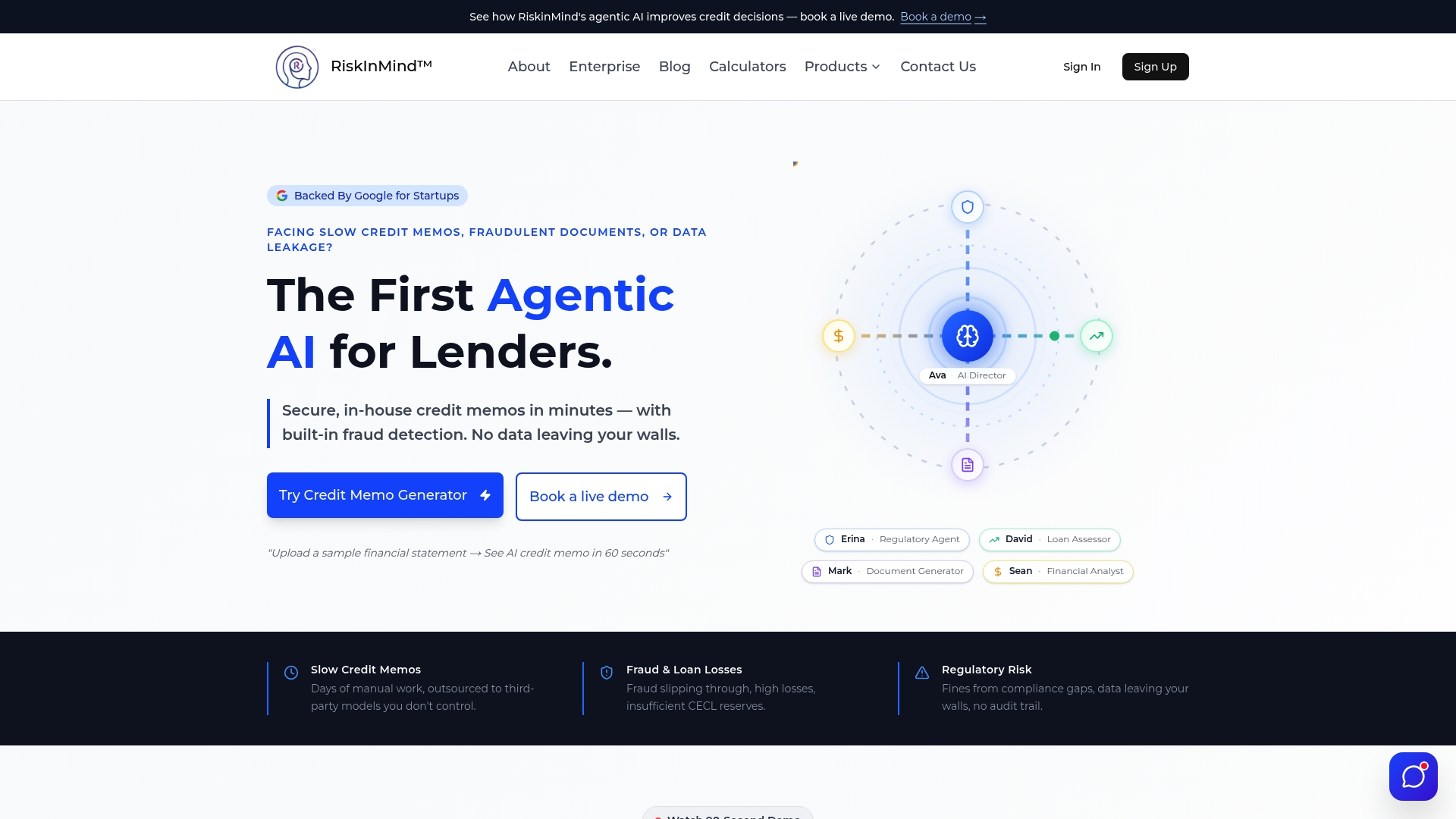
At a Glance
Backed by Google for Startups, RiskInMind positions itself squarely for credit unions and community banks that need AI applied to credit workflows. The product data states SOC 2® compliance and end-to-end encryption, a security claim the vendor makes on its site.
Core Features
- AI-generated in-house credit memos from financial statements in minutes, removing much of manual write-up work.
- Built-in fraud detection and anomaly flagging to highlight outliers in transaction and application data.
- CECL-compliant loan loss reserve modeling and continuous portfolio trend analysis for credit oversight.
- Real-time regulatory compliance monitoring with automated reporting and audit trail support.
Key Differentiator
Agentic AI that routes work to specialized AI agents is the platform's operational spine. That routing lets subject-matter models handle loan assessment, compliance checks, portfolio analytics, and anomaly detection in parallel instead of a single monolithic model.
Pros
- The vendor advertises a 70 to 80% reduction in manual processing time for credit memos, which directly affects analyst capacity and turnaround.
- In-house data processing reduces reliance on external cloud pipelines and limits data movement, a practical plus for institutions worried about exposure.
- Automated compliance tracking and reporting cut back on repetitive audit prep and create a clearer trail for examiners.
- Domain-specific AI agents surface credit and market signals faster than rule-heavy spreadsheets, helping credit officers prioritize reviews.
- The product data states SOC 2® compliance and end-to-end encryption, which supports a bank-grade security posture for regulated institutions.
Cons
- Limited public detail on how models are customized to a specific institution's loan products and credit policies; that gap suggests you will need discovery and validation work during onboarding.
Notable Integrations
- APIs for core banking systems and data sources, enabling connectivity to general ledger feeds, loan servicing systems, and application databases without inventing custom extractors.
Who It's For
Risk managers, credit officers, and compliance professionals at credit unions and community banks that want to shift routine credit analysis and compliance tasks from manual work to automated workflow orchestration.
Unique Value Proposition
Real-time compliance monitoring with automated reporting converts exam readiness from a quarterly scramble into an ongoing operational state. For small-to-medium lenders where exam windows are tight, that continuous feed into audit trails changes how you staff and schedule compliance work.
Real World Use Case
According to the vendor, the platform can cut manual credit memo effort from days to minutes while improving fraud flagging and monitoring. A regional credit union used that capability to speed decision cycles and move senior credit officers to higher-value reviews.
Pricing
Pricing is not published. The product data indicates pricing is likely customized for enterprise clients, so expect contract-based quotes that depend on integration scope, data volume, and the number of agent workflows deployed.
Website: https://riskinmind.ai
Abrigo
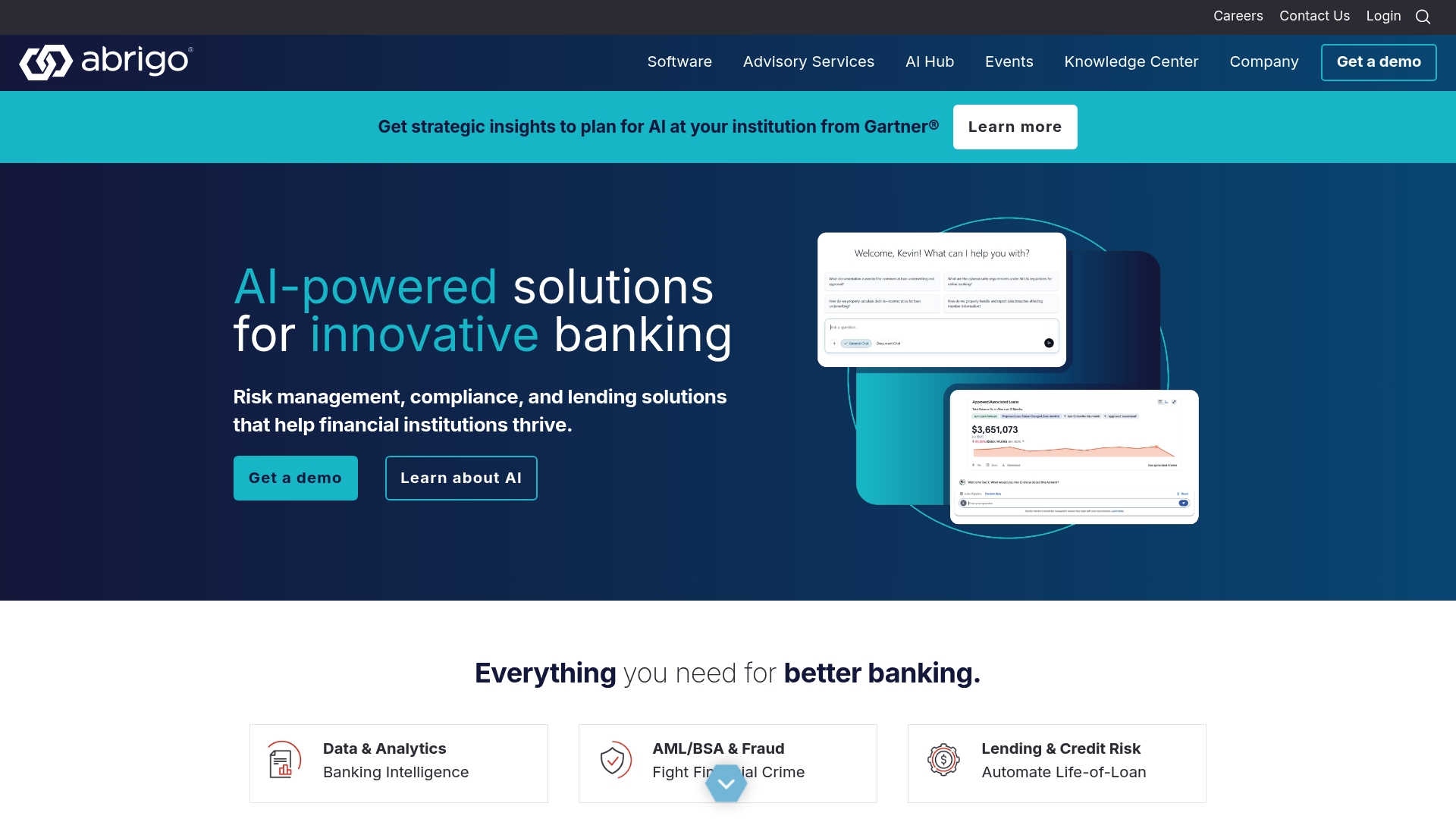
At a Glance
Abrigo brings multiple acquired risk and compliance brands into a single platform, combining AML workflows, credit risk tools, CECL support, and advisory services under one vendor roof. The site was briefly inaccessible during data collection, so some product detail below comes from vendor descriptions and third-party summaries.
Core Features
Abrigo offers integrated credit risk management, transaction monitoring and AML workflows, and portfolio risk tools that include CECL loan review and stress testing. The platform also provides banking intelligence and data analytics connectors plus advisory services for policy and growth support.
Key Differentiator
Abrigo pairs software with expert advisory services so you get tooling and policy guidance from the same provider. That mix of analytics, AML/BSA workflows, and consultative support is the platform’s central claim to value.
Pros
- Consolidates AML, CDD, transaction monitoring, and regulatory filing functions in a single workflow, which reduces manual handoffs and duplicated research.
- Customer support and onboarding receive positive mention in vendor and review summaries, helping teams move from pilot to production faster.
- Strong analytics capabilities give lending and risk teams clearer signals for portfolio optimization and stress testing.
- Advisory services let risk teams translate model outputs into policy changes or board-ready reporting without hiring external consultants.
- The integrated approach reduces the number of point products security and compliance teams must manage.
Cons
- The platform surface is feature-rich and can feel overwhelming for first-time users; training investment is likely required.
- Several reviewers cited an initial learning curve for teams unfamiliar with enterprise compliance systems.
- The vendor website was inaccessible during research which limited direct verification of feature detail and documentation availability.
When It May Not Fit
If you run a very small credit union or community bank with light compliance needs and no budget for formal training, Abrigo’s breadth may be more than necessary. If you need transparent, self-serve pricing on day one, this vendor does not publish rates publicly. Teams that prefer minimal configuration and single-click simplicity will find the platform dense at first.
Who It's For
Risk managers, compliance officers, lending officers, and analytics teams at mid to large-sized banks and financial institutions who need an integrated suite for AML, CECL, and portfolio risk. Organizations that want vendor advisory support alongside software will find the pairing useful.
Real World Use Case
A regional bank consolidated AML, credit risk, and portfolio monitoring into Abrigo to reduce manual reconciliation across systems. The bank reported fewer duplicate investigations and a faster quarterly CECL review cycle after centralizing data and workflows with the platform.
Pricing
Pricing is not publicly disclosed. Abrigo provides custom quotes on inquiry and typically scopes solutions based on institution size, module selection, and advisory services required.
Website: https://abrigo.com
Corizance
At a Glance
A connected risk management approach links cyber, operational, and compliance signals in real time across Corizance's platform. The vendor's marketing materials describe the product as award-winning and emphasize AI-driven identification and predictive models.
Core Features
- Real-time risk monitoring and alerting across multiple domains so teams see incidents and trends as they emerge.
- AI-powered risk identification that profiles risks and priorities rather than only logging incidents.
- Low code implementation and APIs for custom connectors to shorten integration timelines with existing tooling.
- Automation of compliance workflows, benchmarking, and predictive risk modeling are part of the same stack.
Key Differentiator
The platform's main distinction is its focus on linking risk domains into a single operational view. That connected approach makes sense if you want cyber signals feeding operational resilience scoring and compliance checks in one place, rather than stitched together from separate point tools.
Pros
- Proactive monitoring reduces mean time to detection. The real-time feeds and alerting let security and risk teams act before an issue escalates.
- Predictive analytics provide forward-looking risk signals that help prioritize limited remediation budget. Those models feed into dashboards that risk committees can use in briefings.
- Automation of compliance tasks lowers manual review cycles and can shrink recurring audit work by reducing repetitive evidence collection.
- The vendor advertises industry awards and certifications, which supports buyer confidence during vendor due diligence.
- Strong connector strategy means data from existing systems can be ingested without throwing out current tooling.
Cons
- The breadth of features produces implementation complexity for smaller teams; configuration and taxonomy mapping take time.
- Depending on existing infrastructure, deployment can demand significant engineering involvement and change management.
- Public pricing information is limited, which makes cost forecasting and procurement planning harder from the buyer side.
When It May Not Fit
If your organization needs a lightweight, out-of-the-box risk checklist for a single risk domain, this platform is likely too feature-rich and expensive to run. Small community banks and micro-lenders with minimal in-house engineering may struggle with the setup burden.
If procurement requires line-item, self-serve pricing or a predictable per-seat SaaS fee, the limited public pricing details will slow evaluation.
Notable Integrations
- Microsoft Dynamics 365
- APIs for custom connectors that let you map data from core banking, ticketing, or security tools into Corizance
Who It's For
Financial institutions and regulated enterprises that need consolidated visibility across cyber, operational resilience, and compliance. Teams with some integration capacity and a roadmap to unify multiple risk domains will extract the most value.
Real World Use Case
A regional bank deployed Corizance to automate compliance monitoring and link cyber threat signals into its operational resilience scorecard. The bank used predictive models to prioritize vendor remediation and reduced recurring manual evidence pulls for audits.
Pricing
Not applicable — informational only. Public-facing pricing is not published in the available materials, so vendors typically discuss pricing during sales engagements and scoping workshops.
Website: https://corizance.com
Comparative Analysis of Risk Management Software Options
Selecting an appropriate risk management solution depends on the institution's scope, operational complexity, and required features. Here, we examine the distinctions among the featured options to aid prospective buyers in identifying the most suitable fit for their needs.
Feature Adaptability and Specialization
RiskInMind.ai differentiates itself with its Agentic AI workflow orchestration, enabling parallel task processing across specific areas such as compliance, credit assessment, and anomaly detection. This structure minimizes manual input and results in measurable efficiency gains, particularly valuable for credit unions and community banks managing constrained resources. However, the necessity for thorough discovery and customization during onboarding may demand additional planning.
Abrigo, on the other hand, merges diverse risk management capabilities, including AML and CECL modeling, within a suite. The availability of advisory services to augment in-house expertise presents a distinctive advantage for organizations seeking guidance on policy formulation alongside software deployment. Despite initial learning challenges for new teams, its integrated and approach simplifies long-term operational workflows post-implementation.
Integration and Deployment Considerations
Both RiskInMind.ai and Corizance excel in integration strategies. RiskInMind.ai offers APIs conducive to compatibility with various institutional systems, streamlining credit and compliance workflows. Conversely, Corizance touts its low-code implementation options and the ability to integrate operational, compliance, and cyber risk data into a unified risk profile. However, smaller teams or institutions with limited IT capacity may find Corizance's setup more demanding due to its implementation complexity.
Best Fit Recommendations
- RiskInMind.ai: Suitable for credit unions and community banks looking to enhance credit memo efficiency and regulatory compliance oversight through AI-powered workflows.
- Abrigo: Best for mid-sized to large organizations that value a unified suite encompassing AML, credit risk, and portfolio management, coupled with consultative advisory services.
- Corizance: Ideal for institutions focusing on multi-domain risk unification, especially when cyber risk intelligence capability integration is a priority.
Our Pick
We recommend RiskInMind.ai for community-oriented financial institutions aiming for a specialized and effective approach to managing credit and compliance processes. By coupling scalability with minimal staff resource requirements for recurring reviews, it aligns closely with the practical needs of smaller organizations. However, mid-sized to large institutions may opt for Abrigo if advisory support is a significant value driver.
Risk Management Software Alternatives
Choosing the right risk management software depends on the features that align with your organization's needs, including compliance automation and integrated AI capabilities.
| Product Name | Core Feature | Key Differentiator | Best For | Pricing | Notable Limitation |
|---|---|---|---|---|---|
| RiskInMind | Automated credit memos and compliance tools | Specialized AI agents for parallel workflows | Credit unions and community banks | Not disclosed | Limited customization detail for workflows |
| Abrigo | Integrated AML and credit risk management | Pairing software with advisory services | Mid to large-sized financial institutions | Not disclosed | Complexity can require significant onboarding |
| Corizance | Consolidated visibility across risk domains | Real-time risk linking operational and cyber signals | Regulated enterprises managing multiple risks | Not disclosed | Setup burden for small teams and minimal engineering |
Discover a Smarter Alternative to prmia.org with RiskInMind
If you are searching for prmia.org alternatives that focus specifically on automating credit risk management and real-time compliance monitoring, RiskInMind offers a powerful solution built for credit unions and community banks. Many financial institutions face challenges managing manual credit memo workflows, regulatory compliance tracking, and fraud detection all at once. RiskInMind tackles these pain points with specialized AI agents designed to accelerate loan underwriting, enhance portfolio monitoring, and deliver continuous audit readiness.
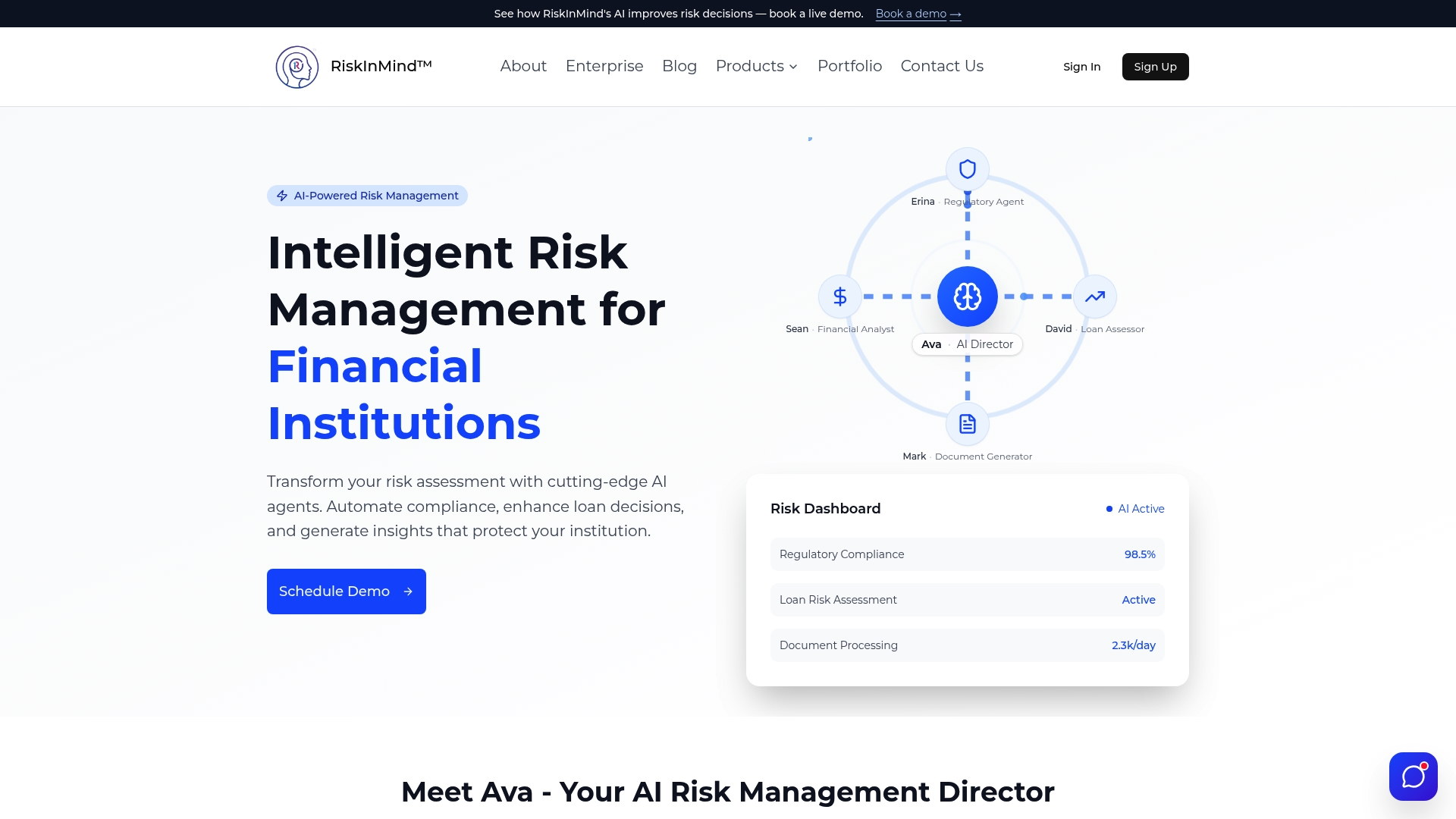
Explore how RiskInMind’s AI-powered platform can reduce manual processing time by up to 80 percent while maintaining strict SOC 2® security standards. Visit RiskInMind to schedule a demo and see how you can automate credit memo creation and compliance reporting to cut days off your decision cycles.
Frequently Asked Questions
How does Riskinmind enhance credit memo generation?
Riskinmind generates AI-generated in-house credit memos from financial statements in minutes, significantly reducing manual write-up work. This feature allows institutions to speed up credit analysis processes and enhance analyst turnaround. Consider using Riskinmind to streamline your credit memo workflow.
What is the difference between Riskinmind and Abrigo in terms of compliance support?
Abrigo provides integrated AML workflows alongside credit risk tools, making it a strong choice for organizations needing comprehensive compliance solutions. In contrast, Riskinmind focuses on real-time regulatory compliance monitoring and automated reporting, catering specifically to efficiency in credit workflows. Choose Riskinmind if your primary need is to improve credit analysis efficiency while maintaining compliance.
Which platform offers better automation for fraud detection?
Riskinmind excels with its built-in fraud detection and anomaly flagging features that identify outliers in transaction and application data efficiently. This capability allows credit unions and community banks to enhance their fraud monitoring without excessive manual oversight. Look into Riskinmind for a more automated approach to fraud detection in your credit assessments.
Can I use Riskinmind for continuous portfolio trend analysis?
Yes, Riskinmind includes CECL-compliant loan loss reserve modeling and continuous portfolio trend analysis as part of its service. This feature supports ongoing credit oversight, making it a suitable option for institutions looking to monitor their portfolios rigorously. Consider leveraging Riskinmind to maintain a proactive stance on portfolio risks.
How does Riskinmind's integration capability advantage financial institutions?
Riskinmind offers APIs for core banking systems, enabling seamless connectivity to various data sources without the need for custom extractors. This capability is particularly beneficial for institutions looking to integrate data efficiently into their existing processes. Use Riskinmind if you want a platform that facilitates straightforward integration with your current systems.