Managing risk, compliance, and fraud detection with a single software platform remains elusive for credit unions, regional banks, and community lenders. Most risk management tools demand cloud storage, custom onboarding, or lack combined AI-driven workflows, which prevents unified operation and regulatory traceability. This comparison covers integration capacity, data controls, workflow automation, and pricing so risk managers, compliance leaders, and loan officers can match an alternative to their team's requirements.
Table of Contents
Maintain 100% NCUA & OCC Audit Readiness
Monitor regulatory updates 24/7, check internal credit policies, and generate compliance trails with Erina (AI Regulatory Agent).
RiskInMind
At a Glance
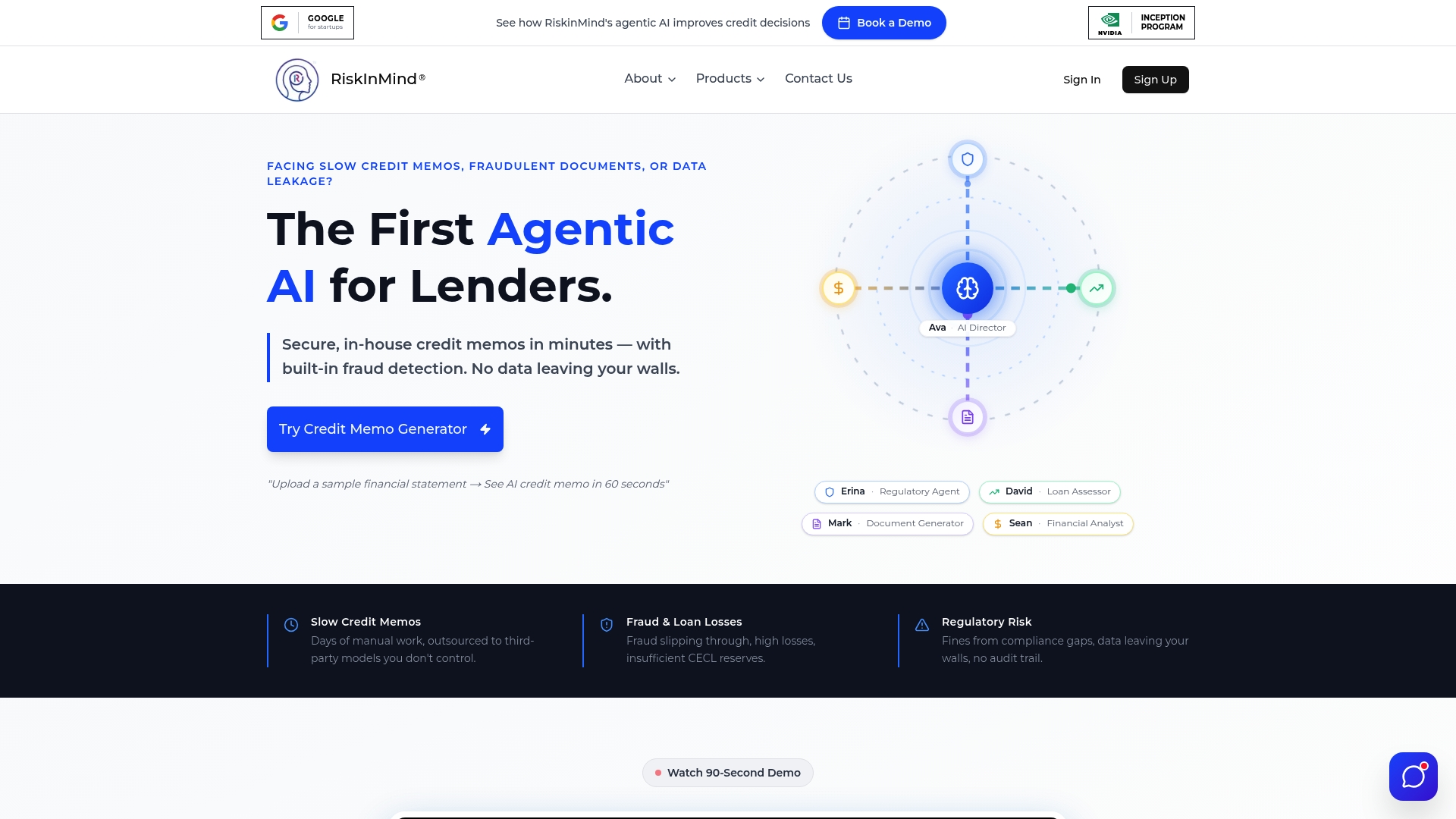
The platform runs entirely inside an institution's infrastructure so data never leaves the organization. The vendor advertises SOC 2 certification and bank grade security. The system uses a central AI director called Ava to coordinate specialized AI agents for credit, compliance, and market analysis.
Core Features
The vendor advertises AI-driven credit memo generation that produces memos from financial statements within minutes. Built in fraud detection flags anomalies and reduces potential losses. Regulatory change monitoring, automated compliance reporting, AI loan and credit risk assessment using alternative data, and portfolio analytics round out the core toolset.
Key Differentiator
RiskInMind keeps all processing inside the institution while consolidating credit, risk, and compliance workflows. That architecture reduces third party data exposure and meets stricter internal control requirements. Real time regulation tracking and an integrated fraud detector work alongside credit scoring to shorten review cycles.
Pros
The platform enables automated credit memo creation inside the institution, which lowers manual review workload and centralizes documentation. It groups portfolio analytics, regulatory monitoring, fraud detection, and risk scoring into one workflow, reducing handoffs between teams. The vendor reports advanced AI models with high accuracy and confidence levels, and the product includes encryption and bank grade security.
Cons
- May require significant initial setup and integration effort for smaller institutions or those with legacy systems.
Who It's For
Risk managers, loan officers, and compliance professionals at credit unions, regional banks, and community lenders. Teams that must keep data on premises and need automated credit memos, regulatory audit trails, and portfolio trend analysis. Organizations with some IT bandwidth to handle initial integration will get the most value.
Unique Value Proposition
Ava orchestrates specialized AI agents for credit risk, compliance monitoring, and market analysis under a single director. That coordination reduces manual handoffs and compresses the workflow from data intake to audit ready reports. For credit teams this turns scattered tasks into a single, traceable process.
Real World Use Case
According to the vendor, a regional credit union used RiskInMind to cut manual credit memo review time from days to minutes while keeping all data inside its systems. That change sped up lending decisions and created automated audit trails for regulatory reviews.
Pricing
Not specified. Pricing is likely bespoke and tailored for enterprise or institutional deployments. Expect contract based rates that reflect implementation, on premises deployment, and ongoing support.
Website: https://riskinmind.ai
Corizance
At a Glance
The vendor advertises 200+ connectors and APIs for data ingestion and third-party links. Corizance combines real-time risk monitoring with AI-powered predictive intelligence, aimed at banking, insurance, and other regulated firms. The platform is also described as award-winning for its analytics approach.
Core Features
Corizance maps operational risk, controls, and regulatory obligations into a connected risk management framework and generates real time alerts for incidents and thresholds. The system includes industry specific taxonomies, enterprise wide predictive models, and automated compliance workflows with regulatory heatmaps. Low code implementation and packaged analytics are part of the onboarding path to speed integration.
Key Differentiator
Corizance centers its product on connected risk management that links operational risk data across silos and runs predictive analytics tailored for highly regulated financial services. That design focuses on using cross domain signals to surface emerging exposure before it escalates.
Pros
High levels of automation reduce manual tracking and feed predictive models that apply across operational, cyber, and compliance domains. The platform supports regulatory reporting and resilience planning while offering packaged taxonomies that match banking and insurance terminology. That connector count above helps explain why the vendor emphasizes broad integration with core systems and external regulatory sources.
Cons
- Limited visibility into the user interface and day to day ease of use from public reviews and materials. This makes it hard to judge desktop and mobile workflows.
- No specific pricing details are publicly listed, which suggests enterprise sales and custom quotes rather than clear per seat or per module tiers.
- The platform appears geared to larger regulated organizations. Smaller lenders or teams without dedicated onboarding resources may find implementation complex.
When It May Not Fit
Corizance may be overpowered for community banks and small fintechs that need a compact risk register or a single compliance checklist. Teams with no integration capacity or no central data model will face longer setup timelines. Organizations that require transparent, self serve pricing and month to month contracts will not find that here.
Notable Integrations
- Microsoft Dynamics 365
- Custom APIs
- Regulatory data sources
Who It's For
Regulated financial institutions, large insurers, asset managers, and NBFCs that need enterprise wide risk and resilience controls will find the platform relevant. Risk teams that must combine cyber telemetry, operational incidents, and regulatory reporting into one decision layer will see the most benefit. Technology and compliance leaders with integration resources match the expected buyer profile.
Real World Use Case
A mid sized bank uses Corizance to ingest vendor risk feeds, monitor cyber alerts, and route incidents into a single control framework. The platform correlates incidents with regulatory obligations and generates automated heatmaps for the compliance team. That flow reduced time spent reconciling multiple spreadsheets and centralizes reporting for exam readiness.
Pricing
Pricing is not published and the vendor lists enterprise oriented sales engagement rather than fixed tiers. Prospective buyers should expect a custom quote and a professional services component for implementation.
Website: https://corizance.com
Modus AI
At a Glance
Modus AI applies graph AI to transaction records to identify mule networks and high risk customer clusters. The system also uses specialized AI agents to automate document review and regulatory checks. These two mechanics make its fraud detection approach explicitly network centric rather than rule only.
Core Features
The platform combines an AI Agent for Compliance Review that automates document analysis, red flag detection, and report generation with a Graph AI layer that maps transaction relationships to surface suspicious rings. Customer and merchant monitoring functions provide anomaly detection, risk profiling, portfolio monitoring, and news tracking. A set of AI agents manages alert triage, chargebacks, AML and PEP screening, and onboarding linkages.
Key Differentiator
Modus AI focuses on deep customization for risk and compliance teams, tailoring graph models to transaction formats and client workflows. That narrow focus targets operations where relationship chains matter more than isolated alerts. Organizations that need network aware detection, not just signature matching, will find this approach distinct.
Pros
The product offers tailored models for complex risk problems, which helps teams automate document and regulatory review while reducing manual steps. Its graph driven detection improves visibility into layered fraud and mule behaviors using transaction context. The vendor says Modus AI has investor backing and a leadership team with experience in fraud strategy and scalable systems, which supports its execution claims.
Cons
- Limited publicly available detailed case studies or user reviews to evaluate effectiveness at scale.
- Potentially high customization complexity might require dedicated engineering and integration effort.
- No listed third party integrations or published APIs for quick plug and play connections.
- Public pricing is not published, which can slow procurement conversations.
When It May Not Fit
Modus AI may not suit smaller lenders that lack engineering bandwidth to support heavy customization. Firms that need out of the box connectors to a long list of vendors will find the empty integrations list restrictive. Buyers seeking transparent, self serve pricing or rapid procurement may face delays.
Who It's For
Risk and compliance teams at banks, fintechs, and regulatory agencies that handle complex transaction flows and suspect networked fraud. Teams with data science support and operational capacity to tune graph models will extract the most value. Groups focused solely on basic rule based alerts will see less upside.
Real World Use Case
A fintech uses Modus AI to monitor transaction streams and link accounts by identity and device signals. The platform flags clusters that match mule network patterns and surfaces alerts for compliance review. The company then automates document checks and generates compliant reports for audit trails.
Pricing
The vendor lists pricing as Not applicable and labels site information as informational only. There are no published tiers or self serve prices, so procurement requires direct engagement with the vendor.
Website: https://modussecure.com
MetricStream Connected GRC
At a Glance
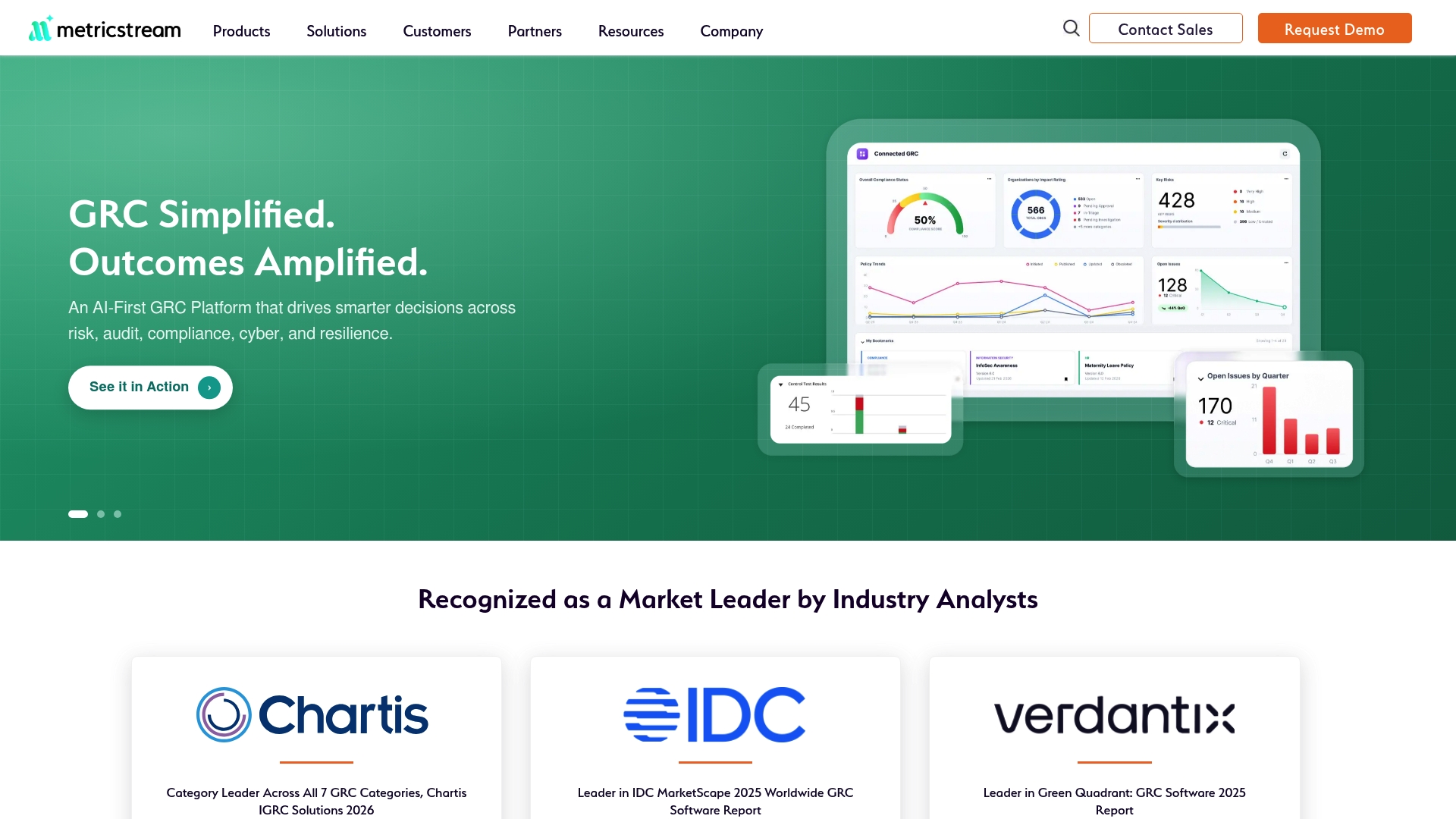
MetricStream reports it uses purpose built AI to automate data capture, assessments, control testing, and insights across the GRC lifecycle. The vendor advertises this AI first approach alongside unified coverage of risk, compliance, audit, third party risk, cybersecurity, and resilience. Low code and no code configuration aims to reduce IT dependency while real time dashboards deliver role specific intelligence.
Core Features
MetricStream connects risk, compliance, audit, cybersecurity, third party risk, and operational resilience into a single system for governance teams and program owners. AI powered modules automate assessments, control testing, regulatory intelligence, and predictive analytics for emerging threats. Real time dashboards and dynamic risk assessments provide role based views and drill downs for audit, compliance, and CRO teams. Scenario testing and automated response planning support operational continuity and recovery exercises across business units.
Key Differentiator
The platform’s standout feature is its AI first design that aims to span the entire GRC lifecycle. That design links automation, predictive analytics, and control testing into one coordinated workflow for program owners. Low code configuration lets governance teams adapt templates and assessments without heavy developer involvement.
Pros
MetricStream brings multiple GRC domains into a single implementation, which reduces duplicate controls and overlapping assessments. The vendor advertises analyst recognition across several categories, which suggests market validation for enterprise deployments. Low code and no code configuration shortens iteration times for process owners and reduces reliance on central IT. Automated control testing and regulatory feeds cut manual evidence collection and keep control gaps visible to risk teams.
Cons
-
Complex setup process may require significant time and resources to reach full functionality.
-
Organizations must invest in training and change management to drive user adoption and correct usage.
-
The platform may be better suited to large, complex organizations managing multiple programs rather than small teams.
When It May Not Fit
Avoid this platform if you need a lightweight point solution that targets a single risk domain and must deploy quickly. Small credit unions, community banks, or teams with limited integration budgets will find deployment timelines and resource needs restrictive. Organizations that want a narrowly focused point tool for a single workflow will likely prefer a specialist vendor instead.
Who It's For
Large enterprises with complex risk, compliance, and audit requirements in regulated industries are the primary fit. Finance, healthcare, energy, and technology firms with distributed operations will benefit from unified reporting and scenario planning. Security and risk teams that can commit implementation resources and ongoing customization will extract the most value.
Real World Use Case
A multinational bank used MetricStream Connected GRC to unify risk and compliance processes across regions. The bank automated audit workflows, reduced manual steps, and centralized control evidence for regulators. That deployment improved visibility for regional CROs and accelerated decision cycles for compliance teams.
Pricing
Pricing is not publicly listed and appears tailored to organization size and scope. Prospective buyers should request a custom quote that covers selected modules, deployment scale, and professional services. Small organizations should budget for implementation and training when discussing costs.
Website: https://metricstream.com
Comparison of alternatives
Among the many solutions available for risk management, each platform presents unique strengths tailored to specific organizational needs. This analysis examines key differences between RiskInMind, Corizance, Modus AI, and MetricStream Connected GRC to help you determine the best fit for your institution's requirements.
Data processing and architectural integrity
RiskInMind differentiates itself with its design for local processing, ensuring that all data remains securely within an organization's infrastructure. This feature appeals to institutions with strict data governance needs. Meanwhile, Corizance offers extensive third-party integration with over 200 connectors, providing agility but requiring external data management. Modus AI's focus on customizable graph AI caters to organizations requiring tailored fraud detection networks but lacks integration support out of the box.
Fraud detection and scalability
Modus AI's application of advanced graph AI excels at identifying complex fraud networks by analyzing transaction patterns and relationships. This capability surpasses generalized fraud detection mechanisms offered in other platforms, relying on methods rather than traditional rule-based approaches. However, smaller institutions with limited resources might find the required customization and engineering unsuitable.
Best fit
- For organizations emphasizing secure onsite data processing combined with automated credit memos and regulation monitoring, RiskInMind provides an all-inclusive solution.
- Teams requiring a multiple-source risk integration and predictive insights across various operational risk areas will benefit from Corizance.
- Institutions focusing on fraud strategy using advanced relationship mapping capabilities should explore Modus AI.
- Enterprises managing complex, multi-regional governance needs with high configurability requirements will find MetricStream Connected GRC effective.
Our pick
For financial institutions prioritizing localized data processing alongside AI-coordinated workflows for compliance and risk assessment, RiskInMind emerges as the recommended choice. By orchestrating specialized AI agents under the Ava director, it streamlines complex processes efficiently. However, enterprises seeking out-of-the-box integration or those with straightforward operational workflows might consider other platforms tailored for their specific needs.
The table below presents a comparative overview of financial risk management platforms, showcasing features such as key differentiators, target users, and pricing structures.
| Product | Key Functionality | Target Users | Key Differentiator | Notable Limitation | Pricing |
|---|---|---|---|---|---|
| Riskinmind | AI-driven credit memo generation, compliance | Risk managers, compliance teams at regional lenders | Data remains on premises | Significant setup effort for legacy systems | Price not published |
| Corizance | Real-time risk monitoring, predictive AI | Regulated financial institutions, insurance companies | 200+ connectors and APIs | Complex integration for smaller organizations | Price not published |
| Modus AI | Fraud detection through graph AI models | Risk and compliance teams handling suspicious networks | Network-centric fraud detection | Limited publicly available user reviews | Price not published |
| MetricStream Connected GRC | Governance across risk and compliance domains | Large enterprises in regulated industries | Unifies diverse risk management areas | Complex setup process | Price not published |
Addressing Key Challenges in Risk Management with Riskinmind
Financial institutions such as credit unions, community banks, and lenders often face complex challenges when selecting effective orx.org alternatives. These challenges include maintaining strict data security, accelerating credit memo reviews, and integrating credit risk, compliance, and portfolio workflows without exposing sensitive information. Riskinmind solves these pain points by running all processes inside your institution's infrastructure. Their central AI director, Ava, coordinates specialized AI agents to automate credit risk assessment, regulatory compliance, and market analysis while keeping data fully secure.
Riskinmind’s SOC 2-certified platform offers real-time processing that cuts manual review times from days to minutes, supporting faster lending decisions and compliant audit trails. If your team requires automated credit memos, regulatory audit visibility, and portfolio analytics within a single secure system, explore the capabilities at the Riskinmind website and learn how it supports complex financial workflows.
Take the next step to reduce manual workload and consolidate risk functions in one platform. Visit Riskinmind to see demos, client testimonials, and risk dashboards designed for teams managing credit, compliance, and portfolio risk.
FAQ
How does Riskinmind assist with credit memo generation?
Riskinmind automates credit memo creation from financial statements within minutes. Its AI-driven credit memo generation feature significantly reduces manual review workload and centralizes documentation. You can improve your lending process efficiency by leveraging this capability.
What is the difference between Riskinmind and Corizance?
Corizance excels in providing a connected risk management framework with over 200 connectors and APIs for integration. In contrast, Riskinmind is designed for institutions that need to keep data on premises while delivering automated regulatory compliance and credit risk assessments. Choose Riskinmind if your institution prioritizes data privacy.
How does Riskinmind's fraud detection work?
Riskinmind features built-in fraud detection that flags anomalies, helping organizations reduce potential losses. This proactive approach ensures better safety and quicker responses to fraud risks. Integrate this feature to enhance your risk management strategy.
Can I use Riskinmind if my organization has legacy systems?
Riskinmind may require significant initial setup and integration effort for institutions with legacy systems. This suggests that while it offers powerful capabilities, ensure your team is prepared for the integration process to maximize the platform's value.
How does Riskinmind address regulatory compliance?
Riskinmind supports automated compliance reporting alongside real-time regulation tracking. This functionality helps teams generate audit-ready reports efficiently. Utilizing this feature can streamline your compliance activities and keep you prepared for audits.