
Mortgage underwriting AI shortens routine document review and data verification from days to minutes while leaving final credit decisions and regulatory sign-off with licensed humans. That division of labor is not a temporary compromise. FHA, VA, and GSE frameworks require it, and the lenders seeing real returns are the ones who accept it as the operating model rather than a rule to work around. The practical task for 2026 is measuring both sides: how much faster files move, and how tightly a human still controls the outcome.
- AI mortgage underwriting can reduce file processing time from 30-45 days to as little as eight minutes, mainly for verification and initial eligibility checks.
- Automating document classification, OCR, and fraud detection improves accuracy, reduces errors, and decreases post-close defect rates, positively impacting risk management.
- Human underwriters focus more on exceptions, model validation, and confirming model reasoning, rather than manual data entry and routine approvals.
- Integration challenges with legacy systems and the need for workflow redesign are common barriers delaying AI deployment and realizing its full potential.
- Successful pilots should target simple loan types, set clear KPIs, ensure auditability, and avoid scaling until defect and fair-lending metrics stabilize.
Automate Regulatory Model Risk Governance
Examine models against 32 qualitative criteria and resolve risk Tiers with pre-deployment checklists per OCC 2011-12 guidelines.
Table of Contents
- What Mortgage Underwriting AI Actually Does
- How Much Faster and More Accurate Does AI Underwriting Make Lending?
- What Happens to Underwriters and Loan Officers?
- Where Regulators and Investors Draw the Line
- Why AI Projects Stall Against Legacy Systems
- Building a Pilot: Steps, KPIs, and Governance Checkpoints
- What the Early Evidence Actually Shows
- The Executive Decision Checklist
- Where This Goes From Here
- How Riskinmind Fits the Adoption Checklist
- Sources
What Mortgage Underwriting AI Actually Does
Ask ten vendors what their "AI underwriting" product does and you will get ten overlapping but distinct answers. Strip away the marketing language and modern systems cluster around four functions, each mapped to a specific point in the traditional underwriting chain.
Document classification, OCR, and data extraction form the foundation layer. Pay stubs, W2s, bank statements, and tax transcripts arrive in every format imaginable, scanned crookedly, photographed on a phone, or exported as a jumbled PDF. Machine learning models trained on financial document structures now classify these files, extract the relevant fields, and populate loan origination system records without a processor retyping numbers by hand. This is the least glamorous part of AI mortgage approval processes, and it's also where the labor savings are least disputed.
Automated eligibility checks and decision-support layers sit on top of, not in place of, the automated underwriting systems (AUS) lenders already rely on. Fannie Mae's Desktop Underwriter and Freddie Mac's Loan Product Advisor remain the investor-required decision points for most conventional loans, and their built-in features like ACE and AIM already automate collateral and income verification. What newer AI layers add is faster pre-screening, condition prediction, and plain-language explanations of why a file triggered a particular finding, before it ever reaches the AUS.
Anomaly and fraud detection cross-references data points that a human reviewer would need hours to reconcile manually: does the employer on the pay stub match public records, does the property's estimated value align with recent comparable sales, does the bank statement's transaction pattern look synthetic. These models flag inconsistencies for a human to investigate rather than issuing an automatic denial, which matters both for accuracy and for defensibility if a decision is ever challenged.
Orchestration patterns tie the pieces together. Instead of a single monolithic AI making a lending decision, well-designed systems use specialized agents, one for document reading, one for eligibility logic, one for fraud screening, coordinated through APIs and event-driven connectors into the existing loan origination system (LOS). This matters because multi-agent architectures produce cleaner audit trails than black-box models, letting a compliance reviewer trace exactly which agent flagged what and why.
In practice, a functional AI underwriting stack handles:
- Intake and classification of borrower-submitted documents against required conditions
- Automated pulls and cross-checks against credit bureaus, employment verification services, and asset accounts
- Pre-submission eligibility scoring that flags likely AUS outcomes before formal submission
- Fraud and anomaly signals routed to a human queue rather than resolved autonomously
- Real-time status updates to loan officers and borrowers through conversational interfaces
Fannie Mae's own research on lender priorities confirms this pattern. Surveyed institutions consistently point to compliance review, underwriting data verification, appraisal automation, and borrower risk assessment as the AI applications they want built out first—not full decisioning autonomy.
How Much Faster and More Accurate Does AI Underwriting Make Lending?
The headline number gets repeated often enough that it deserves scrutiny before you build a business case around it. AI-based underwriting methods have been reported to cut processing times from an industry average of 30 to 45 days down to as little as eight minutes in specific deployments.
The Eight-Minute Figure, In Context: That number describes a narrow slice of the process, typically the automated verification and initial eligibility check on a clean, well-documented file, not the full 30-to-45-day cycle from application to closing. Appraisals, title work, and investor conditions still take their own time regardless of how fast the underwriting engine runs.
Where the gains actually come from is worth unpacking. Three mechanisms drive most of the improvement:
- Parallel processing replaces sequential handoffs, so document verification, credit pulls, and fraud screening happen simultaneously instead of one after another.
- Elimination of re-keying removes the single biggest source of both delay and manual error, since data entered once by the borrower or their employer flows through without a human retyping it at each stage.
- Condition prediction flags likely stipulations before submission, so borrowers supply the right documents on the first pass instead of the fourth.
Quality improvements track alongside speed. Fewer manual re-entries mean fewer transcription errors, and fewer transcription errors mean fewer post-close defects that trigger investor repurchase demands, one of the more expensive and reputationally damaging outcomes in mortgage operations. A lender that reduces defect rates even modestly changes its risk profile with investors and reduces the staff hours spent on curative work after the fact.
Fair-lending considerations cut both directions here. A well-governed model can reduce the inconsistency that creeps into manual underwriting, where two underwriters might reach different conclusions on similar files based on subjective judgment calls. But an ungoverned model trained on historical lending data can just as easily encode past disparities into new-generation decisions. This is why bias-detection and testing protocols have to run continuously, not as a one-time model validation exercise before launch. Riskinmind's own guidance on bias testing in lending treats this as an ongoing compliance discipline, not a checkbox.
What Happens to Underwriters and Loan Officers?
The honest answer is that the job changes shape rather than disappears, and the change is uneven across roles. Licensed mortgage loan originators still carry SAFE Act obligations that no AI system can absorb. Underwriters still hold the credit decision authority that FHA, VA, and GSE guidelines require a human to exercise, even when an AI system has done most of the analytical legwork.
What shifts is where the human's attention goes. Instead of spending the bulk of a shift keying data and chasing missing documents, an underwriter working alongside an AI system spends more time on:
- Exception handling for files the anomaly-detection layer flags as inconsistent or unusual
- Interpreting model outputs and confirming the reasoning holds up against the actual file
- Reviewing edge cases that fall outside the model's training distribution, like unusual income structures or non-traditional credit histories
- Auditing a sample of AI-cleared files to confirm the system's judgment continues to align with policy
This is a genuine skills shift, not a euphemism for job elimination. Teams that get the most value from AI underwriting invest in training people to read model explanations critically, validate data lineage, and understand where a model is likely to be wrong, rather than just where it's usually right. Hiring priorities move toward candidates comfortable with audit review and governance work, alongside the traditional credit-analysis background.
Pro Tip: Don't put your most experienced underwriters exclusively on exception queues. Rotate senior staff between AI-cleared file audits and manual exception review so institutional knowledge about what "normal" looks like doesn't erode as routine files stop crossing their desks.
Operationally, the most effective designs place the human checkpoint at the decision, not at the data gathering. Let the AI assemble and verify; let the underwriter decide, override, and sign. That division keeps you compliant with the human sign-off requirements regulators expect while still capturing the speed gains upstream.
Where Regulators and Investors Draw the Line
Nothing about AI adoption in mortgage lending removes the underlying compliance architecture. MBA's policy research on AI in mortgage lending confirms that FHA, VA, and GSE guidance continue to require human oversight, and in many cases a certified underwriter's or licensed MLO's sign-off, regardless of how much of the analytical work an AI system performed.
Automated Underwriting Systems remain the required decision point for most conventional loans. Any AI layer you deploy needs to work alongside Desktop Underwriter and Loan Product Advisor, feeding them better data and faster pre-screening, not attempting to bypass them. Novel machine-learning scoring models can inform a lender's own risk appetite and pricing, but they don't replace the AUS determination an investor expects to see in the file.
Model governance has become the practical center of gravity for compliance teams evaluating AI vendors. The essentials, per industry guidance, come down to:
- Explainability: can you produce a plain-language reason for any AI-influenced decision or flag, not just a confidence score
- Bias testing: is fair-lending performance tested on an ongoing basis across protected classes, not just at model launch
- Audit logs: is there a complete, retrievable record of what the AI flagged, what a human reviewed, and what the final decision was
- Version control: can you identify which model version made a given decision months or years later if a loan is challenged
Before signing any vendor contract, push for specific assurances rather than general claims. Ask for documented bias-testing methodology, not just a statement that testing occurs. Ask how audit logs are retained and for how long. Ask whether the vendor's model updates require your compliance team's sign-off before deployment, or whether they push changes silently. Riskinmind's overview of automated underwriting for finance professionals walks through how AUS augmentation and compliance controls typically fit together in a governed deployment.
Why AI Projects Stall Against Legacy Systems
Most AI underwriting disappointments trace back to integration, not the model itself. Loan origination systems built over the past two decades were not designed with API-first architectures in mind, and connecting a modern AI layer to a legacy LOS often means building custom middleware just to get clean data flowing in both directions.
The data problem usually runs deeper than the connectivity problem. Fields that seem standardized, like "loan status" or "condition type", often mean subtly different things across a lender's LOS, its point-of-sale system, and its servicing platform. Without a canonicalization effort that maps these fields to a single consistent schema, an AI system trained on one data source will misread inputs from another, producing exactly the kind of silent errors that are hardest to catch.
Industry analysis frames the deeper issue as structural rather than technical: lenders who bolt AI tools onto fragmented, handoff-heavy workflows see incremental gains at best. The real value shows up when institutions redesign the approval chain itself, removing redundant reviews and reassigning decision rights, rather than just inserting a faster tool into a slow process.
Practical mitigations that consistently show up in successful deployments:
- Build a data dictionary and provenance map before selecting any AI vendor, so you know what "clean" data actually means in your environment
- Prioritize connectors and APIs over point-to-point custom integrations, which become maintenance burdens as systems update
- Pilot on a single, well-defined loan type or document category before expanding scope
- Treat workflow redesign as a prerequisite, not a follow-up project, once the AI tool is running
Pro Tip: Ask any vendor during procurement to walk through exactly how their system handles a "dirty" data scenario, a mismatched employer name, a missing middle initial, an inconsistent date format, rather than a clean demo file. How gracefully a system degrades tells you more than how well it performs on a perfect input. A closer look at AI versus manual underwriting against legacy LOS environments covers integration patterns in more depth.
Red flags during vendor evaluation include reluctance to discuss data lineage, an inability to explain model decisions in specific terms, and pricing models that don't account for the integration engineering work most legacy environments require.
Building a Pilot: Steps, KPIs, and Governance Checkpoints
A pilot that tries to prove everything at once proves nothing well. The lenders who get useful signal from an early AI underwriting deployment narrow scope aggressively before they narrow risk.
- Pick one loan type and one document category. Conventional purchase loans with W2 income are the most common starting point because the data patterns are well understood and the AUS logic is mature.
- Set a defined pilot window, typically 60 to 90 days, long enough to move a meaningful sample of files through the full cycle but short enough to course-correct quickly.
- Establish a sample size threshold before you start, generally at least 100 to 150 files, so that early results reflect a pattern rather than a lucky run of clean applications.
- Define success criteria in advance, in writing, including both throughput and control metrics, so a fast pilot with hidden compliance gaps doesn't get mistaken for a win.
- Run parallel manual review on a subset of pilot files for the first several weeks, comparing AI-assisted outcomes against traditional underwriting to catch discrepancies before scaling.
The KPI dashboard for a serious pilot needs to track more than speed. The metrics that matter fall into two buckets:
- Throughput metrics: cycle time from submission to conditional approval, number of conditions cleared automatically versus manually, average time-to-clear per condition type
- Control metrics: post-close defect rate on AI-assisted files versus the historical baseline, fair-lending disparity ratios across protected classes, audit-log completeness rate, percentage of AI flags overridden by human reviewers and why
Governance checkpoints belong in the pilot design from day one, not bolted on after launch. That means running bias testing against your existing fair-lending benchmarks before the pilot starts, confirming the vendor can produce explainable reasoning for every AI-influenced flag, and verifying security certifications like SOC 2 compliance before any borrower data touches the system.
Architecturally, the systems producing the cleanest audit trails tend to share a common pattern: specialized agents handling discrete tasks (document reading, eligibility checking, fraud screening) coordinated by a central orchestration layer rather than one monolithic model making every call. Riskinmind's platform, for example, organizes its specialized agents, covering regulatory compliance, credit risk assessment, and market analysis, under a central AI director called Ava, which lets a human reviewer trace a decision back through the specific agent responsible rather than interrogating an opaque single system. This kind of layered design matters more for audit defensibility than for raw speed. A checklist for loan officers navigating an AI-assisted workflow is worth building alongside the KPI dashboard, and Riskinmind's own loan underwriting checklist for 2026 offers a starting template.
What the Early Evidence Actually Shows
Published figures on AI underwriting deserve the same scrutiny you'd apply to any vendor claim, because the gap between a marketing number and an audited outcome is often wide. The eight-minute processing figure against a 30 to 45 day industry average comes from specific deployment reporting, not an industry-wide average, and it describes a narrow segment of the underwriting task rather than origination-to-close.
What the data actually supports: Fannie Mae's lender surveys show adoption clustering around compliance review, income verification, and appraisal automation, not full-decision autonomy. That's a meaningfully different claim than "AI approves mortgages," and it's the one the evidence backs.
Production examples add useful texture beyond the survey data. LendingTree's multi-agent mortgage assistant built on Amazon Bedrock has shown meaningful borrower engagement in production, handling both educational questions and early transactional intent through coordinated specialized agents rather than a single chatbot. Separately, conversational credit decision engines now let loan officers query underwriting rules and investor pricing in real time, cutting the friction that used to send a question into a support queue for hours.
The caveats matter as much as the results. Vendor-reported metrics are not the same as independent audits, and lenders adopting these tools should treat production claims from any provider, including the ones cited here, as a starting point for due diligence rather than a substitute for it.
Barriers to adoption remain concrete rather than abstract:
- Integration complexity with legacy LOS environments tops most surveyed lists of adoption obstacles
- Upfront cost, including the often underestimated engineering work of data mapping, deters smaller institutions
- A documented lack of proven, audited success stories makes risk committees cautious about committing budget
- Structural workflow fragmentation limits what any AI layer can deliver until the underlying process gets redesigned
The Executive Decision Checklist
Start small and start with the right file type. Conventional purchase loans with straightforward W2 income remain the most tractable pilot candidate because AUS logic and data patterns are mature and well documented.
Before signing any contract, insist on vendor assurances covering auditability (can every AI decision be traced to a specific input and reasoning path), security certification (SOC 2 or equivalent, with bank-grade data handling), and documented bias-testing methodology applied on an ongoing basis, not just at launch.
Know when to scale and when to pause. Scale when defect rates hold steady or improve and fair-lending metrics show no disparity drift. Pause, and redesign the underlying workflow, if the AI layer is producing speed gains that don't survive contact with your existing handoffs and approval chain.
| Decision Point | Green Light | Pause and Redesign |
|---|---|---|
| Post-close defect rate | Stable or improved vs. baseline | Rising or unexplained |
| Fair-lending disparity ratios | Within existing benchmarks | Drifting or unmonitored |
| Audit trail completeness | Full traceability per decision | Gaps or black-box outputs |
| Workflow fit | Redesigned approval chain | AI bolted onto old handoffs |
Where This Goes From Here
The next two years look less like sudden transformation and more like uneven, deliberate adoption. Lenders with clean data and redesigned workflows will pull ahead; those layering AI onto broken processes will see modest gains and blame the technology. The organizational work, reassigning decision rights, retraining underwriters for exception handling, funding governance as a permanent function rather than a launch checklist, matters more than model selection. Incentives need to reward accuracy and auditability alongside speed, or teams will optimize for the metric that gets measured instead of the one that protects the institution.
— Raj
How Riskinmind Fits the Adoption Checklist
If the roadmap above sounds right but building it in-house feels like a multi-year systems project, there are AI platforms designed to provide a governed solution your compliance team can actually sign off on, instead of a point tool your engineers have to wire into a legacy LOS from scratch.
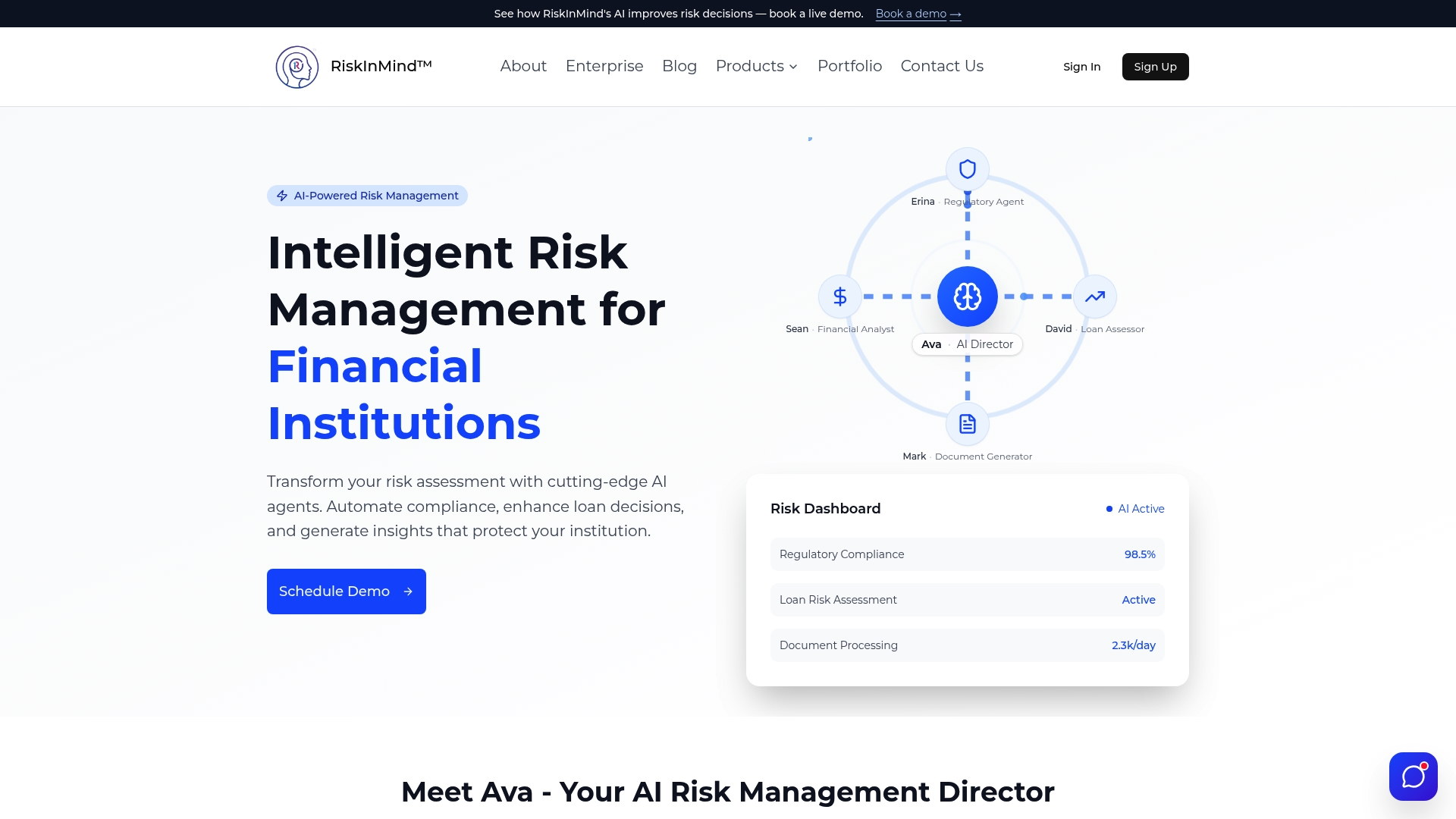
Some AI risk management platforms organize specialized AI agents, covering credit risk assessment, regulatory compliance, and market analysis, under a central AI director that coordinates their work and preserves audit trails examiners and investors expect to see. Such platforms often run on SOC 2 certified infrastructure with bank-grade security and real-time processing, providing risk and compliance teams with governance assurances such as explainability, audit logs, and continuous oversight rather than a one-time model validation. Real-time risk dashboards and mobile access enable underwriting and portfolio teams to see the same data at the same speed, regardless of their location.
If you're evaluating a pilot along the lines described above, a useful next step is a working demo scoped to your specific loan type and integration points. Start by reviewing Riskinmind's loan underwriting solution and requesting a demo built around your document types, your LOS environment, and the KPI dashboard your risk committee needs to see before approving a wider rollout.
Sources
- How AI is already transforming—and improving—the mortgage underwriting process
- MBA policy report on the state of AI in mortgage lending
- Fannie Mae research on AI adoption in mortgage lending
- How LendingTree built a multi-agent mortgage assistant on Amazon Bedrock