
Streamlined risk review is defined as a focused, decision-oriented process that replaces status reporting with clear accountability, named owners, and evidence-based closure. Risk managers and compliance professionals in financial institutions face mounting pressure to accelerate review cycles without sacrificing accuracy. 66% of organizations have mostly automated their risk processes, yet only 11% have reached full automation. That gap represents both a vulnerability and an opportunity. Knowing how to streamline risk reviews means understanding which structural, technological, and behavioral changes produce the fastest, most durable results.
How to streamline risk reviews: prerequisites and tools
The right structure comes before the right technology. Only 48% of organizations have a centralized risk management function, and those that do report fewer barriers to timely decision-making. Centralization removes the fragmented ownership that forces risk managers to chase updates across departments before every review cycle.
Maintain 100% NCUA & OCC Audit Readiness
Monitor regulatory updates 24/7, check internal credit policies, and generate compliance trails with Erina (AI Regulatory Agent).
Cross-functional collaboration is the second prerequisite, and it is far less common than most institutions assume. Only 26% of organizations report true cross-functional collaboration in risk management. Without it, credit risk, compliance, and operational risk teams each run separate review tracks, duplicating effort and missing interdependencies.

Technology fills the gap between structure and speed. Automation, AI, and cloud platforms replace manual data collection, spreadsheet consolidation, and email-based escalation. Embedding analytics into daily operations is what separates future-ready risk functions from those still running quarterly reviews off static reports.
The table below contrasts the prerequisites and tools in a traditional review process versus a structured, technology-enabled one.
| Dimension | Traditional process | Structured, tech-enabled process |
|---|---|---|
| Organizational structure | Siloed, department-level ownership | Centralized or integrated risk function |
| Collaboration model | Sequential handoffs between teams | Cross-functional review with shared data |
| Data collection | Manual, spreadsheet-based | Automated feeds from core systems |
| Technology stack | Email, static reports, shared drives | AI platforms, cloud dashboards, real-time alerts |
| Skills required | Risk domain knowledge | Data literacy plus AI fluency |
| Review frequency | Quarterly or ad hoc | Monthly or continuous with defined cadence |
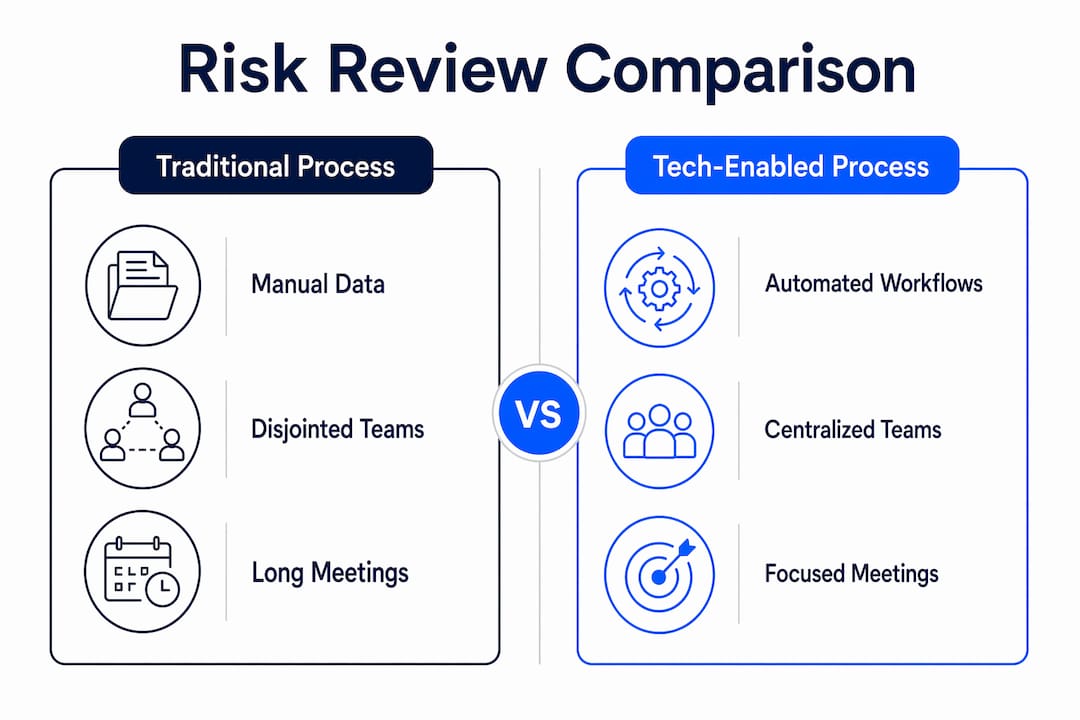
90% of senior risk leaders rank improving non-financial risk literacy as a top priority. That figure signals that technology alone is insufficient. Risk teams need professionals who can interpret model outputs, challenge AI-generated flags, and translate analytics into board-level decisions.
How should you structure risk review meetings for efficiency?
Meeting design is where most efficiency gains are lost. A risk review meeting that runs two hours and covers 40 items produces no decisions. One that runs 45 minutes and covers 12 prioritized risks with named owners produces five.
The most effective structure follows four principles.
-
Set a decision objective for every agenda item. Each risk on the agenda must have a defined outcome: accept, reduce, escalate, or close. Items without a decision objective become status updates, which belong in a dashboard, not a meeting.
-
Limit the agenda to 10–20 active, high-priority risks. Agenda overload is the single most common cause of ineffective reviews. Agenda items that fail to drive decisions after two consecutive meetings should be removed. This forces the agenda to shrink toward what actually requires leadership attention.
-
Assign one named owner and one named decision-maker per item. Named owners and decision-makers prevent accountability from diffusing across teams. When a risk is assigned to "the compliance team," no one acts. When it is assigned to a specific individual with authority, decisions happen.
-
Cap meeting length at 30–60 minutes. Effective risk reviews last 30–60 minutes and focus on decisions, not reports. After two review cycles, reassess every agenda item and remove those that have not produced a decision or escalation.
Pro Tip: Start each meeting with field-level input before opening the dashboard. Frontline observations from loan officers or branch managers often surface emerging risks that aggregate data has not yet captured.
The table below compares two common meeting designs and their outcomes.
| Meeting design | Duration | Agenda items | Outcome |
|---|---|---|---|
| Status-reporting format | 90–120 min | 30–50 items | Updates logged, few decisions made |
| Decision-focused format | 30–60 min | 10–20 items | Clear decisions, named owners, evidence required |
How does automation improve risk review speed and accuracy?
Automation removes the manual work that consumes review preparation time. Before a single agenda item is discussed, risk managers in traditional institutions spend hours pulling data from loan origination systems, compliance logs, and portfolio monitoring tools. Automated workflows eliminate that preparation burden entirely.
Replacing manual, fragmented risk tasks with automated, data-driven workflows is the primary driver of successful risk process modernization. The practical effect is that risk managers arrive at reviews with current data already organized by severity, not with spreadsheets they assembled the night before.
AI and generative AI tools extend automation into analysis. These tools identify emerging credit risk patterns, flag regulatory compliance gaps, and generate draft mitigation summaries. AI and GenAI rank as the top tools risk leaders plan to deploy over the next three to five years. That prioritization reflects a recognition that speed and accuracy in risk identification now depend on machine-assisted analysis, not manual review alone.
Real-time analytics platforms change the evidence standard for risk closure. Instead of accepting a status note that says "mitigation in progress," reviewers can require a dashboard confirmation that a control is active and performing within tolerance. This shift from narrative to data-driven evidence is what makes optimized risk assessment genuinely reliable.
- Automated data feeds from core banking systems eliminate pre-meeting data collection.
- AI-generated risk flags surface issues before they appear in manual reviews.
- Real-time dashboards replace static reports, giving reviewers current exposure data.
- Workflow automation routes escalations to the correct decision-maker without manual intervention.
- Digital audit trails document every decision and evidence point for regulatory examination.
Pro Tip: Integrate your risk platform directly with your loan origination system. When credit risk data flows automatically into the review dashboard, your team spends meeting time on decisions, not data reconciliation.
41% of organizations plan to spend over half their risk budget on technology. That budget shift reflects a clear institutional judgment: manual risk processes cost more in time, errors, and missed signals than the technology that replaces them. For guidance on automating risk workflows in practice, the implementation steps matter as much as the platform choice.
What are the most common pitfalls in risk review processes?
Even well-designed review processes degrade over time. The most common failure modes are predictable, and each has a direct fix.
Agenda overload. When every risk in the register appears on the review agenda, meetings become endurance events. The fix is a strict prioritization filter: only risks rated high or critical, with active mitigations due for review, appear on the agenda. Everything else goes to a monitoring report that reviewers read before the meeting.
Informal escalation. When escalation rules are undefined, risk owners escalate informally through side conversations rather than through the review process. This bypasses the decision record and creates accountability gaps. Define escalation thresholds in writing before the first review cycle.
Generic ownership. Assigning a risk to "the credit team" or "compliance" guarantees inaction. One named individual with the authority and resources to act must own every agenda item. This is not a bureaucratic preference. It is the structural condition that produces timely decisions.
Premature closure. Mitigation closure requires concrete evidence, not just a status note. Define explicit closure criteria before the review cycle begins. A mitigation is closed when field verification confirms the control is active, not when the owner reports that it is.
Risk reviews that accept status notes as evidence of closure are not managing risk. They are documenting the appearance of risk management. The difference shows up in the next audit, not the next meeting.
Cultural resistance and skills gaps. 90% of senior risk leaders identify non-financial risk literacy as a top priority precisely because many risk teams lack the data fluency to work effectively with automated tools. Addressing this gap requires targeted training, not just platform deployment. The role of automation in financial compliance is well-documented, but the human capability to interpret and act on automated outputs determines whether that investment pays off.
Key Takeaways
Efficient risk reviews require centralized structure, named ownership, evidence-based closure, and technology that automates data collection and surfaces risks in real time.
| Point | Details |
|---|---|
| Centralize before you automate | Only 48% of organizations have centralized risk functions; structure must precede technology for reviews to improve. |
| Limit agendas to high-priority risks | Cap agenda items at 10–20 active risks and remove items that produce no decision after two cycles. |
| Name one owner per risk item | Generic team ownership diffuses accountability; one named individual with authority drives timely decisions. |
| Require evidence for closure | Define explicit, evidence-based closure criteria before meetings; status notes are not sufficient proof. |
| Automate data collection first | Replacing manual data preparation with automated feeds is the fastest way to reduce review cycle time. |
What I've learned about risk reviews that most guides won't tell you
Most articles on improving risk management focus on the technology layer. Buy the platform, connect the data, run better reports. That advice is not wrong, but it misses the harder problem.
The reviews that fail are not failing because of bad data. They are failing because the meeting itself has no decision architecture. I have sat in risk review sessions at financial institutions where 40 items were on the agenda, three people had authority to decide anything, and the outcome was a promise to "follow up offline." The platform was fine. The process was broken.
Risk management by design means embedding accountability into the structure of every review, not just into the technology that feeds it. The shift from status reporting to decision-making is a leadership behavior change, not a software configuration. Leadership tone sets the standard. If the CRO accepts status updates as outcomes, the team will produce status updates. If the CRO demands a decision on every agenda item, the team will come prepared to decide.
The agenda refinement discipline is also underrated. Pruning agenda items that produce no decisions is uncomfortable because it feels like deprioritizing risk. It is actually the opposite. It focuses leadership attention on the risks that genuinely require it, rather than distributing attention across a list that no one can act on in 90 minutes.
The institutions that get this right share one trait: they treat the review meeting as the final step in a process, not the process itself. Data collection, owner preparation, and evidence assembly happen before the meeting. The meeting is for decisions only.
— Raj
Riskinmind: AI-powered tools for faster, more accurate risk decisions
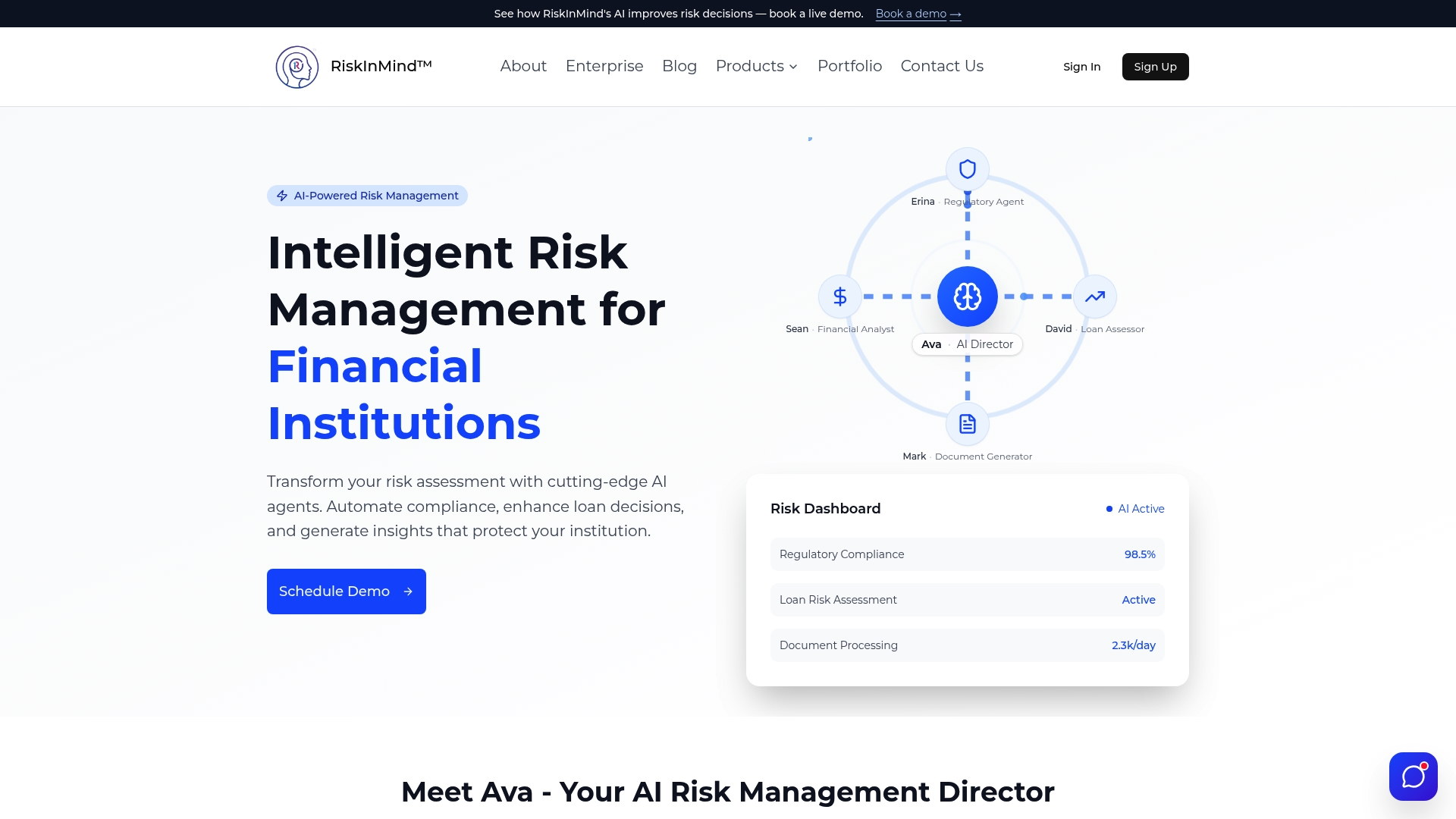
Riskinmind builds AI-powered risk management tools specifically for credit unions, community banks, and lenders. The platform's Loan Application product automates credit risk assessment at the point of origination, giving risk managers current exposure data without manual data pulls. The CRE Loan Risk Predictor applies machine learning to commercial real estate portfolios, accelerating credit decisions with real-time risk scoring. Both tools integrate with existing core banking systems and deliver results in under half a second, with SOC 2® certification and bank-grade security. For risk managers who want to reduce review preparation time and improve decision quality, Riskinmind provides the data infrastructure that makes it possible.
FAQ
What does it mean to streamline a risk review?
A streamlined risk review is a short, decision-focused meeting that covers only high-priority risks with named owners and defined outcomes. It replaces status reporting with evidence-based decisions made in 30–60 minutes.
How many risks should appear on a review agenda?
Limit the agenda to 10–20 active, high-priority risks. Items that produce no decision after two consecutive meetings should be removed to keep the review focused on real constraints.
What role does automation play in improving risk reviews?
Automation eliminates manual data collection before meetings and surfaces risk flags in real time. 98% of organizations report that digital acceleration improved their approach to risk management.
How do you close a risk item properly in a review?
Closure requires concrete evidence that a control is active and performing, such as field verification or a dashboard confirmation. A status note from the risk owner is not sufficient proof of mitigation.
What is the biggest barrier to efficient risk reviews?
Lack of centralized structure and cross-functional collaboration are the primary barriers. Only 26% of organizations report true cross-functional collaboration, which means most review processes operate with fragmented ownership and incomplete information.