
The most effective approach to document fraud detection combines a layered AI forensic pipeline with calibrated thresholds and human review for borderline cases. Expect two core outputs from any serious system: an authenticity score between 0 and 100 and a forensic heatmap that localizes suspected manipulations. Enterprise platforms built for financial institutions, including SOC 2 aligned solutions, now package this into workflows that credit and compliance teams can actually run at scale.
TL;DR:
- Vendors should provide Pixel-F1 scores on your specific document types and require a calibration pass before deployment to ensure real-world detection effectiveness.
- Multi-layered forensic signals include metadata checks, layout matching, pixel analysis, and AI- generated document detection, each targeting different fraud typologies.
- Real-time scoring and heatmaps should be integrated into onboarding workflows with thresholds calibrated to balance false positives and manual review workload.
- Fraud detection systems need ongoing calibration and audit artifact retention to adapt to evolving tactics and maintain low false acceptance rates.
- Conduct thorough pilots using your existing flagged documents and AI-generated forgeries, ensuring heatmap export and calibration procedures are properly documented.
Maintain 100% NCUA & OCC Audit Readiness
Monitor regulatory updates 24/7, check internal credit policies, and generate compliance trails with Erina (AI Regulatory Agent).
Table of Contents
- How Document Fraud Detection Works: Signals and Technical Layers
- Common Fraud Typologies Financial Institutions Face
- Why Benchmarking and Calibration Determine Real-World Accuracy
- Integrating Document Forensics Into Compliance Workflows
- A Procurement and Pilot Checklist for Risk Teams
- Turning This Into an Adoption Roadmap
- How Riskinmind Handles Document Fraud Detection at Scale
- Sources
How Document Fraud Detection Works: Signals and Technical Layers
A capable document fraud detection system doesn't rely on one trick. It stacks several independent forensic layers, and each layer catches something the others miss.
File and metadata forensics examine what's invisible to the naked eye: creation timestamps, traces left by editing software, and inconsistencies in internal PDF structure or embedded fonts. A statement that claims to come from a major bank's system but carries fonts from a consumer PDF editor is a red flag before anyone looks at the content.
Template and layout matching compares a submitted document against known issuer formats. Fields shifted by a few pixels, misaligned logos, or spacing that doesn't match the issuer's actual template often expose fabricated paystubs faster than a human reviewer would catch on a screen.
Pixel-level forensics hunt for noiseprints, compression artifacts, and copy-move edits, the kind of tampering where someone pastes a higher balance over an original figure. Edge-focused detection models sharpen this further by targeting boundary-level manipulation, and research shows these edge-focused deep learning methods meaningfully improve localization accuracy over baseline models.
Generative-AI detection is the newest and fastest-growing layer, built to catch generator fingerprints, unnatural textures, and face-swapped identity photos, since AI image tools now produce convincing fake receipts that pass a casual glance.
The output that ties all of this together is the authenticity score and forensic heatmap. The score gives you a single number to route decisions; the heatmap shows exactly which region triggered the alert, which is what turns a flag into evidence you can act on.
- Metadata and file-structure checks flag editing-software traces and font mismatches
- Template matching catches layout drift against known issuer formats
- Pixel and edge-level analysis exposes copy-move edits and compression anomalies
- Generative-AI detectors catch synthetic textures and face-swap artifacts
- Score plus heatmap gives you both a decision signal and an audit trail
Document-related fraud isn't a niche problem. It contributes meaningfully to the billions in fraud losses reported annually across the country, which is exactly why each of these layers needs to work together rather than in isolation.
Common Fraud Typologies Financial Institutions Face
Different fraud types leave different fingerprints, and knowing which detection signal maps to which typology helps you evaluate a vendor's claims instead of taking them on faith.
Tampered bank statements and paystubs usually show pasted or edited fields: a balance changed, a deposit added. Pixel-level and metadata forensics are what catch these, since the edit itself leaves a compression or noise signature the eye can't see.
Template injection happens when someone builds a fake document from an editable template designed to look like a real issuer's format. Template and layout matching against a known-issuer database is the direct countermeasure here.
AI-generated documents and receipts are the fastest-growing category. Because there's no original document to compare against, texture analysis and generator-fingerprint detection carry the weight that template matching can't.
Identity-document manipulation, including face-swaps and replay attacks on scanned IDs, shows up constantly in onboarding. This overlaps heavily with synthetic identity detection, since a manipulated ID is often one piece of a broader synthetic identity attempt.
- Tampered statements and paystubs: pixel and metadata forensics
- Template-injected fabrications: layout matching against issuer databases
- AI-generated receipts and documents: texture and generator-fingerprint analysis
- ID manipulation and replay attacks: face-match and liveness signals layered with document checks
These typologies show up most often during KYC onboarding, income verification for lending, and ongoing account monitoring, exactly the three checkpoints where a compromised document does the most damage if it slips through.
Why Benchmarking and Calibration Determine Real-World Accuracy
Vendor marketing loves to cite accuracy percentages. Those numbers are close to meaningless without calibration data behind them, and the research backs this up directly.
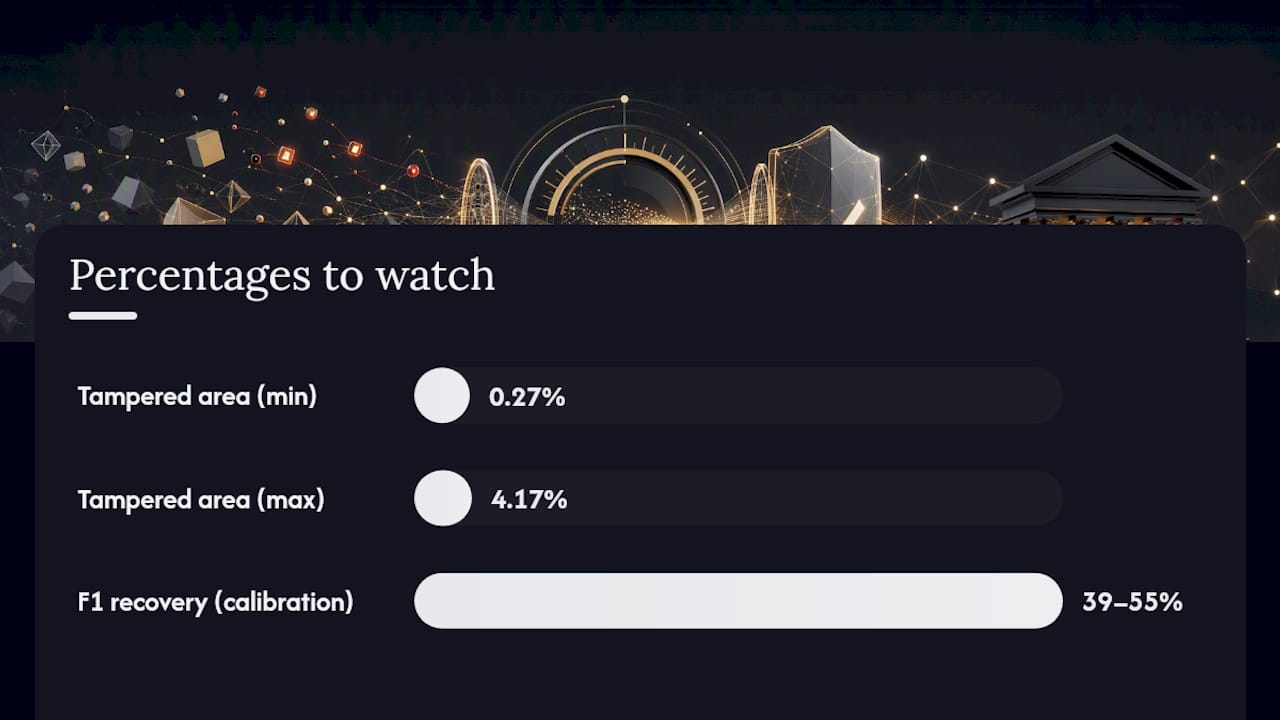
The DOCFORGE-BENCH benchmark found that tampered pixels typically occupy only 0.27% to 4.17% of a document image. Out-of-the-box detectors often post a respectable Pixel-AUC score while their Pixel-F1 score collapses toward zero, because fixed thresholds simply aren't tuned to detect a manipulation that small.
That's the core lesson: Pixel-AUC tells you the model can theoretically separate real from fake, but Pixel-F1 tells you whether it actually catches tampering at the threshold you've deployed. Track both.
| Metric | What it measures | Why it matters |
|---|---|---|
| Pixel-AUC | Overall separability of tampered vs. authentic pixels | Can look strong even when practical detection is weak |
| Pixel-F1 | Precision and recall at your deployed threshold | Reflects real-world catch rate on small tampered regions |
| Threshold adaptation | Gain from calibrating on domain samples | Recovers 39–55% of the F1 gap per DOCFORGE-BENCH |
Pro Tip: Before signing any vendor contract, ask for their Pixel-F1 score on a sample of your own document types, not just their published Pixel-AUC. Then require a 10-image domain calibration pass before go-live.
Ask vendors directly whether they publish benchmark results, whether you can export raw heatmaps for your own validation, and how often they recommend revalidation once your document mix shifts.
Integrating Document Forensics Into Compliance Workflows
Where and how you run these checks matters as much as the detection model itself.
Deployment pattern depends on the use case. Onboarding and loan applications need real-time checks, typically returning a decision in seconds so the applicant isn't left waiting. Ongoing account monitoring can run in batch or streaming mode, scanning uploaded documents overnight or as they arrive.
Decisioning bands built around the authenticity score keep humans focused where they add the most value. A common structure: scores above roughly 85 auto-accept, scores in the middle band route to a human reviewer with the heatmap attached, and scores below a low threshold auto-reject or escalate for investigation.
- Real-time scoring at document intake, integrated through a REST API or SDK
- Webhook callbacks that notify downstream systems the moment a score crosses a threshold
- Human review queues fed by mid-band scores, complete with heatmap and raw signal detail
- Audit-ready evidence export, including heatmaps and flags, retained per your data governance and SOC 2 or ISO requirements
Enriching document checks with behavioral and device signals, such as how a file was uploaded or the device fingerprint behind it, can meaningfully increase fraud detection coverage beyond document analysis alone, which is worth building into your integration plan from the start.
A Procurement and Pilot Checklist for Risk Teams
Run any vendor through these four categories before committing budget.
Technical: What signals does it inspect, can it explain a flag in plain language, does it export heatmaps, and which document types and languages does it support?
Operational: What's the real latency at your volume, what integration paths exist, and how is threshold calibration actually performed?
Compliance and security: Does it hold SOC 2 certification, where is data stored, what does the audit trail capture, and how is personally identifiable information handled?
Pilot design: Pull a representative document sample, run red-team tests using AI-generated forgeries, calibrate thresholds against that sample, and track false accept rate alongside manual review volume before and after.
- Confirm heatmap and raw-signal export before contract signing
- Require a documented calibration procedure, not a black-box threshold
- Test against AI-generated forgeries specifically, not just scanned edits
- Measure manual review reduction as a pilot success metric, not just accuracy
Pro Tip: Run your pilot on documents your team has already flagged manually. If the system doesn't catch those, it won't catch what's coming next.
Turning This Into an Adoption Roadmap
Most institutions get the sequencing backward. They buy a platform, flip it on, and skip straight to production, then wonder why false positives pile up in month one.
The order that actually works: pilot on a real document sample, calibrate thresholds against that specific domain, integrate the calibrated model into your decisioning workflow, then monitor and revalidate on a schedule. The DOCFORGE-BENCH findings on calibration aren't an academic footnote. They're the difference between a detector that looks good in a vendor demo and one that catches fraud in your actual document mix.
The biggest pitfalls I'd flag: leaning on a single signal type instead of a layered stack, skipping calibration because it feels like an extra step, and failing to keep audit artifacts, heatmaps, flags, score history, that hold up when a regulator or auditor asks how a decision was made. Institutions that treat calibration as ongoing, not one-time, are the ones whose false accept rates actually stay low as fraud tactics evolve.
— Raj
How Riskinmind Handles Document Fraud Detection at Scale
Riskinmind is built around the exact layered approach this guide describes: AI-driven forensic analysis that produces an authenticity score and forensic heatmap for every document your team touches, backed by SOC 2 aligned security and processing designed to return results in under half a second.
The platform's AI agents, coordinated by its central director Ava, handle document fraud detection alongside credit risk and compliance review, so a flagged paystub or tampered bank statement doesn't sit in a separate silo from the rest of your underwriting decision. Calibration isn't an afterthought either. Riskinmind supports threshold adaptation on your own document population, heatmap export for audit evidence, and integration through API and webhook callbacks so flagged cases route straight into your existing review queue. If you've read this far because a tampered statement or AI-generated pay stub already slipped past a manual review, document fraud detection built for compliance teams is worth a direct look. Request a pilot and calibrate the model against your own document mix before you scale it across onboarding and lending.
Sources
- Forensic outputs: authenticity score and heatmap (DOI reference)
- Enhancing document forgery detection with edge-focused deep learning (MDPI)
- NICB: Fraud costs Americans billions annually