
Bank statement analysis AI turns raw transaction records into structured income signals, categorized cash flow data, and fraud flags in minutes rather than days. Enterprise-grade platforms pair this extraction with mathematical verification, using standards like the Golden Rule balance check, and produce audit-ready outputs rather than a black-box guess. Platforms including RiskInMind build this verification directly into the underwriting workflow, so risk teams get a defensible answer, not just a fast one.
- Verification signals such as balance checks, confidence scores, and source tagging are essential for trust and auditability, not just extraction accuracy.
- Fraud detection combines document artifact analysis with behavioral and transaction anomaly detection, supplemented by external verification services for higher reliability.
- Pilot programs should focus on format diversity, discrepancy detection, and system latency, with proper thresholds and review processes established before full deployment.
- Ongoing accuracy depends on continuous feedback, format monitoring, and pattern updates, rather than a one-time model certification.
Maintain 100% NCUA & OCC Audit Readiness
Monitor regulatory updates 24/7, check internal credit policies, and generate compliance trails with Erina (AI Regulatory Agent).
Table of Contents
- What Does Bank Statement Analysis With AI Actually Do?
- What Input Formats Should Bank Statement AI Support?
- How Can You Trust AI-Extracted Bank Statement Data?
- What Fraud Detection Methods Work on Bank Statements?
- How Do You Pilot Bank Statement AI at Your Institution?
- What Security and Compliance Standards Should Risk Teams Require?
- How Should You Evaluate Bank Statement AI Vendors?
- Publisher Perspective and Proof Points From the Field
- How Do You Keep Bank Statement Models Accurate Over Time?
- How Do Bank Statement AI Tools Compare on Capability?
- Where Does Bank Statement AI Deliver the Most Value?
- How Does Bank Statement AI Fit Into Existing Systems?
- Why Do Hybrid Extraction Pipelines Outperform Single-Method Parsing?
- The Overrated Metric and the One That Actually Predicts Success
- Get Started With RiskInMind's Bank Statement Analyzer
- Sources
What Does Bank Statement Analysis With AI Actually Do?
Extraction and analysis are two different jobs, and confusing them is where a lot of institutions get burned. Extraction, whether it runs through optical character recognition (OCR) or intelligent document processing (IDP), pulls raw text and numbers off a page. Analysis is what happens next: categorizing each transaction, calculating recurring income, and flagging patterns that matter to an underwriter.
A production-grade system should hand back a consistent set of structured outputs regardless of which bank issued the statement or what format it arrived in. That consistency is what makes the data usable across a loan portfolio instead of one file at a time.
Typical structured outputs include:
- Normalized transaction records with consistent date, amount, and description fields
- Opening and closing balances for every statement period
- Identified income streams, separated from transfers, refunds, and one-time deposits
- Debt-to-income (DTI) calculations built from verified cash flow, not self-reported figures
- Month-over-month cash-flow trend lines that reveal seasonality or deterioration
Auditability separates a genuinely enterprise tool from a convenience app. A lending decision built on unverifiable extraction is a liability the moment a regulator or an internal auditor asks how a number was derived.
What Input Formats Should Bank Statement AI Support?
A parser that only handles clean PDFs from three major banks will fail the moment a member submits a scanned statement from a regional credit union or an export from an accounting tool. Format coverage is the first thing risk teams should test in any demo.
Structured, machine-readable formats should always route through deterministic parsers, never through a language model. These include:
- OFX/QFX exports from personal finance software
- CAMT.053 and MT940, the ISO 20022 and SWIFT formats common in commercial banking
- CSV exports from online banking portals
Digital PDFs and scanned images are the harder case. Plain OCR routinely garbles multi-column layouts, misreads negative signs, or drops rows near page breaks on scanned statements. Handling this diversity of formats is exactly why hybrid pipelines exist: deterministic parsing first, a text-based large language model for digital PDFs that resist simple parsing, and a vision-language model as the fallback for scanned or photographed documents.
Pro Tip: Ask any vendor how they auto-detect format before parsing even starts. A system that guesses wrong on format detection will misclassify data before verification ever gets a chance to catch the error.
Auto-detection routes each file to the right pipeline and maps everything into one unified transaction model, so a loan origination system downstream never has to know or care whether a file arrived as a CAMT.053 export or a phone photo of a paper statement.
How Can You Trust AI-Extracted Bank Statement Data?
Trust in this context is not a feeling. It is a set of machine-checkable signals a reviewer can point to when a regulator asks how a number was verified.
The clearest of these is balance verification, sometimes called the Golden Rule: opening balance plus the sum of all transactions must equal the closing balance printed on the statement. Systems built around this check report a status for every extraction, typically VERIFIED, DISCREPANCY, or FAILED, giving reviewers an immediate, binary signal about extraction quality before a human ever opens the file.
Beyond balance checks, mature platforms attach:
- A confidence score to each extracted row, not just the document as a whole
- A
source_methodtag showing whether a value came from deterministic parsing, a text LLM, or a vision LLM - Deduplication logic that catches repeated transactions across overlapping statement periods
- Continuity checks confirming one statement's closing balance matches the next one's opening balance
Vendors that return evaluation results and confidence scores instead of raw model output give underwriters something they can actually defend in an audit. A reconciliation export tied to every one of these signals is what turns a parsing tool into an audit-ready system.
What Fraud Detection Methods Work on Bank Statements?
Document fraud on bank statements ranges from crude Photoshop edits to sophisticated regeneration of an entire PDF with altered numbers. Effective detection layers several distinct techniques rather than relying on one.
Document integrity checks look for artifacts a human reviewer would miss but software catches instantly: font inconsistencies within a single statement, metadata timestamps that contradict the claimed statement date, layout shifts that suggest a template was edited rather than generated natively by a bank's system, and balance signs that don't match the transaction pattern around them.
Transaction-level anomaly detection works differently, flagging behavioral patterns instead of document artifacts:
- Deposits that don't match the rhythm of a claimed employer or pay cycle
- The same vendor name appearing with inconsistent amounts or spacing that suggests manual insertion
- Cash flow that spikes right before a statement's submission date and nowhere else
Document analysis alone has limits, though. Permissioned account-linking services and employment verification APIs add a real-time signal that a static PDF simply cannot fake, and pairing the two approaches in a waterfall catches far more than either does alone.
How Do You Pilot Bank Statement AI at Your Institution?
A pilot succeeds or fails based on how it's scoped, not on how sophisticated the underlying model is. Rushing straight to full production is the single most common mistake risk teams make with this technology.
- Select a representative sample. Pull statements across your actual format mix. Weighting a pilot toward clean digital PDFs and skipping scanned images guarantees a nasty surprise later.
- Route deterministically first. Send every OFX, CAMT.053, and CSV file through deterministic parsing before any file touches an LLM. This cuts model costs and keeps the majority of your data on the most auditable path.
- Set acceptance thresholds. Decide, before the pilot starts, what confidence score triggers automatic acceptance versus human review.
- Design the review queue. Build a human-in-the-loop process with a defined service-level agreement, commonly 24 to 48 hours for flagged files, and track how often reviewers overturn the model's output.
- Track the right metrics. Watch verification pass rate, discrepancy rate, fraud-flag precision, throughput, and end-to-end latency from ingestion to decision.
- Confirm integration points. Test REST API ingestion, ledger export formats, and connectors into your loan origination system before you scale beyond the pilot.
Pro Tip: *Run your pilot's discrepancy rate against your current manual error rate before declaring success.
What Security and Compliance Standards Should Risk Teams Require?
Data protection is not optional in this category. It's the price of admission for any tool touching a member's or borrower's financial records.
Redaction of personally identifiable information should happen by default, not as an opt-in setting a busy implementation team forgets to enable. Some institutions will additionally require local-first or on-premises processing to avoid sending statement data to a third party's cloud at all, and vendors serious about enterprise deployment should offer that option.
Certifications and controls worth requiring in any RFP:
- SOC 2 attestation covering the specific product, not just the parent company
- Encryption at rest and in transit as a baseline, not a premium add-on
- Secure ingestion channels that don't rely on email attachments or unencrypted file transfer
Audit readiness comes down to a few concrete features: immutable transaction hashes that prove a record wasn't altered after extraction, clear source provenance for every value, a full review log showing what a human changed and why, and export formats regulators can actually consume. A compliance checklist built around these specifics will catch a vendor's gaps long before a live examiner does.
How Should You Evaluate Bank Statement AI Vendors?
Procurement teams waste time comparing marketing pages instead of running the same test cases against every vendor in an RFP. A capability checklist fixes that.
Checklist categories to score every vendor against:
- Supported input formats (OFX/QFX, CAMT.053, MT940, CSV, scanned PDFs)
- Balance verification method and how discrepancies are reported
- Granularity of confidence scoring (per document versus per row)
- PII redaction defaults and local-processing options
- SOC 2 status and encryption standards
- API access, export formats, and throughput SLAs under real load
For the demo itself, insist on running these test cases:
- A batch of scanned, low-quality statements from at least three different banks
- A file with a deliberately introduced balance discrepancy, to confirm the system actually catches it
- A mixed batch of structured and unstructured formats submitted simultaneously
- A latency test under a volume matching your actual monthly statement intake
Red flags that should end a conversation quickly: no verification status per document, no per-row confidence scoring, refusal to disclose SOC 2 status, or an inability to explain what happens when extraction and vision-LLM outputs disagree.
Publisher Perspective and Proof Points From the Field
The recurring lesson from institutions piloting this technology is that verification, not raw extraction accuracy, is what determines whether a risk team actually adopts the tool. A parser that's 95% accurate but can't tell you which 5% failed is less useful in practice than one that's 90% accurate and flags every uncertain row for review.
Platforms reflecting this bias toward provable outputs include SOC 2® certification, bank-grade security controls, and sub-half-second response times on core processing. Realistic pilots run 60 to 90 days and should produce a comparison of manual review time before and after deployment. Case studies worth requesting from any vendor should show discrepancy rates and reviewer override frequency, not just processing speed.
How Do You Keep Bank Statement Models Accurate Over Time?
A model that performs well at launch will drift, usually within months, as banks change statement layouts, new formats appear, and fraud patterns evolve to route around whatever detection you shipped. Treating accuracy as a one-time certification instead of an ongoing discipline is how institutions end up quietly degrading their own risk controls.
Continuous feedback from the human review queue is the single highest-value input for maintaining accuracy. Every time a reviewer overrides a model's output, that correction should feed back into retraining or rule adjustment, not disappear into a log nobody revisits. Institutions that treat their review queue as disposable throw away the exact data that would keep the model current.
Format drift deserves its own monitoring. Banks redesign statement templates periodically, and a deterministic parser tuned to last year's layout can silently start failing on this year's version. Track parser success rates by source bank, not just in aggregate, so a single institution's template change doesn't hide inside an otherwise healthy overall number.
Fraud pattern updates need faster cycles than general model retraining. Anomaly detection rules calibrated against last year's fraud attempts will miss new manipulation techniques, so pattern libraries should update on a rolling basis, not an annual review cycle.
Finally, benchmark against a held-out set of manually verified statements on a recurring schedule, not just at initial deployment. Reconciliation exports from production, reviewed periodically against ground truth, catch quiet accuracy decay before it shows up as a bad lending decision.
How Do Bank Statement AI Tools Compare on Capability?
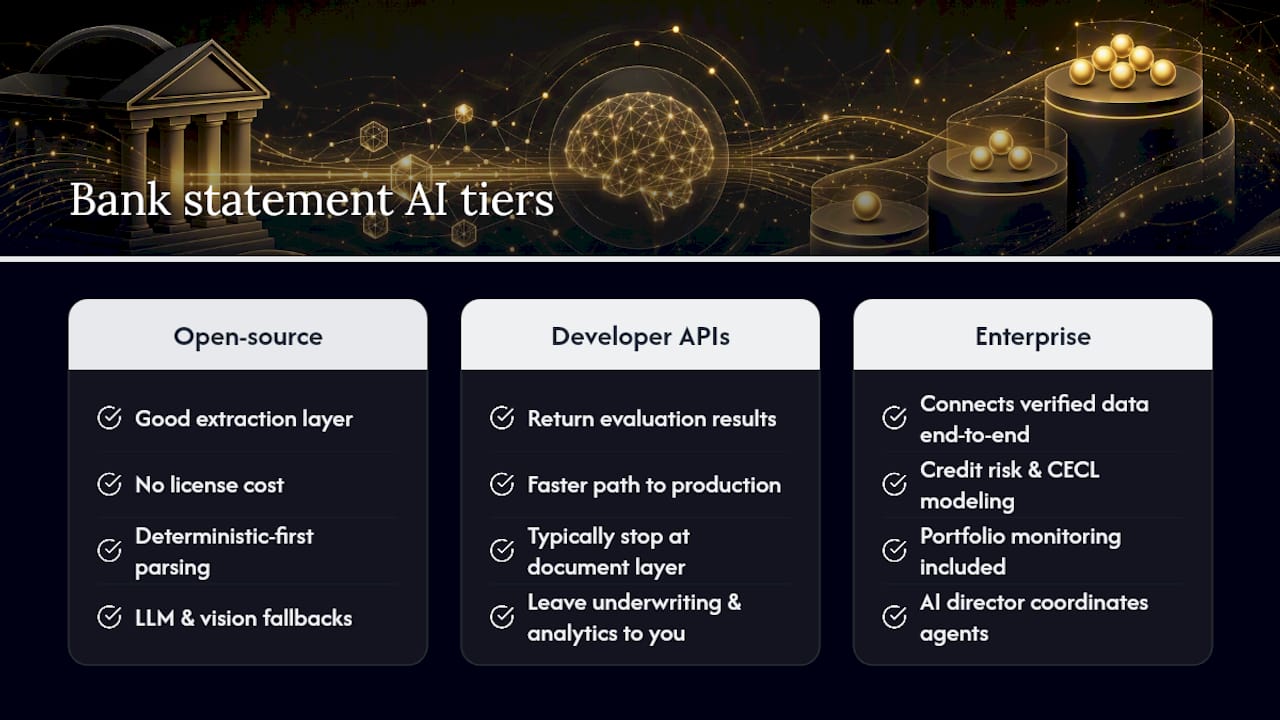
The market splits roughly into three tiers, and understanding which tier a tool occupies matters more than any single feature comparison.
Open-source parsing libraries handle the extraction layer well and cost nothing beyond engineering time. Tools built around hybrid pipelines and Golden Rule verification demonstrate that even freely available software can implement production-grade patterns, deterministic-first parsing with LLM and vision fallbacks, when the underlying design is sound. The tradeoff is that your team owns integration, hosting, and support entirely.
Developer-focused APIs sit in the middle tier. Services that return evaluation results rather than raw text give engineering teams a faster path to production than building extraction from scratch, though these tools typically stop at the document layer and leave underwriting logic, portfolio analytics, and compliance workflows to be built separately.
Enterprise risk platforms occupy the top tier, and this is where RiskInMind competes directly. These platforms don't just extract and verify a statement. They connect that verified data to credit risk assessment, CECL reserve modeling, and portfolio monitoring in one system, with an AI director coordinating specialized agents across the underwriting workflow rather than handing a risk analyst a spreadsheet of extracted numbers to interpret alone.
The right tier depends on what you're building. A fintech building a narrow feature might reasonably choose an API. A credit union or regional bank running statement analysis as part of loan underwriting at scale needs the verification, audit trail, and workflow integration that only an enterprise platform delivers end to end.
Where Does Bank Statement AI Deliver the Most Value?
Lending is the most obvious use case, and for good reason. Underwriters using verified cash-flow data catch income inconsistencies that self-reported figures hide, particularly for gig workers, small-business owners, and anyone without a traditional W-2 paycheck history. DTI calculations built from actual transaction history are simply more defensible than numbers pulled off a paystub the applicant provided themselves.
Accounting and bookkeeping firms use the same underlying technology differently. Deterministic normalization into a consistent transaction model lets a firm reconcile client accounts without manually re-entering every line from a PDF, and exports into formats like QBO or CSV plug directly into existing bookkeeping software.
Financial planning applications lean on the categorization layer more than the verification layer. A planner building a client's cash-flow picture cares less about fraud detection and more about accurate spending categories and reliable income trend lines across twelve or twenty-four months of statements.
Portfolio monitoring at the institution level is the use case that compounds value over time. Once bank-statement data is structured and verified at intake, that same data feeds ongoing monitoring, flagging a borrower's deteriorating cash flow months before a payment is missed, rather than waiting for a delinquency to surface the problem. That shift from reactive to leading-indicator risk management is where the technology's return on investment moves from cost savings to genuine risk reduction, and where portfolio-level risk analysis turns individual verified statements into a fuller picture of institutional exposure.
How Does Bank Statement AI Fit Into Existing Systems?
Integration failure kills more pilots than model accuracy ever does. A tool that extracts data beautifully but can't get that data into your loan origination system or your general ledger creates a new manual step instead of removing one.
REST API ingestion should be the default connection point, accepting files directly from wherever your institution already collects them, whether that's a member portal upload, an email intake process, or a document management system. The API should return structured JSON, not a PDF report a human has to re-transcribe.
Ledger and accounting exports matter just as much as ingestion. Support for standard export formats means extracted transaction data can flow into existing accounting software without a custom integration project for every new format that shows up.
Loan origination system connectors are where the lending use case closes the loop. Verified income figures, DTI calculations, and fraud flags should populate directly into the underwriting record inside your existing origination platform, not sit in a separate dashboard that a loan officer has to check manually before proceeding. Risk assessment workflows that already define how underwriters move a file from application to decision are the right place to slot in automated statement verification as a gate rather than an afterthought.
The institutions that get the most value treat integration planning as a first-week conversation with a vendor, not a phase-two problem to solve after the pilot proves the extraction works.
Why Do Hybrid Extraction Pipelines Outperform Single-Method Parsing?
Relying on one extraction method for every statement type is the fastest way to either overpay for LLM processing or underperform on accuracy. Hybrid pipelines exist because no single technique handles every input format well.
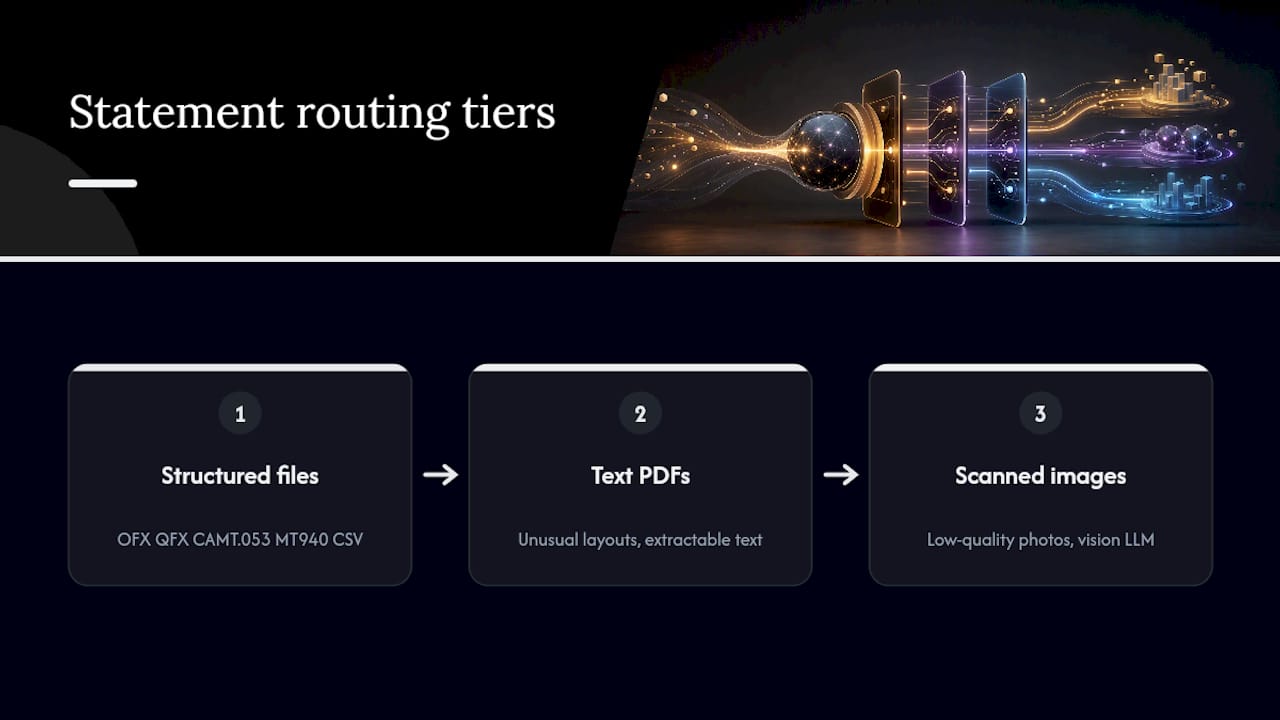
The routing logic works in three tiers. Structured formats, OFX, QFX, CAMT.053, MT940, and CSV, go straight to deterministic parsers because these formats have fixed, predictable schemas. There's no ambiguity to resolve, so running them through a language model would waste compute and introduce unnecessary variability into an otherwise perfectly reliable process.
Digital PDFs that resist straightforward parsing move to a text-based LLM. These are typically statements with unusual layouts, multi-column formatting, or bank-specific templates that a rules-based parser wasn't built to handle, but where the underlying PDF still contains extractable text.
Scanned images and low-quality photographs fall to a vision-language model as the final fallback. This is the most computationally expensive tier and the one where errors are most likely, which is exactly why it should be the last resort rather than the default path.
Practical pilot setups confirm this pattern holds in production: routing structured files through deterministic parsers first keeps the majority of a typical statement batch off the LLM pipeline entirely, preserving both cost efficiency and auditability. Only the genuinely hard cases, the scanned statement from a small regional bank with an unusual layout, ever reach the vision-LLM tier. That's the whole point of hybrid design: spend the expensive, less predictable processing only where deterministic methods genuinely can't do the job.
The Overrated Metric and the One That Actually Predicts Success
Raw extraction accuracy gets all the attention in vendor pitches, and it's the wrong number to optimize first. A system boasting 98% field-level accuracy tells you almost nothing if it can't identify which 2% to distrust. Verification rate and confidence scoring matter more than headline accuracy, because they determine how much manual review your team actually does, not just how good the model looks in a controlled benchmark.
The conventional advice in this space, buy the most accurate parser, gets the sequencing backward. Accuracy without provenance just moves the trust problem from the document to the model. What actually reduces risk is a system that tells you, row by row, whether a value came from deterministic parsing, a text LLM, or a vision fallback, and that reconciles every statement against its own printed balance before a human ever sees it.
Institutions evaluating this category should prioritize the Golden Rule check and confidence scoring over marginal accuracy gains between vendors, since a 2-point accuracy difference matters far less than whether discrepancies get caught automatically or slip through into an underwriting decision. Pilot design should test failure modes deliberately, not just clean-case performance, because production statements are rarely as tidy as demo data. The institutions that get this right treat verification as the product, with extraction as the necessary but insufficient input underneath it.
— Raj
Get Started With RiskInMind's Bank Statement Analyzer
RiskInMind gives risk teams the enterprise layer that open-source parsers and narrow developer APIs stop short of: verified extraction connected directly to underwriting, portfolio monitoring, and compliance reporting in one platform.
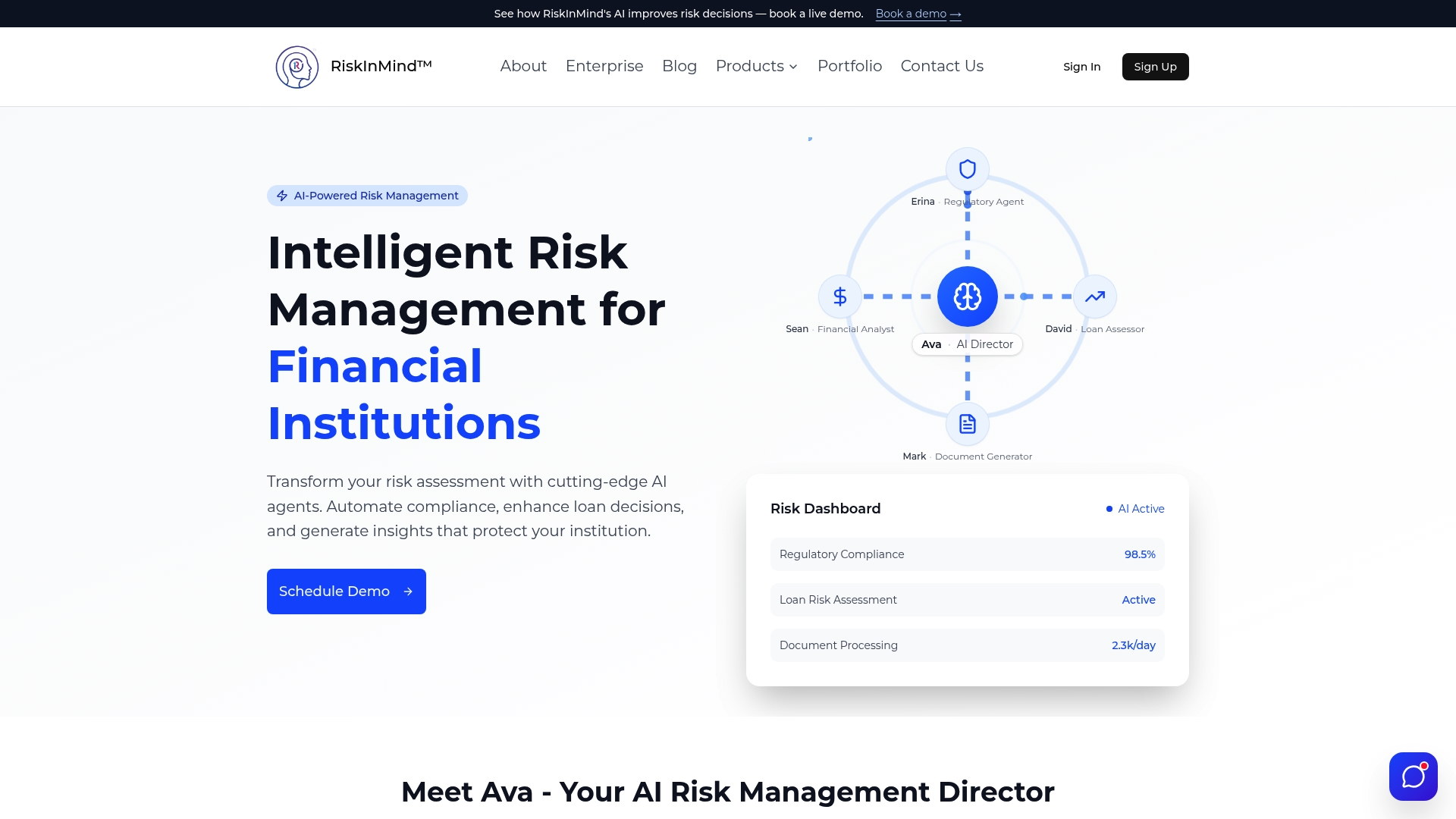
Every checklist item covered above, format coverage, Golden Rule balance verification, confidence scoring, PII redaction, and SOC 2® controls, is built into the bank statement analyzer rather than bolted on after the fact. Response times under half a second mean loan officers get verified cash-flow data during the application conversation, not a day later. If your institution is comparing options for the loan application workflow, request a demo and run your own hardest test cases, the scanned statements, the mixed-format batches, the deliberately introduced discrepancies, against RiskInMind's pipeline before deciding what production-ready actually means for your risk team.
Sources
- Bankstatementparser
- bankstatementparser (PyPI)
- statement-normalizer — GitHub
- Bankstatemently developers — PDF Bank Statement API for Developers