Automating real-time risk assessment, compliance monitoring, and credit evaluation across complex financial environments often fails when traditional platforms require manual evidence collection and lack integrated AI-driven insights. Most enterprise-grade risk and GRC solutions demand lengthy implementation, hide pricing behind custom quotes, or overwhelm smaller teams with steep technical requirements. This comparison covers automation features, integration depth, pricing, and ease of deployment so you can identify which AI risk platform best fits your organization's capacity, regulatory needs, and operational maturity.
Table of Contents
- RiskInMind
- Auditrunner
- RiskOpsAI
- Earthian AI
- RiskWise.AI
- Compler.AI
- Comparing Top Risk Management and Compliance Platforms
Automate Regulatory Model Risk Governance
Examine models against 32 qualitative criteria and resolve risk Tiers with pre-deployment checklists per OCC 2011-12 guidelines.
RiskInMind
At a Glance
The vendor advertises sub-second processing with response times under half a second and a 99.7% detection accuracy for risk signals, claims drawn from the product materials. This performance and accuracy claim underpins the product's focus on real-time risk decisions.
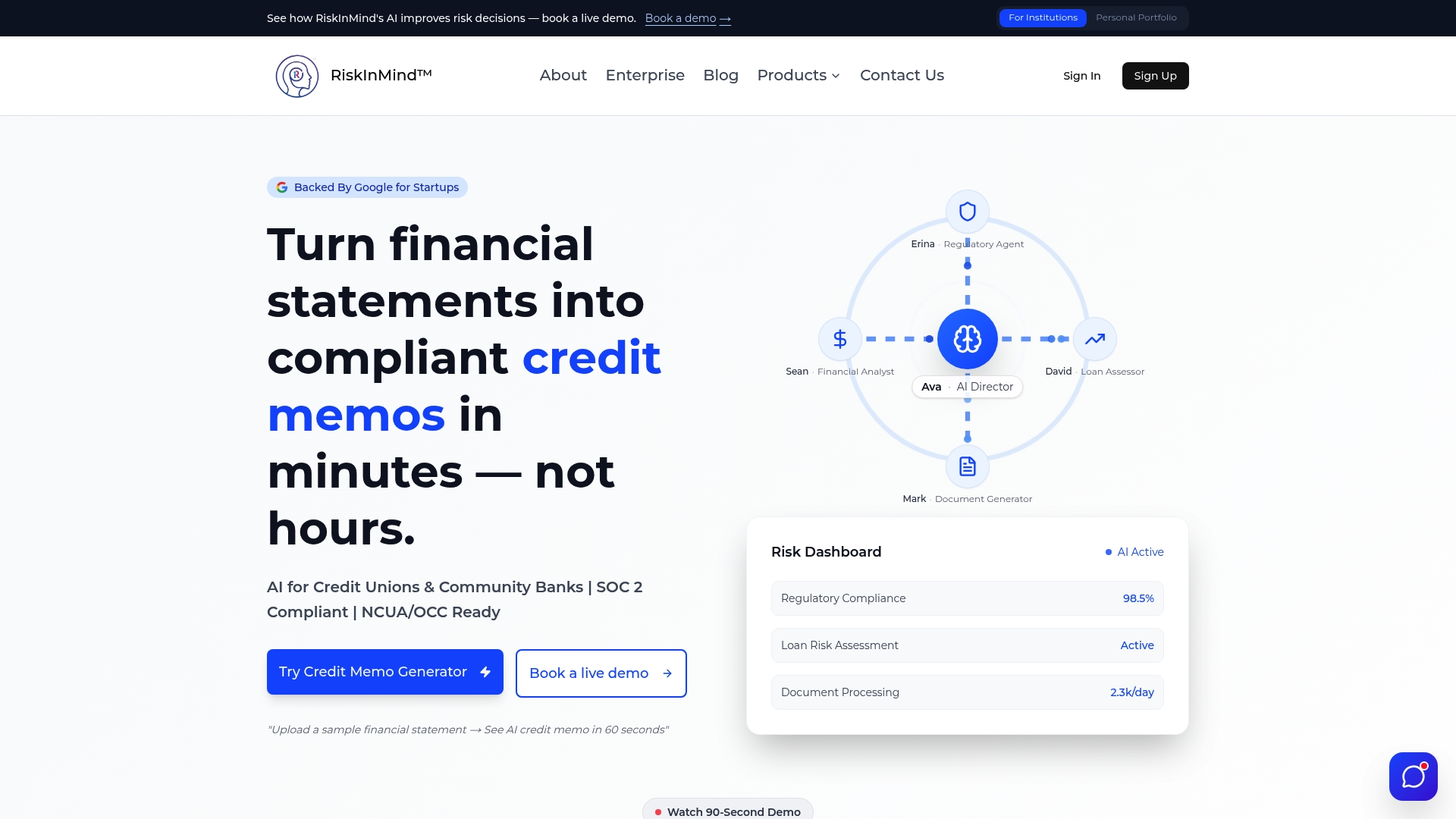
RiskInMind combines a suite of specialized AI agents for credit risk, regulatory monitoring, loan assessment, and document generation with enterprise security and mobile dashboards.
Core Features
- Specialized AI agents for credit risk evaluation, regulatory compliance monitoring, loan underwriting, and financial analysis.
- Automated credit memo creation, reporting, and compliance alerts to reduce manual documentation.
- SOC 2 security posture, encryption, and audit logging plus a cloud-native, scalable architecture.
- API integrations for core banking systems and a mobile app for on-the-go risk dashboards and alerts.
Key Differentiator
The product's architecture assigns dedicated AI agents to discrete risk functions so those agents collaborate under centralized control, producing continuous, role-specific insights. That design moves routine assessments into automated pipelines while preserving human review points.
Pros
- Automation of compliance workflows cuts repetitive tasks and centralizes audit trails, freeing compliance officers to focus on exceptions rather than status checks.
- The accuracy and latency claims above give risk teams a defensible starting point when arguing for productionizing model outputs in underwriting pipelines.
- Built-in security controls and audit logging reduce vendor due diligence time relative to tools without documented SOC 2 posture.
- The modular agent approach allows banks to adopt one function at a time—credit scoring first, portfolio monitoring next—rather than swapping core systems all at once.
- Mobile dashboards and real-time alerts let loan officers surface problem loans in the field rather than waiting for batch reports.
Cons
- Onboarding and integration can be complex for smaller institutions; initial setup often requires technical resources and coordination with core banking teams.
Who It's For
Risk managers, compliance officers, and loan officers at mid to large-scale banks and credit unions that have engineering capacity and want to move risk decisions toward automated, auditable workflows.
Unique Value Proposition
A named central AI director orchestrates multiple specialist agents so each risk domain operates with its own model and ruleset while feeding a unified risk dashboard. That coordination reduces duplicate analysis and keeps regulatory checkpoints visible to human reviewers.
Real World Use Case
According to the vendor, a credit union using RiskInMind cut loan review time from hours to minutes while retaining strict compliance controls. That customer example illustrates how automated credit memo generation and real-time alerts shorten decision loops.
Pricing
Pricing is not published and is likely customized for enterprise deployments. Expect a commercial model that reflects onboarding, integration work, and per-module licensing for agent-based features.
Website: https://riskinmind.ai
Auditrunner
At a Glance
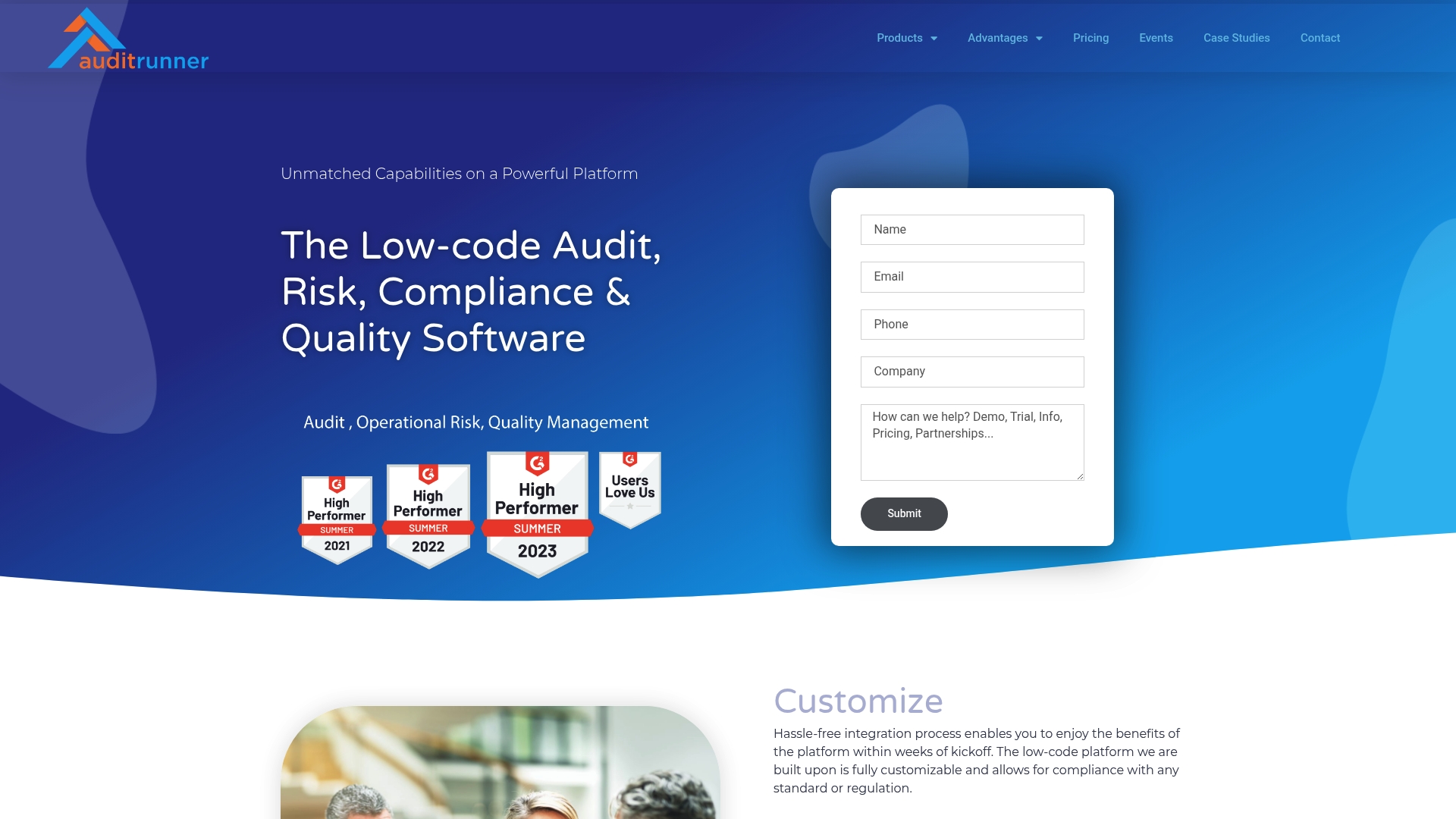
The platform supports both cloud-based and on-premise deployment, a useful option for organizations that must keep sensitive data on their own infrastructure. The vendor says Auditrunner helps organizations align with standards like ISO 27001, ISO 31000, and GDPR while offering low-code customization.
Core Features
Auditrunner exposes a modular set of GRC functions: Audit, Risks, Controls, Compliance, and Quality. Each module plugs into a central workflow engine that you can adapt with low-code configuration.
The product includes automated audit and report generation, risk assessment and scoring tools, and document control features for versioning and access logs. It also supports integrations with enterprise systems to feed evidence and controls data.
Key Differentiator
The low-code modularity is the real angle. You can assemble a tailored GRC system by selecting modules and then extend workflows without heavy engineering overhead. That model shortens custom development and makes upgrades predictable across regions.
Pros
-
Strong audit trail and tracking capabilities. The platform records evidence, changes, and reviewer activity so you can reconstruct decisions during an inspection.
-
Effective risk scoring that lets you prioritize controls by impact and likelihood. The scorecard integrates with audit schedules so high-risk items feed higher-frequency checks.
-
Responsive, helpful customer support. The company provides hands-on assistance during setup and early audits, which speeds initial adoption.
-
Flexible modular structure. You can deploy only audit and controls today and add compliance or quality later without a forklift migration.
-
Good integration capability with ERP and document management systems, which reduces manual evidence collection for recurring audits.
Cons
-
Steeper learning curve for some features. Low-code flexibility means more options to configure, which can overwhelm teams without a power user guiding the first workflows.
-
Setup can be time-consuming for complex environments. Large organizations should budget multiple weeks for mapping processes, connecting source systems, and validating controls automation.
-
Interface may feel dated to some users. The UI prioritizes clarity over modern visual flourishes, which is fine for auditors but may feel utilitarian for everyday users.
When It May Not Fit
If you need a plug-and-play GRC tool with turnkey templates and next-day value, Auditrunner may feel heavy. The product rewards teams that invest in process design and a technical admin role to maintain custom workflows.
If your implementation must be live within days and you have no internal resources to map controls to source systems, consider a hosted, single-tenant SaaS alternative instead.
Notable Integrations
-
ERP systems to pull transaction evidence.
-
Document management systems for automated version control and access logs.
-
Compliance frameworks and standards mapping, including ISO and GDPR references.
These are the integration categories the vendor lists; actual connectors will vary by deployment and implementation package.
Who It's For
Mid to large-sized organizations that require a configurable, auditable GRC platform and have the internal capacity to own deployment and process design. Especially suited to firms operating across regions or regulated industries with mixed deployment requirements.
Real World Use Case
A multinational company used Auditrunner to centralize internal audit, risk scoring, and document control across several business units. The implementation automated recurring audit reports and reduced manual evidence collection by linking the audit engine to existing ERP and document repositories.
Pricing
Pricing is quoted per organization based on size, selected modules, and deployment choice. Expect a formal quote after scoping your modules and integration needs; the vendor asks for requirements before publishing a price.
Website: https://auditrunner.com
RiskOpsAI
At a Glance
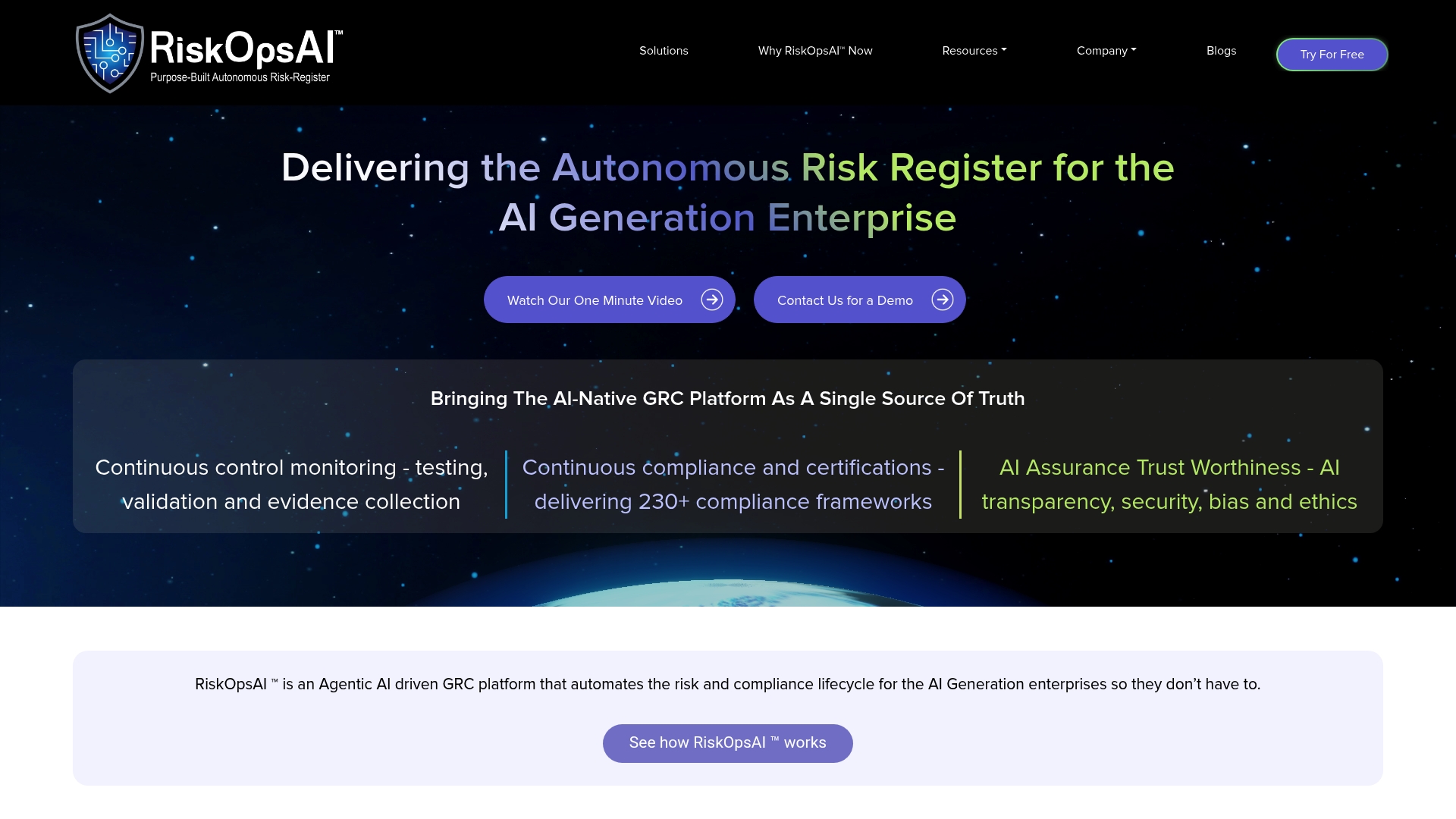
RiskOpsAI's marketing materials state automated compliance assessments across 230+ frameworks, combined with AI-based risk quantification and continuous controls testing. The vendor positions the platform for rapid configuration and a pay-as-you-go commercial model aimed at large enterprises.
Core Features
- Continuous control monitoring with automated evidence collection and real-time test results for controls.
- AI-based risk quantification that scores exposures and surfaces priority remediation candidates for analysts and leadership.
- Automated compliance assessments across a broad set of regulatory frameworks and maturity modeling for multiple regimes.
- Third-party vendor risk lifecycle assessments, AI ethics and bias mitigation tooling, and customizable real-time dashboards for stakeholders.
Key Differentiator
The vendor markets RiskOpsAI as an AI-native GRC platform that folds AI ethics governance into the same workflow as compliance and vendor risk. That unified approach is intended to reduce handoffs between model governance, security, and compliance teams.
Pros
- Near real-time automated risk assessments and continuous controls testing reduce manual evidence pulls and audit prep time for risk teams.
- The platform includes explicit tooling for AI transparency and ethics, which helps compliance and model governance teams document bias mitigation and explainability workflows.
- Support for a large set of regulatory frameworks makes mapping controls to obligations faster for teams facing multi-jurisdictional oversight.
- Dashboards are intended for different stakeholder levels, helping translate technical findings into executive-ready metrics and heatmaps.
- The vendor advertises a pay-as-you-go pricing model and free trial options, which can lower procurement friction for pilot projects.
Cons
- No specific third-party user reviews are available, which limits independent validation of usability and long-term performance.
- The breadth of features creates potential complexity; teams will likely need dedicated onboarding and role-based training to get full value.
- Public materials do not disclose detailed implementation timelines or referenceable customers, making procurement risk harder to assess.
When It May Not Fit
If your organization needs a GRC tool with an extensive archive of independent customer reviews and third-party case studies, this product may feel opaque. Small teams with minimal security or compliance headcount may find the platform more feature rich than they can operationalize without extra resources.
Who It's For
Chief Risk Officers, compliance officers, and CXOs at large enterprises seeking a single platform that combines continuous controls testing, vendor risk oversight, and AI governance. Particularly useful where multiple regulatory frameworks must be mapped and monitored concurrently.
Real World Use Case
The vendor describes a large multinational using RiskOpsAI to continuously monitor cyber risks, regulatory compliance, and AI ethics across global operations. The example emphasizes continuous evidence collection, consolidated dashboards, and faster remediation coordination between security and compliance teams.
Pricing
Public materials do not list fixed subscription tiers. The vendor advertises a pay-as-you-go model and free trial options, but exact rates and seat or module pricing are available only via direct engagement with their sales team.
Website: https://riskopsai.com
Earthian AI

At a Glance
Real-time, asset-level climate and risk assessments that fuse satellite imagery, geospatial feeds, and proprietary datasets into inference-driven outputs for underwriting and portfolio analysis. The vendor advertises that its models are benchmarked against leading financial data providers.
Core Features
Earthian AI centers inference-first models and continuous scoring at the asset level.
- Inference-driven risk models for climate, ESG, and geopolitical scenarios.
- Satellite imagery and geospatial data ingestion for location-specific signals.
- Real-time asset-level assessment and continuous adaptive risk modeling.
Key Differentiator
Earthian positions small language models specifically engineered for high-precision climate, ESG, and geopolitical inference. Those models operate as continuously updating engines that feed pricing, underwriting, and scenario analysis rather than static scorecards. That design favors institutions that need live asset signals.
Pros
-
Advanced inference reduces manual feature engineering, letting analysts test scenario hypotheses faster than with traditional statistical pipelines.
-
Integrates visual and tabular sources. Combining satellite imagery with financial feeds gives underwriters sharper exposure context for individual properties.
-
Emphasizes interpretability. The product documentation and model outputs aim to show drivers behind each risk score, which helps audit and governance workflows.
-
Supports multiple risk domains. Lucid Climate-0, Evergreen-0, and Axiom-0 map to climate underwriting, ESG rating, and geopolitical analysis respectively, enabling cross-domain correlation studies.
Cons
-
Model complexity requires specialized staff. Risk teams need data science or model validation expertise to interpret outputs and integrate them into policy rules.
-
Limited independent reviews are available. Public user feedback is sparse, which makes operational validation harder for cautious procurement teams.
-
Heavy reliance on proprietary data sources can complicate reproducibility for internal model risk teams that track third-party inputs.
When It May Not Fit
If your team lacks in-house model validation or a dedicated data science function, adopting inference-first models will add onboarding overhead. If your procurement requires broad third-party user references, the current limited public reviews may slow approvals.
Notable Integrations
Earthian ingests and correlates multiple external feeds.
- Satellite imagery
- Geospatial datasets
- Traditional financial and risk data sources
Who It's For
Risk teams at banks, insurers, and asset managers seeking live, asset-level signals for underwriting, portfolio monitoring, or stress testing. Best for organizations able to operationalize model outputs and house model governance expertise.
Real World Use Case
A global insurer uses Lucid Climate-0 to reprice a property portfolio under near-term climate scenarios. The model surfaced acute flood exposure at parcel level that had been masked in aggregated ZIP code analytics, prompting underwriting adjustments.
Pricing
Not applicable. The offering is listed as informational only, so licensing and deployment costs are provided through vendor discussions and enterprise procurement rather than public list pricing.
Website: https://earthianai.com
RiskWise.AI
At a Glance
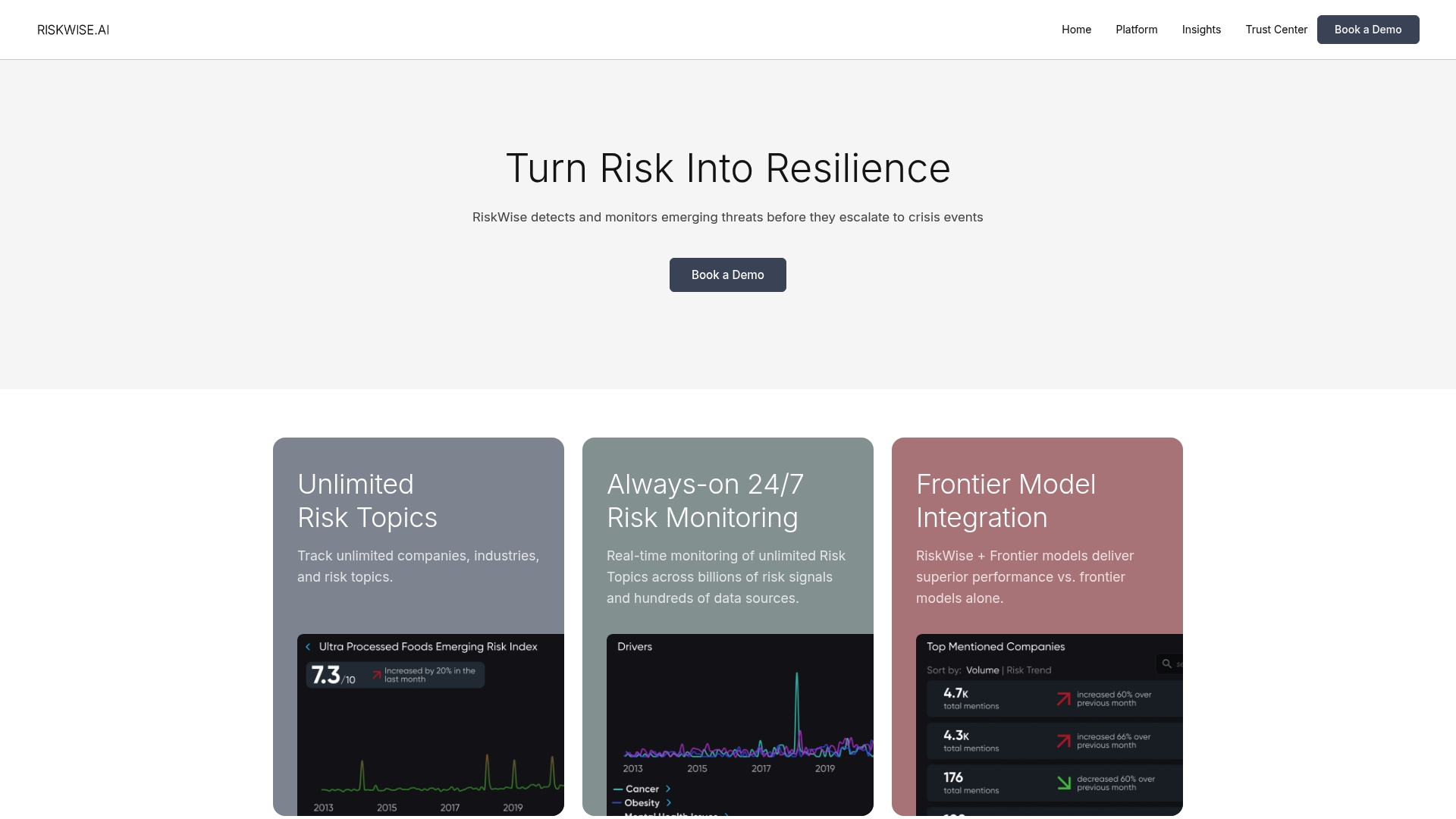
The vendor advertises continuous ingestion of billions of signals to power early risk detection across sectors. The company also states it maintains SOC 2 Type II security controls, which matters when you feed sensitive corporate data into a predictive pipeline.
Core Features
- Real-time monitoring of unlimited risk topics across news, filings, social, and niche sources.
- Continuous ingestion architecture that aggregates vast signal sets for trend detection and alerts.
- Causal driver extraction and hierarchical attribution to explain which factors feed a score.
- Structured risk indices calibrated to observed outcomes across insurance, financial services, and consumer products.
Key Differentiator
RiskWise.AI pairs heterogeneous data with causal hierarchical models so predictions come with an evidence chain rather than a black box score. That design targets teams who need to justify forecasts to underwriters, legal, or board members while keeping a forward-looking view of exposures.
Pros
-
Early intervention focus helps spot likely litigation, regulatory scrutiny, or product quality spikes before incidents escalate.
-
Broad sector coverage supports concurrent monitoring for insurers, banks, and consumer product teams without separate point tools.
-
Explainable outputs include evidence chains and driver attributions, which simplify audit trails and cross-functional handoffs.
-
Security posture is addressed in the vendor materials with SOC 2 Type II listed, easing procurement conversations for enterprise security teams.
-
Agent-native architecture allows embedding alerts and actions into autonomous workflows and downstream systems.
Cons
-
There are no publicly available third-party reviews for independent validation, so reference checks and pilot projects are more important than usual.
-
The platform is complex and may require dedicated analyst time or a data scientist to tune models and interpret hierarchical causal outputs.
-
Pricing is not published and appears to be tailored to enterprise engagements, which adds negotiation overhead for smaller risk teams.
When It May Not Fit
If your risk function needs a turn-key dashboard you can run without specialist support, this platform may demand more setup and governance than you want. Small teams with no analyst bandwidth will find the causal model outputs powerful but resource intensive to operationalize.
Who It's For
Enterprise risk management teams, insurance underwriters, financial risk analysts, and compliance officers that need proactive, explainable intelligence. Best for organizations with internal capacity to translate model drivers into policy, training, and underwriting adjustments.
Real World Use Case
An insurer deployed RiskWise.AI to surface early signals of regulatory investigations tied to a product line. The alerts allowed the underwriting desk to rebalance exposure and the compliance team to draft preemptive disclosures, reducing realized losses in the following quarter.
Pricing
Pricing is not publicly disclosed and the vendor indicates custom enterprise contracts. Expect setup and data integration fees plus subscription tiers tied to scope and signal volumes.
Website: https://riskwise.ai
Compler.AI
At a Glance
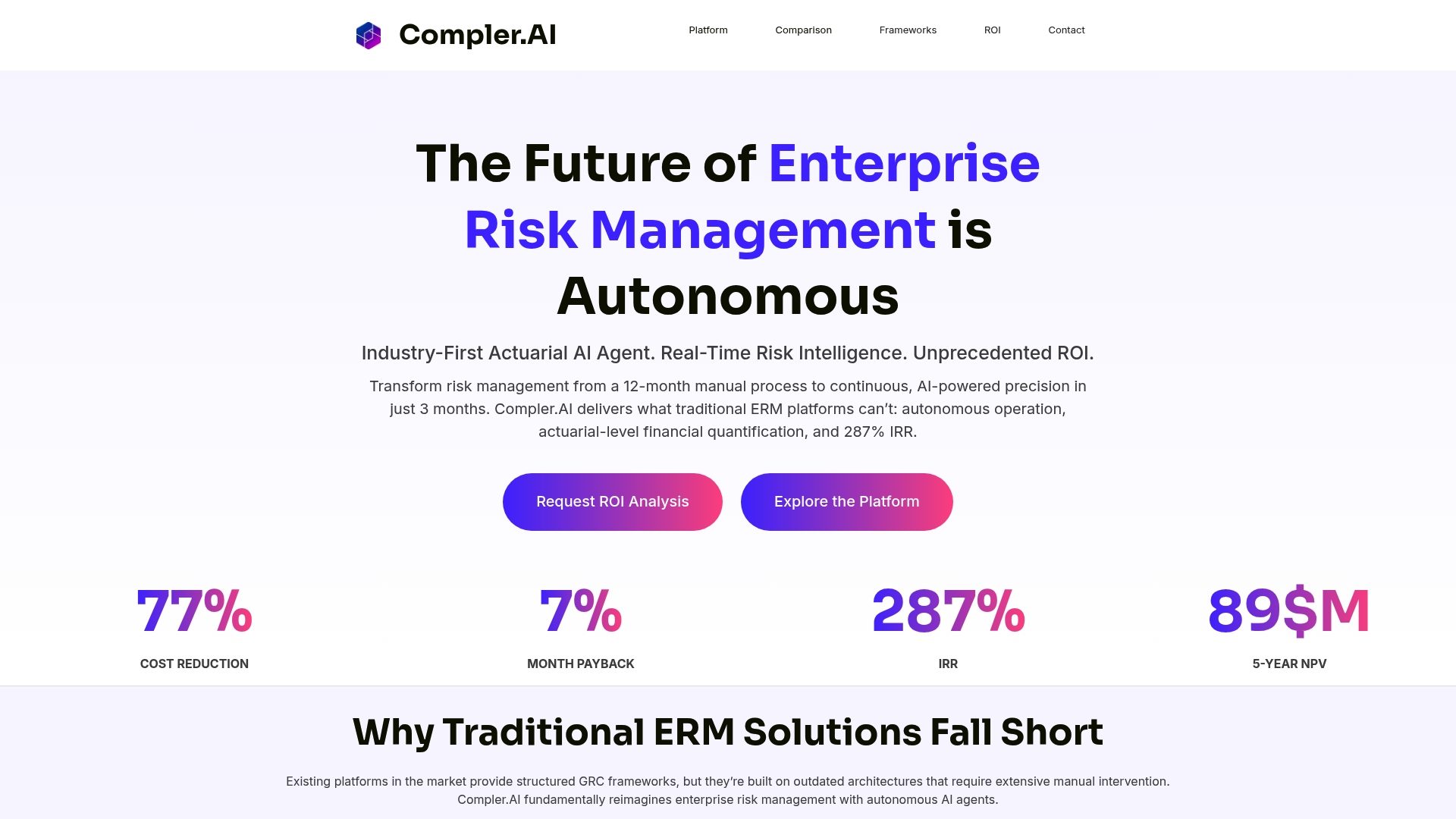
Compler.AI's marketing materials claim it reduces human effort by over 80% through an autonomous multi-agent approach, which is the platform's most prominent operational pitch. That reduction claim shapes expectations for implementation and staffing impact.
Core Features
The platform centres on an autonomous multi-agent AI system that ingests real-time data and runs continuous monitoring workflows. The vendor advertises predictive risk forecasting with a 6 to 12 month horizon and actuarial-style dollar impact models. Automated compliance mapping covers more than 50 frameworks with multilingual reporting.
Key Differentiator
The defining angle is the combination of continuous autonomous monitoring and actuarial-level quantification. Instead of human-paced dashboards, agents produce continuous risk signals and dollarized impact estimates intended to feed executive dashboards and capital planning models.
Pros
- Transforms routine risk tasks into agent-driven workflows, which the vendor says reduces staff effort substantially and reallocates analysts to exceptions.
- Predictive forecasting aims to surface risk events months ahead, helping teams prioritize controls and capital buffers.
- Actuarial-level quantification gives finance and CRO offices dollar impact estimates for exposures, useful for budget and scenario modeling.
- The vendor advertises 99.5% data accuracy and integration with 500+ enterprise systems, which if realized reduces data reconciliation and manual normalization.
- Extensive regulatory coverage reduces manual mapping across Basel III, Solvency II, GDPR, and SOX regimes.
Cons
- No substantive third-party user reviews are available to validate onboarding friction or long-term reliability; the customer experience is largely undocumented publicly.
- Implementation complexity is likely high for organizations that lack mature data pipelines or enterprise-scale infrastructure.
- Customized pricing and high entry tiers mean the platform may be resource-intensive for smaller risk teams.
When It May Not Fit
If your organization lacks centralized data engineering or a governance function, the deployment overhead will absorb resources and slow time to value. The platform depends on enterprise-grade data architecture and process maturity to perform as advertised.
Notable Integrations
The product data lists integration with over 500 enterprise systems. The vendor claims broad connectivity to core banking, ERP, GRC, and trade surveillance systems, which supports cross-domain signal synthesis and reduces point-to-point integration work.
Who It's For
Large enterprises and regulated financial institutions with mature data environments and centralized risk or compliance functions. Risk officers who need continuous quantification and automated cross-jurisdictional reporting will find the platform aligned with their mandate.
Real World Use Case
A multinational bank deploys Compler.AI to automate cross-jurisdictional compliance reporting and run continuous credit and market risk signals. According to the vendor, that implementation reduced routine analyst hours and produced near real-time regulatory reports for supervisors.
Pricing
Pricing is custom. The vendor lists a Starter option at $15,000 per month and an Enterprise tier at $45,000 per month, with specialized DORA and ISP packages available on request. Expect professional services and integration fees during onboarding.
Website: https://compler.ai
Comparing Top Risk Management and Compliance Platforms
Selecting the risk management and compliance platform involves identifying tradeoffs that align with organizational priorities and capabilities. Below, we analyze salient dimensions of performance, modularity, pricing, and onboarding, drawing distinctions between products and identifying suitable profiles for potential users.
Real-Time Decision Speed vs Modular Scalability
RiskInMind achieves remarkable operational processing speeds with sub-second latency and accuracy claims reaching 99.7%, which make it well-suited for environments requiring real-time decisions. However, Auditrunner, with its modular and low-code configurability, offers scalability for enterprise expansion and customization, enabling tailored deployments across multiple modules, often a priority for large organizations spread over regions. Earthian AI, while optimized for asset-specific risk models using geospatial and satellite data, lacks the generalized speed characteristics beneficial to high-volume banking workflows.
Transparency in Pricing Models: Pay-As-You-Go
Both RiskOpsAI and Compler.AI emphasize flexible pricing structures, particularly RiskOpsAI's pay-as-you-go approach. This provides cost efficiency, allowing organizations to scale expenditures according to usage without incurring upfront commitments—a valuable consideration for enterprise deployments trialing advanced features. In comparison, RiskInMind does not publicize pricing schedules directly, requiring prospective users to approach the vendor for tailored quotes.
Best Fit Recommendations
- RiskInMind: Suitable for financial institutions emphasizing automated real-time compliance monitoring with resource and engineering support for integration.
- Auditrunner: Alternative for organizations prioritizing low-code GRC workflows and modular deployment for integration across departments.
- RiskOpsAI: Recommended for large-scale enterprises seeking a unifying platform combining regulatory compliance, vendor risk assessments, and AI governance plus flexible scaling options.
- Earthian AI: Best suited for asset managers and insurers targeting detailed environmental data-driven underwriting and portfolio analytics.
Why We Recommend RiskInMind
RiskInMind distinguishes itself by combining specialized AI agents to provide modular yet centralized risk insights across compliance domains. Its design is ideal for automating decision processes requiring high accuracy and defensible speed benchmarks. However, organizations favoring transparent pricing or advanced configurability without setup complexities might explore alternatives such as RiskOpsAI or Auditrunner for alignment with their operational requirements.
Risk Management AI Platforms Comparison
The following table compares leading risk management AI platforms based on features, core focus, target audience, limitations, and pricing.
| Platform | Core Feature | Best For | Key Differentiator | Notable Limitation | Pricing |
|---|---|---|---|---|---|
| RiskInMind | Specialized risk AI agents and dashboards | Mid to large-scale banks and credit unions | Modular AI agents for tailored automation workflows | Complex onboarding for smaller institutions | Not disclosed |
| Auditrunner | Modular GRC functions and workflows | Organizations across regions and regulations | Low-code customization for tailored GRC systems | Steep learning curve for comprehensive features | Not disclosed |
| RiskOpsAI | AI-native GRC with compliance assessments | Large enterprises needing AI ethics tools | Integrated AI transparency and regulatory risk management | No independent user reviews available | Pay-as-you-go |
| Earthian AI | Real-time asset risk analytics | Banks, insurers, asset managers | Inference-first models for asset-level signals | Requires specialized data science expertise | Not applicable |
| RiskWise.AI | Real-time global signal monitoring | Enterprises across insurance, finance, sectors | Causal models with explainable evidence chains | Requires analyst expertise for model usage | Not disclosed |
| Compler.AI | Autonomous multi-agent risk management workflows | Large enterprises in regulated industries | Predictive risk forecasting and quantification | High implementation and pricing tiers | $15,000+ per month |
Discover why RiskInMind stands out among top thinkrisk.ai alternatives for 2026
Facing the challenge of moving risk decisions toward automated, auditable workflows can feel overwhelming. If real-time risk assessments, regulatory compliance, and portfolio monitoring are top priorities, RiskInMind offers a solution built specifically for credit unions, community banks, and lenders who need speed and accuracy. With specialized AI agents guided by a central AI director, RiskInMind delivers sub-second processing and 99.7% detection accuracy to help reduce manual tasks and elevate decision confidence.
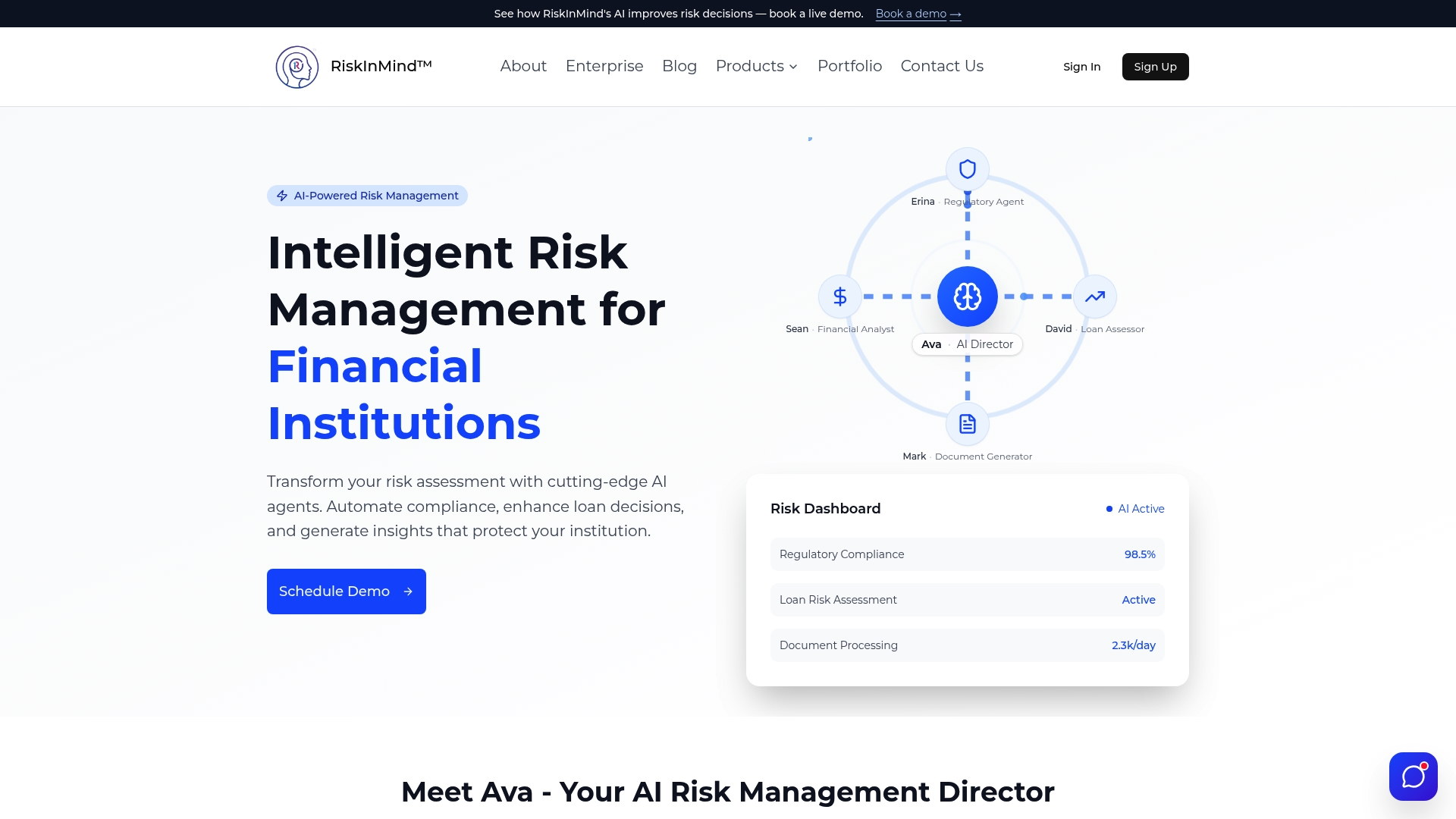
Explore how RiskInMind’s SOC 2® certified platform transforms credit risk evaluation and compliance management by visiting RiskInMind. See real-time dashboards, mobile access, and automated reporting tools in action—book a demo today and experience fast, secure underwriting processes tailored to your financial institution’s exact needs.
Frequently Asked Questions
What is the detection accuracy of Riskinmind?
Riskinmind claims a detection accuracy of 99.7% for risk signals. This high level of accuracy supports its goal of facilitating real-time risk decisions, making it a reliable tool for risk managers.
How does Riskinmind compare to Auditrunner in ease of use?
Auditrunner offers a modular approach with low-code customization that allows teams to assemble their GRC system easily. While Auditrunner excels at configurability and user support, Riskinmind’s structure is more suited for institutions looking for dedicated AI agents focused on specific risk functions. Consider Riskinmind if your priority is automated, auditable workflows.
Which platform is better for mobile risk monitoring, Riskinmind or Compler.AI?
Riskinmind provides mobile dashboards and real-time alerts, facilitating field use by loan officers to identify problem loans quickly. In contrast, Compler.AI focuses on predictive risk forecasting and compliance, making it a strong choice for those looking for extensive regulatory coverage. Choose Riskinmind for its mobile capabilities in real-time monitoring.
Can small institutions effectively use Riskinmind?
Small institutions may find the onboarding and integration for Riskinmind complex, as it often requires technical resources and coordination with core banking systems. It is recommended for mid to large-scale banks that have the engineering capacity to automate workflows efficiently.
How does Riskinmind's real-time monitoring work?
Riskinmind features sub-second processing with response times under half a second, ensuring that risk management teams receive timely insights. This capability allows for immediate decisions, making it ideal for financial institutions that need to act quickly on risk assessments.