
When a vendor fails on a Tuesday afternoon or a regulator issues new guidance before markets close on Friday, your institution cannot afford to wait until next year's risk review cycle to respond. This real-time risk assessment guide addresses exactly that gap: the dangerous lag between when a risk materializes and when your institution formally recognizes it. Traditional annual assessments were designed for a slower world. What follows is a step-by-step framework for implementing continuous, AI-driven risk evaluation that keeps your credit risk profiles, compliance posture, and portfolio exposures current at all times.
Table of Contents
- Understanding real-time risk assessment and its importance
- Preparing your infrastructure for real-time data integration
- Step-by-step execution: implementing a real-time risk assessment system
- Ensuring compliance and validating risk monitoring effectiveness
- Common challenges and expert tips for sustaining real-time risk assessment
- Why traditional annual risk assessment is obsolete and real-time is the future
- Explore AI-powered real-time risk management solutions
- Frequently asked questions
Automate Regulatory Model Risk Governance
Examine models against 32 qualitative criteria and resolve risk Tiers with pre-deployment checklists per OCC 2011-12 guidelines.
Key Takeaways
| Point | Details |
|---|---|
| Continuous updates | Real-time risk assessment constantly updates risk profiles, replacing outdated annual reviews. |
| Infrastructure is key | A reliable data ingestion pipeline and analytics engine are essential to support real-time risk monitoring. |
| Defined triggers | Setting appropriate event-driven triggers ensures timely and meaningful risk recalculations. |
| Compliance support | Continuous monitoring helps maintain current risk records necessary for regulatory compliance. |
| Expertise matters | Balancing automation with human oversight prevents alert fatigue and maintains risk assessment quality. |
Understanding real-time risk assessment and its importance
Real-time risk assessment is a continuous process that updates risk ratings as new data arrives and conditions change, in direct contrast to static annual evaluations that freeze your institution's risk picture to a single point in time. The distinction is consequential. An annual review may tell you a vendor was low-risk in January; it tells you nothing about what happened to that vendor's operational controls in August.
The triggers prompting reassessment in a real-time model are varied and often unpredictable: a third-party vendor experiences a cybersecurity breach, a regulatory agency issues amended capital rules, a borrower's transaction behavior shifts sharply, or an internal control failure surfaces during a routine audit. Each of these events carries material risk implications that simply cannot wait twelve months for formal recognition.
The mindset shift required here is not trivial. Many risk teams have been conditioned to treat the annual risk register as a deliverable rather than a living instrument. Moving toward continuous, data-driven updates means trusting automated data feeds, machine learning signals, and event-driven triggers as legitimate inputs for risk decision-making. Institutions that make this shift consistently report faster response times, more accurate risk ratings, and sharper resource allocation toward current exposures.
Key advantages of continuous risk awareness include:
- Speed: Risks are identified and scored within hours or minutes, not months.
- Accuracy: Risk ratings reflect current data, not year-old assessments.
- Proactive management: Response protocols activate before losses materialize.
- Audit readiness: Risk registers stay current, supporting examiner expectations and internal governance requirements.
"A dynamic risk assessment is not a one-time event but a continuous process that updates risk ratings as new information becomes available, enabling organizations to respond to material changes in real time rather than waiting for the next scheduled review cycle."
If you are exploring how to automate risk assessment across your institution, that framework starts here, with a clear definition of what real-time actually means operationally.
Preparing your infrastructure for real-time data integration
To implement ongoing risk evaluation, your institution must first build the technical backbone that ingests and processes live risk data continuously. Real-time risk monitoring requires a data integration pipeline that continuously ingests live signals alongside an analytics engine that scores anomalies and predicts emerging risks before they become portfolio-level events.
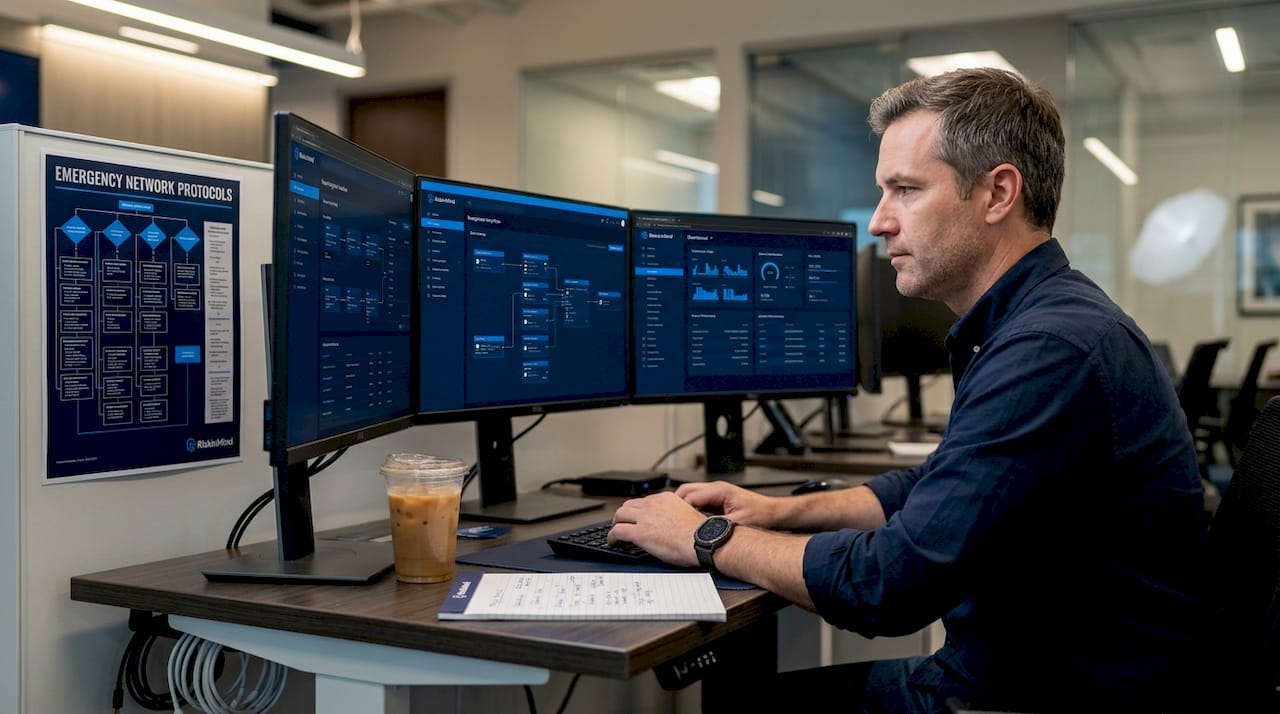
Your data sources must span every material risk domain. For credit and market risk, that means live transaction logs, pricing feeds, and borrower payment data. For operational and vendor risk, it means contract management systems, incident logs, and third-party monitoring feeds. Regulatory risk requires continuous ingestion of agency bulletins, examination findings, and policy amendments.
The core architecture components you need to build or procure are:
- Ingestion pipeline: Captures streaming data from multiple source systems with low latency, typically under one second for material risk signals.
- Analytics engine: Applies machine learning models to score incoming data, detect anomalies, and generate risk ratings continuously.
- Dashboard delivery layer: Translates computed risk scores into actionable visualizations for your risk team, executives, and board reporting.
- Alert and escalation module: Routes scored risks above defined thresholds to the appropriate owner with supporting context.
Data quality is where many institutions stumble. Stale, duplicated, or unnormalized data produces stale risk signals regardless of how sophisticated your analytics engine is. Freshness controls, schema validation, and deduplication logic must be embedded in the pipeline itself, not treated as a downstream cleanup task.
Pro Tip: Before selecting a data integration platform, map every risk data source by latency tolerance. Some feeds, like market pricing, require sub-second ingestion. Others, like regulatory bulletin monitoring, can tolerate hourly batch pulls. Mismatching latency requirements to pipeline design is one of the most common infrastructure mistakes in real-time risk programs.
| Data source | Latency tolerance | Risk domain |
|---|---|---|
| Transaction logs | Sub-second | Credit, fraud |
| Market pricing feeds | Sub-second | Market risk |
| Regulatory bulletins | Hourly | Compliance |
| Vendor monitoring feeds | Daily | Third-party risk |
| Portfolio performance data | Daily | Credit, concentration |
For institutions seeking to understand how AI in financial risk management applies to these infrastructure decisions, the architecture choices here directly determine how much of your risk detection process can be automated versus manually managed.
Step-by-step execution: implementing a real-time risk assessment system
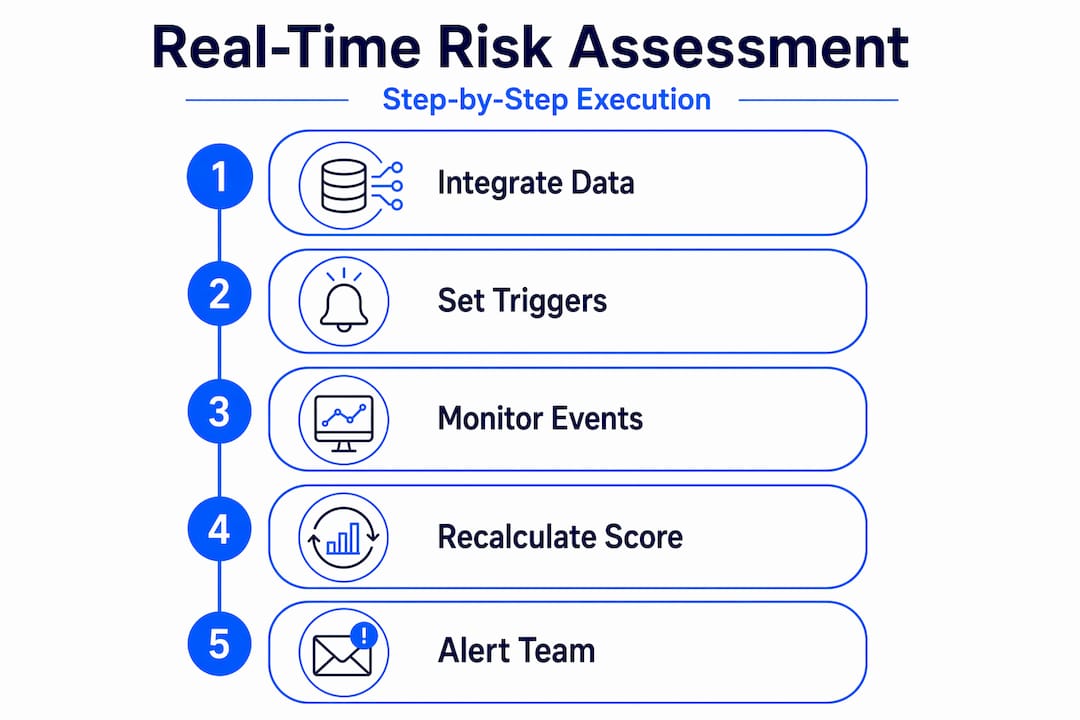
With infrastructure ready, the next step is executing the real-time risk assessment process through well-defined operational practices and automation. Effective real-time risk assessment involves defining data sources, establishing risk dimensions, setting event triggers, building automation mechanisms, and creating response protocols that activate without manual initiation.
Follow this sequence when standing up your system:
-
Identify critical data inputs. Map your vendor, operational, regulatory, and market risk data sources to specific risk dimensions. Each dimension needs at least one continuously updated data feed.
-
Define risk dimensions and scoring models. Credit risk scores might weight payment delinquency trends and loan-to-value ratios. Operational risk scores might weight incident frequency and control failure rates. Tailor each model to your institution's specific risk appetite and regulatory environment.
-
Set event triggers. Define precisely what constitutes a material change. A credit score drop below a defined threshold, a vendor receiving a regulatory enforcement action, or a single large-value transaction flagged by your fraud model should each map to a specific reassessment trigger.
-
Build automation mechanisms. Triggers must fire without human initiation. When a defined threshold is crossed, the system should automatically recalculate the affected risk score, update the risk register entry, and generate a timestamped audit record.
-
Establish response protocols. Every triggered reassessment needs a defined next step: who receives the alert, what escalation path applies, and whether the updated risk score requires an immediate change to the audit plan or credit exposure limit.
Pro Tip: Avoid building a single monolithic risk score. Institutions that separate scores by risk dimension, credit, operational, vendor, regulatory, and market, can activate targeted responses without triggering institution-wide reviews for localized events.
The following comparison illustrates the operational difference between traditional and real-time approaches:
| Dimension | Traditional annual assessment | Real-time assessment |
|---|---|---|
| Update frequency | Once per year | Triggered by events, continuously |
| Risk register currency | 12 months stale by year-end | Updated within hours of trigger |
| Response time to material change | Weeks to months | Minutes to hours |
| Audit trail | Point-in-time documentation | Continuous, timestamped log |
| Resource allocation | Fixed annual cycle | Directed toward current exposures |
For a deeper framework on the analytical foundations that support this execution, our risk analytics guide covers the modeling layer in precise detail.
Ensuring compliance and validating risk monitoring effectiveness
Having executed real-time assessment processes, maintaining compliance and validating system performance ensure sustained operational value and regulatory alignment. Governance structures are the mechanism that keeps your risk information current and aligned with enterprise risk tolerances, not a one-time setup task.
NIST emphasizes that risk monitoring is a continuous lifecycle support function, with governance mechanisms that keep risk registers current according to leadership-set frequency, supporting decision-making that goes well beyond static periodic reporting. This framing is directly applicable to how your institution should position real-time monitoring data within its governance structure.
Compliance benefits from continuous monitoring include:
- Reduced regulatory incidents: Predictive risk signals allow corrective action before examination findings.
- Dynamic audit plan adjustment: Risk scores above threshold automatically inform internal audit prioritization.
- Current risk register maintenance: Examiners expect risk registers to reflect current conditions, not annual snapshots.
- Risk appetite alignment: Continuous data enables real-time comparison of actual exposures against board-approved risk appetite limits.
Validating that your system delivers accurate, actionable outputs requires deliberate testing. Backtesting compares historical risk scores against outcomes to assess model accuracy. Scenario analysis stress-tests your scoring models against hypothetical adverse conditions, such as a sudden interest rate shift or a major counterparty default. Accuracy checks compare automated risk ratings against independent assessments by your risk team on a sample basis.
"Continuous risk monitoring is not a technical luxury; it is a governance requirement. Organizations that treat risk monitoring as a periodic exercise rather than a sustained discipline expose themselves to compliance gaps that examiners are increasingly trained to identify."
The intersection of model validation and model risk management is critical here, particularly as AI-driven scoring models fall under heightened scrutiny from bank regulators in 2026.
Common challenges and expert tips for sustaining real-time risk assessment
Understanding common hurdles and applying expert advice will help your institution sustain a responsive, efficient real-time risk assessment program. Defining triggers and recalculation frequencies by risk type is one of the most persistent challenges practitioners face, because poorly scoped triggers produce either alert fatigue or critical blind spots.
The most frequent obstacles risk teams encounter include:
- Trigger ambiguity: Triggers defined too broadly generate constant noise; triggers defined too narrowly miss material changes entirely.
- Mismatched recalculation cadences: Credit risk scores may warrant daily recalculation, while operational risk scores for stable processes may only need monthly updates. Applying a uniform recalculation schedule across all risk types wastes compute resources and analyst attention.
- Missing or uncertain data: Incomplete vendor data or delayed transaction feeds create gaps in risk scores. Flag these uncertainties explicitly in the risk register rather than suppressing them, and define a protocol for updating the score when data becomes available.
- Automation without oversight: Fully automated systems that generate alerts without human review often erode trust within the risk team over time. Build in structured review points where experienced risk managers validate model outputs against qualitative context.
Pro Tip: Create a tiered alert taxonomy. Tier 1 alerts require immediate escalation to the CRO or board committee. Tier 2 alerts require response within 24 hours by the risk team lead. Tier 3 alerts are logged and reviewed in weekly risk team meetings. This prevents all alerts from feeling equally urgent, which is the fastest route to alert fatigue.
Explore a broader catalog of risk assessment methods to understand which analytical models pair best with your real-time infrastructure and institution size.
Why traditional annual risk assessment is obsolete and real-time is the future
Here is the uncomfortable reality that most risk management frameworks avoid stating directly: the annual risk assessment was never designed to manage risk. It was designed to demonstrate compliance with the expectation of conducting a risk assessment. Those are not the same thing.
Traditional annual risk assessments leave organizations reacting instead of proactively managing risks, while dynamic assessment enables timely, accurate, and efficient risk management that reduces the manual burden on already stretched risk teams. Annual snapshots become outdated within weeks of completion, and by the time they inform a board presentation, they may bear little resemblance to actual current exposures.
Real-time risk assessment changes resource utilization in ways that are not always obvious at first. When risk scores update continuously, your team stops spending cycles on low-risk vendors and portfolios that look fine across every current data point. Effort concentrates on the signals that are moving, which is where it belongs. Risk doesn't just become better managed. It becomes better prioritized.
The cultural shift is real and it takes time. Risk professionals trained on static models often distrust automated scores initially, particularly when those scores conflict with their qualitative judgment. Our position is that this tension is actually healthy. The right model is one where automated signals inform human judgment, not replace it. Institutions that build that balance into their governance structure, rather than treating it as a secondary concern, are the ones that sustain real-time programs long term.
Failure to make this transition carries compounding costs: compliance gaps that examiners cite, slower responses to credit deterioration that widen loss severity, and inefficient resource allocation that leaves your risk team overworked on yesterday's problems. The institutions building automated risk management capabilities now are positioning themselves ahead of both regulatory expectations and competitive pressure.
Explore AI-powered real-time risk management solutions
Translating this real-time risk assessment guide into operational reality requires more than a framework. It requires a platform purpose-built for the data volumes, regulatory demands, and speed requirements that financial institutions face.
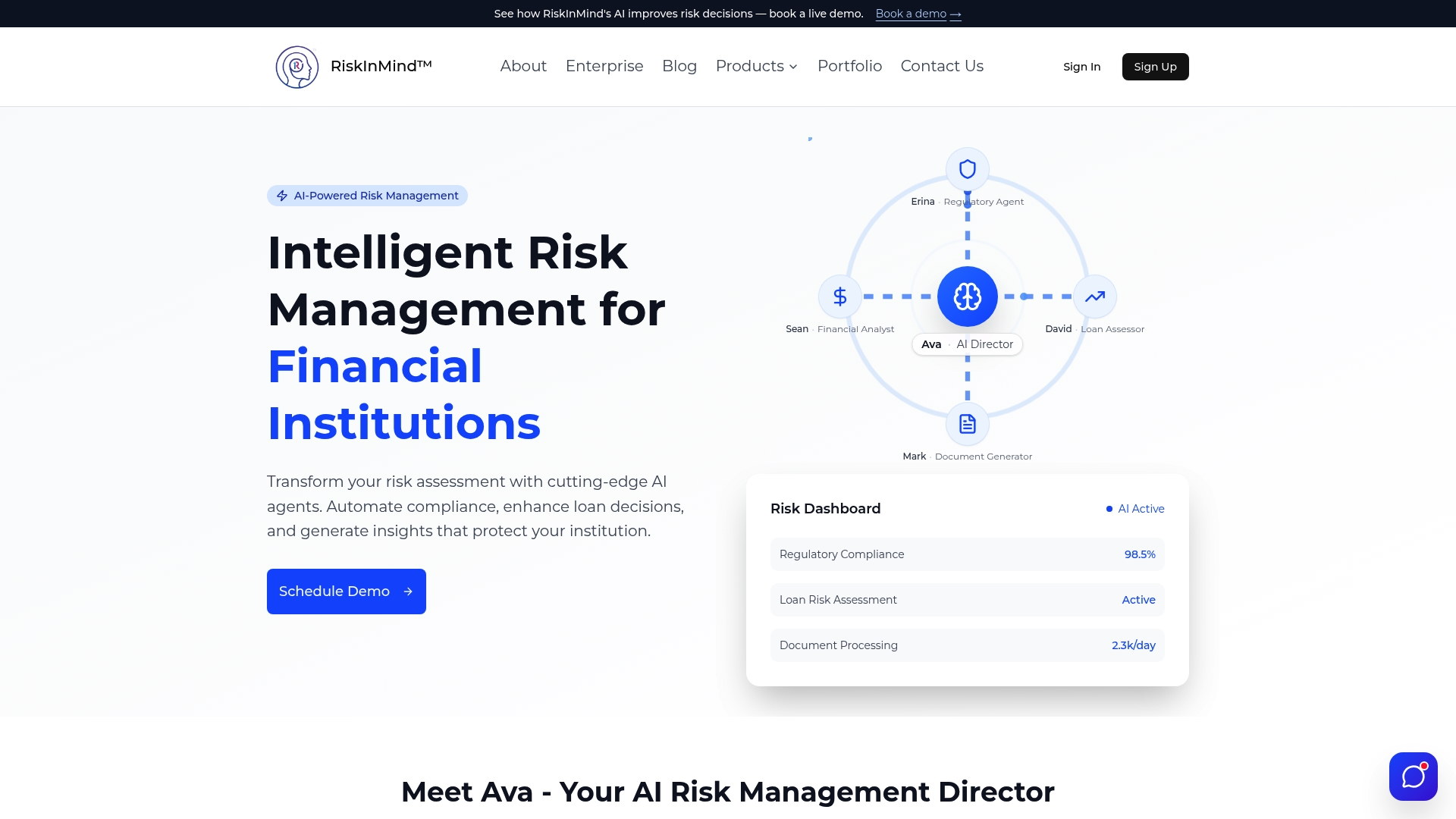
RiskInMind's AI-powered risk management solutions are built specifically for credit unions, community banks, and lenders that need continuous risk visibility without building a custom data engineering team from scratch. The platform's specialized AI agents handle credit risk assessment, regulatory monitoring, and market analysis simultaneously, with Ava, the platform's central AI director, coordinating outputs across every risk domain. The AI regulatory risk agent monitors regulatory developments in real time and surfaces compliance implications before they become examination findings. With SOC 2® certification and response times under half a second, the platform delivers the data freshness and security posture that real-time risk programs require. Review capabilities and RiskInMind pricing to find the configuration that fits your institution's size and risk complexity.
Frequently asked questions
What is the main difference between real-time risk assessment and traditional annual risk reviews?
Real-time risk assessment continuously updates risk ratings as new data and events occur, whereas traditional annual reviews provide a static snapshot that is updated only once per year and becomes progressively less accurate as conditions change.
How often should risk scores be recalculated in a real-time system?
Recalculation frequency varies by risk type, from daily updates for credit and fraud risk to monthly or quarterly recalculation for more stable operational risk categories, with material event triggers overriding the standard schedule when conditions change significantly.
Can real-time risk assessment help with regulatory compliance?
Yes. NIST positions continuous risk monitoring as a governance function that keeps risk registers current and supports decision-making aligned with regulatory expectations, enabling institutions to maintain audit-ready records and adjust responses before examination findings occur.
What are the biggest challenges when implementing real-time risk assessment?
Key challenges include defining triggers with the right specificity, managing data quality and feed freshness across multiple source systems, setting recalculation cadences matched to each risk type, and preventing alert fatigue by distinguishing material changes from routine data variation.
How does AI enhance real-time risk assessment?
AI-driven analytics improve detection accuracy by continuously processing large, diverse data streams, identifying risk patterns that rule-based systems miss, reducing false positives through contextual scoring, and automating alerts that enable faster decision-making across credit, operational, and regulatory risk domains.