
Regulatory compliance has always demanded precision, but missing even one material risk today carries far greater consequences than it did a few years ago. FinCEN issued $1.3 billion in BSA/AML penalties in 2025, a 34% increase from the prior year, and enforcement actions against community banks and credit unions are accelerating rather than leveling off. For compliance officers managing complex, resource-constrained environments, knowing exactly which risks to prioritize and how to spot them early is not a luxury. It is the core of the job. This article breaks down the most pressing regulatory compliance risks, provides concrete examples, and offers frameworks to help your team act before regulators do.
Table of Contents
- Defining regulatory compliance risks: What matters most
- Key examples of regulatory compliance risks in banking
- Comparison: How major regulatory compliance risks measure up
- Emerging risks: AI, vendor management, and model validation
- A risk manager's take: Why the most damaging compliance risks are rarely obvious
- Next steps: Smart tools for managing regulatory risks
- Frequently asked questions
Automate Regulatory Model Risk Governance
Examine models against 32 qualitative criteria and resolve risk Tiers with pre-deployment checklists per OCC 2011-12 guidelines.
Key Takeaways
| Point | Details |
|---|---|
| BSA/AML compliance is critical | Weak BSA/AML controls are the leading source of penalties and require ongoing, robust oversight. |
| OFAC screening needs constant attention | Enhanced due diligence for high-risk customers is essential to avoid sanctions violations and fines. |
| AI and vendors are new risk frontiers | Emerging risks from AI bias and third-party failures demand fresh compliance frameworks and board visibility. |
| Comparison sharpens priorities | Understanding which risks are most likely or most costly helps compliance teams focus efforts. |
Defining regulatory compliance risks: What matters most
With the stakes clear, let's lay out what compliance risk means in practice. Regulatory compliance risk is the probability that a financial institution fails to meet the legal, regulatory, or supervisory requirements that govern its operations, resulting in penalties, operational restrictions, or lasting reputational damage. For community banks and credit unions, that definition spans a wide landscape.
The major risk categories include:
- BSA/AML (Bank Secrecy Act / Anti-Money Laundering): The most scrutinized area, covering suspicious activity reporting, currency transaction reports, and customer due diligence
- OFAC (Office of Foreign Assets Control): Screening and blocking obligations related to sanctions lists and prohibited parties
- Consumer protection regulations: Fair lending, UDAP (Unfair, Deceptive, or Abusive Acts or Practices), and Truth in Lending Act compliance
- Data privacy and cybersecurity: Gramm-Leach-Bliley Act obligations, state-level privacy laws, and incident notification requirements
The consequences of failures across these categories are not uniform. BSA/AML violations frequently attract the largest monetary penalties and board-level corrective action orders, while consumer protection failures more often produce class action exposure and reputational harm. Understanding why compliance matters for long-term institutional trust is foundational before moving to risk specifics.
"Inadequate BSA/AML compliance programs, including weak risk assessments, represent major risks for community banks and credit unions." — OCC Bulletin 2025-37a
The BSA/AML program is the cornerstone of the compliance risk framework not simply because it attracts the largest penalties, but because its failures tend to signal broader systemic weaknesses. A bank with a deficient AML risk assessment almost always has gaps elsewhere, whether in vendor oversight, model validation, or internal audit frequency. Treating it as the canary in the coalmine is not an exaggeration. It is operationally accurate.
Pro Tip: Conduct a gap analysis comparing your current BSA/AML program documentation against the four pillars (internal controls, independent testing, designated compliance officer, and training) before any scheduled examination. Regulators have consistently cited missing documentation as a standalone violation, even when controls are actually in place.
Key examples of regulatory compliance risks in banking
Having clarified the main risk categories, let's examine current, concrete examples affecting institutions now. The OCC's most recent bulletin makes clear that weak BSA/AML controls, suspicious activity monitoring failures, inadequate OFAC screening, and insufficient customer due diligence represent the dominant failure patterns across examined institutions.
BSA/AML program breakdowns typically manifest in three ways:
- Inadequate risk assessments: Many institutions complete an annual risk assessment but fail to update it when they onboard a new product line, enter a new geographic market, or experience significant customer base changes. A risk assessment that does not reflect current operations provides a false sense of security and fails the examiner's first test.
- Policy gaps and stale procedures: Written policies that reference outdated thresholds, retired systems, or staff roles that no longer exist create documented evidence of non-compliance. Examiners read your policies against your actual transaction monitoring system settings, and mismatches draw immediate scrutiny.
- Training deficiencies: Front-line staff who cannot articulate what constitutes a suspicious activity, or who believe reporting is exclusively the compliance team's responsibility, create a structural blind spot that no technology can fully compensate for.
OFAC screening failures present a distinct but equally serious exposure. The FFIEC BSA/AML Examination Manual specifies that enhanced OFAC screening is required for higher-risk customer segments, including politically exposed persons (PEPs), money services businesses (MSBs), and non-bank financial institutions (NBFIs). Institutions that apply a single flat screening protocol across all customer types regardless of risk profile are almost certainly under-screening the highest-risk segments. Real OFAC enforcement cases have involved banks that screened at account opening but did not re-screen when sanctions lists were updated, allowing prohibited transactions to proceed for months.
Customer Due Diligence (CDD) challenges remain pervasive. Common real-world indicators of CDD risk include:
- Incomplete beneficial ownership documentation for legal entity customers
- No documented rationale for risk-rating decisions
- Periodic review schedules that exist on paper but are not executed on time
- Lack of enhanced due diligence procedures for high-risk relationship categories
Reviewing compliance monitoring best practices provides a structured starting point for identifying which of these gaps may already exist in your program. And if you want to understand the downstream consequences of allowing these gaps to persist, studying real enforcement failures offers a sobering perspective on how quickly localized control weaknesses escalate into institution-wide consent orders.

Pro Tip: Map your transaction monitoring alert thresholds against actual peer institution benchmarks at least annually. Alert thresholds that are set too high or too low relative to your customer base generate either false negatives (missed suspicious activity) or alert fatigue, both of which examiners will identify during a BSA review.
Comparison: How major regulatory compliance risks measure up
To help prioritize, here is how top risks compare in terms of exposure and potential impact. Not every compliance risk demands the same response, and resource allocation decisions should reflect both the likelihood of examiner scrutiny and the severity of the consequences when controls fail.
| Risk type | Primary regulatory focus | Typical failure mode | Consequence severity | Recent case frequency |
|---|---|---|---|---|
| BSA/AML program | FinCEN, OCC, FDIC | Weak risk assessments, monitoring gaps | Very high (fines + consent orders) | High |
| OFAC screening | OFAC, FinCEN | Incomplete or infrequent screening | Very high (civil money penalties) | Moderate |
| Customer Due Diligence | FinCEN Pillar 5 | Missing beneficial ownership docs | High (examination findings, MRAs) | Very high |
| Fair lending | CFPB, DOJ | Disparate impact in pricing or approvals | High (restitution, public orders) | Moderate |
| Data privacy / cybersecurity | State regulators, FTC | Inadequate incident response plans | Moderate to high (state fines) | Increasing |
| Third-party / vendor management | OCC, FDIC | No ongoing due diligence process | Moderate (operational risk findings) | Increasing |
FinCEN data shows a 47% CDD pillar 5 failure rate at community banks, which means nearly half of examined institutions are falling short on beneficial ownership documentation alone. That statistic, paired with the $1.3 billion in BSA/AML penalties issued in 2025, makes the BSA/AML and CDD columns the most urgent for most compliance teams to address first.
The comparison also reveals something less obvious: fair lending and data privacy risks, while currently lower in case frequency for community banks, are trending sharply upward. CFPB enforcement posture and state privacy law expansion are bringing these risk areas into examiner focus, particularly for institutions using third-party marketing or automated underwriting tools. Selecting the right regulatory compliance tools to monitor these emerging areas is a decision that benefits from being made before an examination cycle rather than during one.
Emerging risks: AI, vendor management, and model validation
Traditional risks are just part of the picture. The compliance threats accelerating with technology and outsourcing are growing faster than most institutions' governance frameworks are evolving to address them.
AI-powered lending and fair lending compliance present one of the most nuanced risk areas entering 2026. When a model trained on historical loan data produces decisions that disproportionately disadvantage a protected class, the institution bears fair lending liability even if no discriminatory intent existed. Disparate impact analysis is required regardless of whether a human or an algorithm made the credit decision. Institutions deploying AI scoring models without documented testing for disparate impact at each major product release are carrying hidden fair lending exposure.
Key emerging risk areas include:
- Lack of model inventory: Many community banks cannot produce a complete list of all models in production, including vendor-supplied models embedded in third-party platforms
- Insufficient model validation: Annual validation that does not include out-of-time testing or performance benchmarking against alternative models is unlikely to satisfy examiner expectations
- Vendor management gaps: Sole reliance on a vendor's SOC 2 report without independent assessment of that vendor's compliance controls creates an assumption of adequacy that regulators will not share
- Board oversight deficiencies: Model risk governance frameworks that lack board-level reporting on model inventory, validation findings, and exceptions leave the board unable to fulfill its supervisory role
Integrating compliance into AI models is not optional. Surveys show that 75% of financial services executives now cite regulatory risk as their top concern when adopting AI, reflecting how rapidly examiner expectations have shifted from "what does your model do" to "how do you know it is doing it correctly and fairly." Understanding AI risk management strategies and incorporating advanced AI risk strategies into your governance framework are practical next steps.
| Emerging risk | Regulatory authority | Primary control gap | 2026 readiness action |
|---|---|---|---|
| AI/ML model bias | CFPB, OCC | No disparate impact testing | Document and test each model release |
| Vendor management | OCC, FDIC | No ongoing due diligence cycle | Annual vendor risk assessments |
| Model validation | Federal Reserve, OCC | Infrequent or incomplete validation | Independent third-party review annually |
| Board oversight | All primary regulators | No board-level model risk reporting | Quarterly model risk dashboard for board |
Pro Tip: Require every new third-party technology vendor to provide evidence of their own model validation practices and compliance testing, not just their security certifications. A vendor's SOC 2 report covers data security. It says nothing about whether their underwriting model passes a fair lending review.
A risk manager's take: Why the most damaging compliance risks are rarely obvious
Beyond rulebooks and trend reports, here is what front-line experience consistently reveals: the compliance failures that generate the largest fines and the most damaging consent orders almost never originate from the risks that compliance teams are actively watching. They originate from the assumptions no one thinks to test.
The pattern appears repeatedly. An institution invests in a sophisticated transaction monitoring system and then, three years later, discovers that a configuration change made during a core system upgrade had reset several alert thresholds to default values, effectively disabling monitoring for a specific transaction type. No one noticed because the system was "on" and producing alerts. The assumption that the system was correctly configured went untested. That is how a $50,000 investment in compliance technology produces a seven-figure enforcement action.
Similarly, cross-team ownership gaps create invisible risk. BSA/AML compliance does not live only in the compliance department. Loan officers, relationship managers, and branch staff are all obligated to report suspicious activity, and their understanding of what triggers that obligation is frequently out of date or inconsistent. When a compliance failure occurs, examiners examine the entire chain of knowledge and reporting, not just what the compliance officer knew. Misaligned incentives, where relationship managers are compensated for volume and implicitly discouraged from flagging customer activity, create structural pressure against the very behaviors compliance programs depend on.
The solution is not more technology and it is not more policy. It is regular, unscripted process walkthroughs and cross-team simulations that surface what actually happens when an alert fires, a suspicious transaction appears, or a new customer with an unusual profile arrives. These exercises consistently reveal gaps that neither automated tools nor policy reviews can find, because they test the human and process layers that sit between the rules and reality.
Reviewing how AI-driven risk management can support human oversight, and understanding the full range of financial risk assessment methods, positions compliance teams to build programs where automation augments judgment rather than replacing the accountability structures that examiners ultimately hold institutions to.
Next steps: Smart tools for managing regulatory risks
Compliance teams that have mapped their risk landscape now face the practical challenge of monitoring, documenting, and responding to regulatory obligations across multiple domains simultaneously. Manual processes, spreadsheet-based tracking, and periodic manual reviews are not designed for the volume, velocity, or complexity of today's regulatory environment.
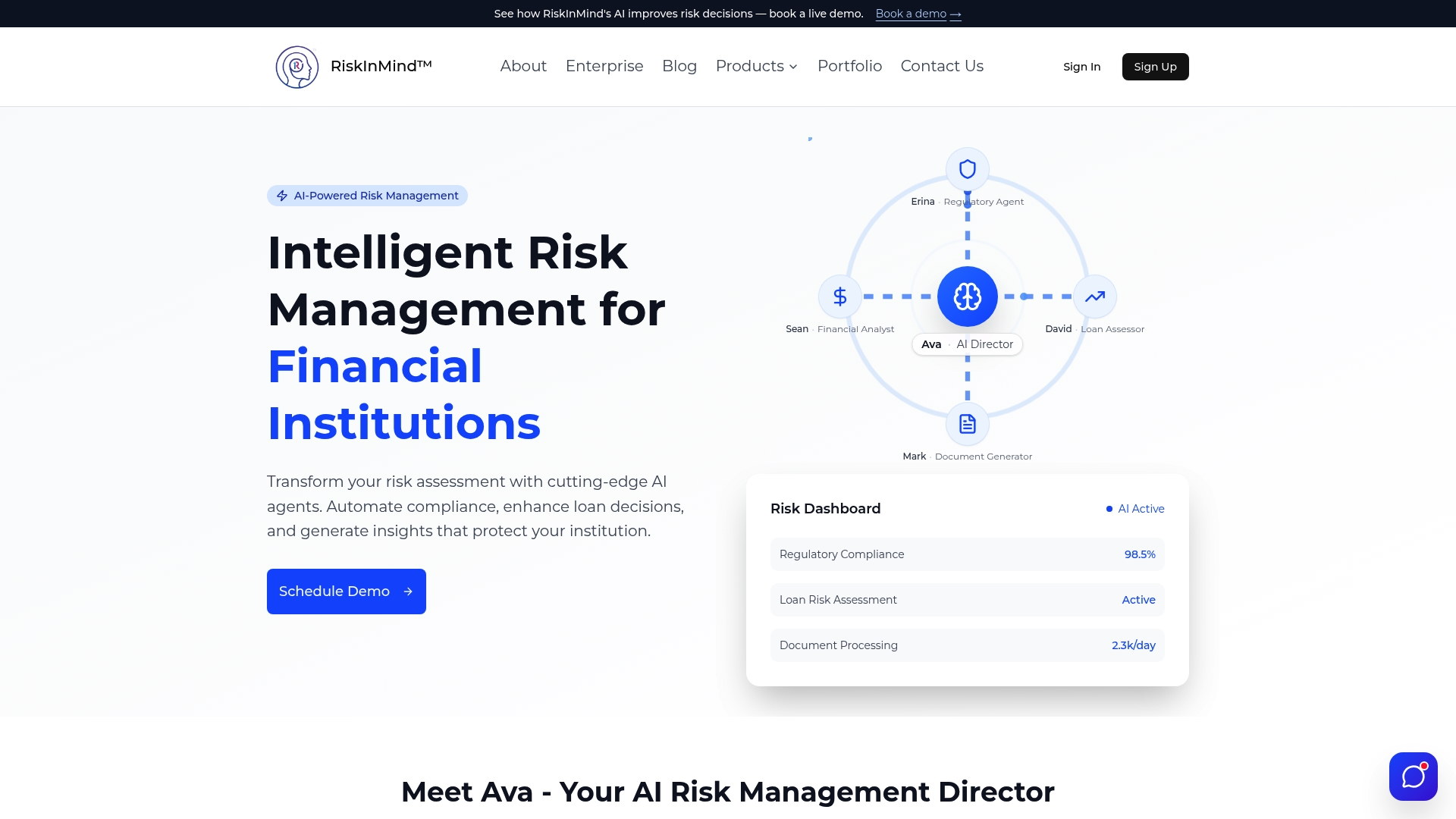
RiskInMind's AI-powered risk management platform is built specifically for credit unions, community banks, and lenders navigating exactly these pressures. Ava, the platform's central AI director, coordinates a suite of specialized AI agents covering regulatory compliance, credit risk, and portfolio monitoring, with response times under half a second and SOC 2 certified security. The platform's AI regulatory agent automates compliance monitoring, tracks regulatory changes, and flags emerging risks before they become examination findings. For institutions managing loan portfolios, the AI loan application solution integrates compliance screening directly into the underwriting workflow. Explore a demo to see how compliance risk management looks when automation and human oversight work together.
Frequently asked questions
What is the biggest regulatory compliance risk for community banks?
The top risk is inadequate BSA/AML compliance, including failures in risk assessment, internal controls, and SAR/CTR reporting. Inadequate BSA/AML compliance is consistently the leading finding in FinCEN enforcement data for community institutions.
How do banks detect regulatory compliance risks early?
Proactive transaction monitoring, robust internal audit schedules, and AI-powered suspicious activity detection help banks surface risks before they escalate into examination findings or enforcement actions.
How is OFAC compliance risk managed?
Banks manage OFAC risk through enhanced screening of high-risk customer segments and ongoing due diligence processes. The FFIEC manual specifies that enhanced due diligence and targeted screening are required for PEPs, MSBs, and other elevated-risk relationships.
What emerging compliance risks should banks watch for in 2026?
AI model bias, vendor management failures, and gaps in model inventory or board-level reporting are the most significant new risk areas for 2026. AI and vendor management now rank among the top concerns for financial institution compliance officers entering the new regulatory cycle.
Recommended
- Why compliance in financial institutions protects trust | RiskInMind
- Compliance monitoring best practices for financial institutions | RiskInMind
- Before Regulators Step In: Stopping Yonkers‑Style Failures with RiskInMind | RiskInMind
- Types of regulatory compliance tools: choosing the right solution | RiskInMind