
Compliance-driven risk management often creates a false sense of security at financial institutions, where separate teams monitor credit, operational, and market risks in isolation while the connections between those risks go unexamined. That fragmentation is precisely where catastrophic losses originate. Enterprise risk management goes beyond compliance, becoming a strategic tool that unifies risk oversight across the entire organization, especially when integrated with advanced technologies. This guide breaks down the leading ERM frameworks, practical methodologies, and how AI is reshaping what proactive risk management looks like for credit unions, community banks, and lenders.
Table of Contents
- What is enterprise risk management?
- Core ERM frameworks: COSO and ISO 31000
- ERM methodologies and tools in practice
- AI-powered ERM: Transforming risk management in finance
- Navigating challenges and nuances in enterprise risk management
- Unlocking ERM's potential: A smarter strategy for financial institutions
- Enhance your ERM strategy with AI-powered solutions
- Frequently asked questions
Automate Regulatory Model Risk Governance
Examine models against 32 qualitative criteria and resolve risk Tiers with pre-deployment checklists per OCC 2011-12 guidelines.
Key Takeaways
| Point | Details |
|---|---|
| Holistic risk approach | ERM integrates all risk types and aligns them with business strategy for comprehensive oversight. |
| Framework flexibility | COSO and ISO 31000 have distinct strengths and are often blended for robust risk programs. |
| Advanced tools and AI | AI-driven analytics and modern tools enable faster, smarter ERM implementation and monitoring. |
| Practical challenges exist | Real-world obstacles like unclear governance require organizational focus and process clarity. |
| Strategic enablement | ERM empowers financial institutions to shift from reactive compliance to proactive advantage. |
What is enterprise risk management?
ERM is a firm-wide, top-down methodology for identifying, assessing, and monitoring risks in alignment with business strategy, replacing the siloed departmental models that most institutions still rely on. Rather than treating credit risk, compliance risk, and operational risk as separate disciplines, ERM integrates them into a single, coherent view of organizational exposure.
For regulated financial institutions, this integration is not optional. Regulators increasingly expect institutions to demonstrate that risk oversight is connected to strategic planning, capital allocation, and board-level governance. ERM delivers that connection by establishing a formal risk appetite statement, defining escalation protocols, and creating ongoing monitoring cycles that surface emerging threats before they become material losses.
Three features distinguish a mature ERM program from a compliance checklist. First, strategic alignment ensures that risk-taking decisions are measured against the institution's stated objectives, not just regulatory minimums. Second, a defined risk appetite gives business units clear boundaries for acceptable exposure. Third, continuous monitoring replaces the annual review cycle with real-time or near-real-time risk signals. Together, these features expose the interdependencies that siloed programs miss entirely.
"Traditional risk management treats each risk category as a separate problem to solve. ERM treats the organization as a system, where risks interact, amplify, and sometimes cancel each other out in ways that only become visible when you look at the whole picture." This systems-level perspective is what separates institutions that anticipate risk from those that simply react to it.
Strong risk governance policies are the foundation that makes this systems-level view actionable, defining who owns which risks and how decisions escalate to the board.
Core ERM frameworks: COSO and ISO 31000
With a foundation in ERM's strategic role, it's critical to choose the right framework. The two dominant standards are the COSO ERM framework and ISO 31000, and understanding their differences determines how effectively you can implement ERM across your institution.
The COSO ERM framework includes five core components and 20 principles, organized around governance, strategy, performance, review, and information and communication. It is prescriptive, structured, and deeply embedded in US financial reporting and internal control requirements. ISO 31000, by contrast, is global and principle-based with flexible implementation, making it adaptable to institutions operating across multiple regulatory environments or those prioritizing operational risk over financial reporting alignment.
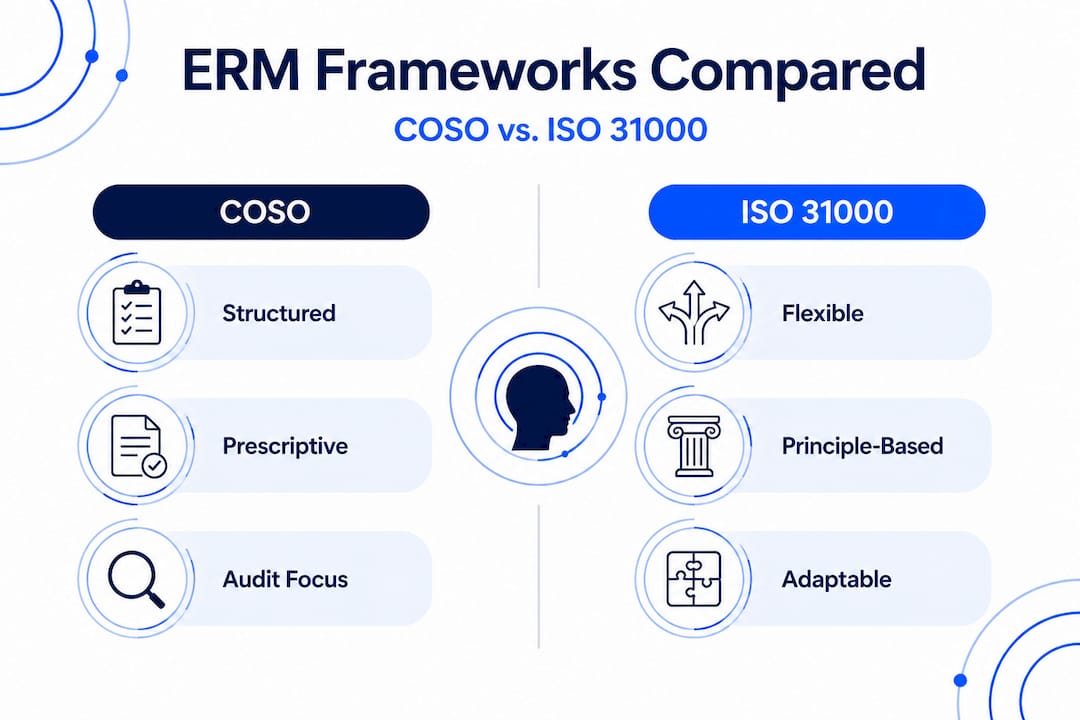
| Dimension | COSO ERM | ISO 31000 |
|---|---|---|
| Orientation | Prescriptive, structured | Principle-based, flexible |
| Primary region | United States | Global |
| Financial reporting alignment | Strong | Moderate |
| Best use case | Compliance-intensive finance | Operational and strategic risk |
| Implementation guidance | Detailed components and principles | High-level principles only |
| Auditability | High | Moderate |
Many institutions find that blending both frameworks produces the strongest outcomes. COSO provides the governance rigor and auditability that US regulators expect, while ISO 31000 offers the flexibility to address operational, reputational, and emerging risks without forcing every exposure into a rigid reporting structure.
Selecting and applying a framework strategically requires a deliberate process:
- Assess your regulatory environment and identify which framework your primary regulator references most frequently.
- Map your existing risk categories to both frameworks and identify where gaps exist in your current program.
- Decide whether a hybrid approach is warranted based on your institution's complexity and geographic footprint.
- Align your risk appetite statement to the chosen framework's language and structure.
- Build monitoring cycles and reporting cadences that match the framework's review requirements.
For practical guidance on applying these frameworks to financial analytics, practical ERM analytics guidance offers a step-by-step breakdown tailored to financial institutions.
ERM methodologies and tools in practice
Once you have chosen a framework, the next challenge is implementation. The concrete tools that bring ERM to life in day-to-day risk oversight include a range of methodologies, each suited to different aspects of the risk management cycle.
Key ERM methodologies include risk registers, heat maps, key risk indicators (KRIs), scenario analysis, value at risk (VaR), and portfolio views. Each tool serves a distinct purpose within the broader ERM cycle, and understanding when to deploy each one is what separates effective programs from theoretical ones.
- Risk registers document identified risks, their owners, likelihood scores, and mitigation status, providing the institutional memory that prevents the same exposures from being rediscovered repeatedly.
- Heat maps translate risk register data into visual priority matrices, making it easier for boards and executives to allocate attention and capital to the highest-severity exposures.
- KRIs are forward-looking metrics that signal when a risk is trending toward a threshold, giving risk managers time to intervene before a loss event occurs.
- Scenario analysis is particularly powerful for financial institutions, where stress testing loan portfolios against rate shocks, unemployment spikes, or sector concentration events reveals vulnerabilities that historical data alone cannot capture.
- VaR quantifies potential portfolio losses within a defined confidence interval, giving treasury and credit teams a common language for discussing exposure limits.
| Tool | Primary purpose | Key strength | Limitation |
|---|---|---|---|
| Risk register | Inventory and ownership | Accountability | Can become static without discipline |
| Heat map | Prioritization | Executive communication | Oversimplifies complex risks |
| KRIs | Early warning | Proactive monitoring | Requires calibration over time |
| Scenario analysis | Stress testing | Forward-looking insight | Model assumptions can be wrong |
| VaR | Quantitative exposure | Precision | Underestimates tail risk |
For credit portfolios specifically, integrating scenario analysis with CECL estimation best practices strengthens both the allowance calculation and the broader ERM narrative presented to regulators.
Pro Tip: Avoid treating these tools as independent exercises. When KRI thresholds, scenario results, and portfolio views feed into a single risk dashboard, interdependencies become visible and your institution gains the early warning capability that siloed tools cannot provide.
AI-powered ERM: Transforming risk management in finance
After exploring traditional methodologies, it is essential to understand how AI is reshaping ERM for financial leaders. The shift is not incremental. AI fundamentally changes what is possible in risk identification, monitoring, and prediction.

ERM is evolving from reactive to AI-powered, with hybrid framework use becoming common as institutions recognize that AI enables proactive resilience against cyber and market risks that traditional tools cannot detect at the required speed or scale. Simultaneously, ERM is shifting from compliance to strategic tool, integrating AI for proactive decision-making that gives financial institutions a measurable competitive advantage.
The practical benefits for financial institutions include:
- Automated data aggregation across loan portfolios, market feeds, and regulatory filings, eliminating the manual consolidation that delays risk reporting by days or weeks.
- Predictive delinquency modeling that identifies borrower stress signals weeks before a missed payment, enabling proactive portfolio management.
- Real-time compliance monitoring that flags regulatory changes and assesses their impact on existing policies without requiring manual review cycles.
- Natural language processing applied to regulatory guidance, audit findings, and board reports, reducing the time risk teams spend on document analysis.
- Anomaly detection in transaction data that surfaces operational risk events before they escalate into reportable incidents.
Choosing AI solutions that align to your ERM framework requires evaluating whether the platform's outputs are explainable, auditable, and mapped to the risk categories your framework defines. Black-box models that cannot be interrogated by examiners create model risk that undermines the very governance structure ERM is designed to strengthen.
For a deeper look at how these capabilities translate into practice, AI-driven ERM strategies and AI ERM best practices provide institution-specific guidance on deployment and governance.
Pro Tip: The most common pitfall when integrating AI into ERM is deploying AI tools without updating your risk appetite statement and governance documents to reflect the new model risk they introduce. Every AI system is itself a risk that must be owned, monitored, and periodically validated.
Navigating challenges and nuances in enterprise risk management
With AI integration and methodological best practices in hand, it is vital to acknowledge the specialized challenges risk professionals encounter when making ERM actionable. These challenges are less about framework selection and more about organizational execution.
ERM treats business units as a risk portfolio, exposes interdependencies, and faces hurdles like unclear governance and siloed responsibilities, particularly in complex financial regulatory environments. When the credit team, compliance function, and treasury operate under separate reporting lines with no shared risk language, the interdependencies that ERM is designed to surface remain invisible.
Practical solutions to these common pain points include:
- Establishing a Chief Risk Officer or equivalent role with cross-functional authority and direct board access, ensuring that risk findings are not filtered through business unit leadership before reaching decision-makers.
- Creating a shared risk taxonomy that all departments use when documenting and escalating exposures, so that credit risk language and operational risk language can be compared and aggregated.
- Scheduling quarterly risk integration reviews where business unit risk owners present their top exposures alongside the enterprise risk register, forcing a conversation about interdependencies.
- Maintaining governance documents that are updated at least annually and reviewed whenever a material regulatory change occurs, such as updates to FDIC model risk guidance.
The intersection of ERM with evolving financial regulations adds another layer of complexity. Model risk management guidance is particularly relevant here, as regulators are raising expectations for how institutions govern the quantitative models embedded in their ERM programs.
"ERM's greatest value is not in the risks it documents, but in the organizational threats it reveals that no single department could have identified on its own." That visibility is only possible when governance structures are clear, risk ownership is unambiguous, and data flows freely across the institution.
Unlocking ERM's potential: A smarter strategy for financial institutions
The most important lesson from working with financial institutions across the ERM maturity spectrum is this: ERM is not a framework exercise. It is a strategic lever, and institutions that treat it as one consistently outperform those that treat it as a compliance obligation.
The hybrid use of COSO and ISO 31000 is increasingly the smartest option for community banks and credit unions, because it captures the auditability regulators require while preserving the flexibility to address risks that do not fit neatly into prescribed categories. Rigid adherence to a single framework often produces technically compliant programs that miss the risks that matter most.
The strongest ERM programs we observe share one characteristic: they embed risk considerations into decision cycles, not just compliance loops. When loan pricing decisions, product launches, and technology investments are evaluated through an ERM lens before approval, risk management shifts from a reporting function to a value-creating one. That shift is what AI for credit union growth ultimately enables, by making risk analysis fast enough and granular enough to inform real-time decisions rather than quarterly reports.
Human judgment remains irreplaceable in interpreting risk signals, setting appetite boundaries, and making the calls that models cannot make. The institutions getting the most from ERM are those that use AI to sharpen human judgment, not replace it.
Enhance your ERM strategy with AI-powered solutions
Translating ERM theory into operational excellence requires more than frameworks and methodologies. It requires technology that can process risk signals at the speed and scale that modern financial institutions demand.
RiskInMind's AI-powered risk solutions are purpose-built for credit unions, community banks, and lenders seeking to automate and optimize their ERM programs. From regulatory compliance automation that monitors rule changes and assesses policy impacts in real time, to the bank statement analyzer that accelerates credit risk assessment with bank-grade security and sub-half-second response times, RiskInMind's platform enables institutions to move from fragmented risk practices to a unified, AI-enhanced ERM strategy. Connect with our team to explore a tailored ERM transformation built around your institution's specific risk profile and regulatory environment.
Frequently asked questions
How is ERM different from traditional risk management?
ERM is a firm-wide, top-down methodology, not siloed within departments, aligning risk oversight with organizational strategy rather than treating each risk category as an isolated compliance obligation.
Can financial institutions use both COSO and ISO 31000 frameworks?
Yes, hybrid use of COSO and ISO 31000 is common among banks and credit unions, balancing strong governance and auditability with the flexibility needed for operational and emerging risk categories.
What role does AI play in modern ERM programs?
AI enhances ERM by automating data collection, improving risk detection speed, and enabling proactive decision-making that shifts institutions from reactive compliance to strategic risk management.
What are common ERM challenges for financial institutions?
Unclear governance and siloed responsibilities are the most persistent barriers to ERM effectiveness, preventing the cross-functional visibility that the methodology is designed to create.
Are ERM frameworks required by regulation?
ERM frameworks are not universally mandated, but regulators increasingly expect integrated, transparent risk management systems that demonstrate strategic alignment and continuous monitoring across the institution.